Minden Storm Update – January 10, 2017

10 Jan

The storm happened and it rained all day this past Sunday. It was very warm that day, in the high 40s. The rivers rose, as predicted, and caused flooding and evacuations. You may have seen some news clips on the national news. Those clips were mostly in Reno, but there were scary events in our valley too. A bridge on Highway 395 (the main highway in the valley) was breached and 395 was closed in both directions. My sister, Jerri, was coming home from Carson City, a trip that normally takes 15 to 20 minutes, and it took her about an hour and a half. She was in bumper-to-bumper traffic for many miles and had to go through a miles-long area where the river was rolling across the road.  Even with these issues, I am high and dry and so is my family.  We have been blessed.

As far as I know, no one has been killed or hurt. A lot of preparation went into anticipating this event. I think our first responders and regular citizens can be proud of their efforts.

Today, 395 is open to northbound travelers. You can to Carson City but can’t get back without the long detour. Needless to say, I’m staying home, doing chores that I never want to do.

In the blast blog, I mentioned that we were awaiting more storms. That is still true. But here is the good news. These new storms are coming from the regular course that brings snow to the mountains (and maybe here) and generally rain to us. So my doom and gloom about the snow pack was for naught. (I hope) We’re supposed to get some strong winds but they haven’t materialized yet. I’m glad because one of my trees in back is listing and our 90 mph winds wouldn’t help it. Oh well, it is what it is.

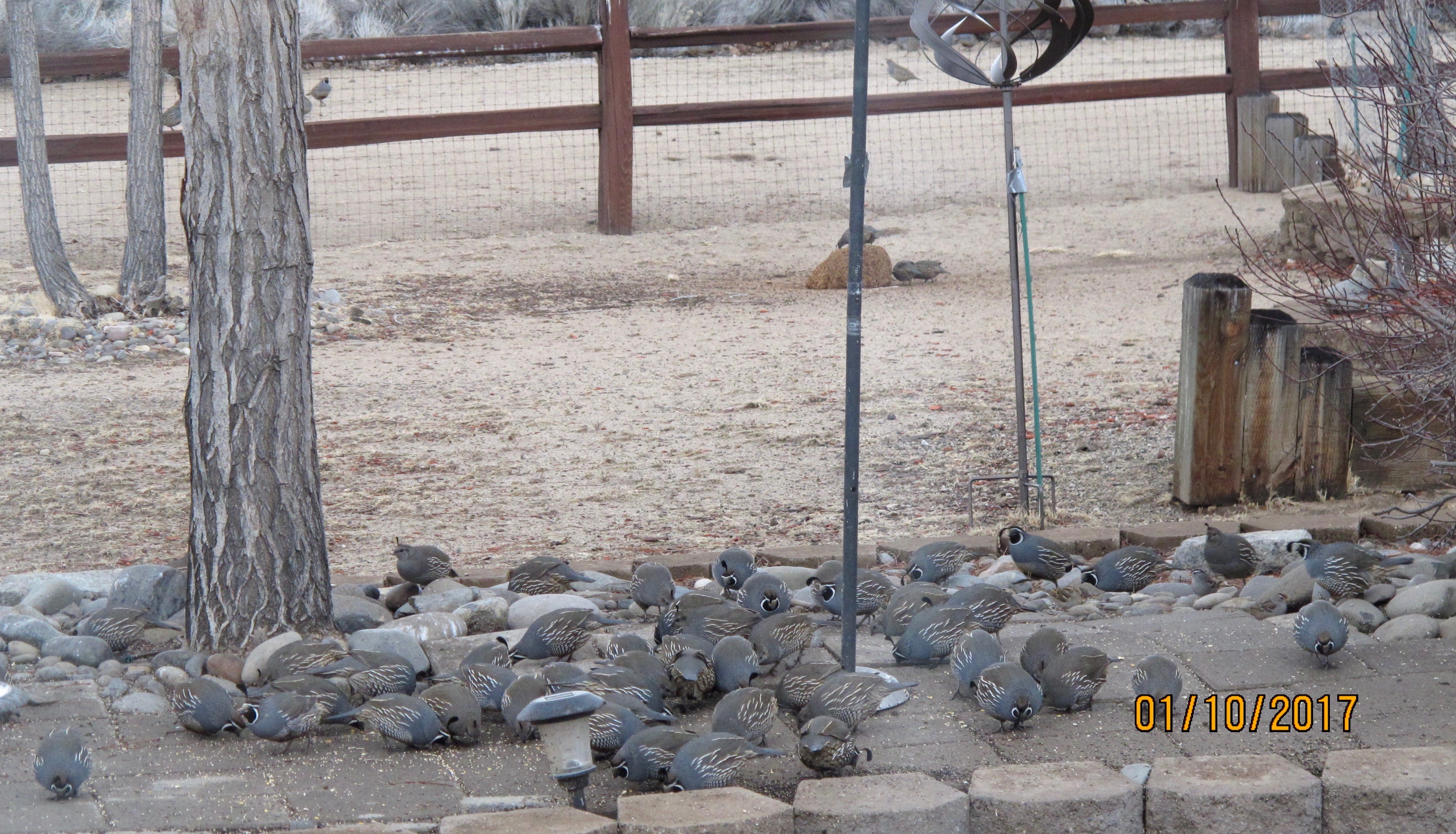
As you can see, the snow and ice is all gone, but the quail are still here for their daily rations. I was just checking them a few minutes ago when I noticed my wrong-way mockingbird was chowing down at the suet cake. I say wrong-way because mockingbirds are not normally in northern Nevada. But this guy has been here off and on since just before Christmas.

As you can see, the snow and ice is all gone, but the quail are still here for their daily rations. I was just checking them a few minutes ago when I noticed my wrong-way mockingbird was chowing down at the suet cake. I say wrong-way because mockingbirds are not normally in northern Nevada. But this guy has been here off and on since just before Christmas.

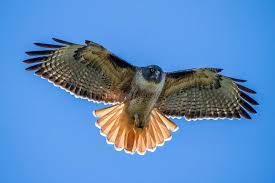
About two minutes after the above photo, a red-tailed hawk swooped in and almost caught one of the quail. I might have gotten a picture of him swooping in, but I was entranced watching the drama unfold. The quail scattered and ran under the bush to the right of the first photo. Then they stood stock still, waiting. The hawk perched and waited too. Eventually, the hawk decided pickings would be better elsewhere. As soon as he flew off, the quail were back pecking at their seeds. It’s an interesting event to watch. I wish I could figure out who gives the alarm. Dad always said their call was “Cuidado!” which means, “Be careful!” in Spanish. There is never a dull moment in this backyard.

About two minutes after the above photo, a red-tailed hawk swooped in and almost caught one of the quail.

I might have gotten a picture of him swooping in, but I was entranced with watching the drama unfold. The quail scattered and ran under the bush to the right of the first photo. They stood stock still, waiting. The hawk perched and waited too. Eventually, the hawk decided pickings would be better elsewhere. As soon as he flew off, the quail were back pecking at their seeds. It’s an interesting event to watch. I wish I could figure out who gives the alarm.  They just seem to know exactly when to move quickly to safety. Dad always said their call was “Cuidado!” which means, “Be careful!” in Spanish. There is never a dull moment in this backyard.

I hope this epistle finds you all doing well with the weather these days. It’s been crazy (except for friends in Maui) but it makes life interesting.

A Backyard Repast – January 2017

7 Jan

Since I set up the bird feeders that my wonderful Cerritos neighbors gave me when I moved to Minden, I have enjoyed numerous hours of watching my birds come to eat their several times daily repast. I don’t spend hours every day, but I do spend time each day watching who comes to eat, their antics and their little spats over jockeying for the best seeds and other treats. Then there are some regular and, on occasion, unexpected varmints who show up. Sometimes they are in my backyard and sometimes they trot along outside my back fence. (Coyotes, in particular)  (If you wish to enlarge the pictures, please click on them)

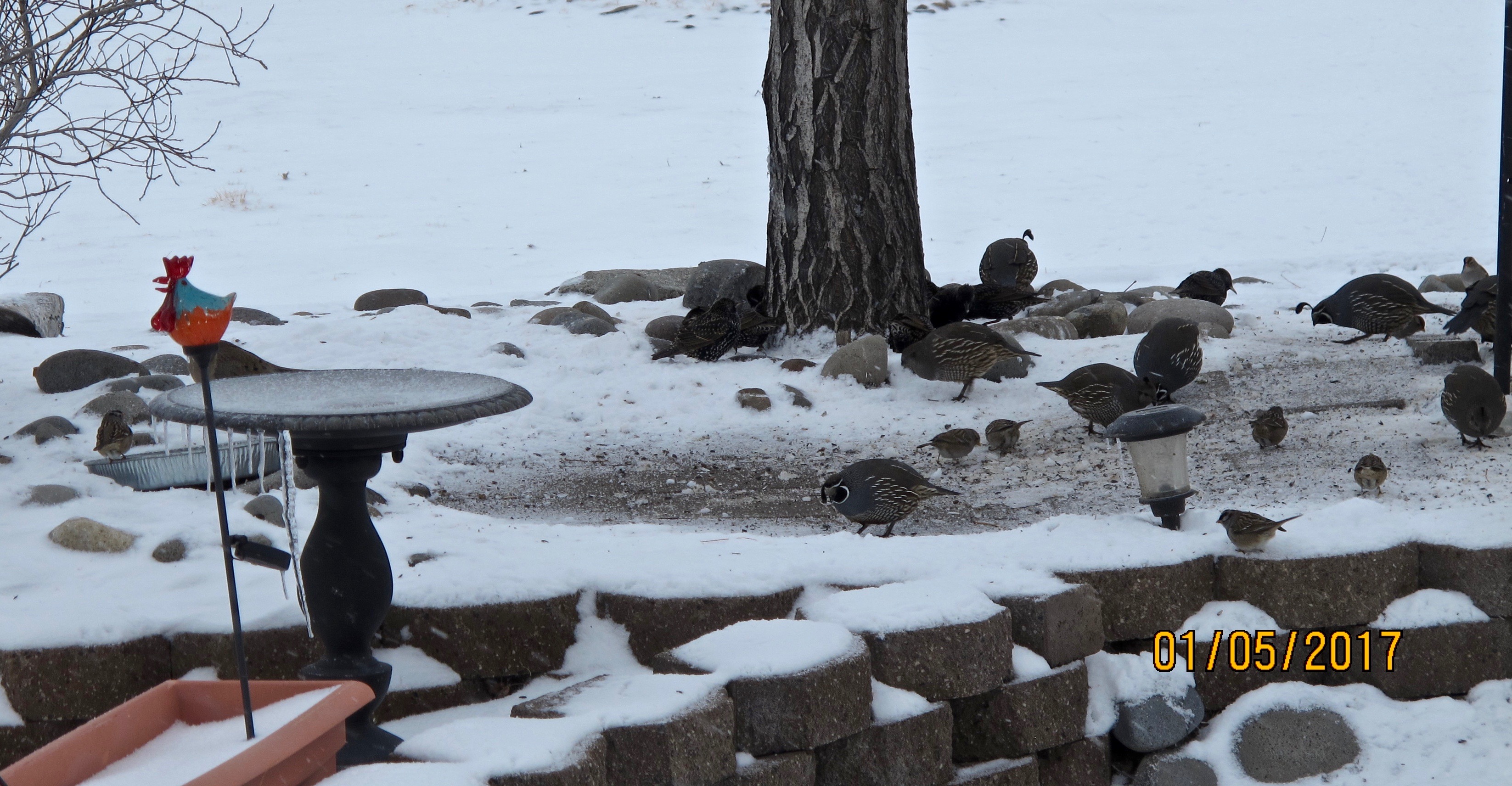
Quail, white crowned sparrows and a couple of those winged rats (pigeons) can be seen in this picture. Often, there are so many quail that it looks like the rocks and pavers are moving. I’ve counted up to 40 and then lost track because they are constantly moving and pecking.

Quail, white crowned sparrows and a couple of those winged rats (pigeons) can be seen in this picture. Often, there are so many quail that it looks like the rocks and pavers are moving. I’ve counted up to 40 and then lost track because they are constantly moving and pecking.

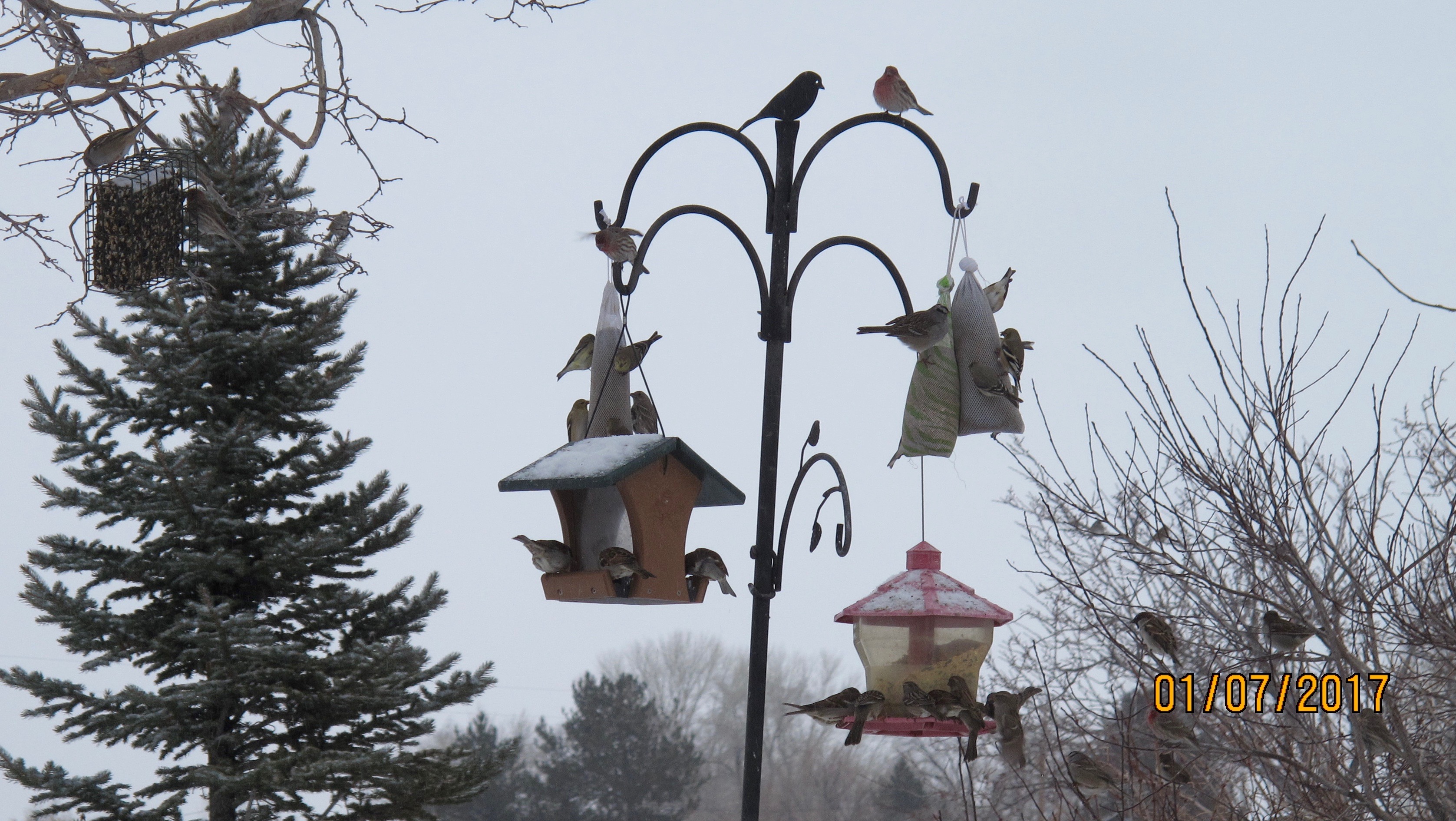
American goldfinches (mostly on the thistle bags), some sparrows and a couple of house finches grace this picture. There is one bird in the pine in back. It makes me think of my mom who always said they were ornaments on her spruce tree.

American goldfinches (mostly on the thistle bags), some sparrows and a couple of house finches grace this picture. There is one bird in the pine in back. It makes me think of my mom who always said they were ornaments on her spruce tree.

Here is a juvenile Cooper’s hawk. He’s the party spoiler. The smaller birds scatter to the four winds and/or huddle under the bushes beside the feeding area when the alarm is sounded. When he catches something, he eats it right away and nothing is left except a pile of feathers. Sharp-shinned hawks come by also and perch in the trees in hopes of catching an unsuspecting victim.

Here is a juvenile Cooper’s hawk. He’s the party spoiler. The smaller birds scatter to the four winds and/or huddle under the bushes beside the feeding area when the alarm is sounded. When he catches something, he eats it right away and nothing is left except a pile of feathers. Sharp-shinned hawks come by also and perch in the trees in hopes of catching an unsuspecting victim.

You might have read about or experienced our weather we are having this week. We had rain and snow and some very cold temperatures. As I write this, it is 20º outside, going up to perhaps 30º this afternoon. I couldn’t get my mail yesterday as my mailbox lock froze and I was afraid the key would break if I forced it. So, with it being so cold, I was sure that my birds needed some extra fuel to keep them warm. The quail and other ground feeders got an extra ration of deluxe seeds. An extra seed block was put out near the fence. The quail like that as well as the small white-tailed antelope squirrels (they are cute little varmints) and cottontail rabbits. I didn’t know rabbits would eat seeds, but they seem to enjoy gnawing on the block. Perhaps that helps to keep their teeth in good shape. Who knows?

You can see icicles hanging from the frozen birdbath. A bird is perched on the metal tin in back of the birdbath to get a drink of fresh water that I put out each day. It’s frozen by nightfall, but you’d be surprised that those silly birds will take a bath even when it’s so cold.

You can see icicles hanging from the frozen birdbath. A bird is perched on the metal tin in back of the birdbath to get a drink of fresh water that I put out each day. It’s frozen by nightfall, but you’d be surprised that those silly birds will take a bath even when it’s so cold.

In front of the two wooden bears, is a sunken fire pit that was half full of water the last time it rained. That water froze and then melted enough so that I could get the ice out. I’ll tell you why shortly.

In front of the two wooden bears, is a sunken fire pit that was half full of water the last time it rained. That water froze and then melted enough so that I could get the ice out. I’ll tell you why shortly.

Half of that ice is sitting behind the other birdbath. It’s been there for a couple of days and has not diminished in size.

Half of that ice is sitting behind the other birdbath. It’s been there for a couple of days and has not diminished in size.

I began this epistle last Thursday and it’s now Saturday. Our valley as well as Carson City, Reno and basically from Mammoth north is under flood alert. A Pineapple Express (an atmospheric river of warm rain) will be arriving tonight and our temperatures will be going from the 20s to the high 40s. You can begin to see an issue here. I know that California is supposed to be getting a ton of rain from this and we are too. The problem for us is that the forecast calls for rain up to 9,000’. This means snow will melt and in a couple of days cause our rivers to flood. A severe Pineapple Express occurred in 1997 and caused millions of dollars in damage. Another one (not as severe) happened in 2005.

I removed the ice because I wanted the fire pit to be as empty as possible.  The water usually soaks in in a day or so, but our ground is fairly saturated and I’m afraid it’ll run over toward the house.  I don’t know that for sure because I wasn’t in this area during the last flood.  But two summers ago, it poured and poured and the fire pit did overflow.  Just trying to be cautious.

What’s frustrating is that we’ve had more rain than usual in our valley and quite a bit of snow in the mountains that might help ease the drought we’ve been having for the last 5 or so years. All we can do is sit and watch and wait. We’ll also be hoping for the best. The weather forecasters in this area are noted for not being as accurate as they are in other areas. But, we are being urged to stock up with food, batteries and sandbags. States of emergency have been declared, so it’s hard not to be alarmed. We’ll see. In the meantime, my birds will keep coming for their rations and begging for more than I give them. 🙂

Sister Trip 7 New Orleans October 14 – October 19

17 Nov

You might recall that we had a great visit at the Rosedown Plantation in St. Francisville, LA. NOLA (New Orleans, LA) is only a little over two hours from St. Francisville, so we decided to go with the wind and see where it took us.

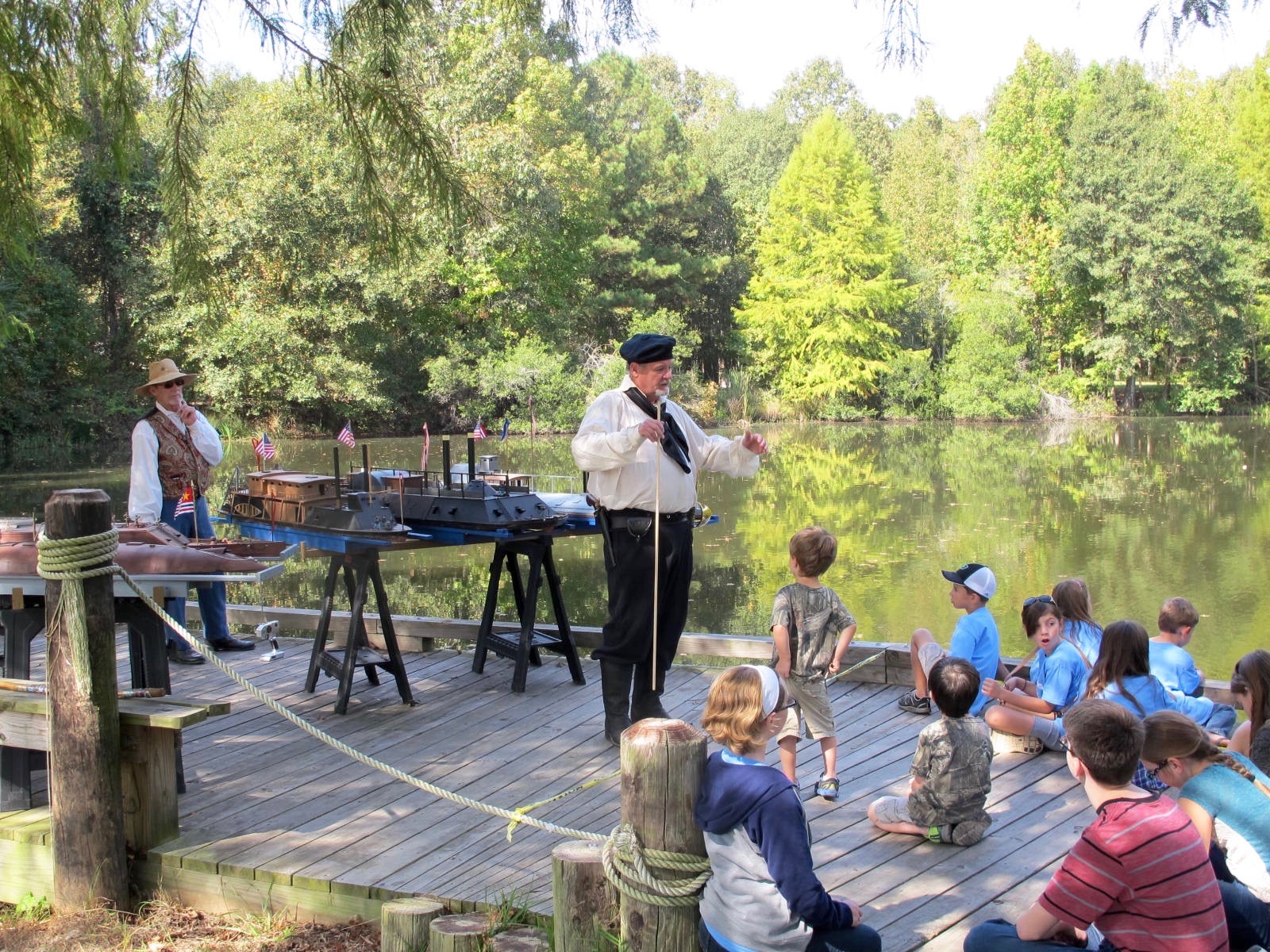
We visited the St. Francisville Cemetery in hope of seeing some very old headstones. It was a very pretty and peaceful place (I should hope it would be peaceful!) Our next stop was Fort Desperate at Port Hudson, scene of the final battle that gave the Union forces full control of the Mississippi River. An interesting site made even more engaginging by volunteers demonstrating medical care, food, naval strategy, artillery and other Civil War details to at least 100 home schoolers.  (Don’t forget to click on a photo if you want to enlarge it)
It was just like any other school demonstration…some paying rapt attention and some, obviously not.

It was just like any other school demonstration…some paying rapt attention and some, obviously not.

I already told you about our visit to the LSU Rural Life Museum. We were disappointed in how the artifacts were cared for and the lack of explanation for many of the artifacts. It was after this visit that we decided to head for NOLA in earnest.

I had Googled driving instructions from the hotel site and we confidently zipped into the city. First, it was a Friday afternoon about 3:30 and, unbeknown to us, the beginning of a weekend when the New Orleans Saints were having a home game. Second, there are many insane drivers, some of whom were already drunk. Third, there are many one-way streets. Fourth, the Google instructions took us down a street that wouldn’t let us turn onto our hotel’s one-way street. So began our hour-long odyssey of trying to navigate our way back to where we could turn correctly onto our hotel street. Believe me, I was ecstatic to turn the car over to the valet for $30 day to not drive it until we departed for the airport!frazzeled

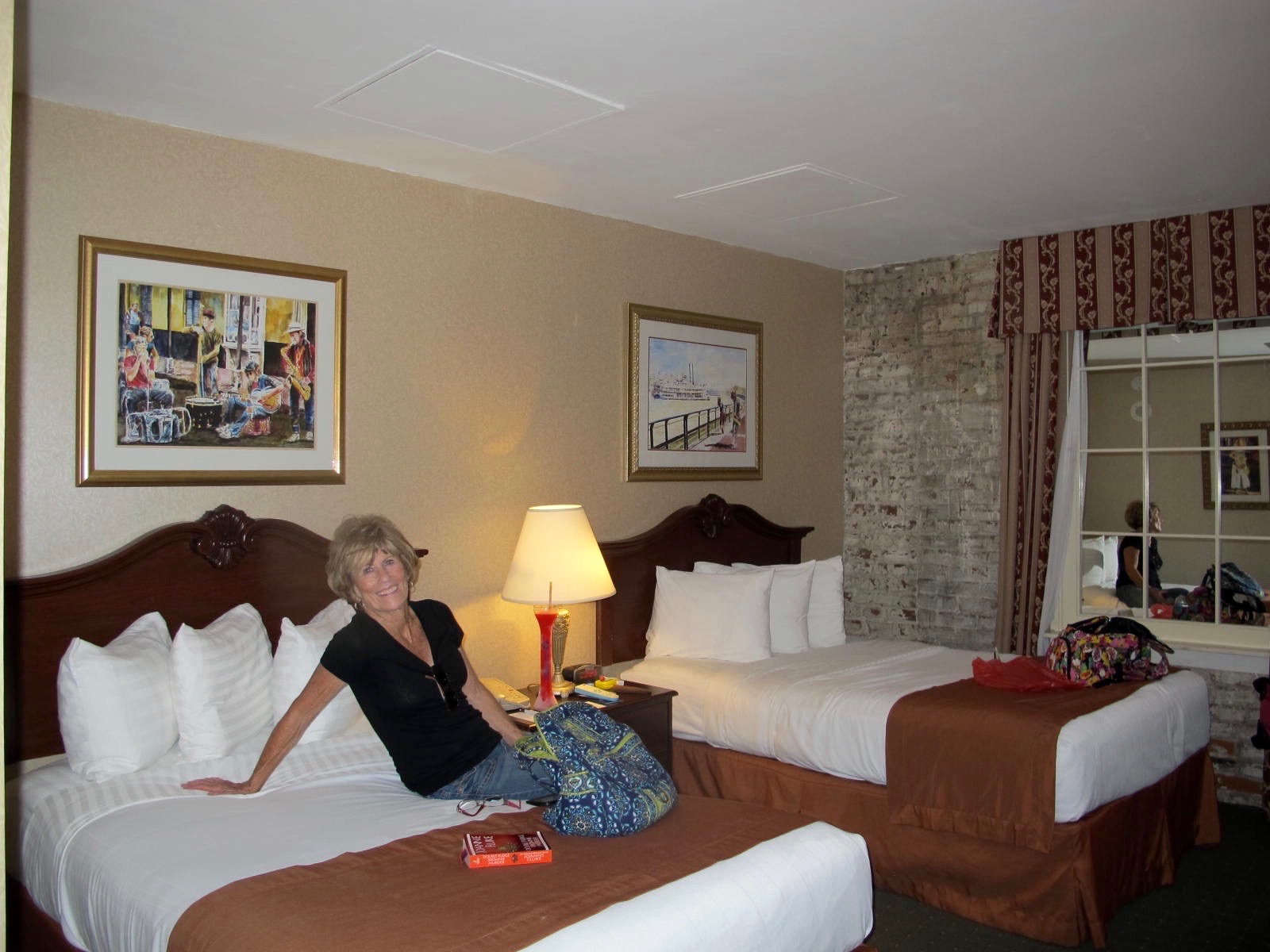
The St. Christopher Hotel was in a super location, though. Everything we wanted to see was within walking, bus or trolley distance. We were happy with it even though we had a room without a window! I thought at first that we might be claustrophobic in it, but it was great. It was so quiet that we never heard any partiers or sirens that other rooms might have been plagued with.
You may think you see a window with drapes, but it's really a mirror to give the illusion the room is larger than it is.

You may think you see a window with drapes, but it’s really a mirror to give the illusion the room is larger than it is. I must admit that we both felt a little weird about running around in various states of undress.

The hotel manager directed us to the Oceana Grill for our first NOLA dinner. It was very delicious as was all the food we ate in NOLA. But all of our dishes had too much good food. We were STUFFED every night.
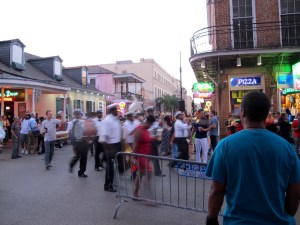
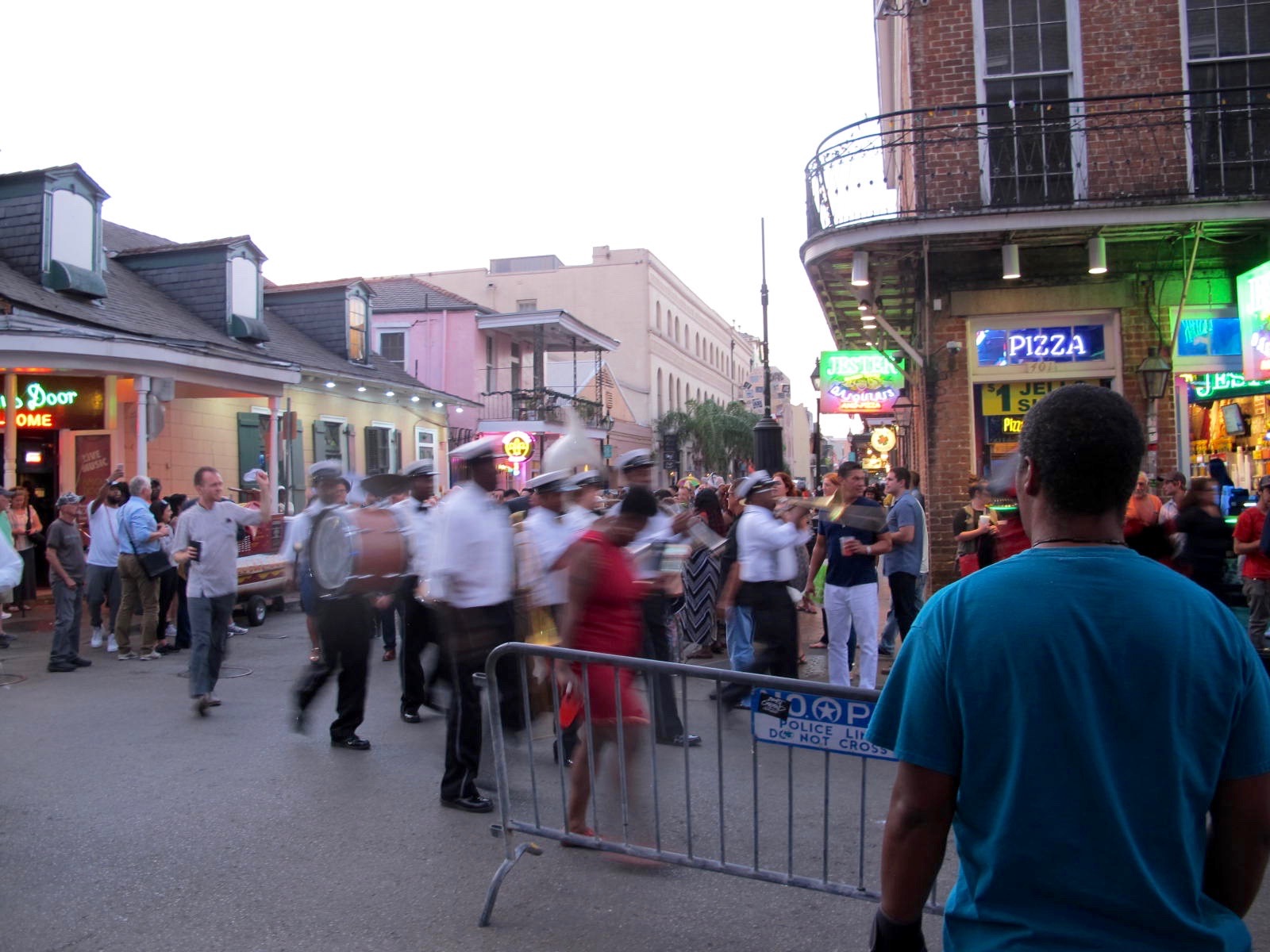
wedding

Upon leaving the Oceana we heard music and espied a wedding celebration coming down the street. It was so fun to see the band and all the dancing guests following the bride and groom. I was late getting the camera out and only got this blurry picture. You get the idea and you can also see that one can carry drinks in public in NOLA.

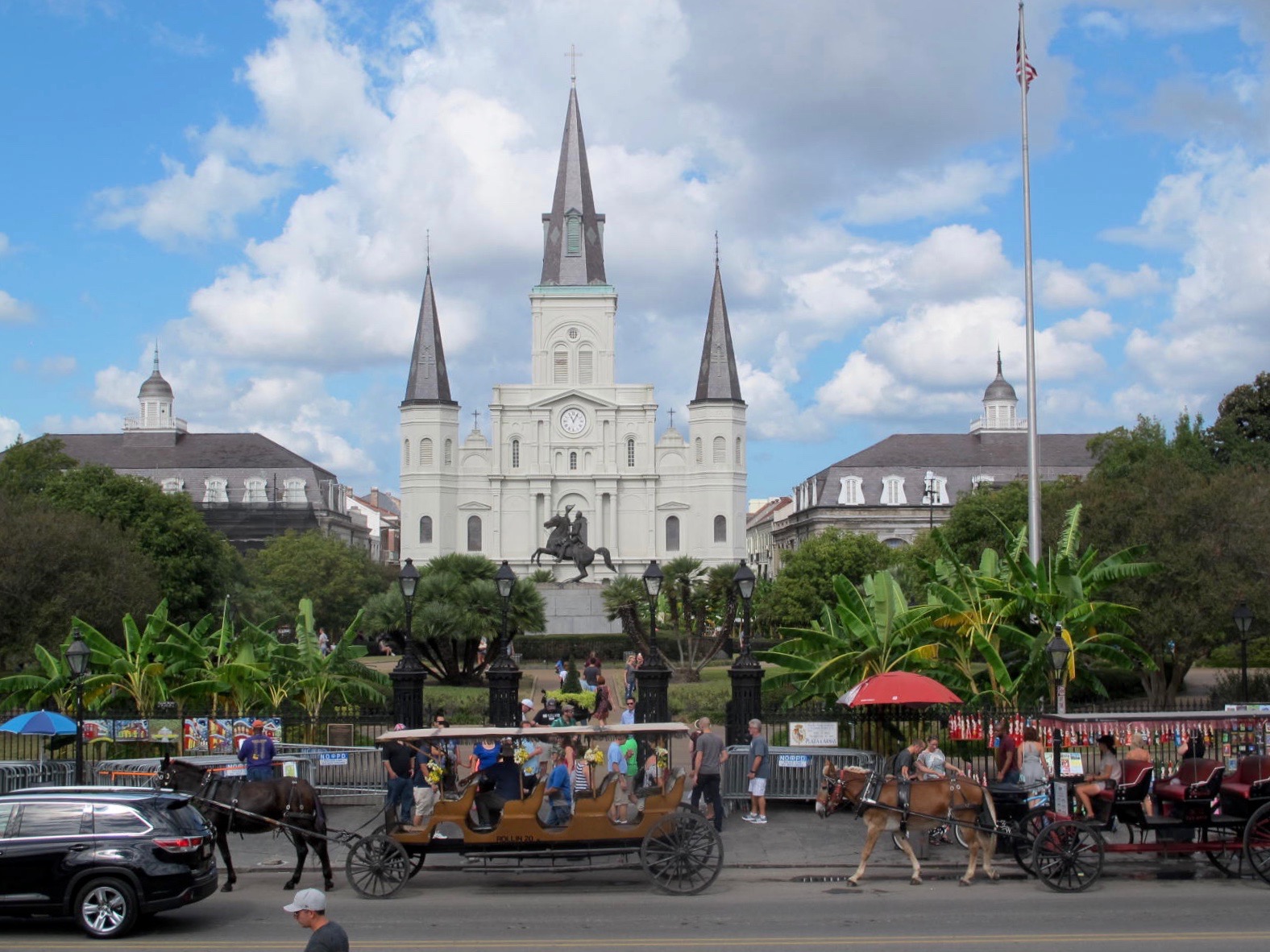
The next morning, we were out fairly early to walk to Jackson Square to take a carriage ride around the French Quarter and visit one of the famous cemeteries. Even by 9AM, Jackson Square was a hoppin' place

The next morning, we were out fairly early to walk to Jackson Square to take a carriage ride around the French Quarter and visit one of the famous cemeteries. Even by 9 AM, Jackson Square was a hoppin’ place
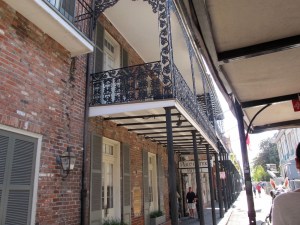
French Quarter buildings fascinated me and I could have taken pictures of them all day long. Iron lace balconies, sweeping fan-like windows and traces of French and Spanish influence comprise “Creole” architecture.

French Quarter buildings fascinated me and I could have taken pictures of them all day long. Iron lace balconies, sweeping fan-like windows and traces of French and Spanish influence comprise “Creole” architecture.

Our carriage driver took us to the St. Louis #1 Cemetery, the oldest and best known of the city’s above-ground cemeteries. He explained that the graves are above ground due to the high water table in NOLA and that the heat/humidity cause a body to deteriorate (in a sense, be cremated in its grave) within a year. This is why several people can be interred in one crypt. In fact, there is a wall of crypts where people rent a space for a year and then the ashes are removed after a year.  I thought this was a fascinating story.

Entire families are interred in one “apartment” in this large cryptorium.

Entire families are interred in one “apartment” in this large crypt.
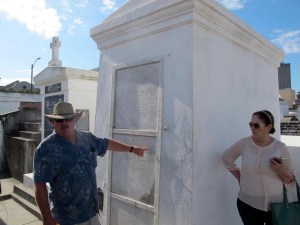
 

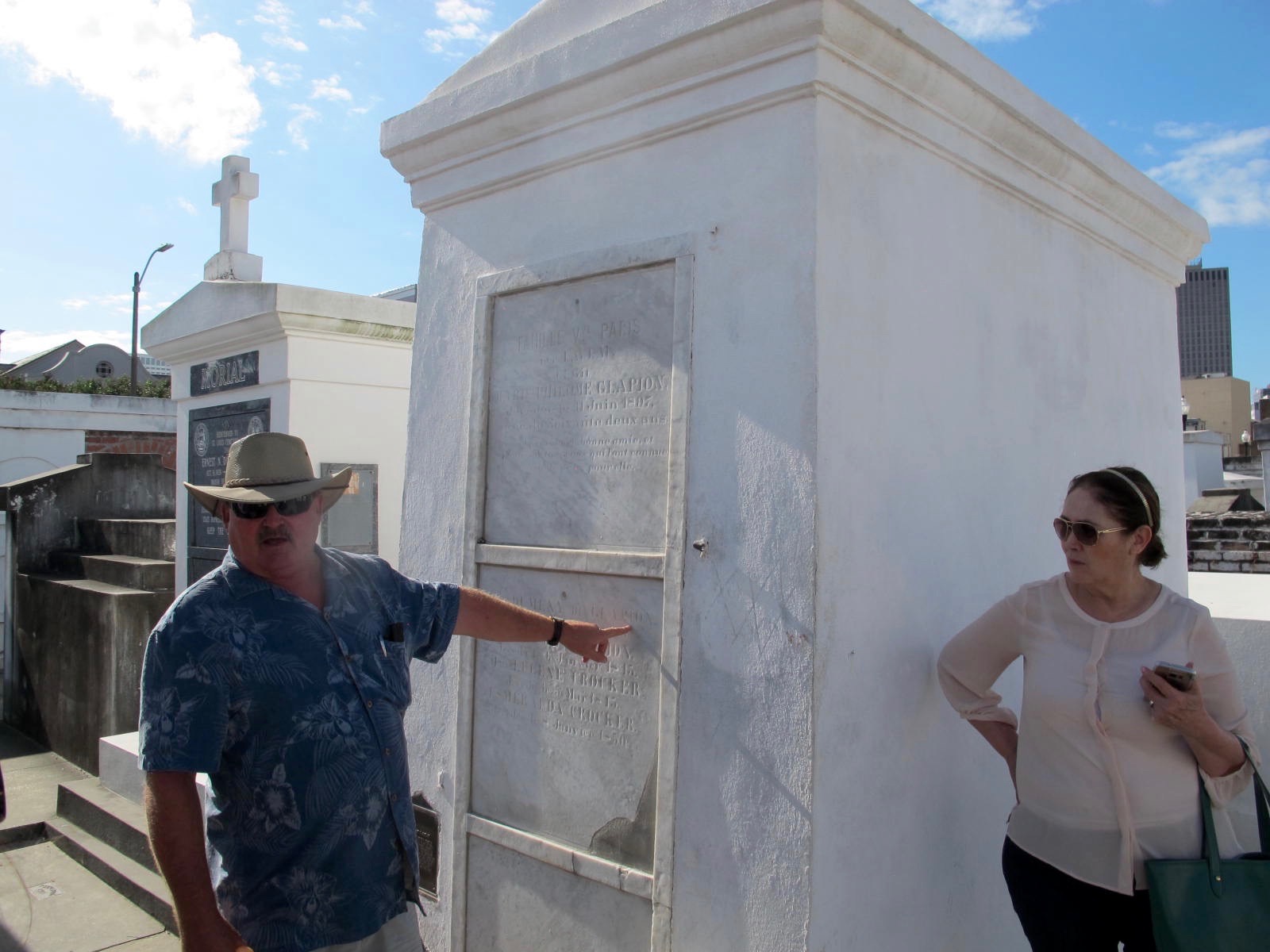
Our carriage driver is pointing to the Glapion family tomb where the remains of voodoo queen Marie Laveau are said to rest. You can see in the background that there are many shapes and sizes of tombs in the cemetery.

Our carriage driver is pointing to the Glapion family tomb where the remains of voodoo queen Marie Laveau are said to rest. You can see in the background that there are many shapes and sizes of tombs in the cemetery.

We worked up an appetite during the carriage ride and decided that we must have a beignet at Café du Monde, a world famous place for those delectable treats. Well, the line was about a block long and we decided to try another place that had a much shorter line.
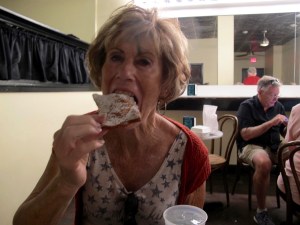
 Jerri’s first taste of a beignet. It was tasty, but I’m sorry we didn’t get to try the Café du Monde.

Jerri’s first taste of a beignet. It was tasty, but I’m sorry we didn’t get to try the Café du Monde.

We walked through the French Market and saw local treasures as well as cool things from other parts of the world. It was fun seeing all the tourists milling around and trying to figure out which was the best bargain.

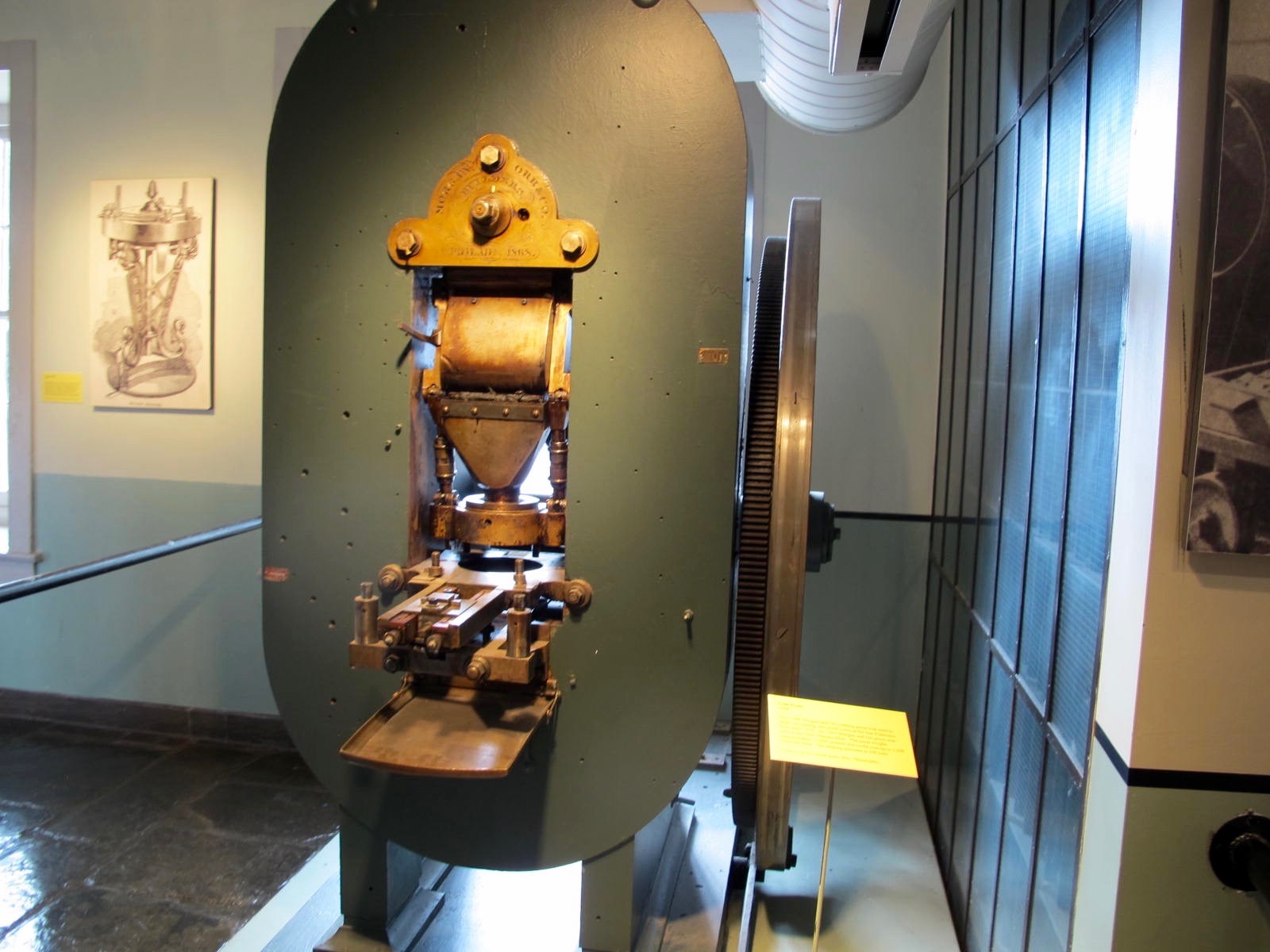
We visited the Old U.S. Mint next door to the French Market. The 1835 structure was a federal mint 1838-61 and was the Confederacy’s only mint for a few months in 1861. It continued to be a U.S. mint until 1909. It’s now a Louisiana State Museum site and houses the Louisiana Historical Center as well as an internationally renowned jazz collection. The mint was of particular interest to us because our Nevada State Museum was originally a U.S. mint.  I liked this portion of the museum because it displays some of the same things we do as well as similar photos.
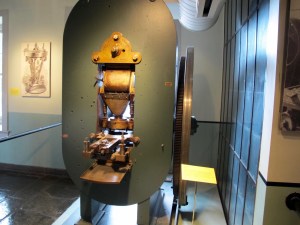
This press looks a lot like our Press #1, complete with the bronze plaque above the press part.

This press looks a lot like our Press #1, complete with the bronze plaque above the press part.

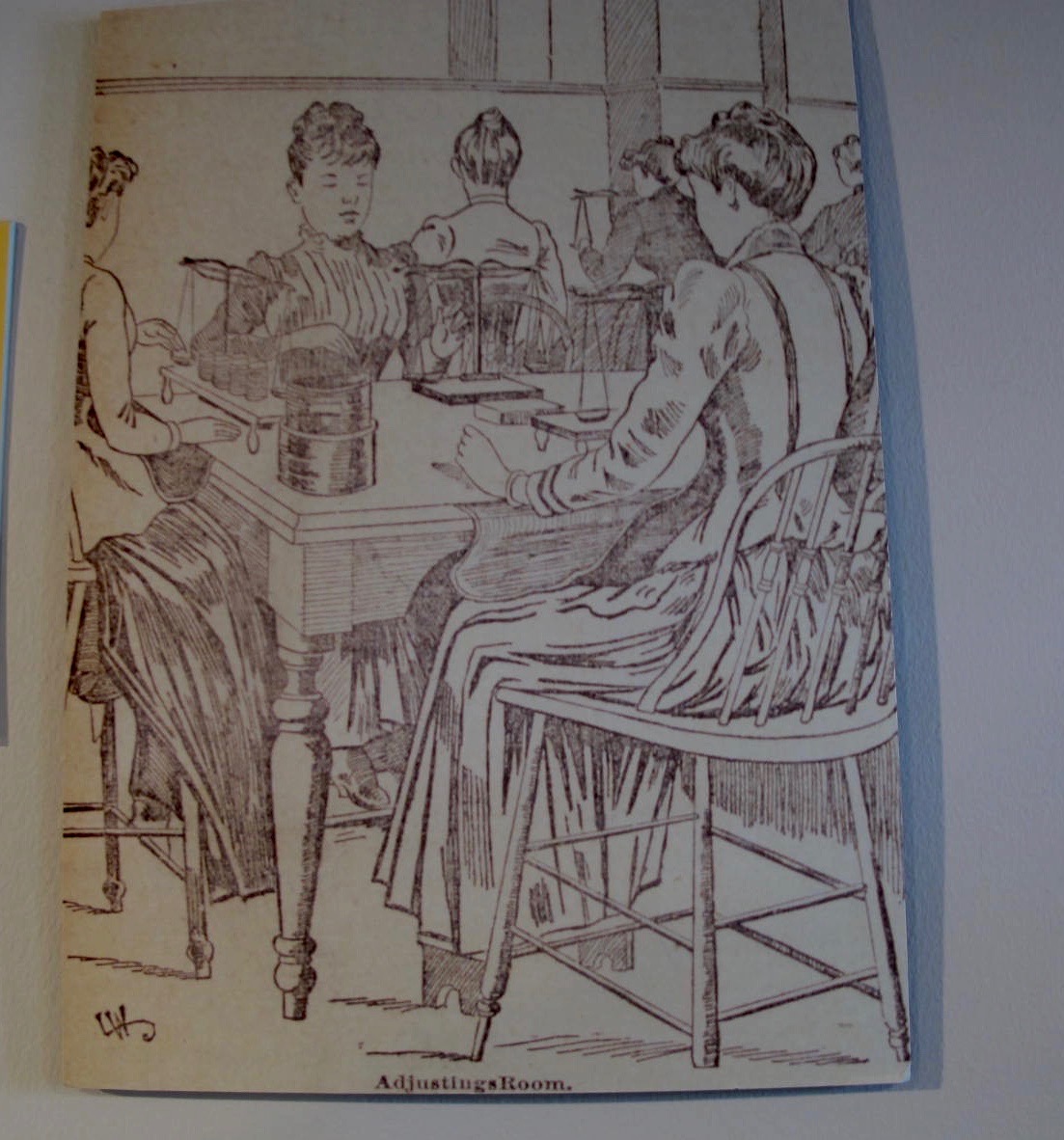
Adjusters - See the next picture for an explanation

Adjusters – See the next picture for an explanation

Click on the photo to enlarge it

Click on the photo to enlarge it

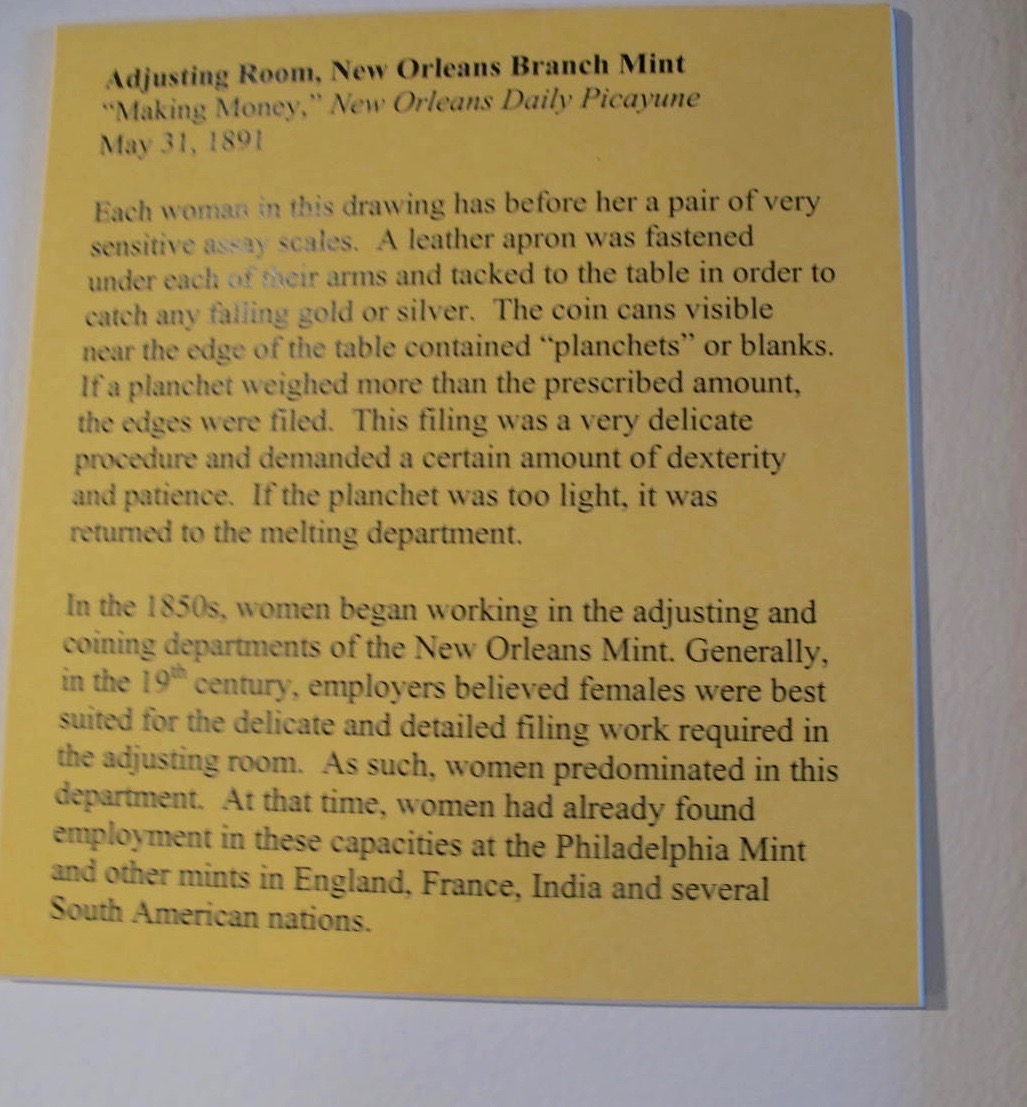
A cutting machine is pictured here. The ore was rolled out to a prescribed thickness and then blanks (planchets) were cut out. Those planchets were then fed into the press where they would be pressed into coins.

A cutting machine. The ore was rolled out to a prescribed thickness and then blanks (planchets) were cut out. Those planchets were then fed into the press where they would be pressed into coins.

Jolee had given me a NOLA walking tour book and we took several of those tours. It was fun walking at our leisure and seeing many French Quarter buildings and learning a bit about each.
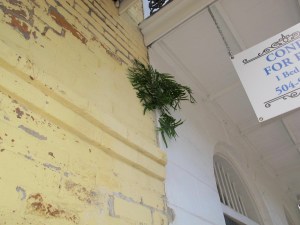
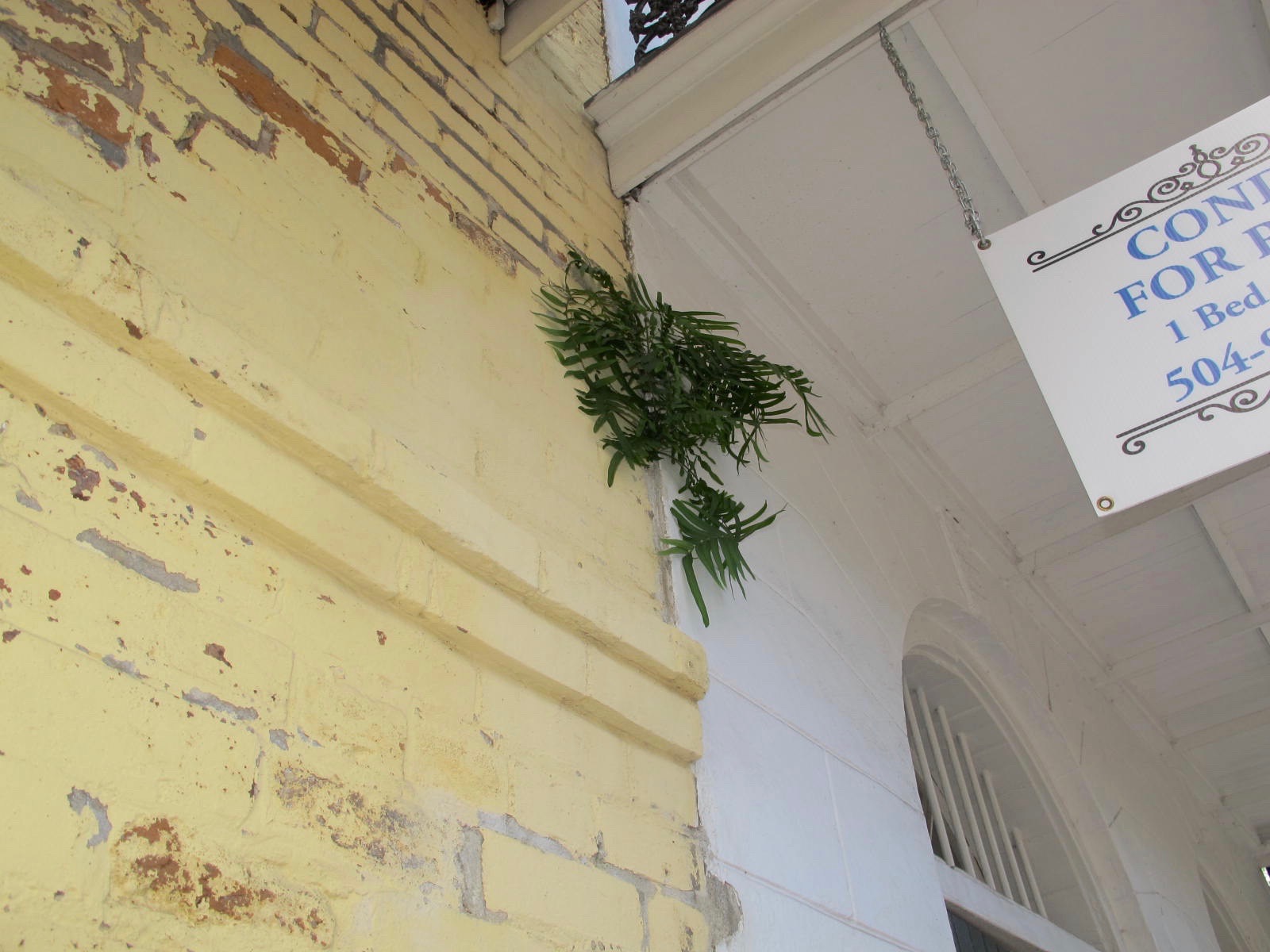
It’s so humid in NOLA that ferns can grow right out of building walls. The weather is just right for a plethora of trees and plants.
It’s so humid in NOLA that ferns can grow right out of building walls. The weather is just right for a plethora of trees and plants.

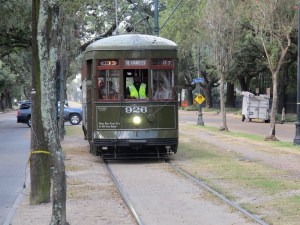
St. Charles Trolley

St. Charles Trolley

We took the St. Charles trolley out to the Garden District, famous for its nineteenth century homes and gardens. The area was originally part of the Livaudais Plantation It became part of the City of Layfayette in 1833 and then annexed by New Orleans in 1852. Several celebrities have homes here and many films have been at been partially shot here. Many of the homes have too much foliage around them so as to prevent a good photo.
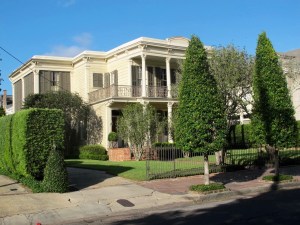
Archie Manning’s home (he was a New Orleans Saints quarterback for many years and is Peyton and Eli Manning’s father).

Archie Manning’s home (he was a New Orleans Saints quarterback for many years and is Peyton and Eli Manning’s father).

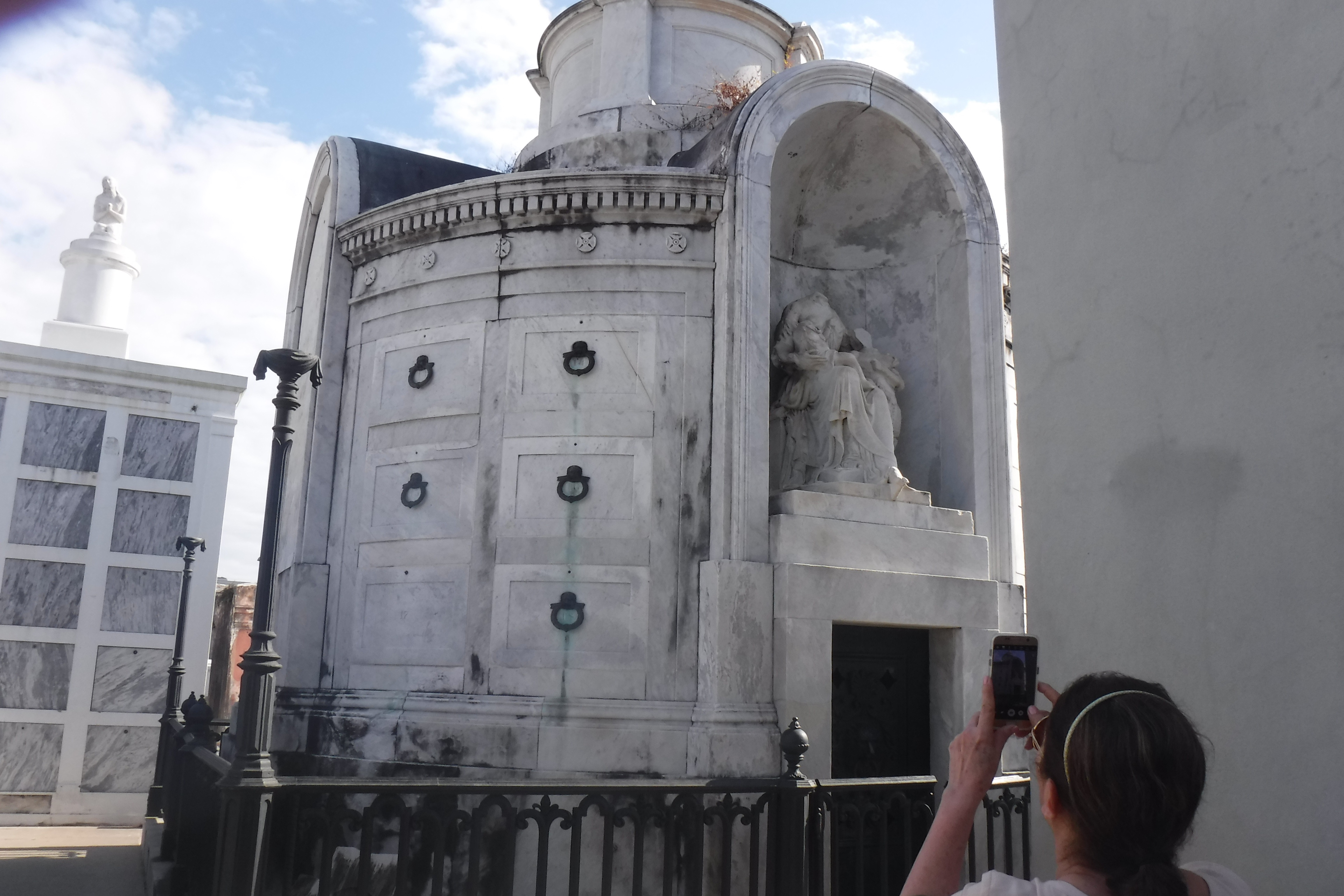
Right next to the Garden District is the Lafayette Cemetery #1 founded in 1833. Again, the crypts are above ground. Some appear to be well kept and others look to be in terrible shape.

Right next to the Garden District is the Lafayette Cemetery #1 founded in 1833. Again, the crypts are above ground. Some appear to be well kept and others look to be in terrible shape.

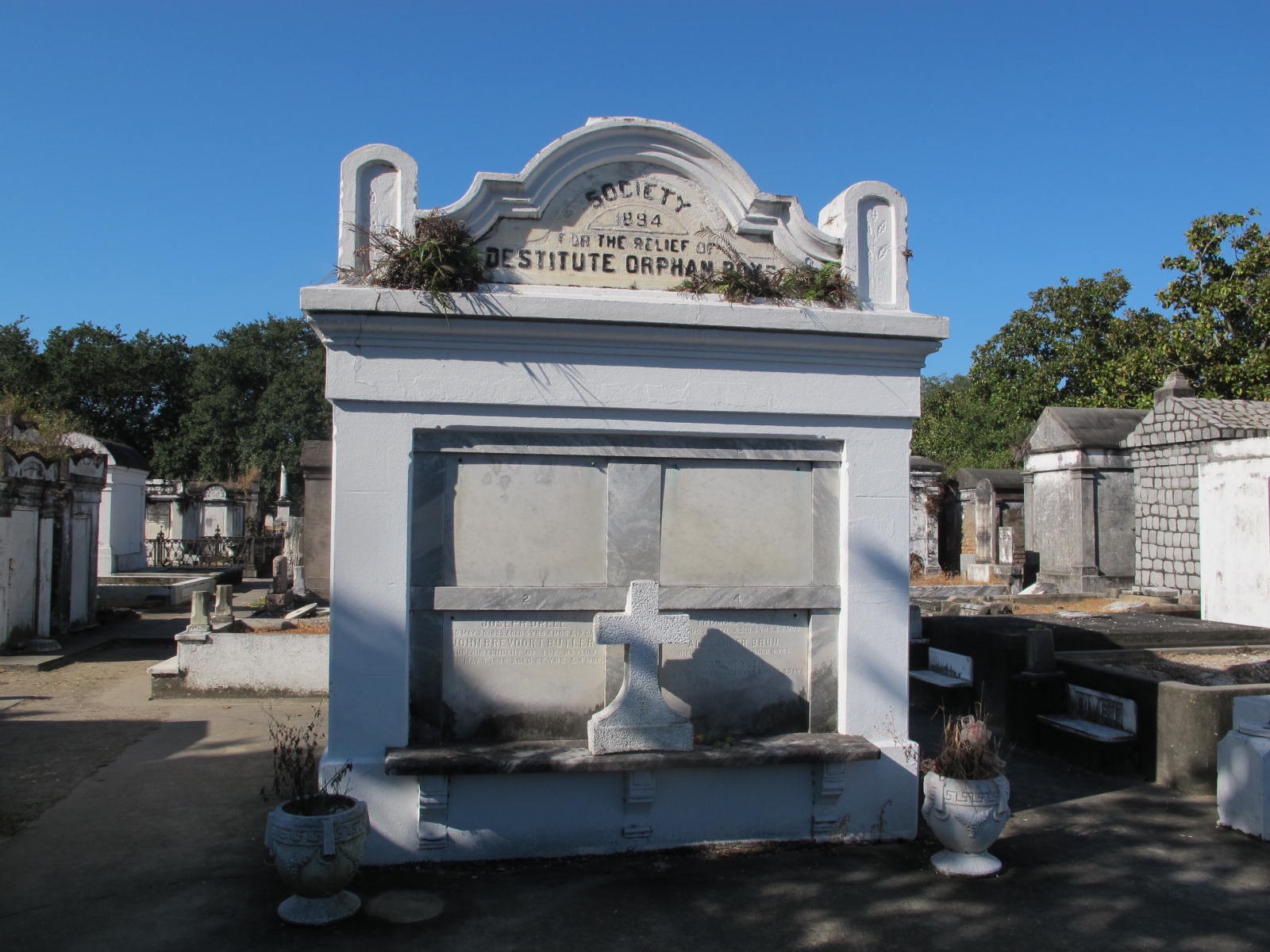
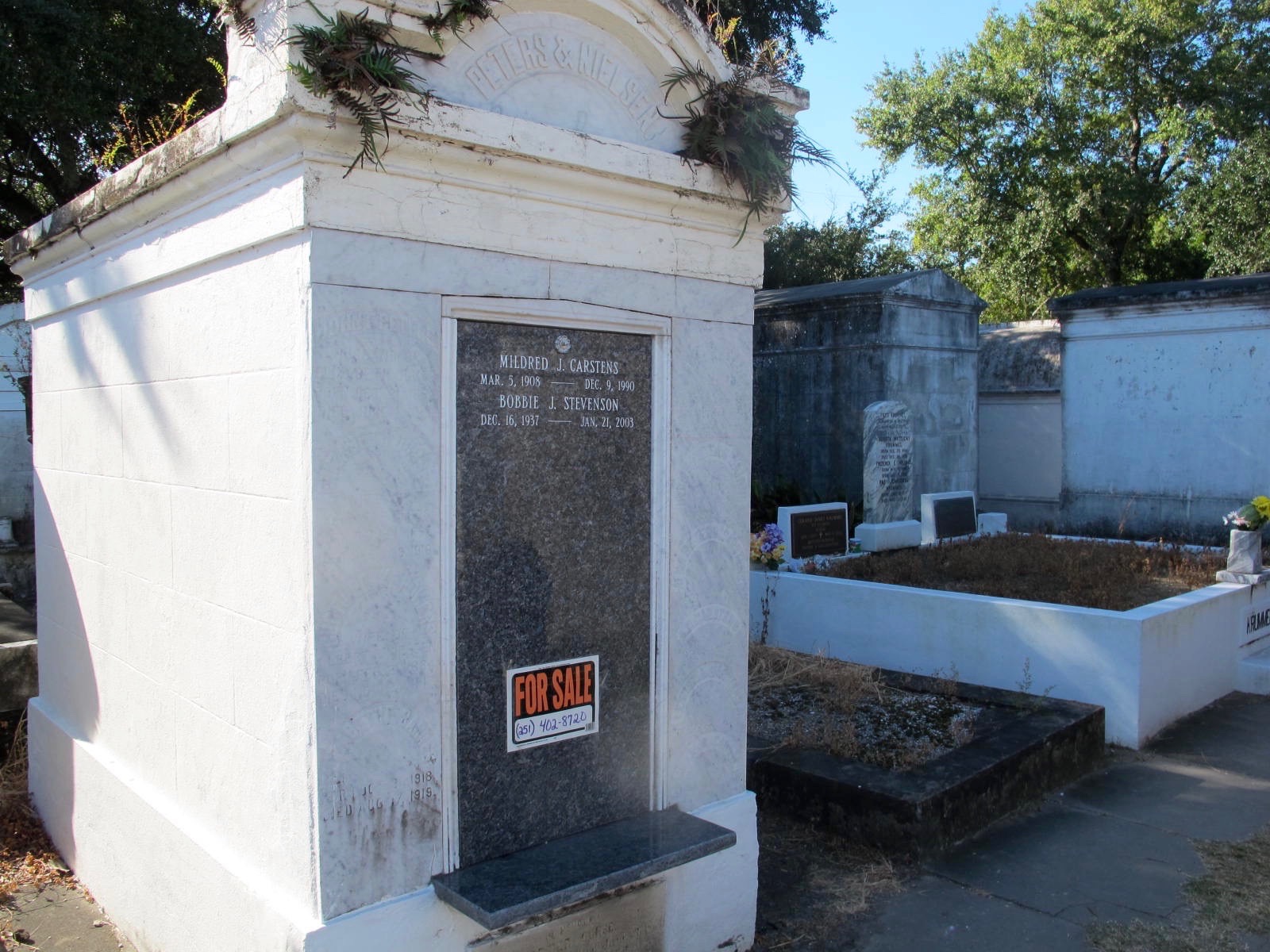
I thought it interesting that one was for sale. Apparently it’s been in use for many years because the inscription on top has different names than the ones naming who is interred.

I thought it interesting that one was for sale. Apparently it’s been in use for many years because the inscription on top has different names than the ones naming who is interred.

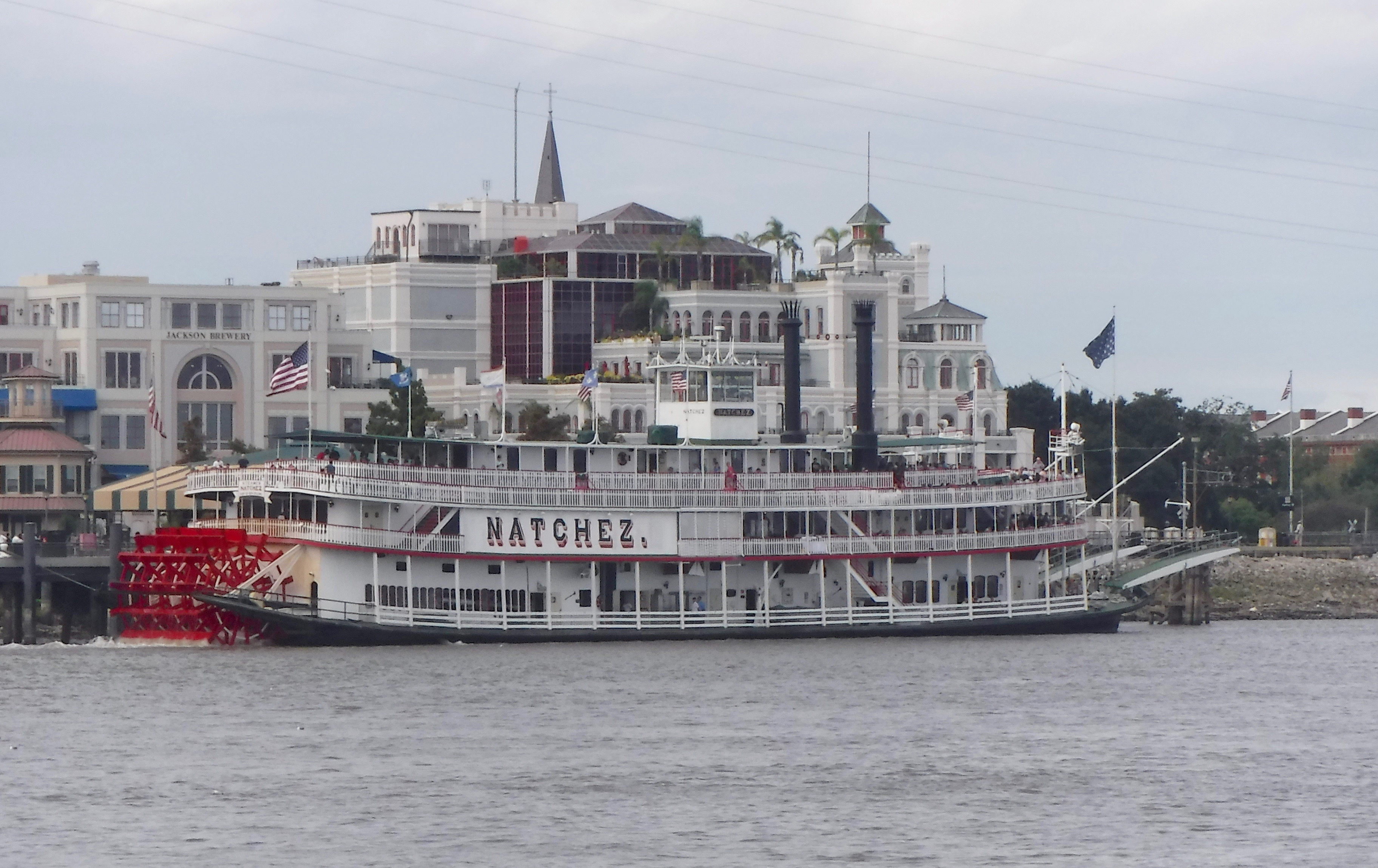
We had to take a ride on the Natchez, a sternwheeler, and experience a bit of what it was like to ride one in the old days. It takes on a two-hour tour down the Mississippi and back again. It was fun but too hot if one wasn’t in the shade.

We had to take a ride on the Natchez, a sternwheeler, and experience a bit of what it was like to ride one in the old days. It takes on a two-hour tour down the Mississippi and back again. It was fun but too hot if one wasn’t in the shade.

We saw a portion of the 9th Ward that was inundated when Katrina went through in 2006. The levees were too high to get any good pictures of the reconstructions. We also saw where the Battle of New Orleans was fought by Andrew Jackson against the British a few weeks after the War of 1812 was ended.

Ocean going vessels sail up and down the River quite often and we saw many tugs along with barges parked along the shore. Since we were there on a Sunday, maybe they weren’t working or didn’t have a load to move.
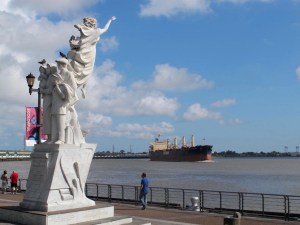
Ocean going vessels sail up and down the River quite often and we saw many tugs along with barges parked along the shore. Since we were there on a Sunday, maybe they weren’t working or didn’t have a load to move.

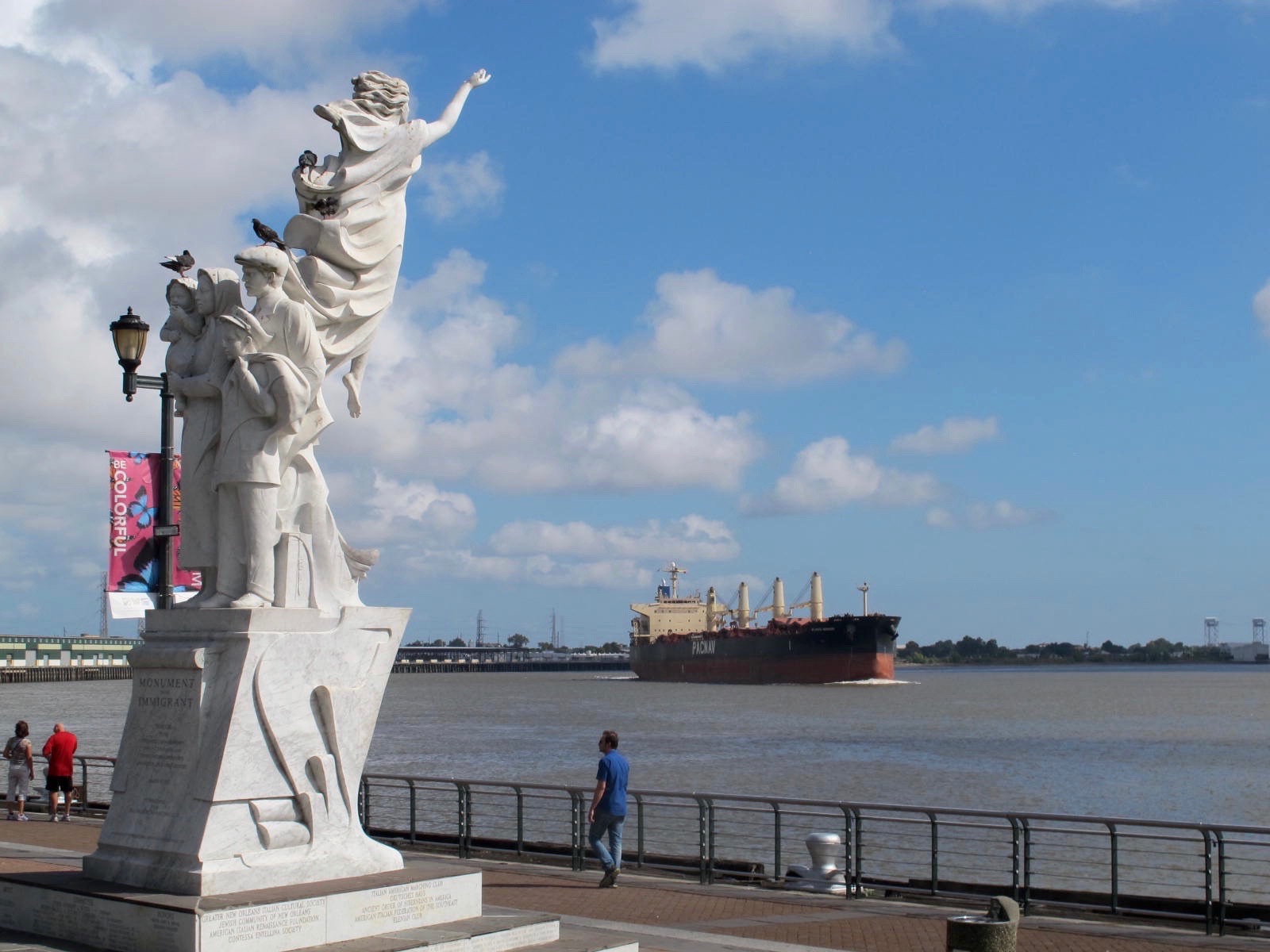
The sculpture facing the River honors immigrants as they land in the USA. I liked it and thought the sculpture was well deserved. I don’t know if it was ironic or not that pigeons were on the sculpted people.

The sculpture facing the River honors immigrants as they land in the USA. I liked it and thought the sculpture was well deserved. Is it ironic or not that pigeons were on the sculpted immigrants?

Now for the Coups de Gras in museums! The World War II Museum, a Smithsonian affiliate, was one of main attractions we wanted to see New Orleans. Wow! What a place, filled with artifacts, great depictions of causes, warfare tactics, the home front and the war’s lasting significance! We arrived when it opened at 9 AM and didn’t leave until closing at 5 PM. To our surprise, we didn’t take very many pictures because the exhibits were too big with sometimes moving parts and the fact that there were many visitors all trying to read the signs. One of the first things we did was to view the “Beyond All Boundaries,” a cinematic experience featuring 4-D special effects and narration by Tom Hanks. That was a perfect set up to go see all the other exhibits.

Jerri with the gunner’s portion of a B-24D Liberator

Jerri with the gunner’s portion of a B-24D
Liberator

A truck named Dorothy...after our mom, I'm sure!

A truck named Dorothy…after our mom, I’m sure!
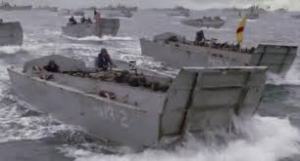
Since this is a Smithsonian affiliate, I wondered why it was not located in Washington, D.C. New Orleans was chosen as the site to honor Andrew Higgins, a local boat builder, whose amphibious landing craft was credited by Dwight D. Eisenhower with winning the war.
Since this is a Smithsonian affiliate, I wondered why it was not located in Washington, D.C. New Orleans was chosen as the site to honor Andrew Higgins, a local boat builder, whose amphibious landing craft was credited by Dwight D. Eisenhower with winning the war.

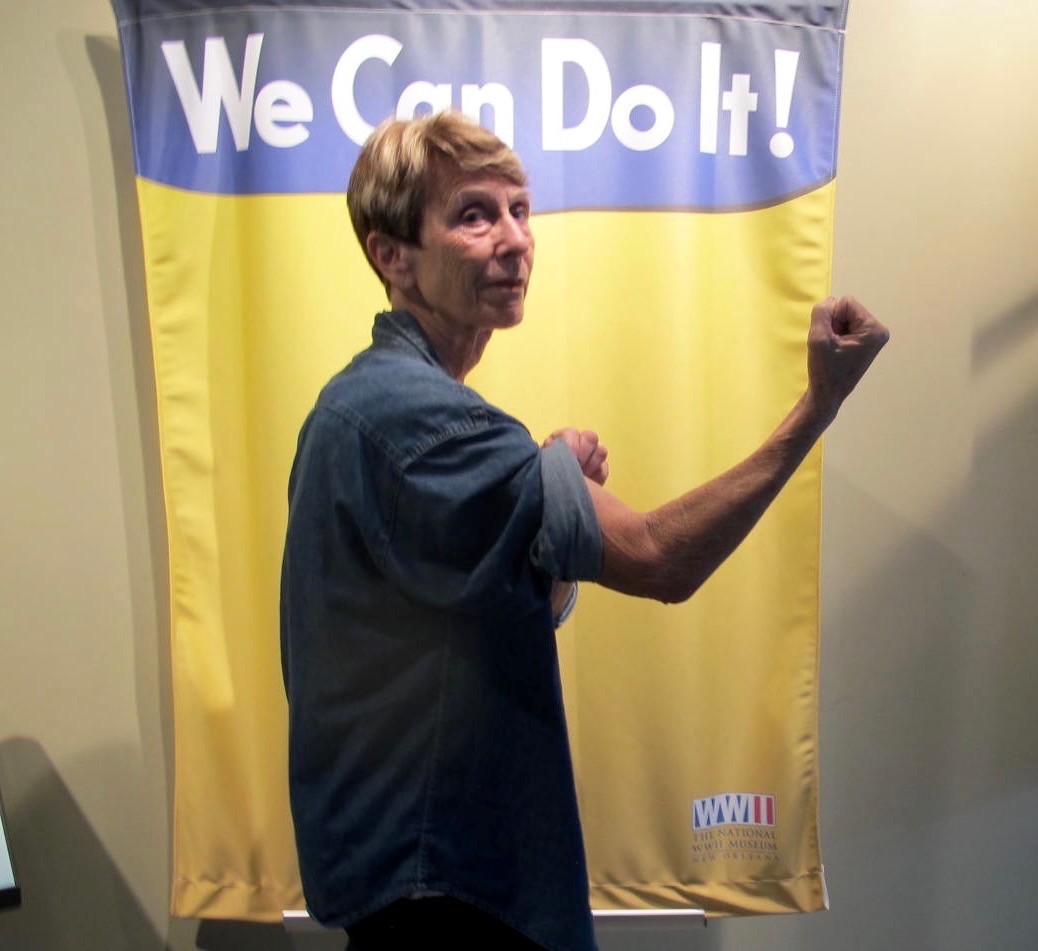
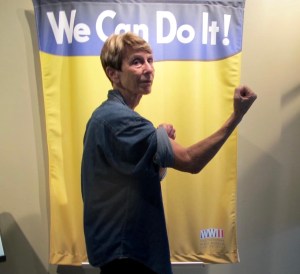
Home Front Chick

Home Front Chick

Army uniforms like the one Dad wore

Army uniforms like the one Dad wore

I do believe this is one of the best museums I have ever visited. It really had our attention throughout the day and we were surprised when the PA system announced it was closing time. The museum is massive, as you can well imagine, and utilizes the latest technology to help you understand and relate to what happened. The relationship begins almost as soon as you enter when you are issued a dog tag and that tag becomes encoded with a person whose war career you will follow throughout your time in the museum. It was just great! The museum behooves one to go back because the experience is rather overwhelming if one reads all the labels and sees all the exhibits. http://www.nationalww2museum.org/visit/exhibits/index.html

After being on our feet all day, we took it easy for a while the next morning. We walked to catch the St. Charles Trolley (the oldest continuously operating streetcar in the world—150 years!) and rode it to the end of the line and back. It rumbles and sways by the Garden District, through a tunnel of live oaks, past dozens of antebellum homes, by historic monuments and Tulane and Loyola Universities.

We loved traveling on the trolleys and the bus because we could get a Jazzy pass for only $3 and we could ride all day long.

We loved traveling on the trolleys and the bus because we could get a Jazzy pass for only $3 and we could ride all day long.

Usually, a trolley is much more crowded than this. We hit it at a slack time.

Usually, a trolley is much more crowded than this. We hit it at a slack time.

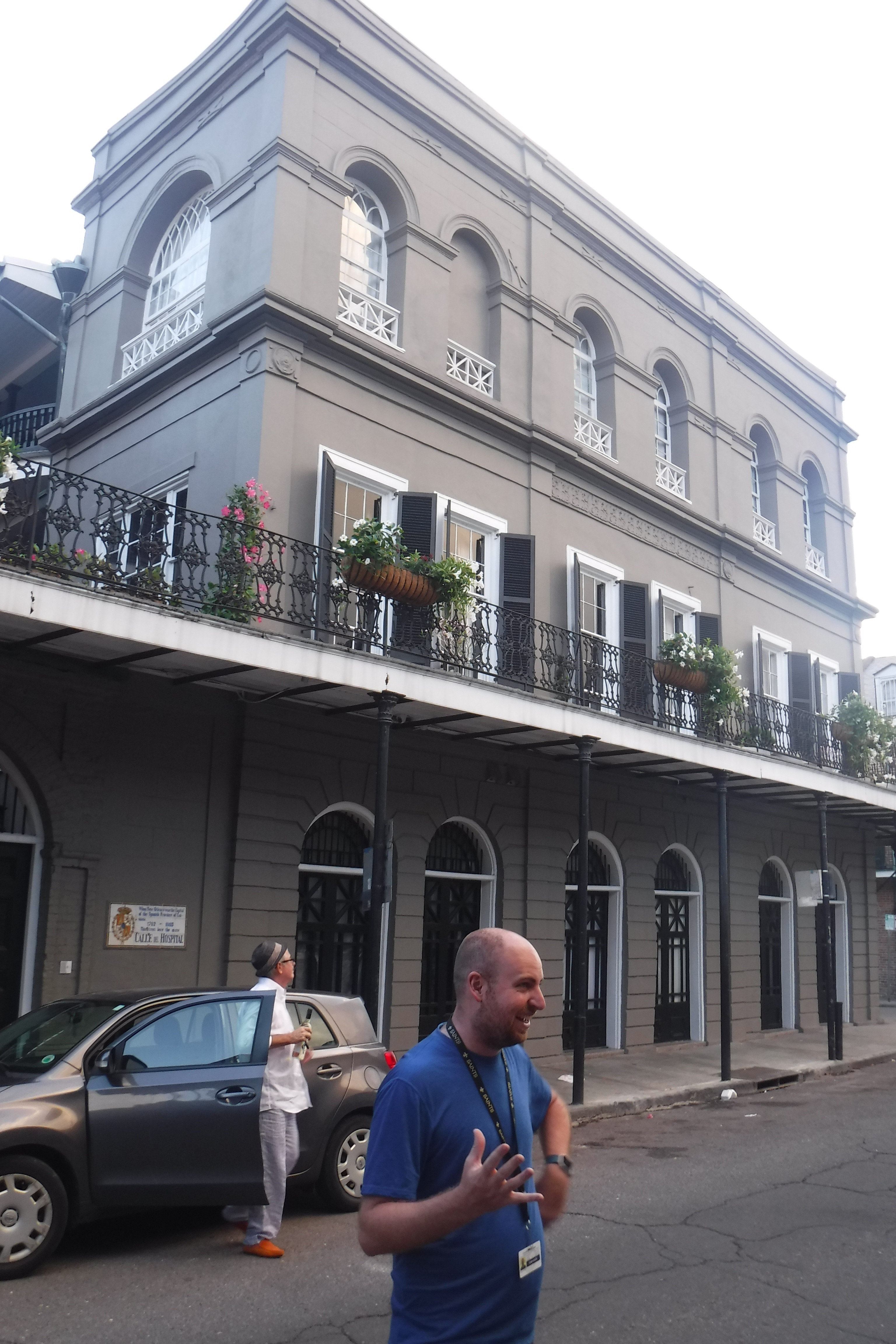
Jerri loves to go on ghost tours and said we had to do one in New Orleans. After all, there should be many ghosts there with all its history and voodoo practices. So on the night before our departure, we joined a small group of ghost aficionados. We heard some stories about sightings in the French Quarter..one was rather gruesome. A lady built a very nice house with slave quarters out in back. After some time, people found that she was mistreating her slaves terribly with whipping, chaining them up and starving them. One slave girl jumped either off the building or out of a window to her death and she haunts the house along with other spirits. Nicholas Cage bought the house and was irritated after just one day of moving in, people were staring at the house and pointing. He thought it was about him but it was really people just hearing the ghost story. He didn’t believe the tour guide and was invited to take a private ghost tour of the city. Once he heard the story about his house, he moved out and sold the place. A person from Houston owns it now and isn’t there much, so he, apparently is not bothered by the ghosts.
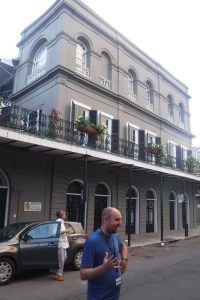
A haunted house in the French Quarter

A haunted house in the French Quarter

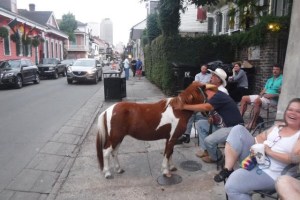
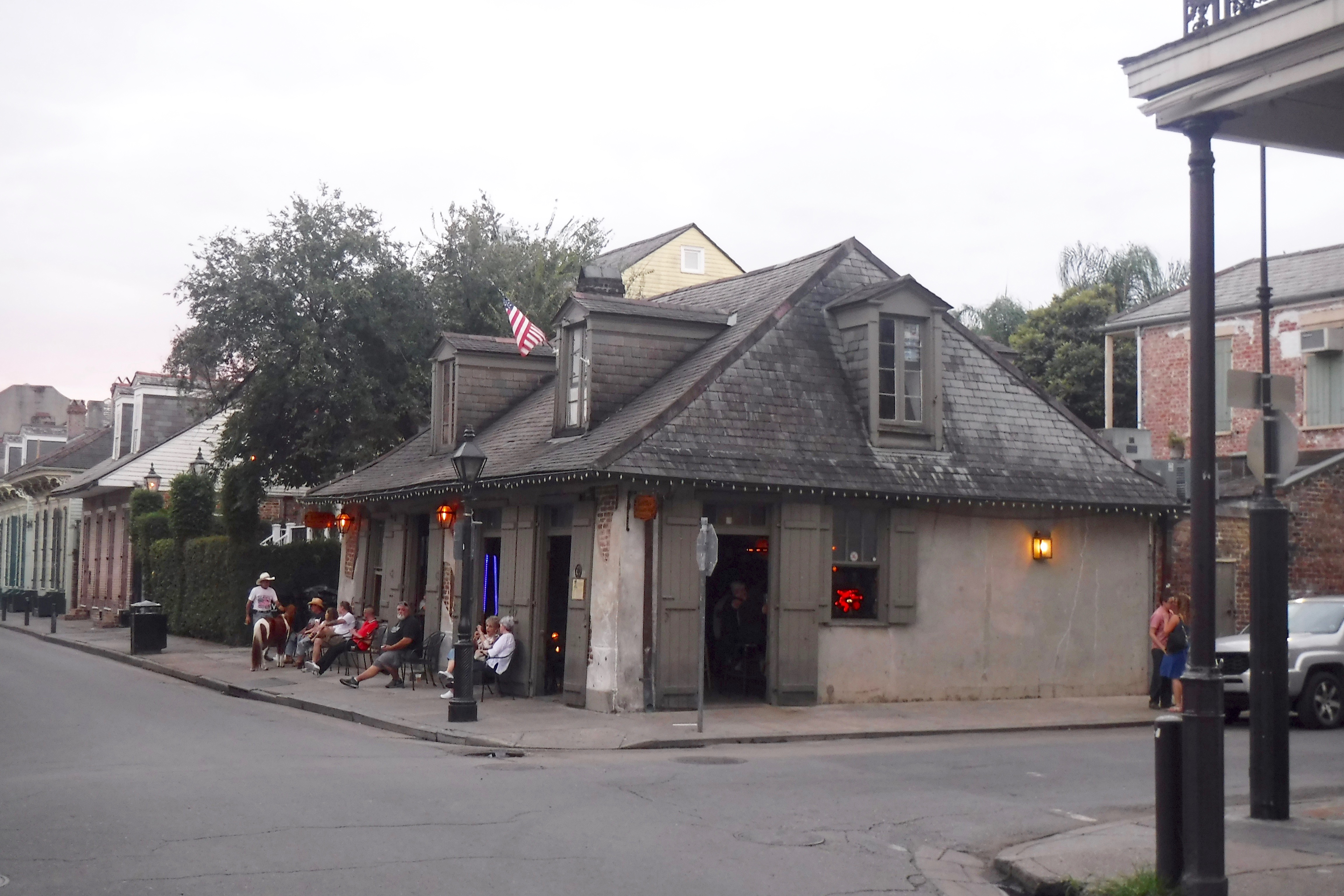
Our tour guide took a break by Lafitte’s Blacksmith Shop Bar, which may go back to the early 1800s but not owned by Lafitte(a privateer, smuggler, often in trouble with authorities and patriot(?) who fought with Andrew Jackson). It was quite a lively, rowdy place on Bourbon Street.   You can see more of the bar story and pictures at http://www.lafittesblacksmithshop.com/AboutUs.html  I asked the bartender for a margarita and got a purple looking daiquiri. He seemed to think that’s what I asked for. There were a lot of characters in and out of the bar. If you look closely at the picture, you’ll see at the left corner of the building, a guy with a Shetland pony! The poor horse seemed to be taking it all in stride, but I would have thought that all the noise would bother it.
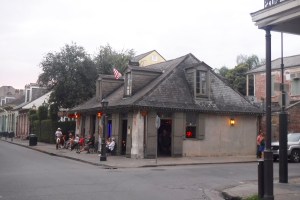
Lafitte's Blacksmith Shop Bar

Lafitte’s Blacksmith Shop Bar

Without the help of my friend RDS, I could not have posted this picture because it would not have been family friendly :-)

Without the help of my friend RDS, I could not have posted this picture because it would not have been family friendly 🙂
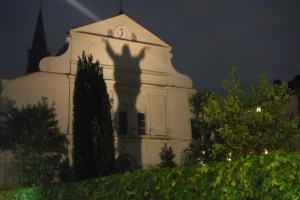
Our guide took us to the back of the St. Louis Cathedral that was in the photo of Jackson Square. He was talking about the figure in this photo. Most people feel that it is a shadow of Christ, but a little 5 year old boy told our guide that it was a giraffe. It’s all in your perspective!
Our guide took us to the back of the St. Louis Cathedral that was in the photo of Jackson Square.  He was talking about the figure in this photo. Most people feel that it is a shadow of Christ, but a little 5 year old boy told our guide that it was a giraffe. It’s all in your perspective!

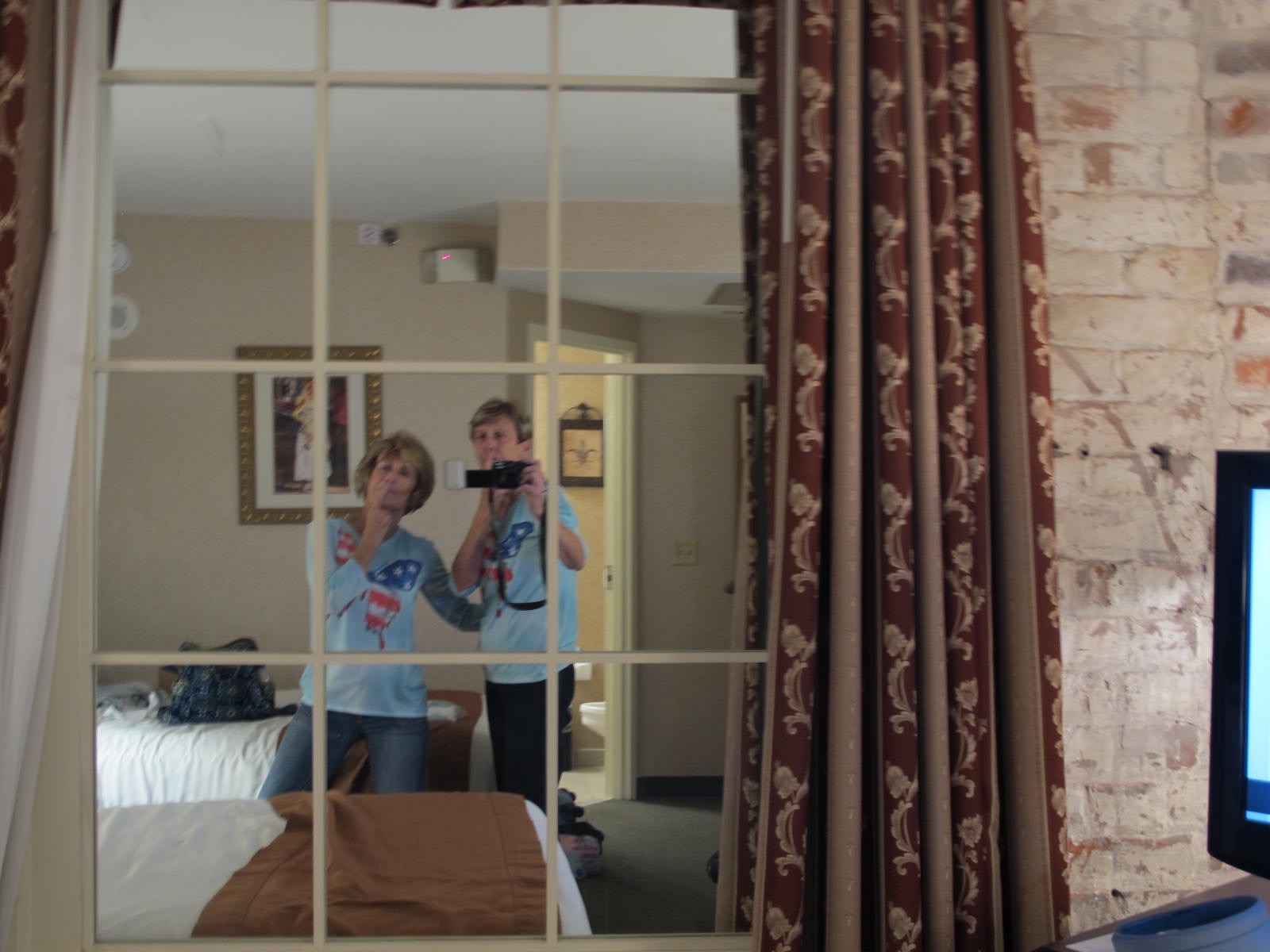
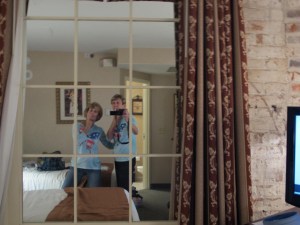
Jerri and I horsing around in front of our mirrored “window.” You can see that the wall is very old and we assume it is one of the original walls of the building. I’m pretty sure someone told me that the building was constructed in the 1800s.

Jerri and I horsing around in front of our mirrored “window.” You can see that the wall is very old and we assume it is one of the original walls of the building. I’m pretty sure someone told me that the building was constructed in the 1800s.

Sister Trip 7 was over way too soon, but then they all are. We loved our first three towns and wished that we’d spent more time in them. New Orleans was fun and we saw and did a lot. We enjoyed meeting the locals in every place we visited and felt they were/are extremely friendly and hospitable. This was true in NOLA, too.  But we’re from such a small, quiet town that we weren’t enchanted with it quite like we were in the other places. Bourbon Street was definitely not our cup of tea…with its own odor and culture. Too much booze, I think. However, we fell in love with the Southern food. They do know how to fry vittles down there. It’s a good thing we were only gone 10 days or we both would have gained waaaay too much weight!

Sister Trip 7 – Vicksburg and Natchez, Mississippi October 10 – 19, 2016

14 Nov

We were so excited for this trip that we didn’t sleep much the night before in anticipation of taking off at 6:05 AM for a glorious trip to the Southeast. This anticipation was quickly replaced by anxiety when Southwest announced that our plane had a dead battery (Can you believe that?) and everyone had to be rerouted. Such a bummer. So instead of arriving in New Orleans at 1:30 their time, we arrived a bit after 4. This wouldn’t have been such a big deal but we had to rent a car and then drive about 4 hours to Vicksburg, Mississippi. Our luggage didn’t get rerouted with us and that was a disappointment.  Luckily we had our meds, cameras and a few essentials in our backpacks. We survived and our bags were FedExed to us in Vicksburg the next day.

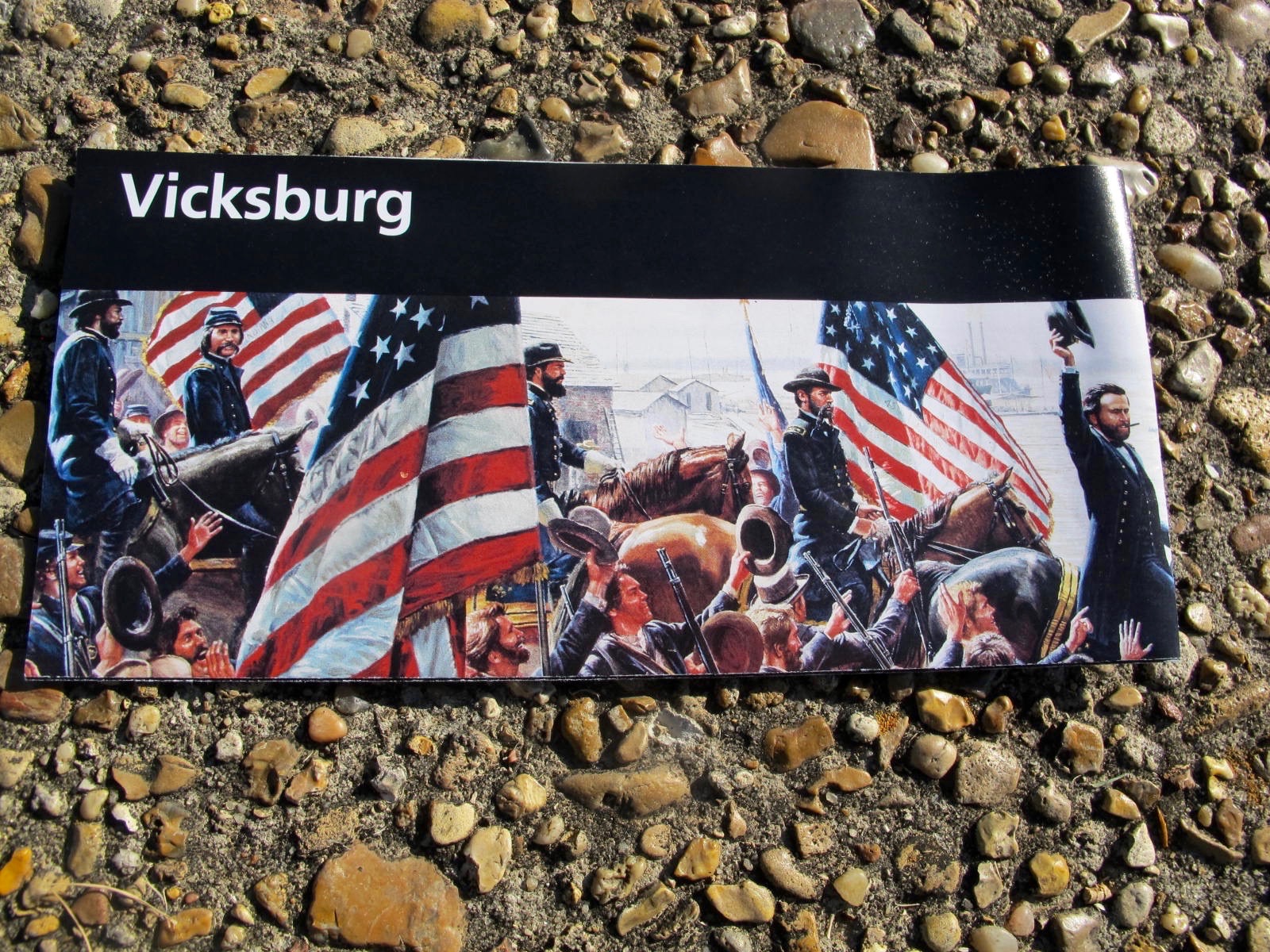
Vicksburg

Just click on a photo if you wish to enlarge it

We chose to visit Vicksburg because Jerri loves learning about the Civil War and visiting important sites of that era. Abraham Lincoln called Vicksburg “the key” for control of the Mississippi River, a major conduit for moving troops and supplies. In October 1862, Vicksburg was the focus of operations between Maj. Gen. U.S. Grant, ordered to clear the Mississippi of Confederate resistance, and Lt. Gen. John C. Pemberton—with 50,000 widely scattered Confederate troops— expected to keep the river open. After many battles and skirmishes, Grant laid formal siege on Vicksburg. It lasted 46 days and on July 4, 1863, Vicksburg was officially surrendered.

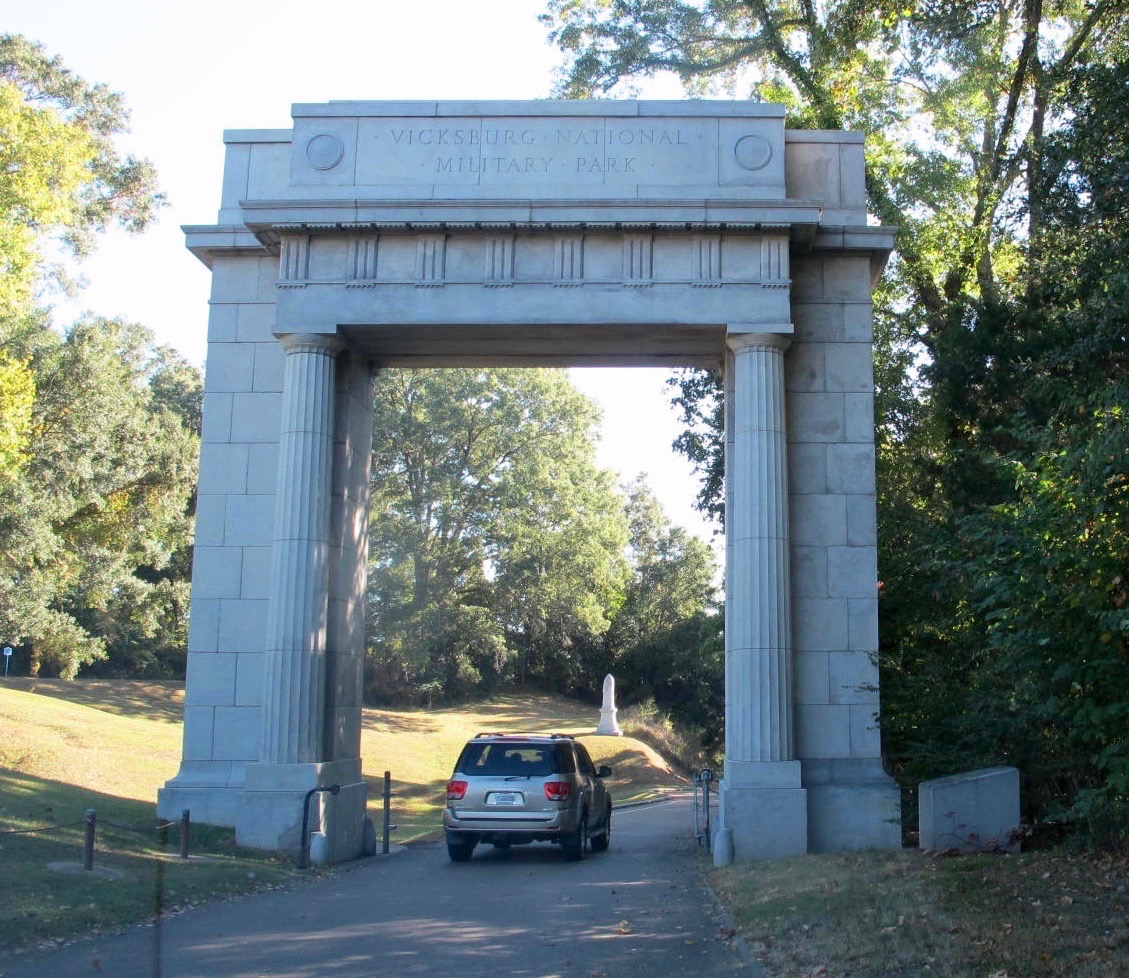
So it is that we visited the Vicksburg National Military Park. After seeing a short movie explaining the campaign and siege of Vicksburg, we drove the very well marked 16 miles of roads through the park. There are red markers that pertain to Confederate lines or emplacements and blue markers refer to Union forces. With all the markers, artillery pieces, monuments and restored forts, rifle pits and battle positions, we had a great visual of who was where and how close the forces were when they battled each other.

So it is that we visited the Vicksburg National Military Park. After seeing a short movie explaining the campaign and siege of Vicksburg, we drove the very well marked 16 miles of roads through the park. There are red markers that pertain to Confederate lines or emplacements and blue markers refer to Union forces. With all the markers, artillery pieces, monuments and restored forts, rifle pits and battle positions, we had a great visual of who was where and how close the forces were when they battled each other.

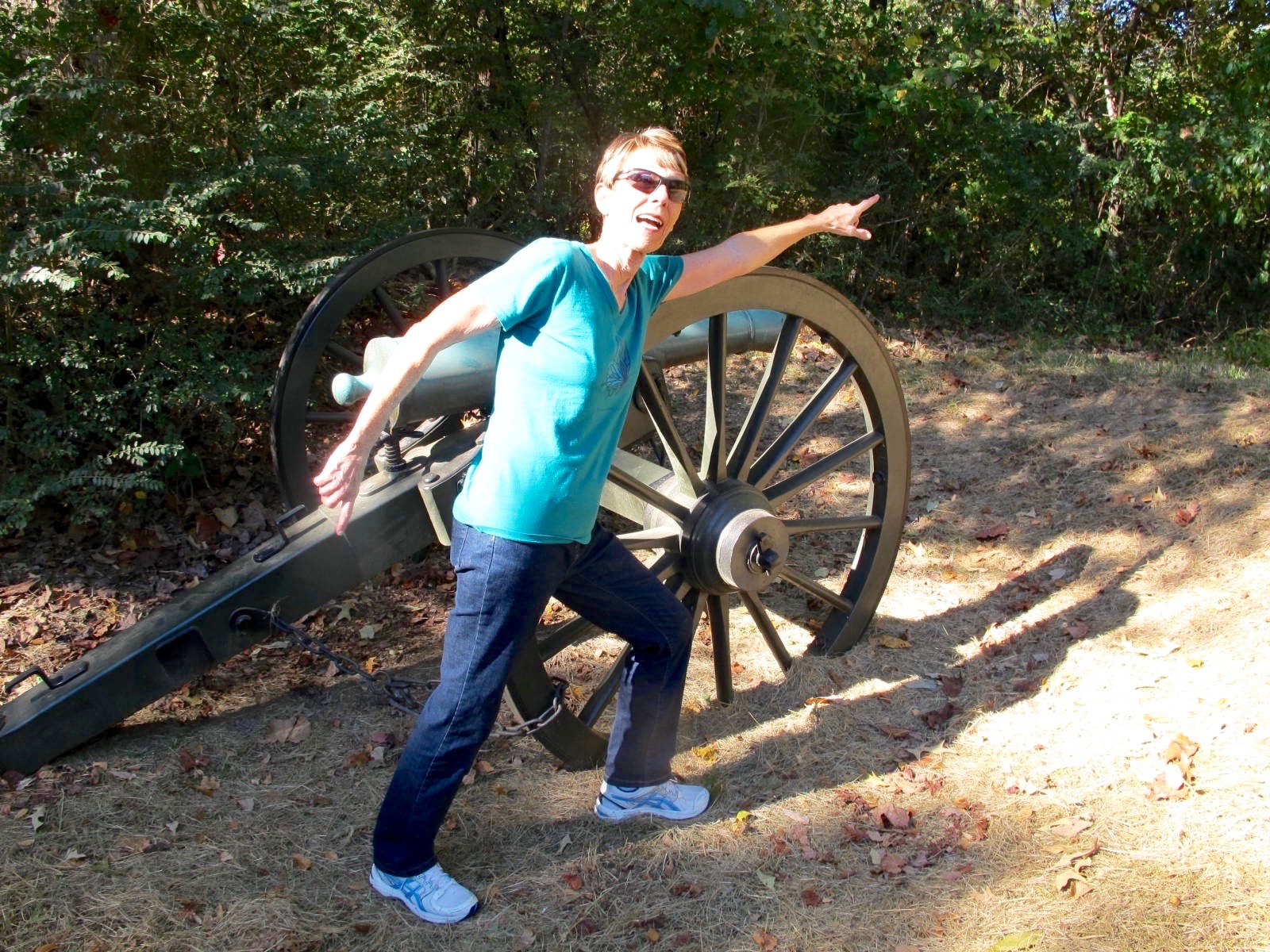
Pointing the way

Pointing the way

This is the Union Battery de Golyer that hammered the Confederate Great Redoubt across a ravine. (FYI-A Redoubt is a fort and in this case, a massive earthwork)

The Union Battery de Golyer that hammered the Confederate Great Redoubt across a ravine. (FYI- a Redoubt is a fort and in this case, a massive earthwork)

 The Great Redoubt can be seen to the left of the white house.

The Great Redoubt can be seen to the left of the white house.

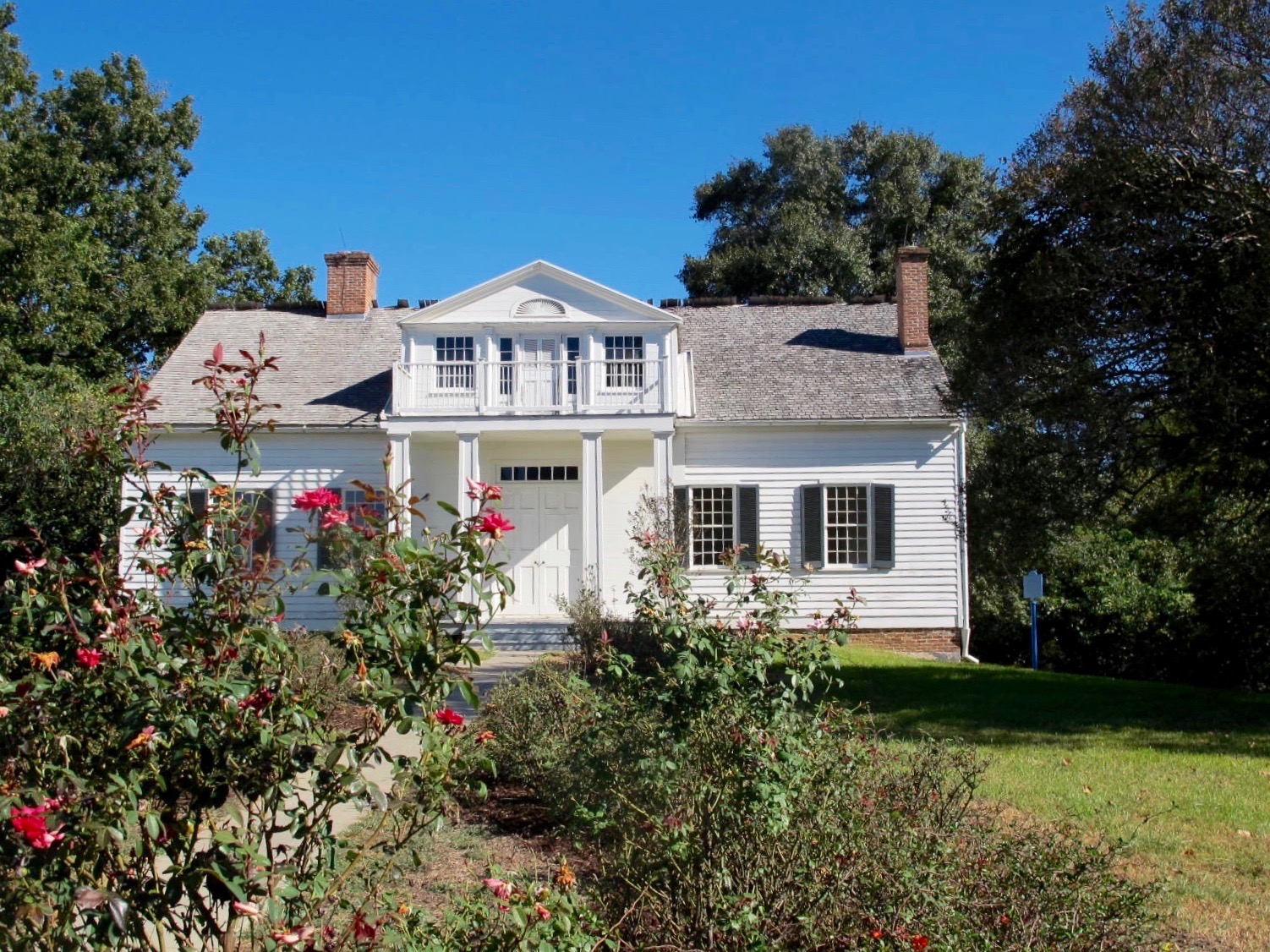
The James & Adeline Shirley house that was caught in a crossfire. It eventually became the Federal Headquarters. It is the only original structure left in the park and has been restored to its 1863 appearance.

The James & Adeline Shirley house that was caught in a crossfire. It eventually became the Federal Headquarters. It is the only original structure left in the park and has been restored to its 1863 appearance.

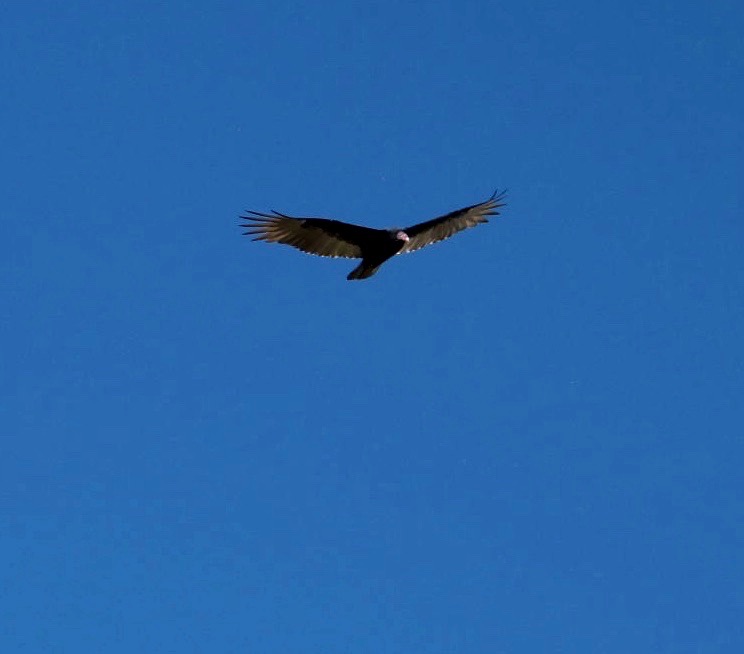
It seemed appropriate that we saw several buzzards flying over the ravine in front of the Shirley House. Many men died in the ravine in front of it.

It seemed appropriate that we saw several buzzards flying over the ravine in front of the Shirley House. Many men died in the ravine in front of it.

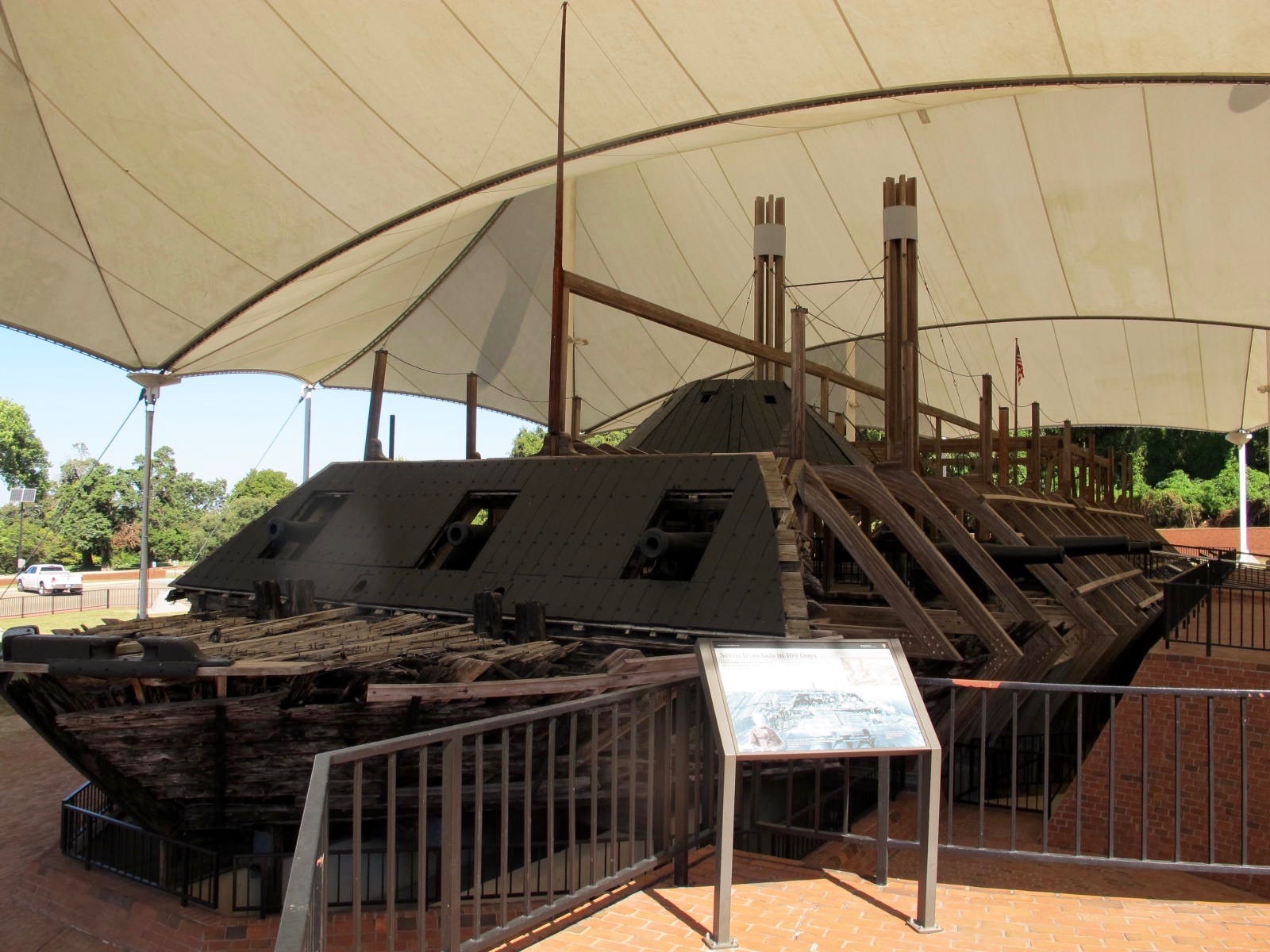
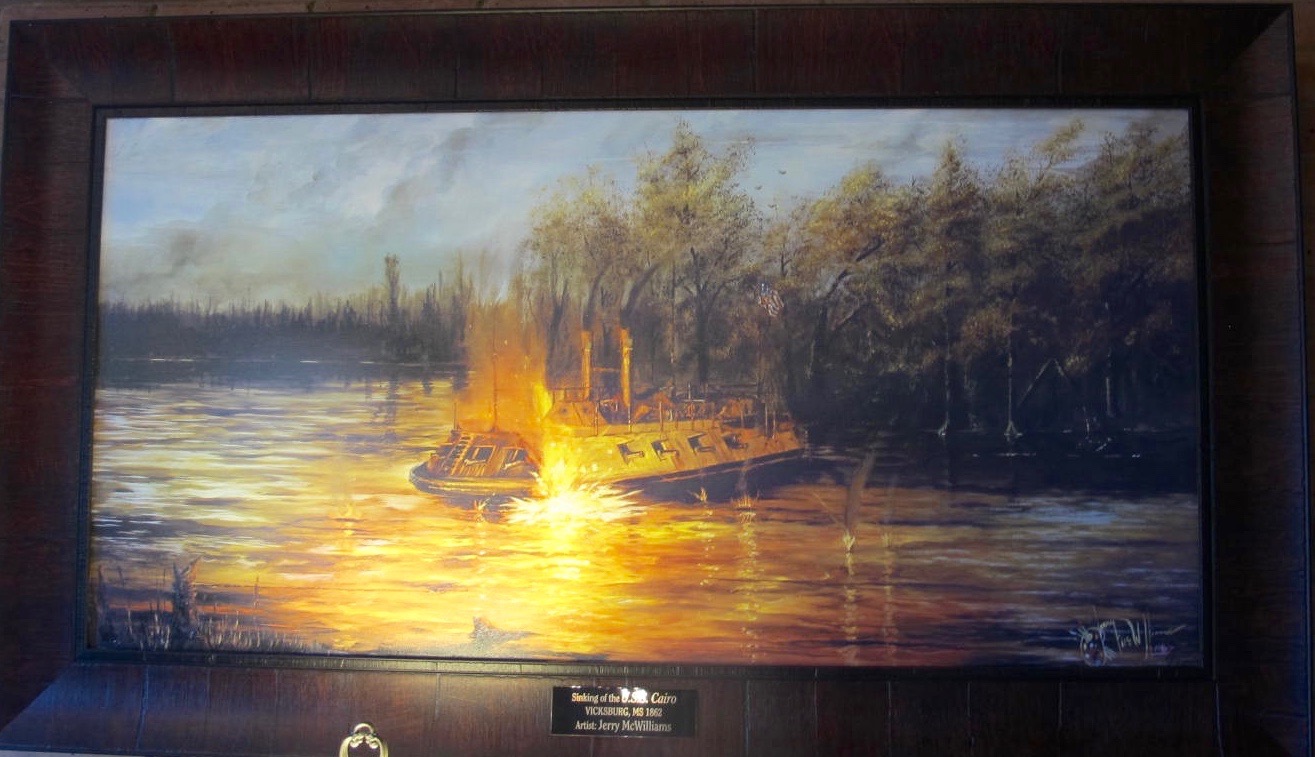
The USS Cairo (pronounced Kay-ro) was sunk in the River and salvaged in the 1960s. The boat’s remains are partially reconstructed and many recovered artifacts are displayed in the nearby museum. You can get a feel of a sailor’s life when you see those artifacts. It certainly wasn’t an easy life for them aboard the Cairo.

The USS Cairo (pronounced Kay-ro) was sunk in the River and salvaged in the 1960s. The boat’s remains are partially reconstructed and many recovered artifacts are displayed in the nearby museum. You can get a feel of a sailor’s life when you see those artifacts. It certainly wasn’t an easy life for them aboard the Cairo.

Cairo sinking painting

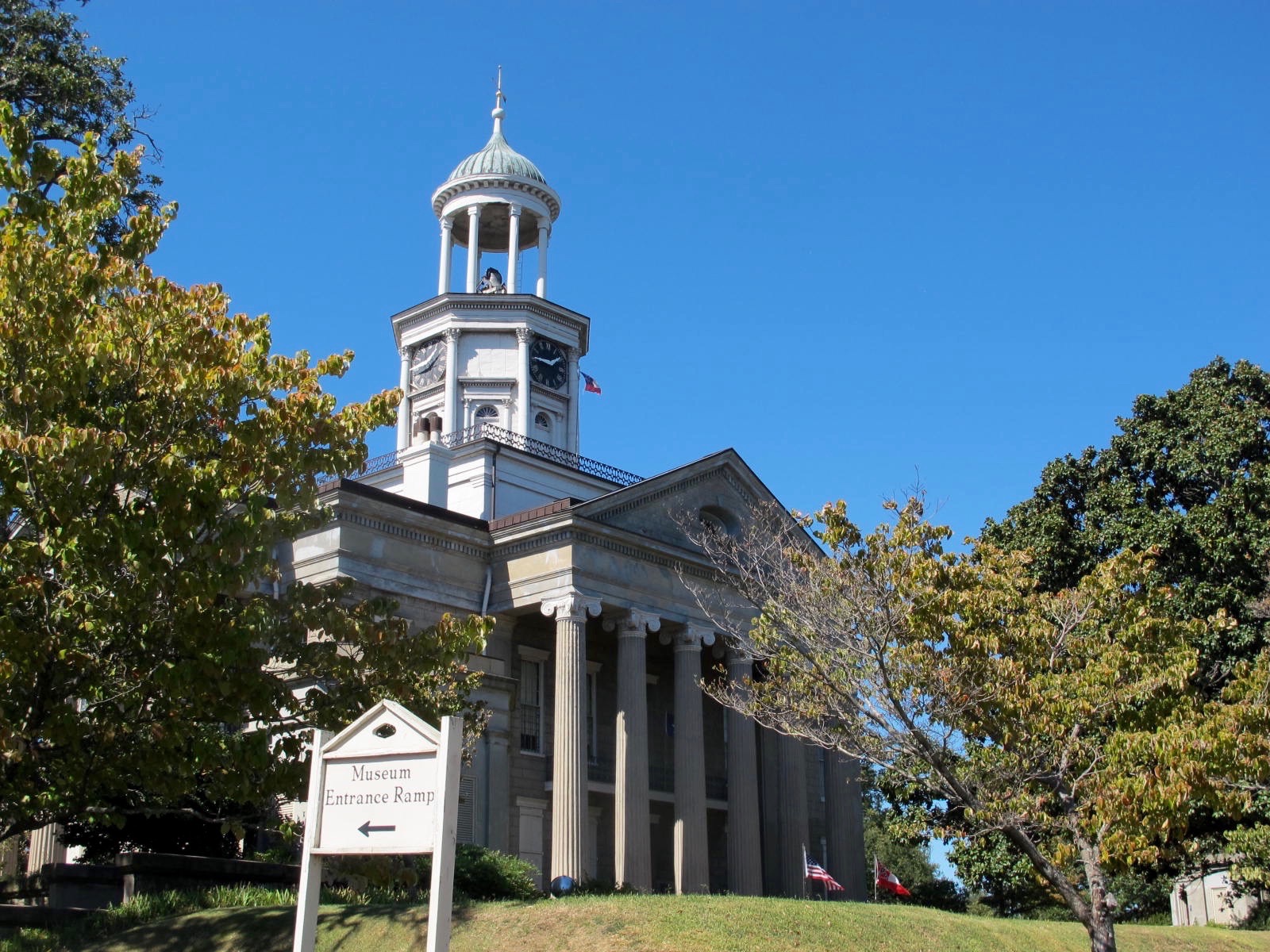
We visited the Old Courthouse in Vicksburg that has been turned into a very nice museum. It has some nice displays of Civil War artifacts and even some Mercí Train artifacts. They had some artillery shell art that was very well done.

We visited the Old Courthouse in Vicksburg that has been turned into a very nice museum. It has some nice displays of Civil War artifacts and even some Mercí Train artifacts. They had some artillery shell art that was very well done.

Our favorite place in Vicksburg was the McRaven House, the most haunted house in Mississippi.

Our favorite place in Vicksburg was the McRaven House, the most haunted house in Mississippi.

Built in 1797, it contains the architecture of three different time periods: Frontier (1797), Empire (1839) and Greek Revival (1849). It served as a waystation at first and then was added to by the local sheriff. His wife died in childbirth there in 1836. The house was purchased by John H. Bobb in 1849, who built the rest of the house.  The house itself was set back among many trees and was not visible from the street. I thought it was sort of creepy around the grounds.

During the Civil War's 1863 Siege of Vicksburg, McRaven was used as a Confederate field hospital and campsite. This might account for some of the “hauntings.”

During the Civil War’s 1863 Siege of Vicksburg, McRaven was used as a Confederate field hospital and campsite. This might account for some of the “hauntings.”

Our tour was extremely well done and Larry the cat added to the ambiance. He loved Jerri.

Our tour was extremely well done and Larry the cat added to the fun. He loved Jerri.

Jerri couldn't resist adding a bit of her own art to McRaven

Jerri couldn’t resist heading into the art portion of the tour

We drove next toward Natchez and joined the Natchez Trace Parkway. The Natchez Trace began as Native American footpath leading between the Chickasaw and Choctaw Nations. In the late 1700s and early 1800s, growing numbers of travelers tramped the rough trail into a clearly marked path.

Where the ground was relatively soft, walkers, riders and wagons wore down the “sunken” sections still seen today.

Where the ground was relatively soft, walkers, riders and wagons wore down the “sunken” sections still seen today.

President Jefferson designated the Trace a national post road for mail delivery between Nashville and Natchez (444 miles). Today, the Parkway creates a beautiful highway from the southern Appalachian foothills of Tennessee to the bluffs of the lower Mississippi River.

Along the way we stopped at Mt. Locust Inn (a “stand” in the late 1700s). For 25¢, travelers could stop for a hot meal and a place to sleep on the porch. People lived in this building until 1944 and Park Service began restoration in 1954.

Along the way we stopped at Mt. Locust Inn (a “stand” in the late 1700s). For 25¢, travelers could stop for a hot meal and a place to sleep on the porch. People lived in this building until 1944 and the National Park Service began restoration in 1954.

Resting her bones at Mt. Locust

Resting her bones at Mt. Locust

This is what the Natchez Trace looks like today near Mt. Locust.

This is what the Natchez Trace looks like today near Mt. Locust.

We loved Natchez! It’s beautiful with many friendly people, filled with history and seems to have an easy-going ambiance. At one time, more millionaires lived here than anywhere else in the country due to King Cotton and their magnificent homes reflected their prosperity. It wasn’t a huge Civil War military objective, so most of the antebellum mansions survived making them a huge tourist draw for the area. We visited a few and enjoyed each for their uniqueness.

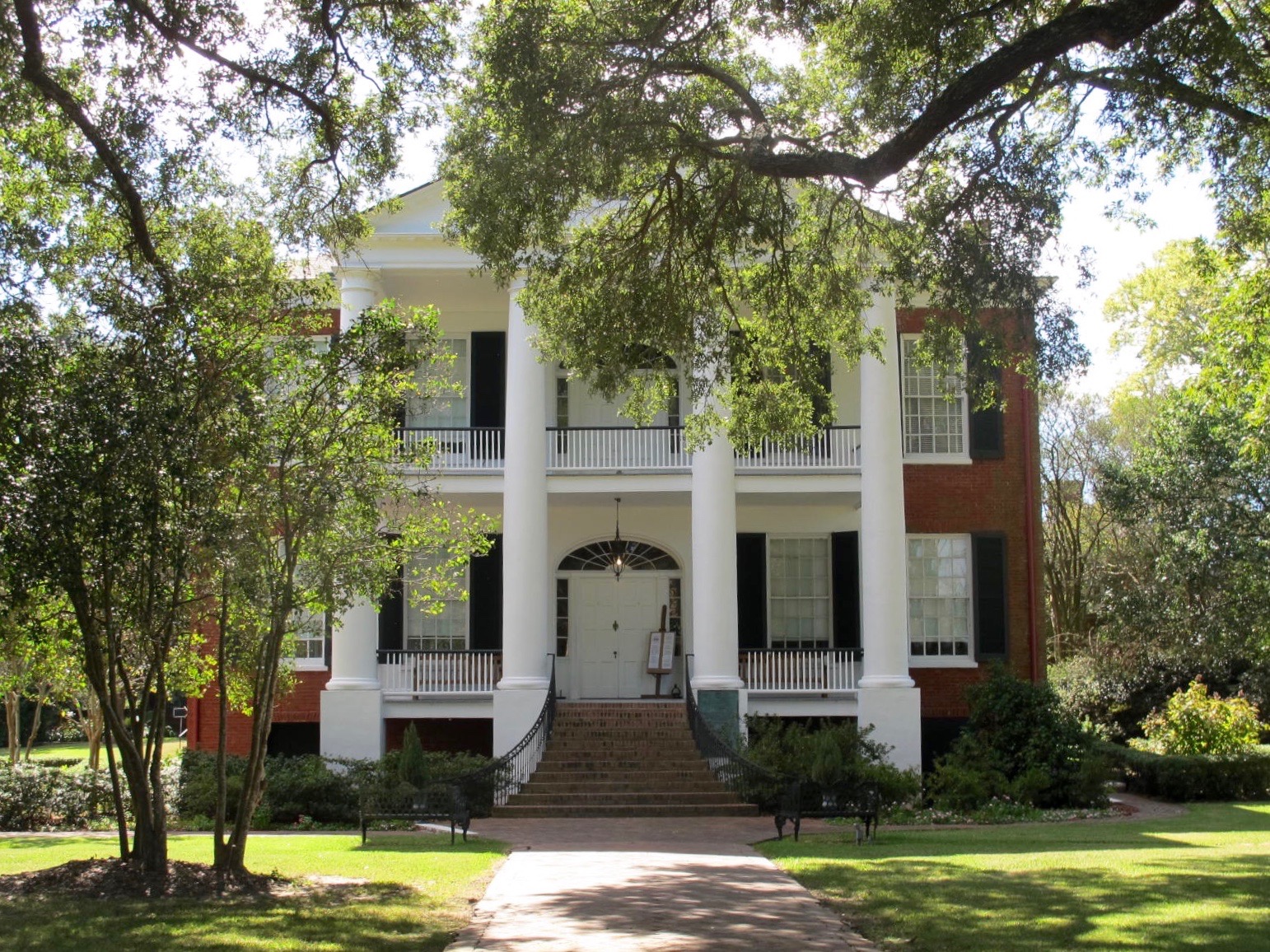
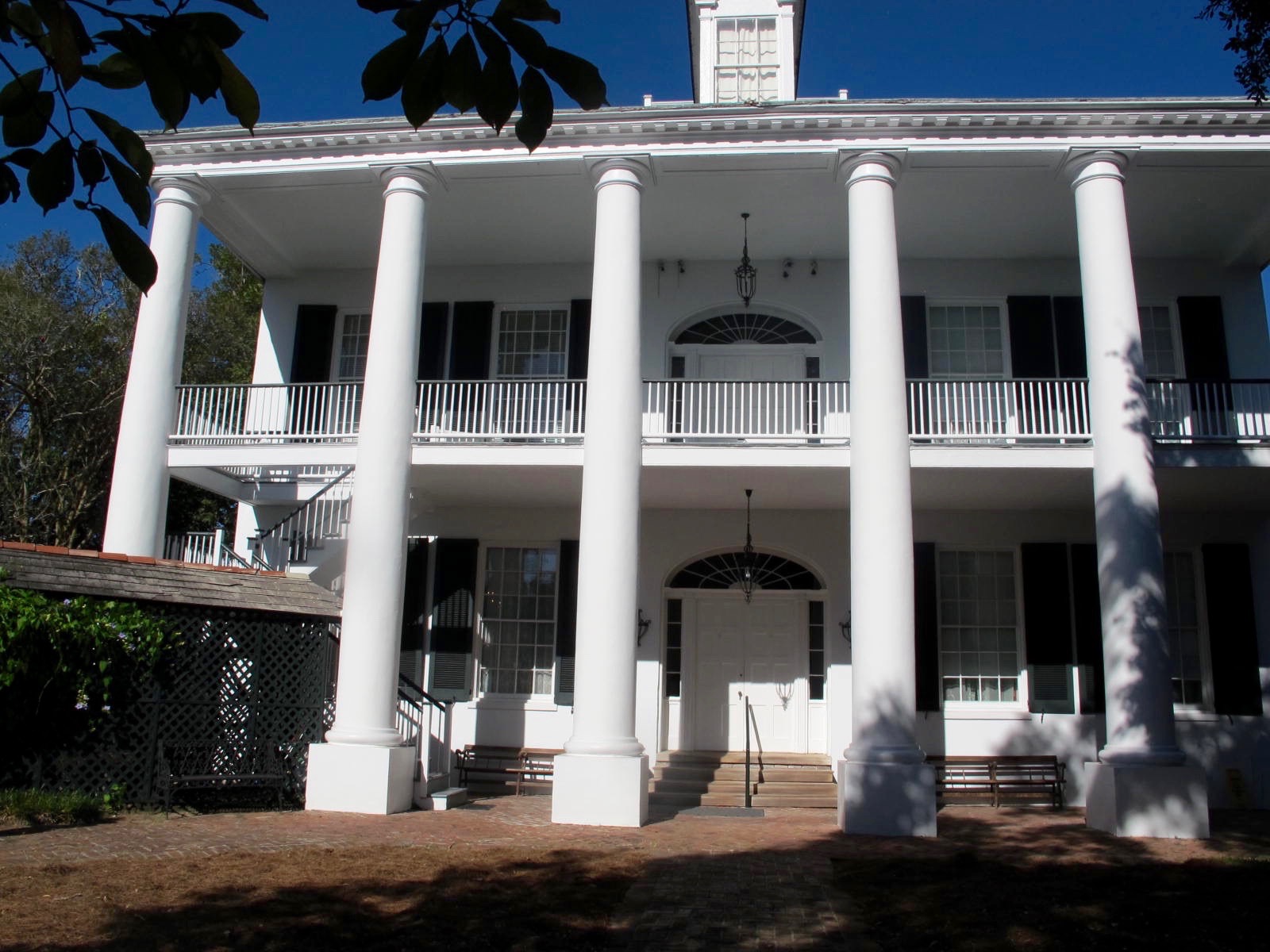
Rosalie was a big hit with both of us for its beauty, its original 1850s furniture and story. Built in 1820 by the Little family, it was purchased in 1857 by Andrew Wilson whose descendents lived in it until 1958. During the Civil War, it was occupied by the Union commander who gave the order to not destroy homes in Natchez.

Rosalie was a big hit with both of us for its beauty, its original 1850s furniture and story. Built in 1820 by the Little family, it was purchased in 1857 by Andrew Wilson whose descendents lived in it until 1958. During the Civil War, it was occupied by the Union commander who gave the order to not destroy homes in Natchez.

Rear entrance to Rosalie.

Rear entrance to Rosalie.

View of the Mississippi from Rosalie’s grounds. That's a tug boat pushing barges

View of the Mississippi from Rosalie’s grounds. That’s a tug boat pushing barges

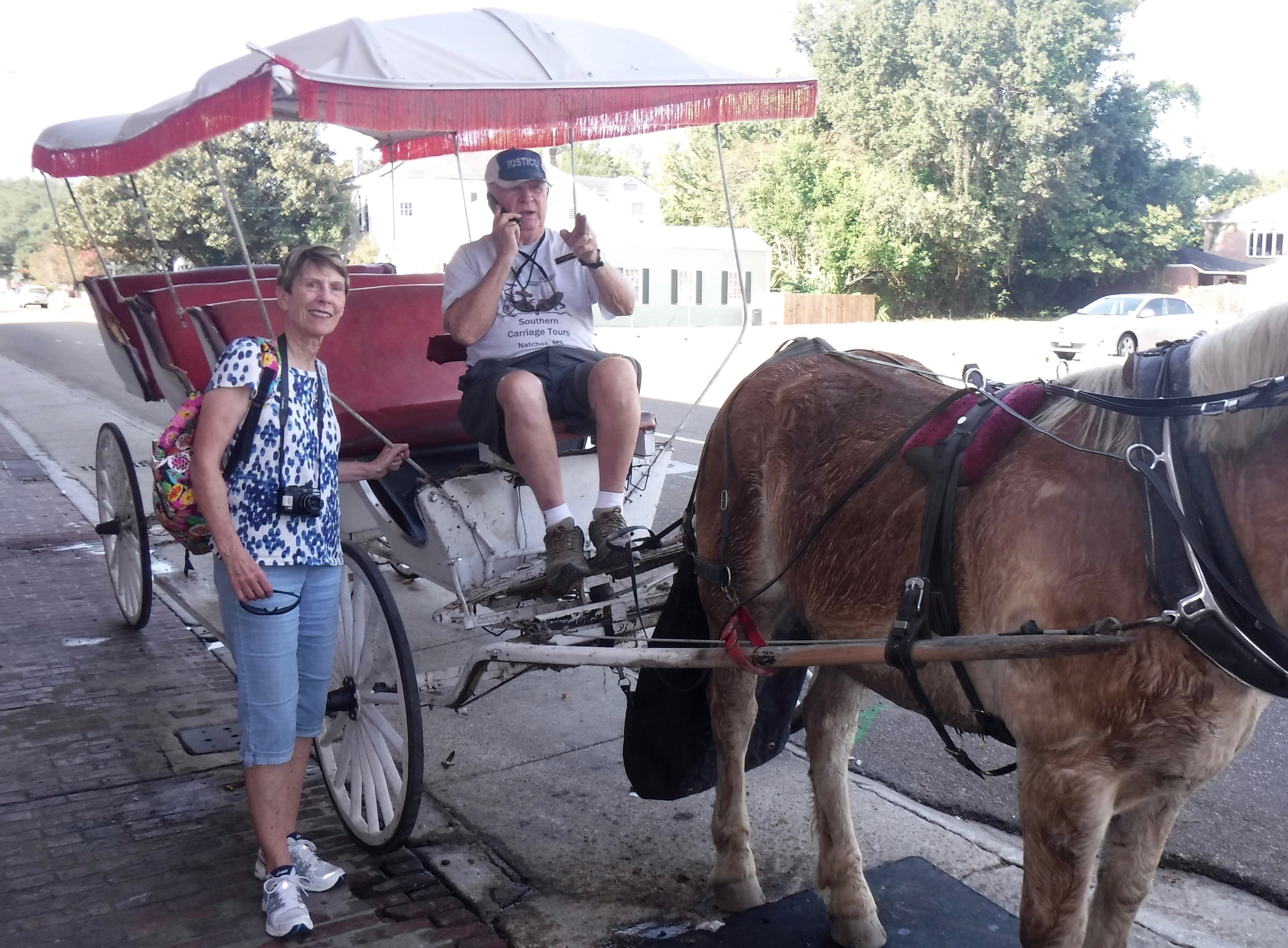
Our carriage that took us on a tour of Natchez. I find it ironic that the carriage driver is on his cell phone.

Our carriage that took us on a tour of Natchez. I find it ironic that the carriage driver is on his cell phone.

Stanton Hall is one of America's largest antebellum mansions. It was built in 1857 and takes up an entire city block

Stanton Hall is one of America’s largest antebellum mansions. It was built in 1857 and takes up an entire city block

Dusk looking toward the Mississippi River and Louisiana on the other side

Dusk looking toward the Mississippi River and Louisiana on the other side

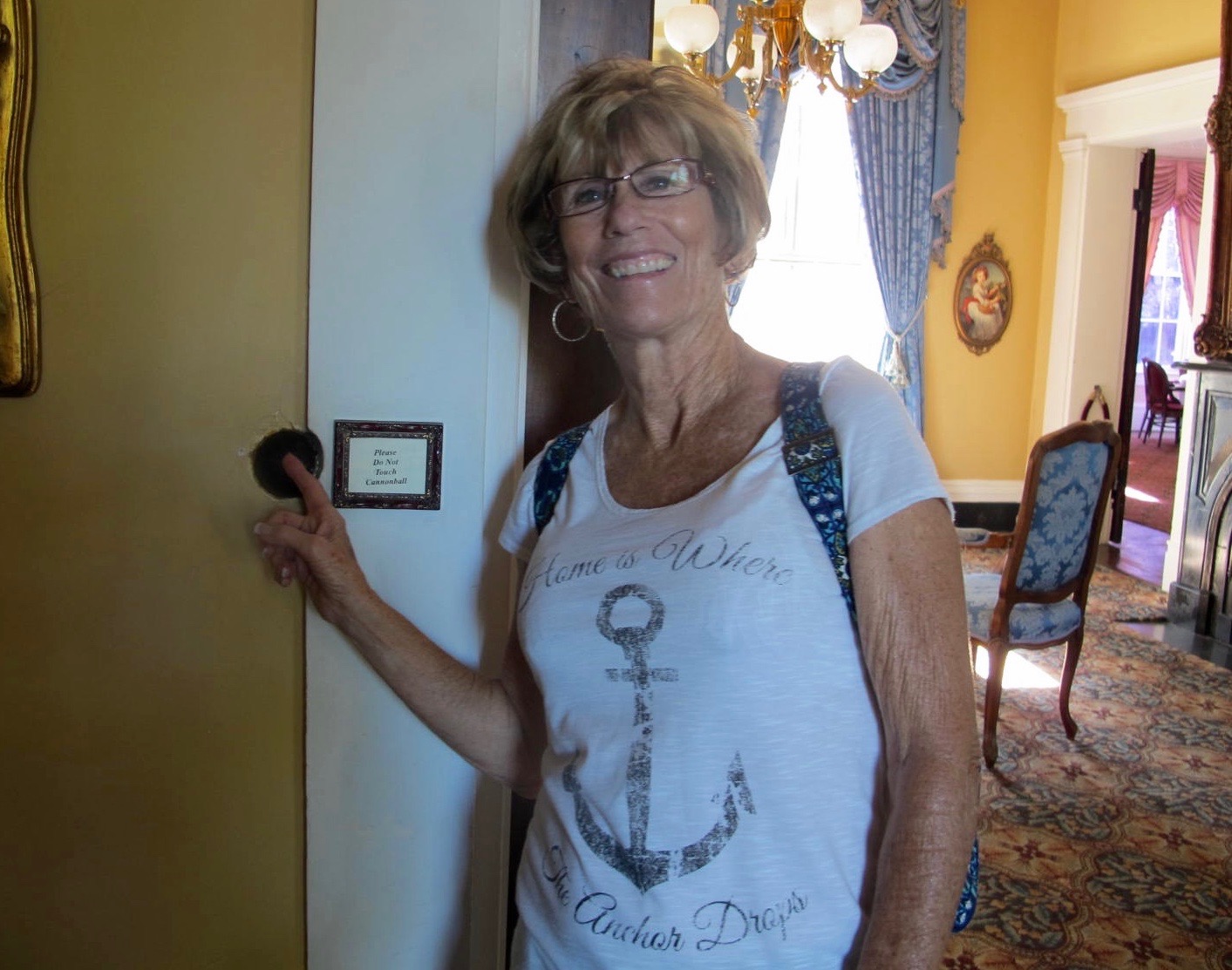
A cannon ball is lodged in the parlor wall of the Cedar Grove Plantation.

A cannon ball is lodged in the parlor wall of the Cedar Grove Plantation.  Don’t touch!

Assuming a helm pose

Assuming a helm pose

From Natchez, we moved south to St. Francisville, Louisiana, where we visited two unique plantation homes. The Myrtles, a 1796 plantation home, now a B and B, had a most interesting tour.

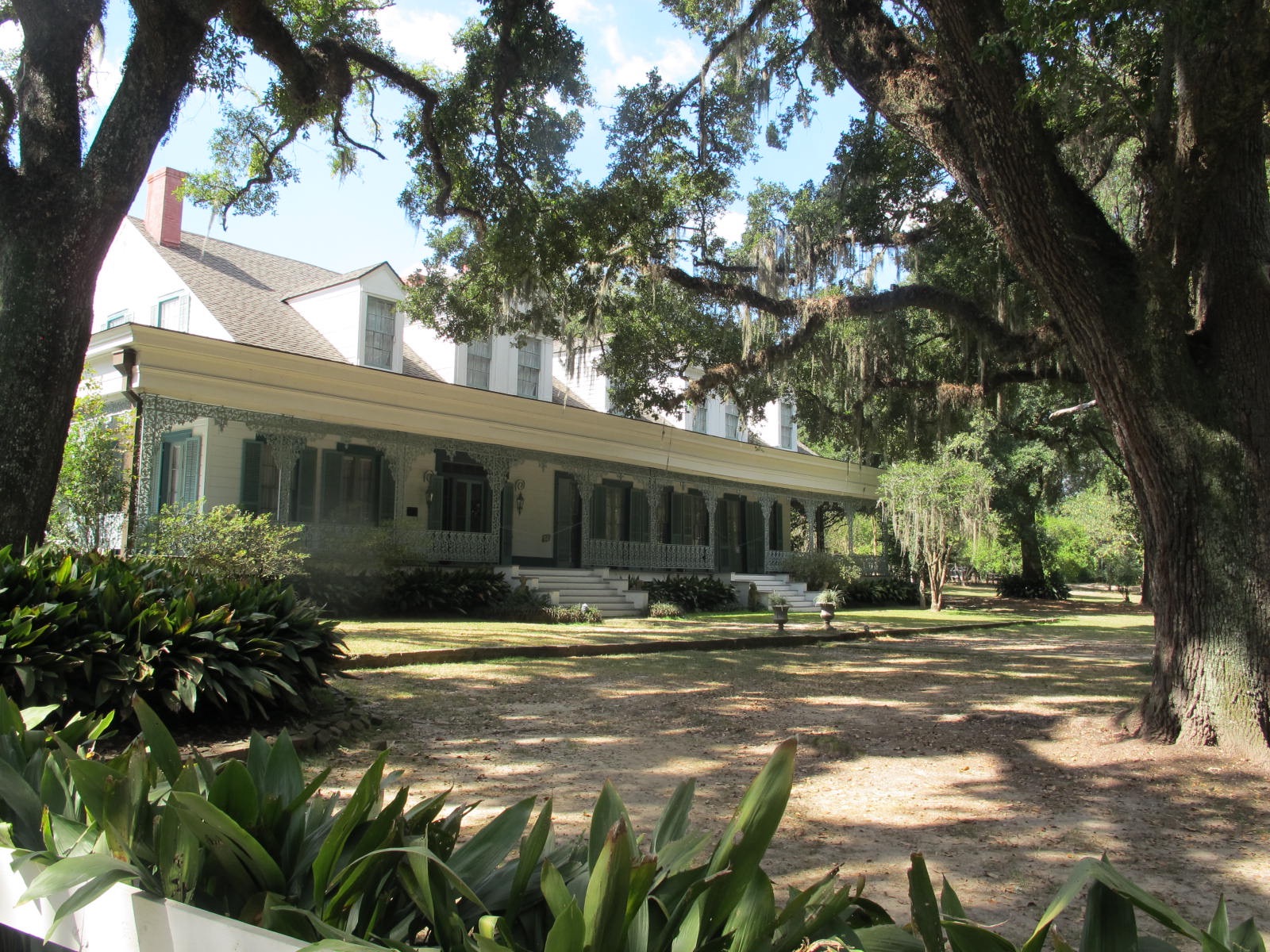
The Myrtles, named for the Crepe Myrtles on the property, was built 1796. Its veranda is 125 feet long

The Myrtles, named for the Crepe Myrtles on the property, was built 1796. Its veranda is 125 feet long

The Myrtles is claimed to be Louisiana’s most haunted mansion. It is said that more than a dozen different spirits have appeared over the years to the home’s owners and guests. We didn’t see any spirits, but enjoyed the tour. We did get to see a photograph taken by a person not of the household that supposedly shows two spirit children by the house. Who knows for sure? I do know that I don’t think I’d like to sleep in that house. It seemed rather creepy to me.  Jerri loves this stuff and I’m too chicken.

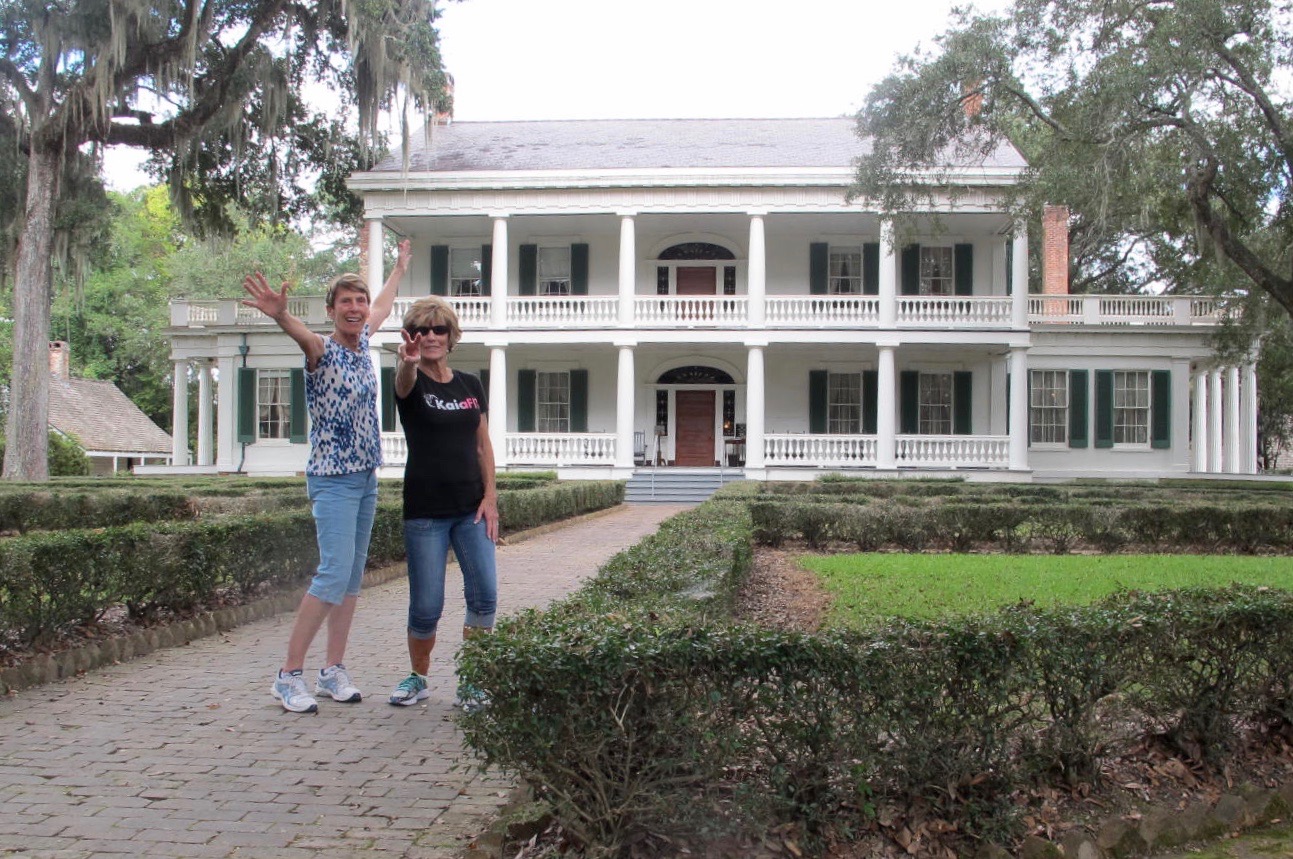
The next day, we visited the Rosedown Plantation State Historic Site, the place that makes me think of Tara in all its grandeur. It’s a 16-room house approached by a live-oak allée. (planted in 1830 and used to funnel cool breezes from the Mississippi River) The couple was inspired by the gardens at Versailles and created a 28-acre formal garden that is still beautiful today.

We visited the Rosedown Plantation State Historic Site, a place that makes me think of Tara in all its grandeur. It’s a 16-room house approached by a live-oak allée. (planted in 1830 and used to funnel cool breezes from the Mississippi River) The couple was inspired by the gardens at Versailles and created a 28-acre formal garden that is still beautiful today.

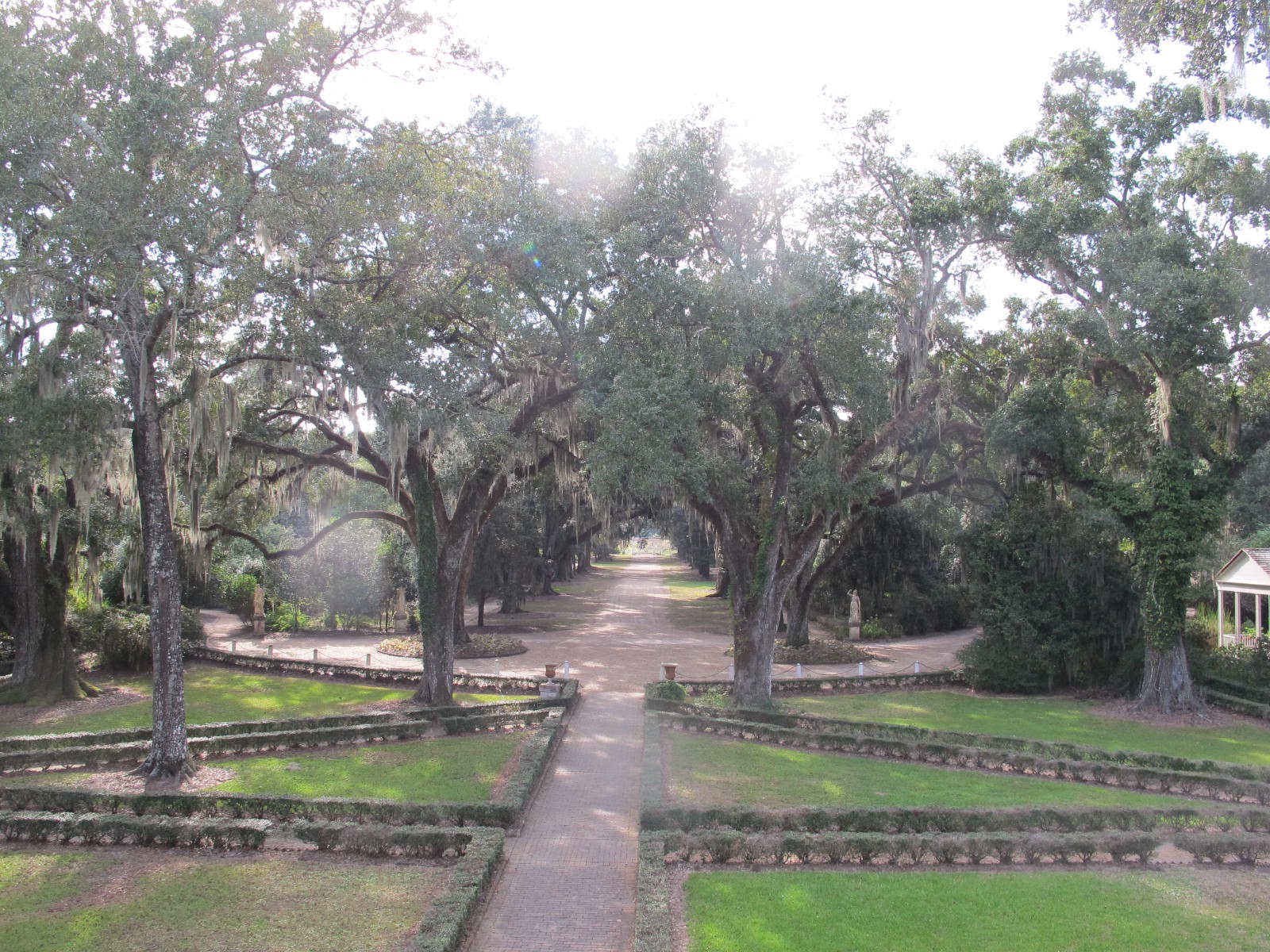
Looking down oak allee

Looking down oak allee from the mansion’s upper veranda

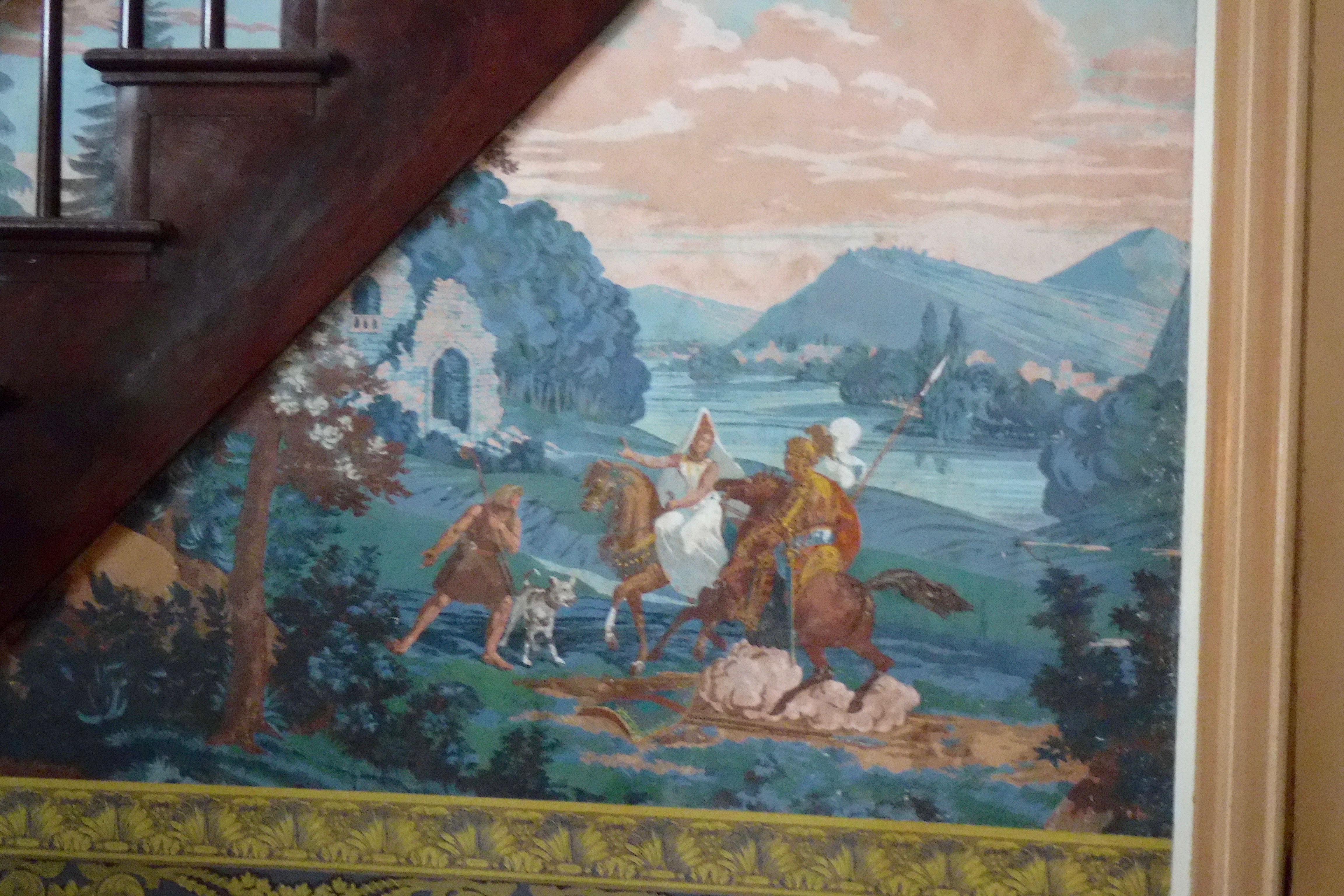
This handpainted French wall paper and a mahogany stairway were in Rosedown's entry hall. this was the epitome of elegance during the heyday of plantations

This hand painted French wall paper and a mahogany stairway were in Rosedown’s entry hall. this was the epitome of elegance during the heyday of plantations

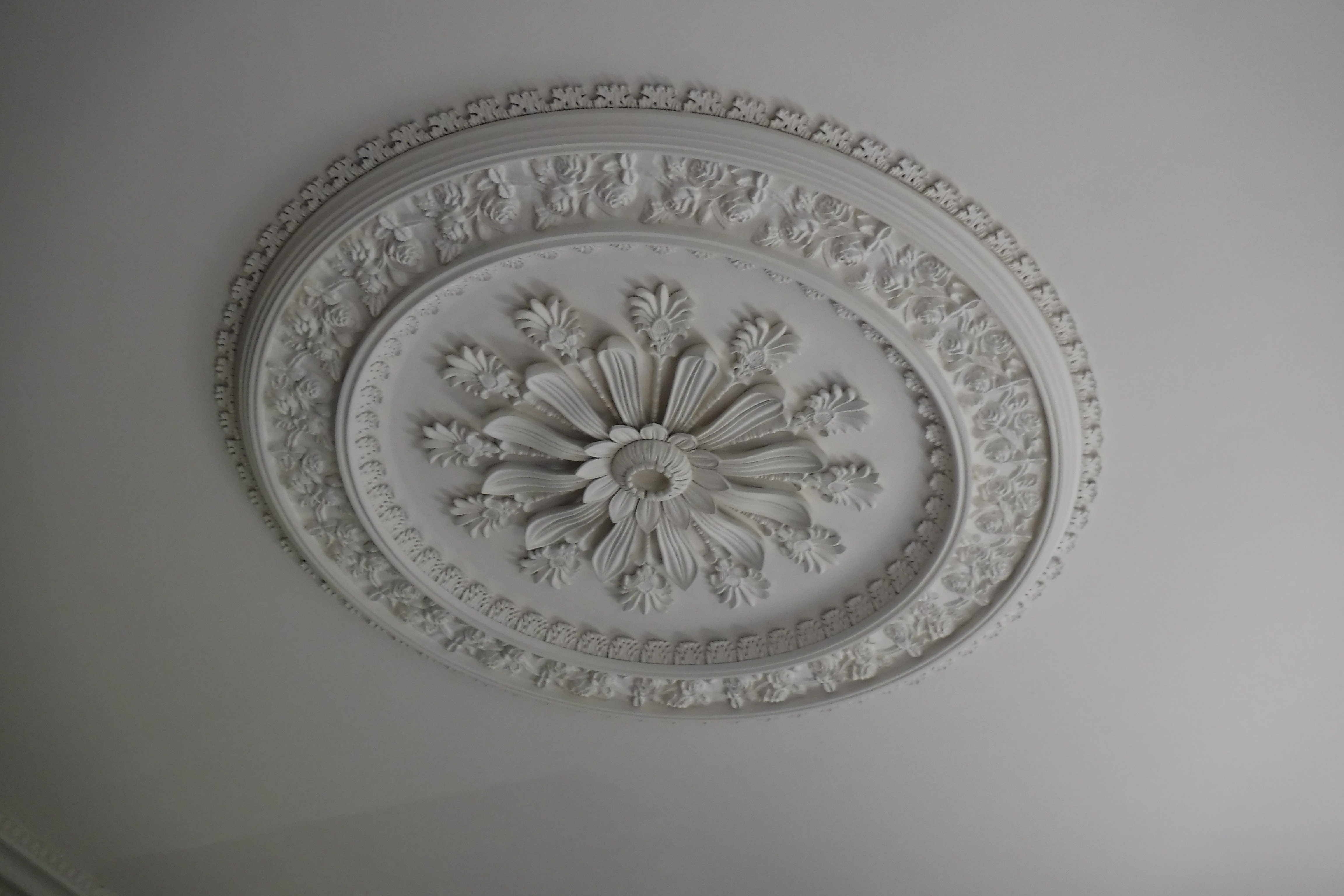
Ceiling décor has pineapples there were a symbol of welcome. This was in several of the homes we visited.

Ceiling décor with pineapples that were a symbol of welcome. This was in several of the homes we visited.

A shoo fly over the dining room table

A shoo fly over the dining room table.  It was like a fan that shooed the flies

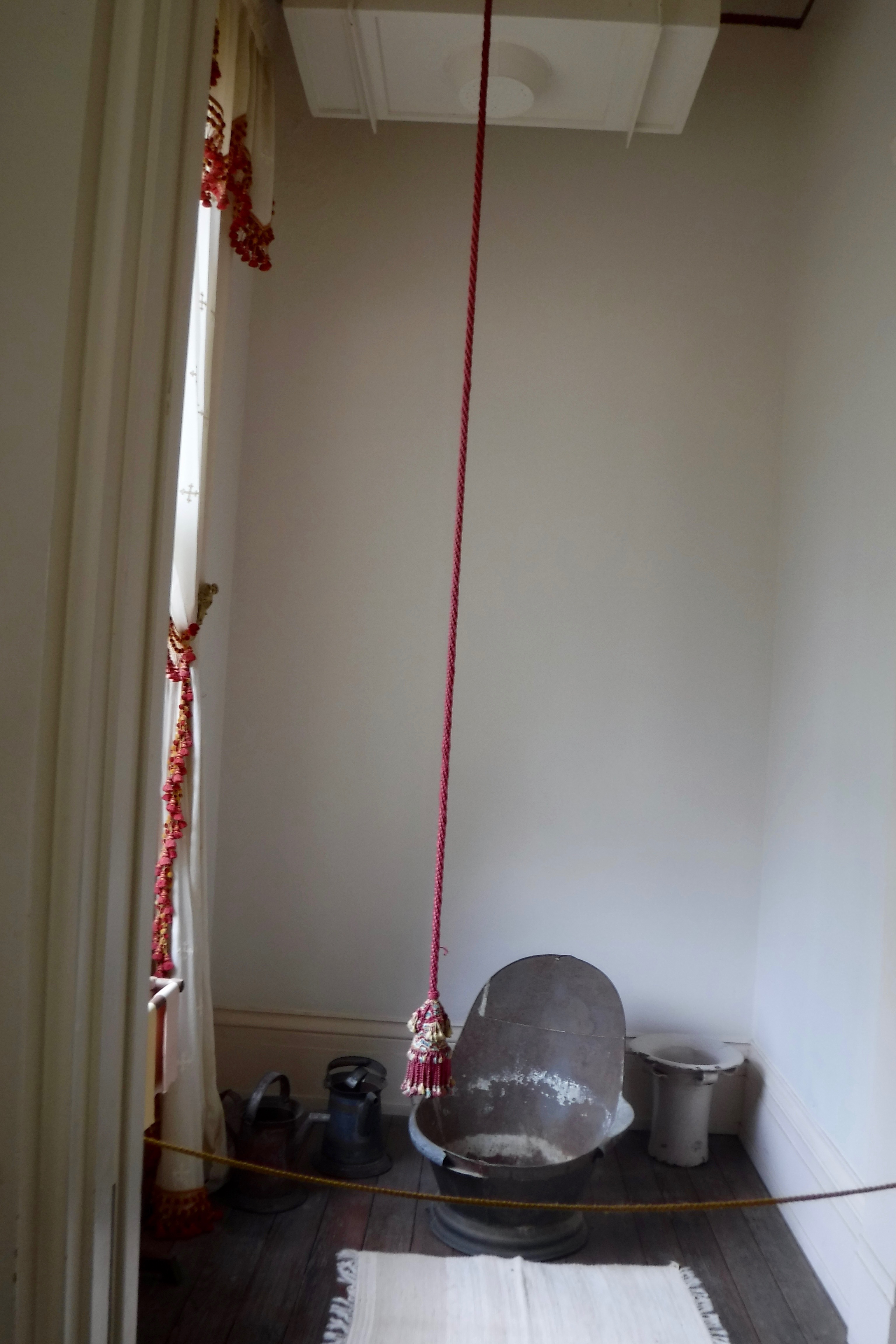
An early indoor shower/bath

An early indoor shower/bath

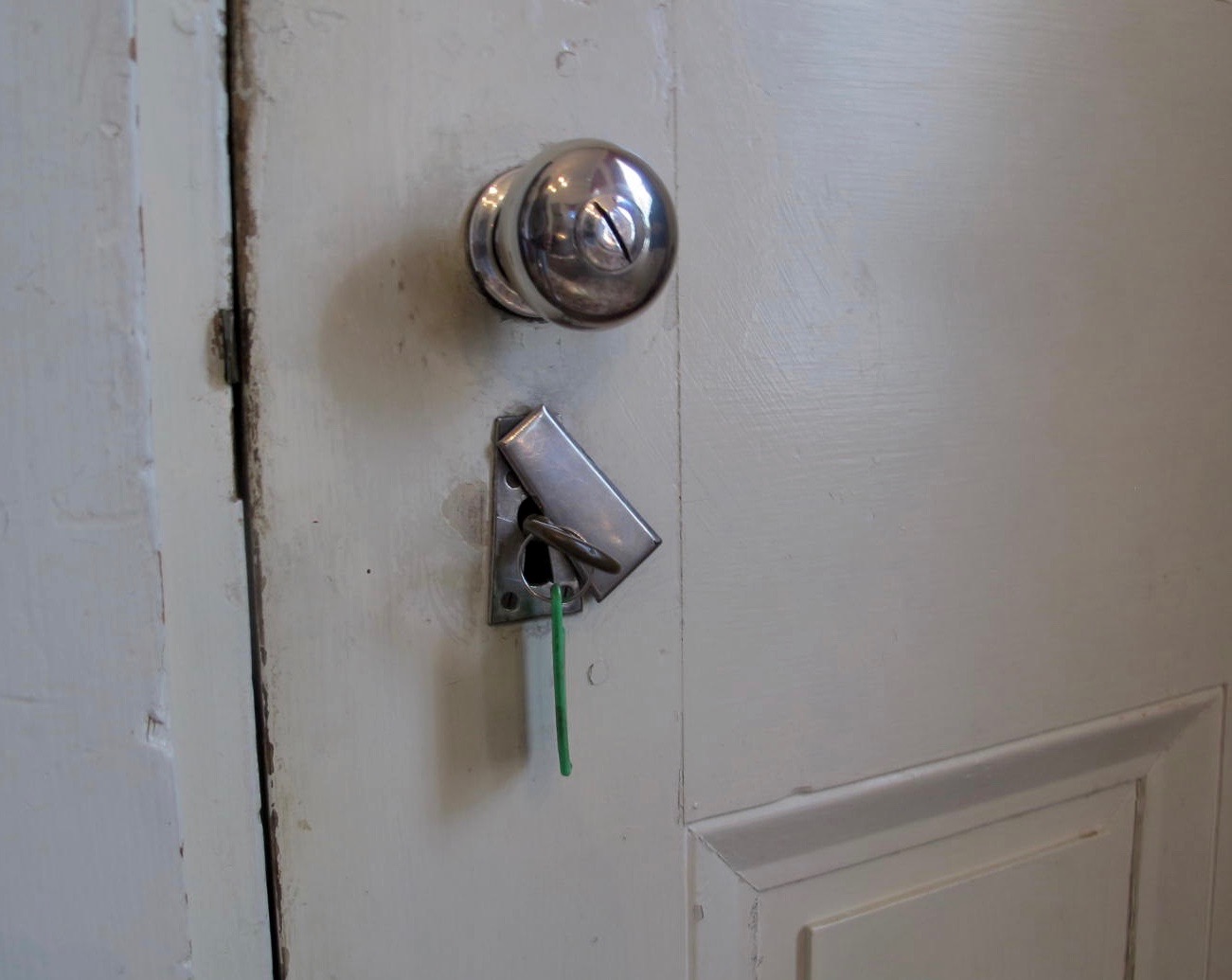
Keyhole covers were sometimes used to ward off evil spirits or even to shut out some of the heat or cold.

Keyhole covers were sometimes used shut out heat or cold and to ward off evil spirits.

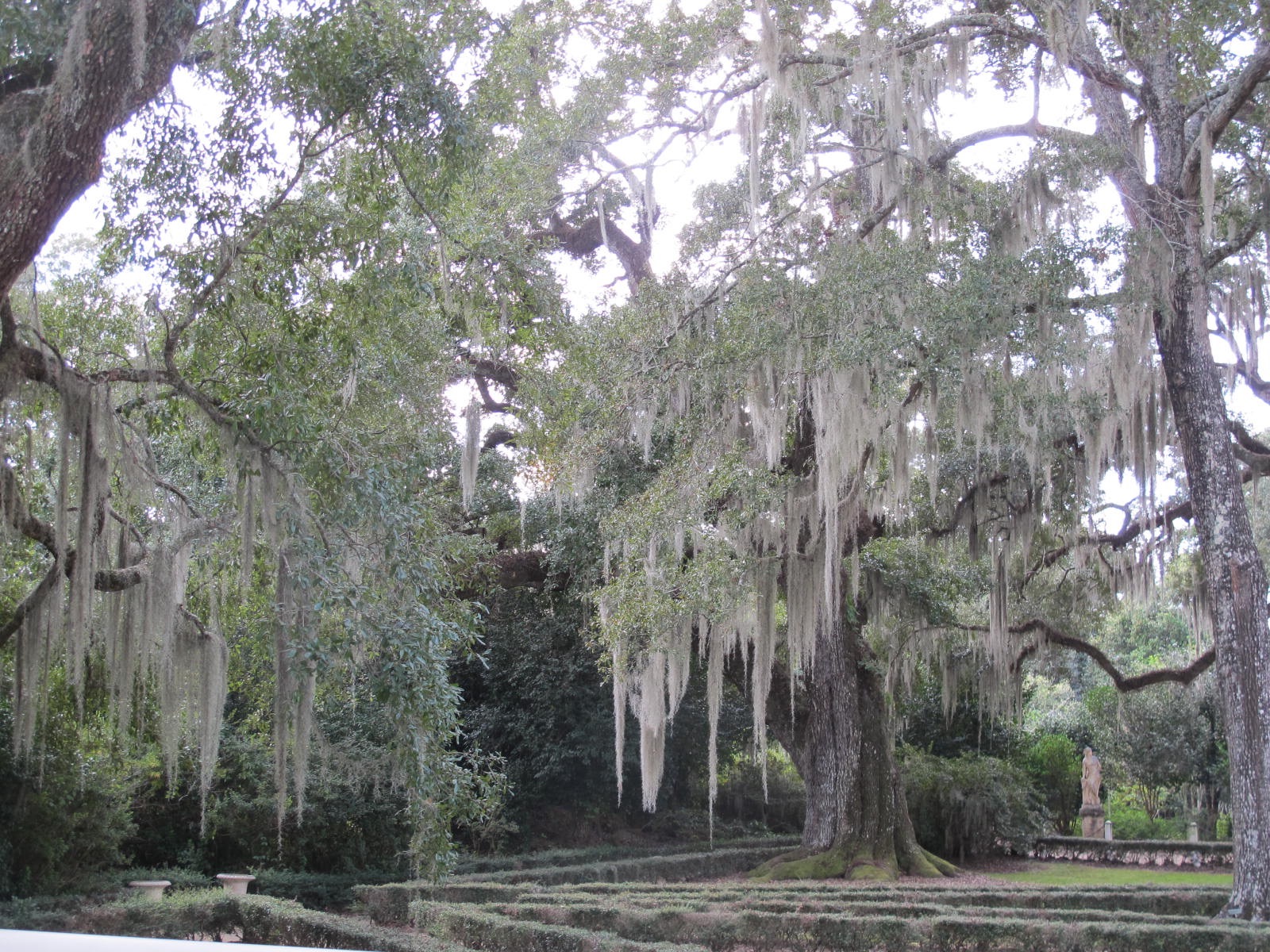
The oldest Live Oak at Rosedown, 260 years old. Live Oaks are native to Louisiana and stay green all year, hence the name Live Oak.

The oldest live oak at Rosedown, 260 years old. Live oaks are native to Louisiana and stay green all year, hence the name live oak.

Spanish moss is rampant in MS and LA and lends a mysterious aura to the trees. The moss was also used to stuff pillows and mattresses but had to be cured first. If not, bugs would get into the beds. Yuck!

Spanish moss is rampant in MS and LA and lends a mysterious aura to the trees. The moss was often used to stuff pillows and mattresses but had to be cured first. If not, bugs would get into the beds. Yuck!

A giant bumblebee in the garden

A giant bumblebee in the garden

You go, Girl!!!

You go, Girl!!!

We really enjoyed Rosedown as we could see the vastness of a plantation as well as the grandeur of an antebellum home. I was very pleased that it’s been well preserved so the people like us can get a taste of antebellum life (at least what the plantation owners’ lives were like).

Jerri and I headed toward Baton Rouge to see the LSU Rural Life Museum that is a recreation of an 1800s plantation with more than 15 relocated or re-created buildings on five acres. The cultures and lifestyles of pre-industrial Louisiana are shown through collections of tools, household utensils, furniture and farming implements. We did get to see some slave quarters as well as an overseer’s cabin that seemed authentic but we were not impressed with the preservation efforts for some of the carriages, furniture and other artifacts in barn-like buildings. There was neither climate control nor apparent effort to preserve the artifacts

. We thought future generations would not be able to enjoy them as they should be able to. (I guess I’ve learned extra awareness about these things since I’ve been volunteering at the Nevada State Museum.)

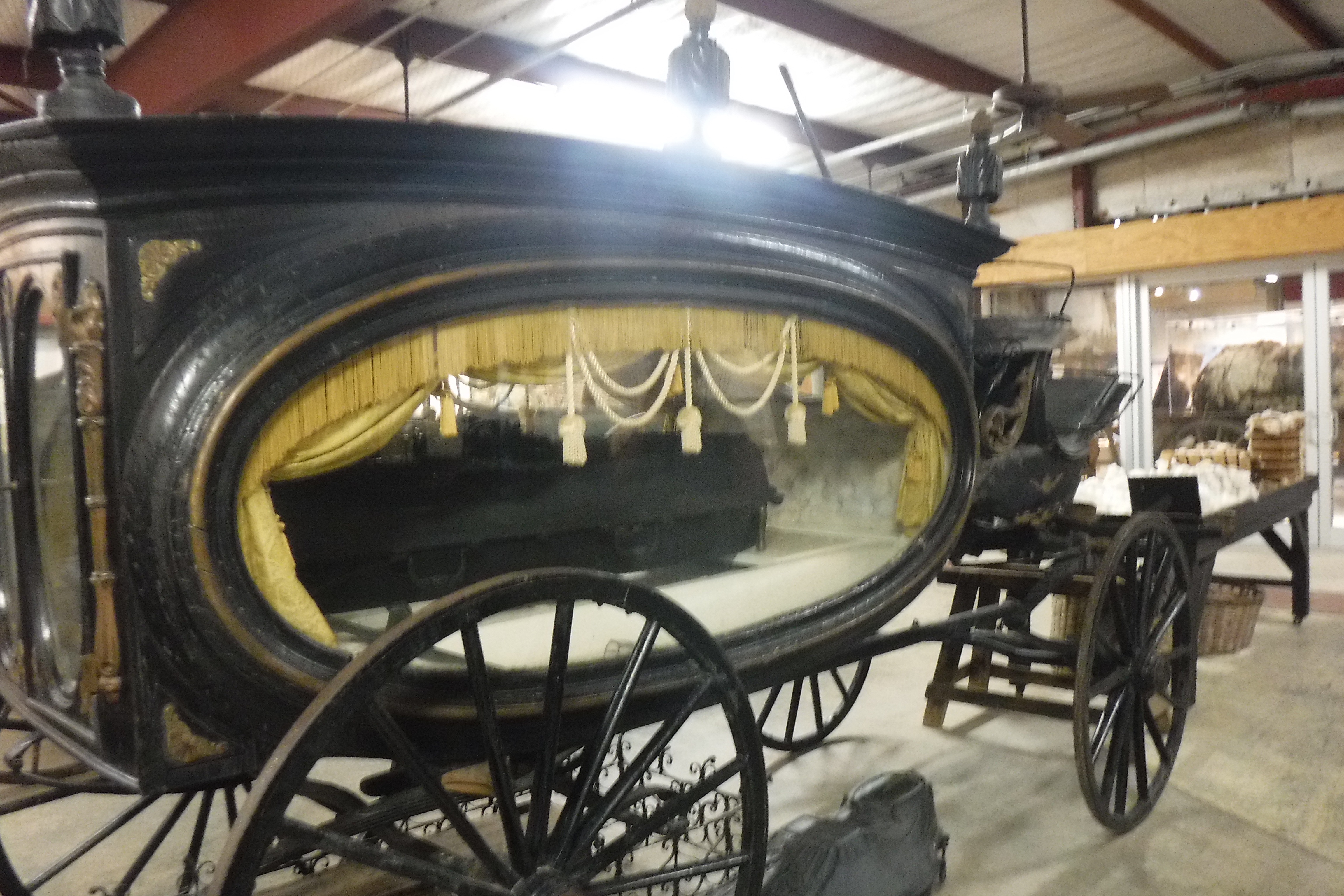
A funeral carriage

A funeral carriage

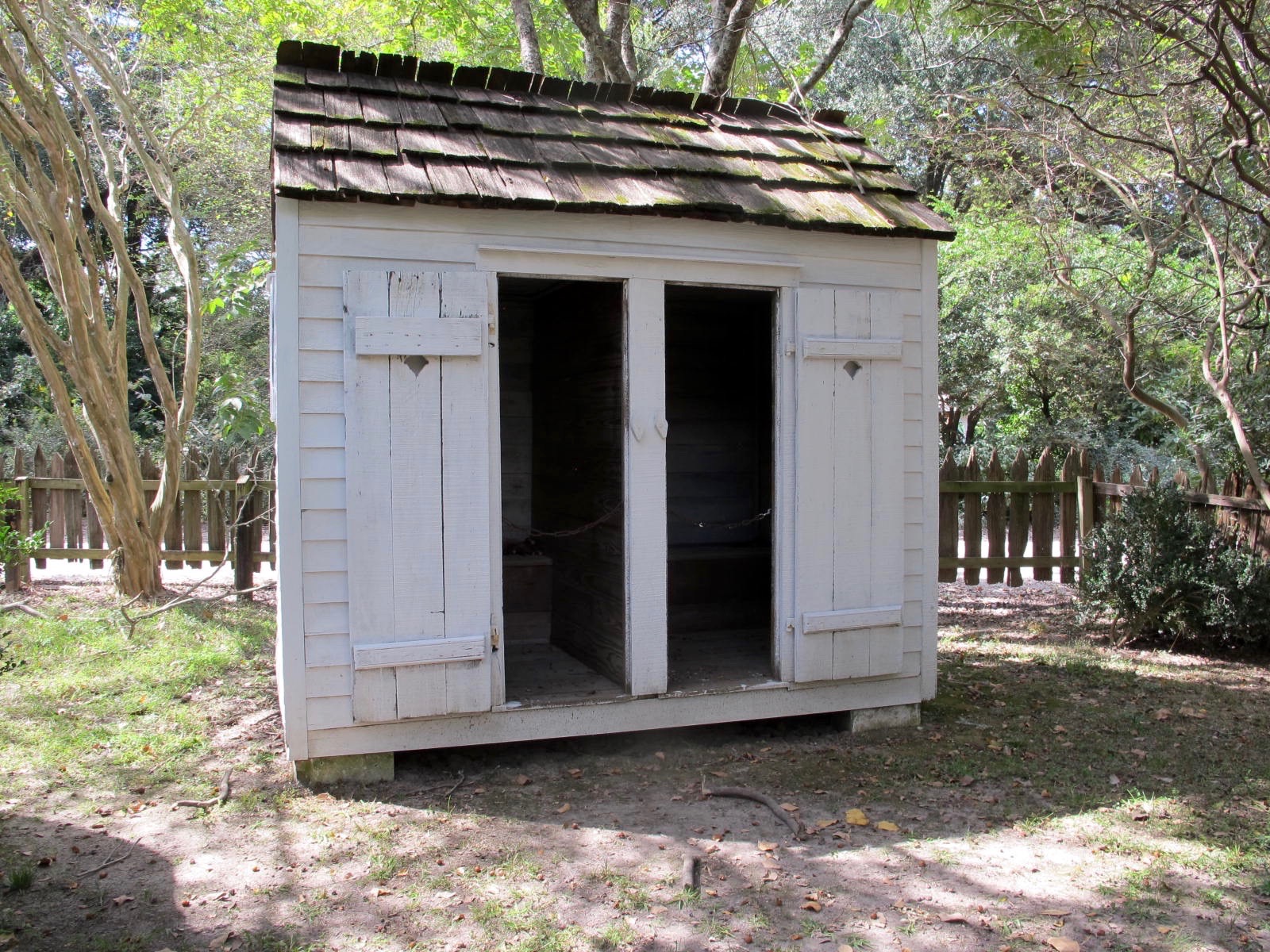
Men's and women's deluxe outhouse

Men’s and women’s deluxe outhouse

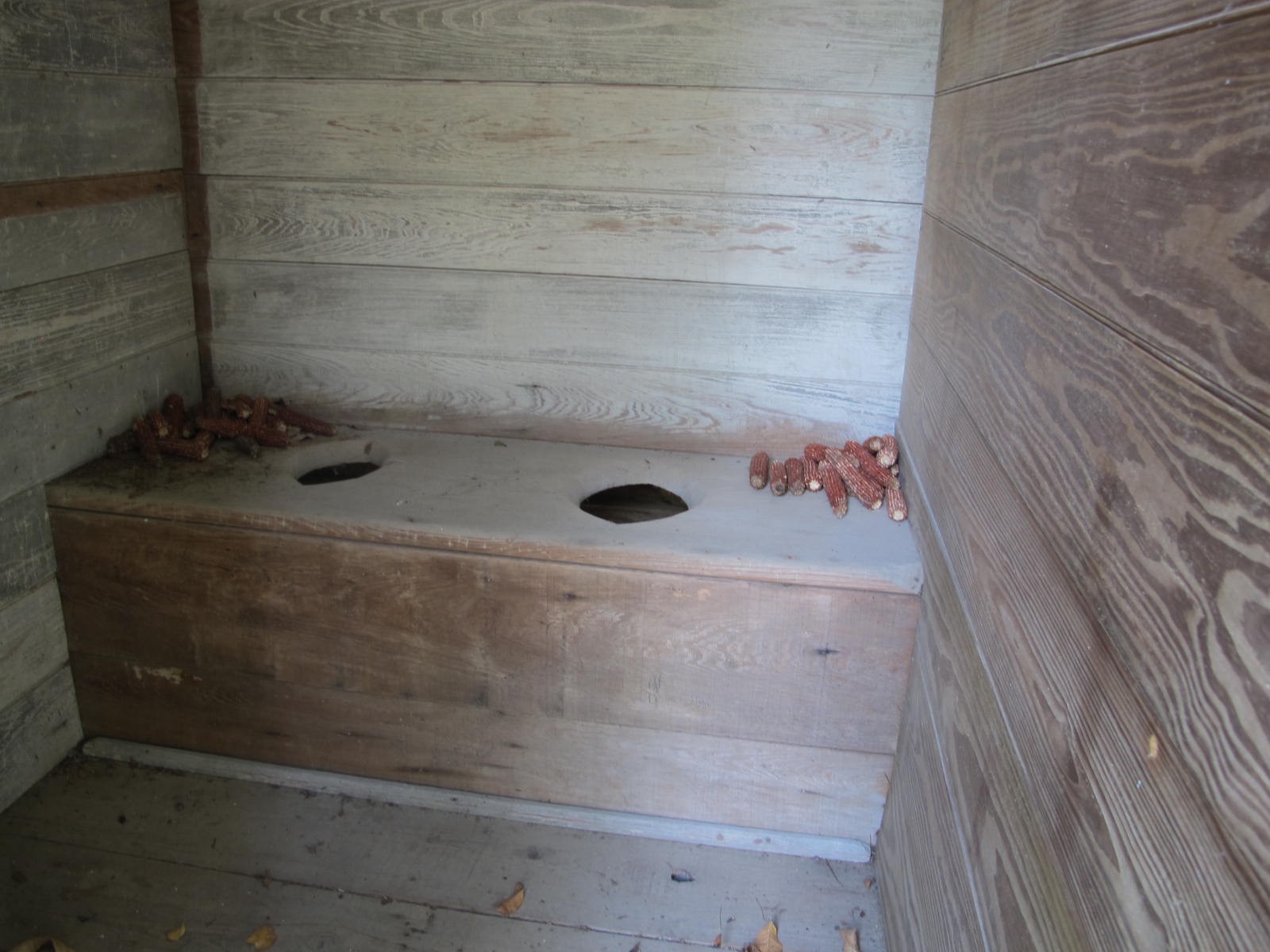
This outhouse comes with its own corn cobs!

This outhouse comes with its own corn cobs!

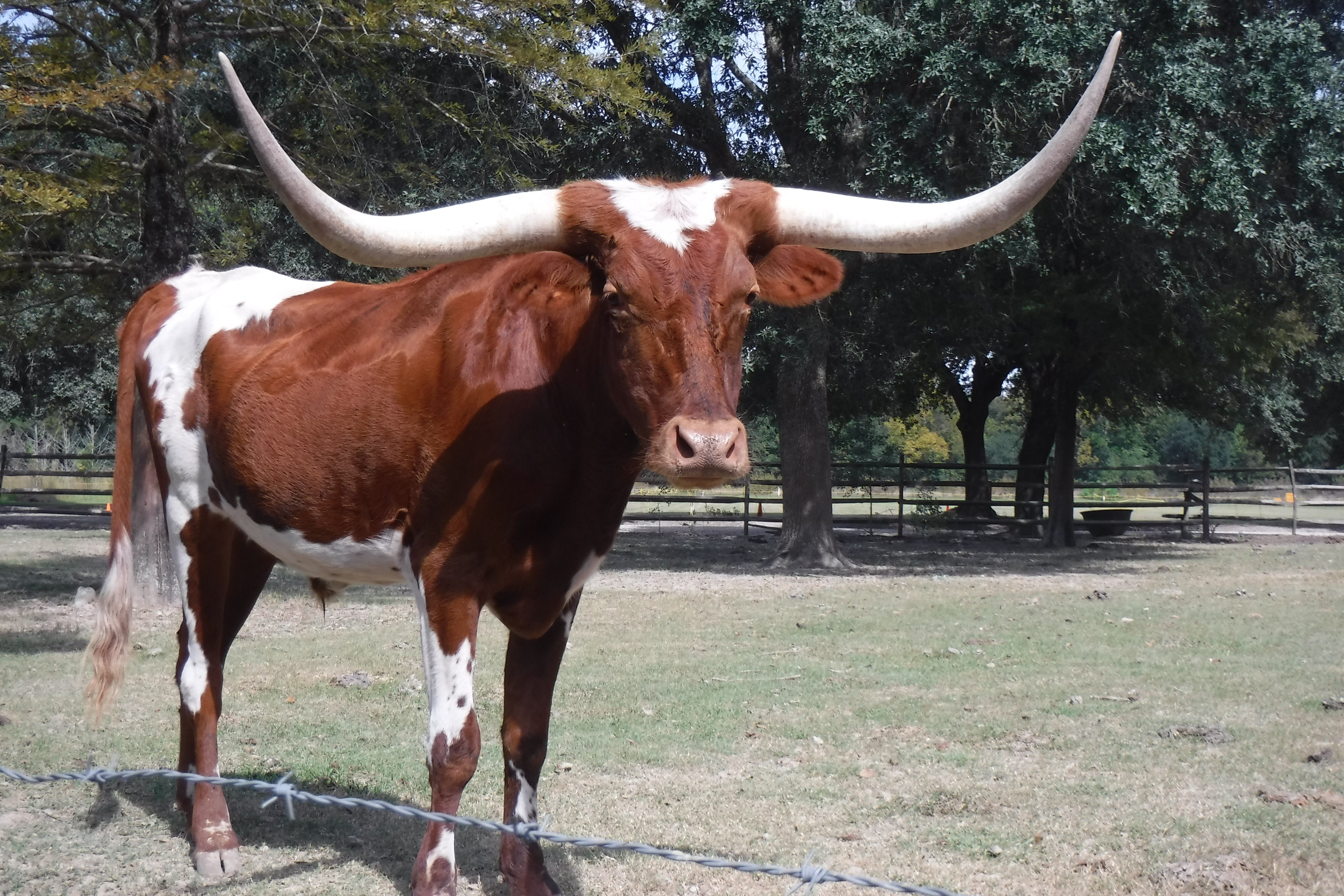
A Louisiana longhorn

A Louisiana longhorn


This has become a very long document and I should have divided it into shorter segments.  But I didn’t, so I am going to close with our visit to the Rural Farm. The next Sister Trip installment will be about our adventure in New Orleans with our nerve wracking journey just trying to get to our hotel.  Until next time…

Orlando with Michael, Floor and Kate October 24 – 28, 2016

13 Nov

October 2016 was the month of three great adventures that were all different, exciting happenings. I’d like to tell you about the third one and then come back to Sister Trip 7.

Michael, one of my Dutch nephews, wrote and asked if I would like to meet him, Floor and Kate while they were on vacation in Orlando, Florida. Wow! How much fun this would be as I hadn’t seen them since 2012 when Michael played in the World Baseball Classic in the Phoenix/Scottsdale, AZ area.  (Please remember to click on the photos you want to enlarge)

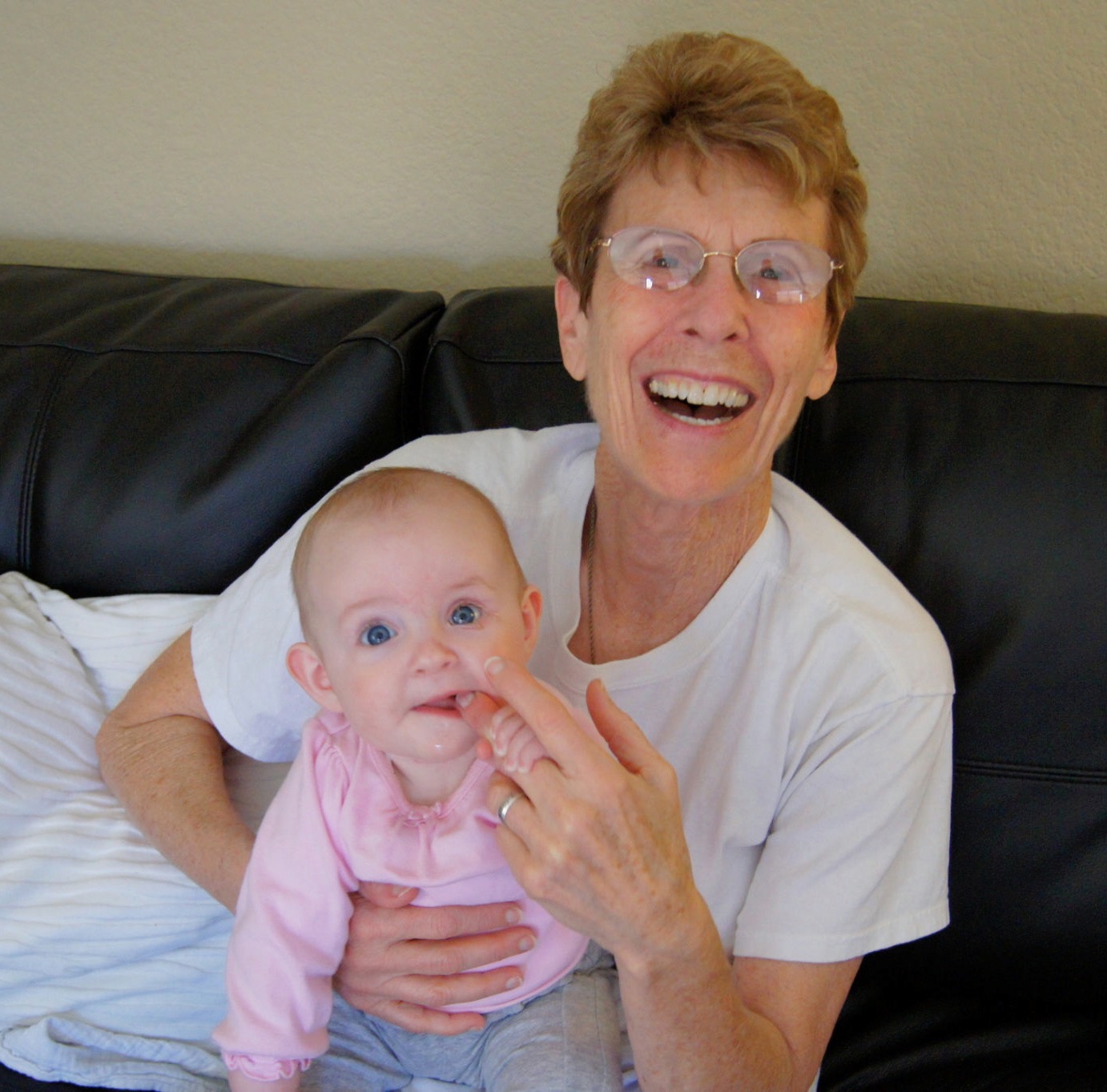
 Kate was about 6 months old and she just liked my finger to gnaw on.

Kate was about 6 months old and she just liked my finger to gnaw on.

Floor and Kate waiting to greet me. I felt just like a celebrity,

Floor and Kate waiting to greet me. I felt just like a celebrity

Our first Orlando dinner together at the Texas Roadhouse.

Our first Orlando dinner together at the Texas Roadhouse.

Michael and Floor had rented a really nice apartment in a resort outside of Orlando. That is where Kate and I became roommates. She was a bit shy at the beginning as she is learning English and I don’t speak much Dutch. Michael and Floor helped us out a bit (especially me) to understand each other. The next morning we created a bond. She was playing with her iPad being very quiet when I woke up. So I began to play with mine and soon she and I were playing some games together. Of course she knew more than me and had to explain what was going on. (It’s hard to be technically outdone by a 4 year old, but that’s life these days) Kate was speaking Dutch and I in English and somehow we understood each other. She told her dad that I knew how to speak Dutch and she was happy. I wish I had pictures of these episodes as I cherished those moments with her.

The next day found us heading to the Magic Kingdom (aka Disneyland for those of us who have been only to the Anaheim site). I was amazed at the land Disney owns in Orlando (43 square miles and employs 78,000 people). The parking lots are huge and are not multi-story. Obviously, they have a lot of land on which to expand. We had to ride a tram just to get to the ferry or monorail to get into the park.

We had tickets to attend Mickey’s Not-So-Scary Halloween Party, a special event from 4 PM to midnight. Kate had a very becoming witch’s costume that she wore throughout the party.

We had tickets to attend Mickey’s Not-So-Scary Halloween Party, a special event from 4 PM to midnight. Kate had a very becoming witch’s costume that she wore throughout the party.

Upon entry, everyone was given a trick or treat bag and a handful of treats. Later, we lined up at various locations to get a ton of treats. We just walked by and they literally gave us handfuls of good stuff! Kate had never experienced this before but she caught on quickly.

Our first ride was The Barnstormer, a just right size (for me) roller coaster that Kate loved. We went on that twice in a row.

Our first ride was The Barnstormer, a just right size (for me) roller coaster that Kate loved. We went on that twice in a row.

It turns out that Kate LOVES roller coasters or rides that take big drops…Splash Mountain for one. The kid goes nuts over them. They had gone to the Magic Kingdom before I got there and with our trip, Kate rode Splash Mountain 6 times and was begging for more! Amazing!!!

Taking a spin in the Mad Hatter's tea cups

Taking a spin in the Mad Hatter’s tea cups

We had a terrific time at the Magic Kingdom riding all our favorite rides, eating chili dogs, watching the Halloween Parade and the fireworks. Kate only saw maybe a few of them and then conked out. That was a long day for her, but she can surely hang in there.

We took it easy the next day and went to the pool to play. Kate loves to be in the water and shoot her water pistol at us. I loved it too.

We took it easy the next day and went to the pool to play. Kate loves to be in the water and shoot her water pistol at us. I loved it too.

Later that afternoon that we went to play miniature golf at the Pirate’s Cove. It was a fun course as you can see by our picture. This was Kate’s first time and she did pretty well. It was threatening rain during the round and opened up just as we got back into the car. Nice timing, eh?

Later that afternoon that we went to play miniature golf at the Pirate’s Cove. It was a fun course as you can see by our picture. This was Kate’s first time and she did pretty well. It was threatening rain during the round and opened up just as we got back into the car. Nice timing, eh?

The next day, we drove about an hour and a half to the Blue Spring State Park that borders the St. Johns River, Florida’s longest river (310 miles). This river is one of the few U.S. rivers that flows north. We took a two-hour tour on the St. Johns and saw many birds, turtles, some alligators and some interesting flora.  Thanks to Floor for these St. Johns River photos.  My camera was on the fritz because I had dropped it that day.

Checking out the river that is a very dark tea color due to tannic acids from certain trees and other foliage

Checking out the river that is a very dark tea color due to tannic acids from certain trees and other foliage

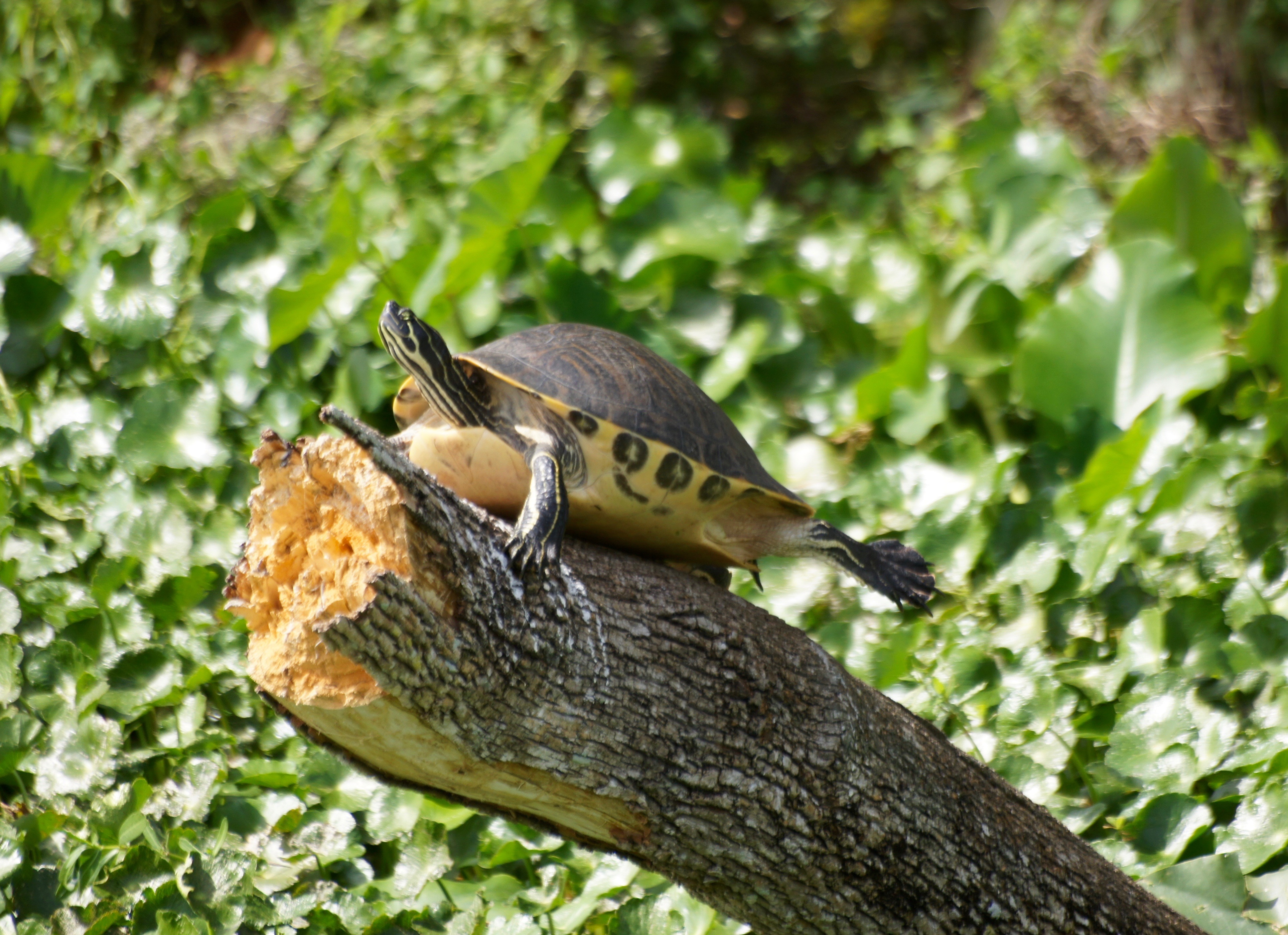
A little turtle catching some rays

A little turtle catching some rays

A black ibis? Boats need to go slowly in the manatee zone becausee they like to sort of float near the surface and are easily hurt by propellers.

A black ibis? Boats need to go slowly in the manatee zone becausee they like to sort of float near the surface and are easily hurt by propellers.

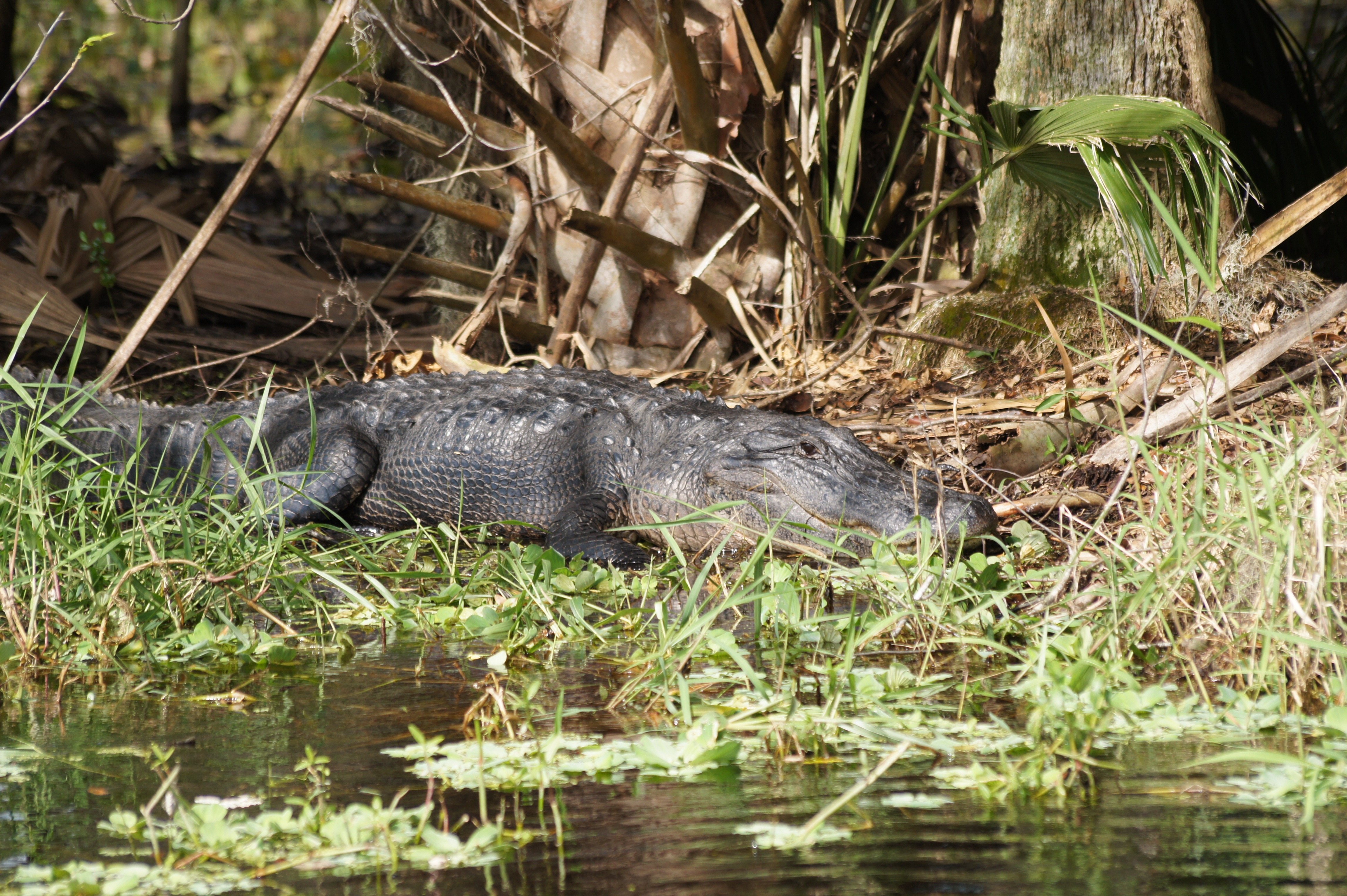
A big 'gator resting by the side of the river

A big ‘gator resting by the side of the river

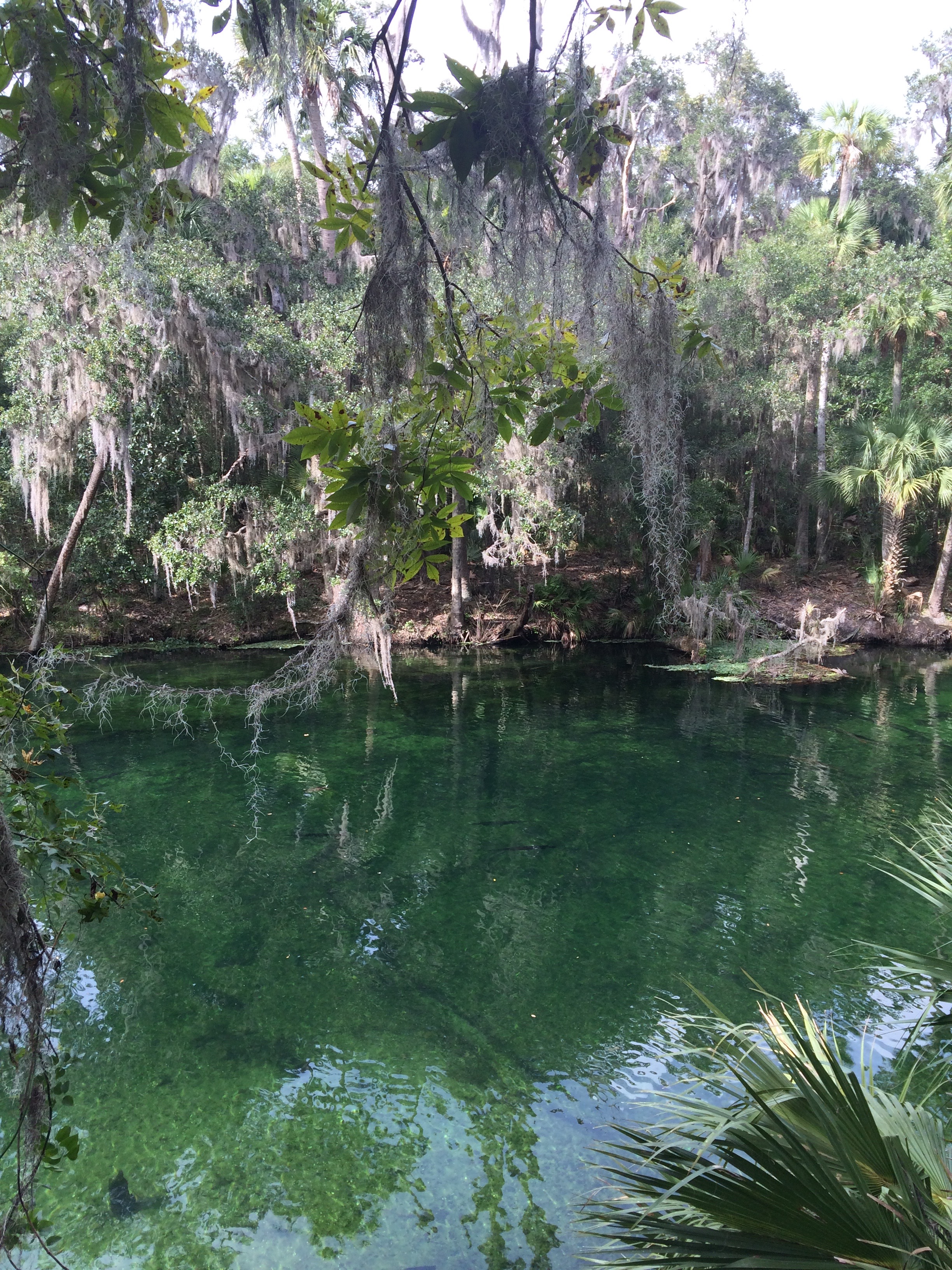
Blue Spring

One of the cool things about Blue Spring is that manatees go to spend the winter there. More than 100 go there to escape the colder waters of the St. Johns for the safety and comfort of the 72-degree spring. The spring was very clear and we could see some very large fish where the manatee would have been had we not been too early to see them.

One thing I have not mentioned is the multitude of ponds/lakes in the Orlando area. It’s no wonder there are many bugs and mosquitoes in the area. All porches are screened in for that reason. Just outside our apartment was a small lake and signs were posted to be alert for ‘gators. Needless to say, people were swimming only in the pool.  Only brave birds walked in the water.

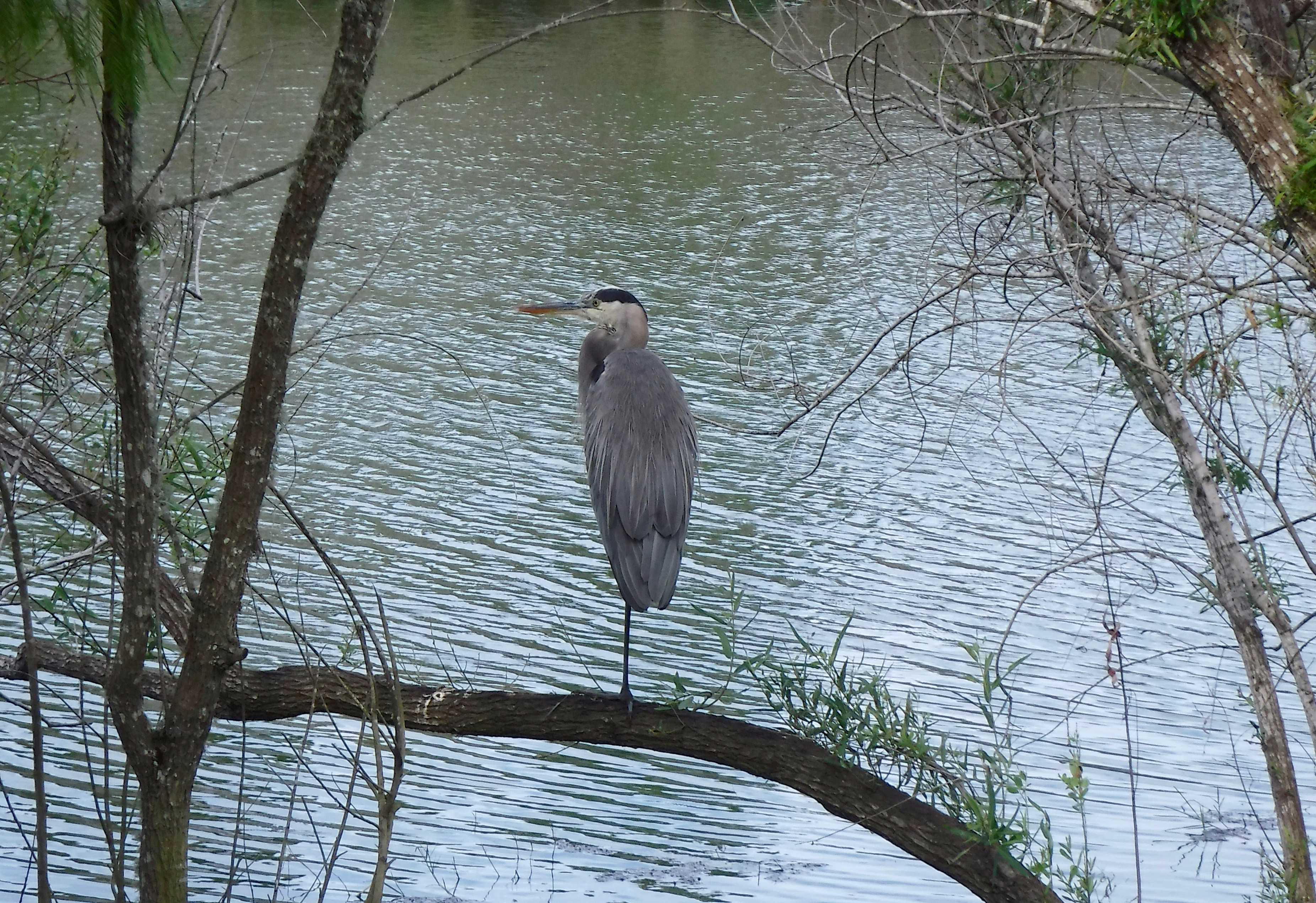
Great blue heron

A great blue heron watching for fish

Ibis foraging for food near our apartment

Ibis foraging for food near our apartment

All too soon, the day came to depart to our respective homes. Such a bummer because we were having a really good time enjoying the Florida sunshine. Since our planes didn’t leave until evening, we decided to go to the ESPN Wide World of Sports Complex. This was really fun because Michael had played baseball there in 2006 during the inaugural World Baseball Classic. It’s another huge Disney-owned place with many fields and buildings that accommodate many, many teams and many sports. While we were touring the site, a 400-team softball tournament and an athletic conference cross-country championship were being held.espnbestBob and I went to see Michael play in 2006 and royally enjoyed ourselves. It was our first time in Orlando. As I remember, it was fairly easy to find our way (no GPS for us), but it surely has grown and changed in 10 years.

Disney has so much influence in the area…as well can be expected. But I thought it was amazing to see some power lines in the shape of mouse ears!

Disney has so much influence in the area…as can well be expected. But I thought it was amazing to see some power lines in the shape of mouse ears!

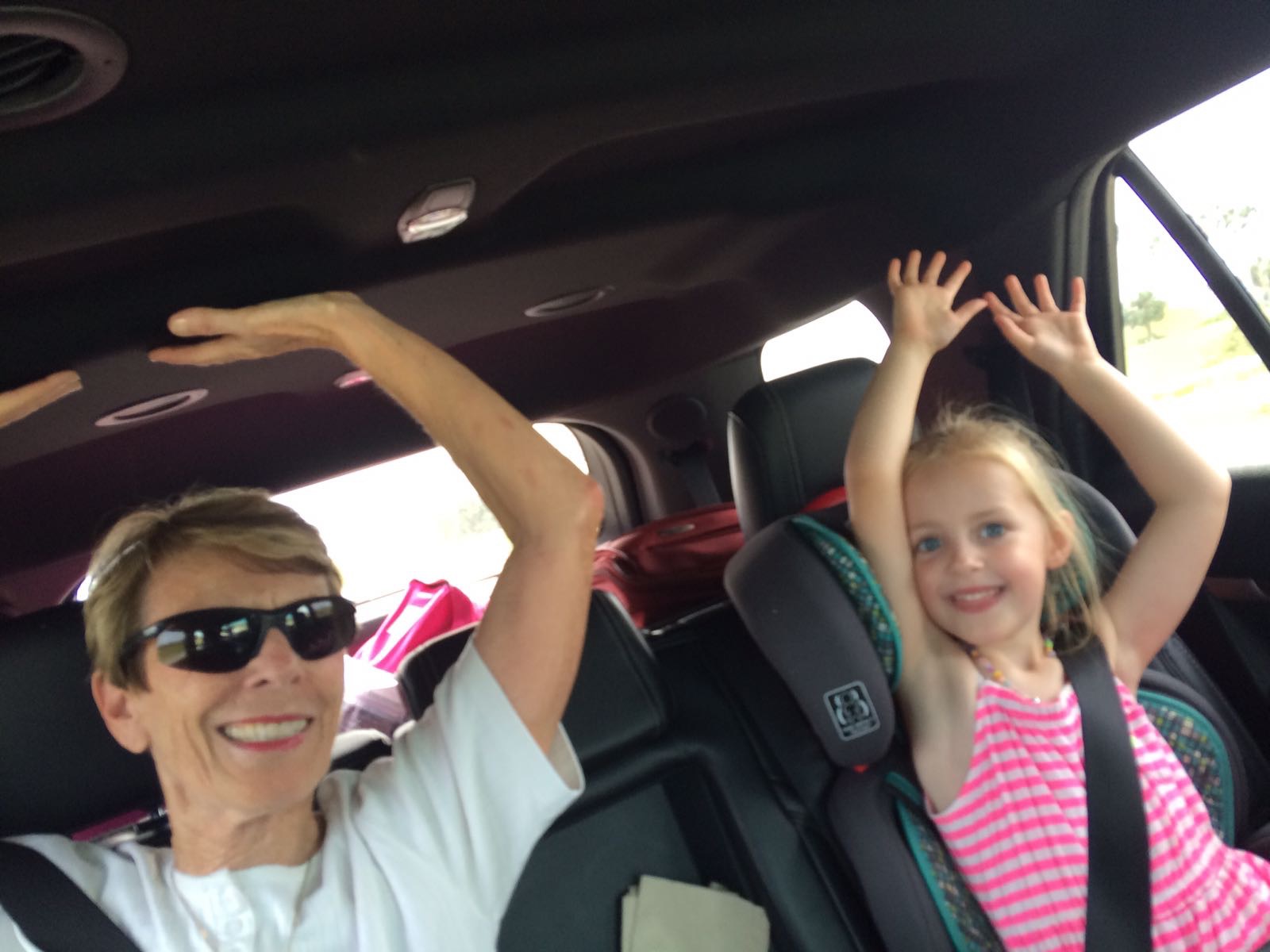
Kate loved to raise her arms on roller coasters, so we did it going on an on-ramp. What a kick!

Kate loved to raise her arms on roller coasters, so we did it going on an on-ramp. What a kick!

I feel particularly blessed to have good relations with all my nieces and nephews and so enjoy being together with them. For that reason, it was so awesome to be able to reconnect with Michael and Floor and get to know Kate a lot better. I hope to be able to continue this kind of relationship with all the nieces and nephews for many years to come.

Michael, Floor, Kate and I bid our adieus at the Orlando Airport and soon we each left the Disney magic and flew home to reality, i.e., regular routines

Michael, Floor, Kate and I bid our adieus at the Orlando Airport and soon we each left the Disney magic and flew home to reality, i.e., regular routines

For me, I finally got home to my own bed about 1 AM Minden time and was up again early to go to help with the celebration of Nevada Day (our admission to the USA that is celebrated in style in northern Nevada). It is a huge celebration with a three to four hour parade, contests, free admission to the museum, open house at the Governor’s Mansion, a carnival and many other events. For many, it is a time to come home to reconnect with old friends and family.  It might be hokey to some, but most of us think it’s a ton of fun and look forward to Nevada Day weekend.

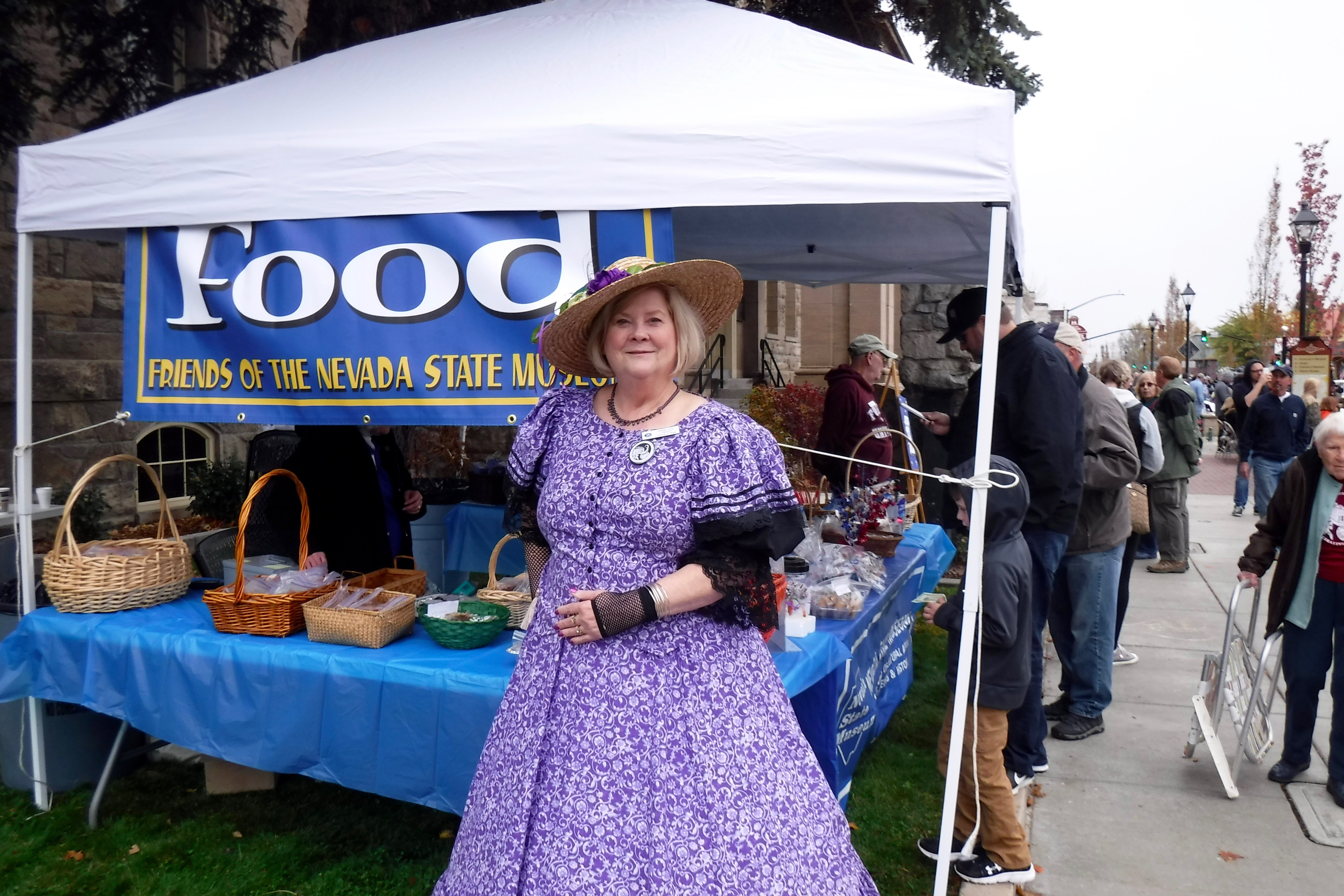
The Friends of the Nevada State Museum (of which I am chair) holds its annual bake sale during the parade to raise money for the museum.

The Friends of the Nevada State Museum holds its annual bake sale during the parade to raise money for the museum.

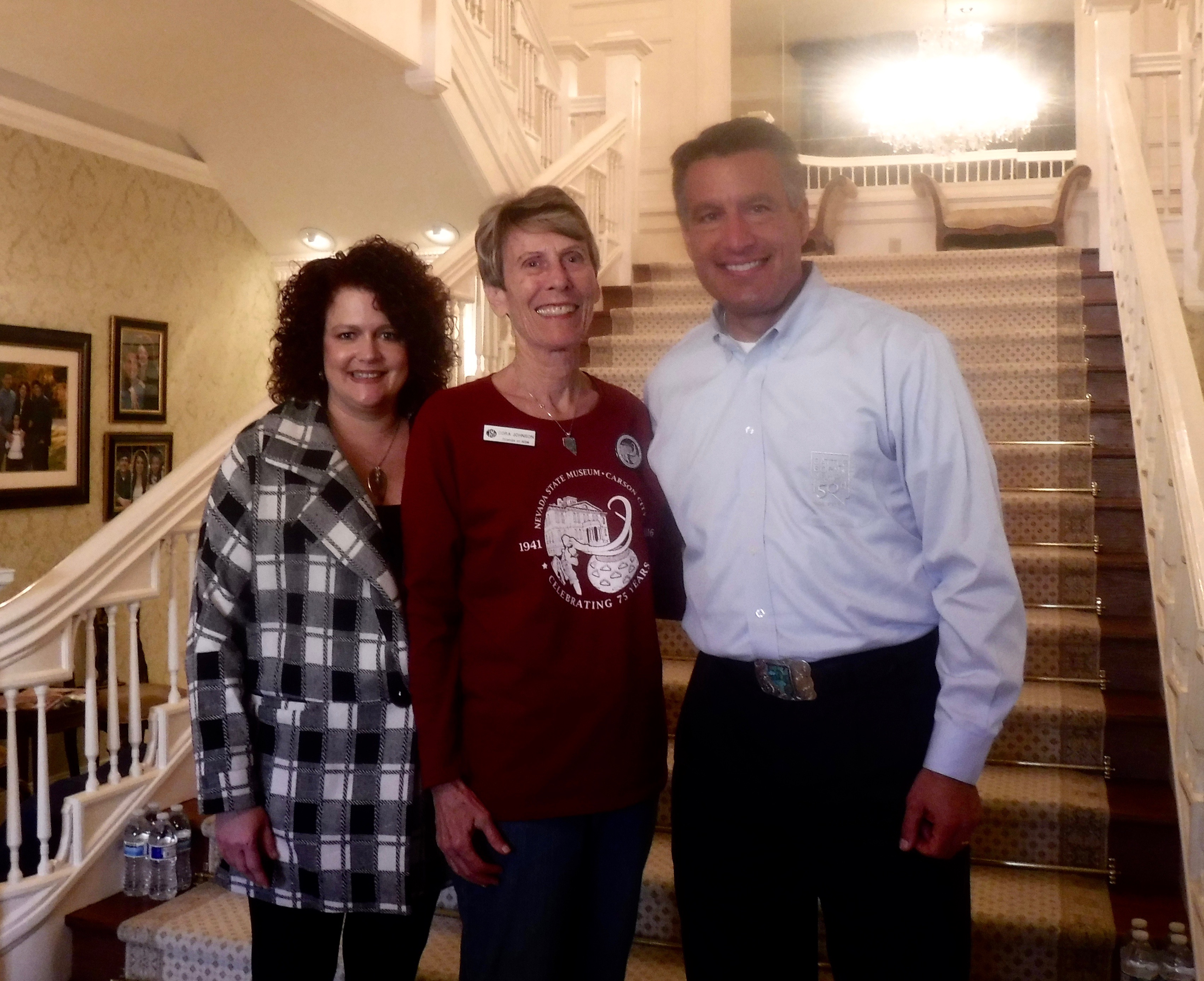
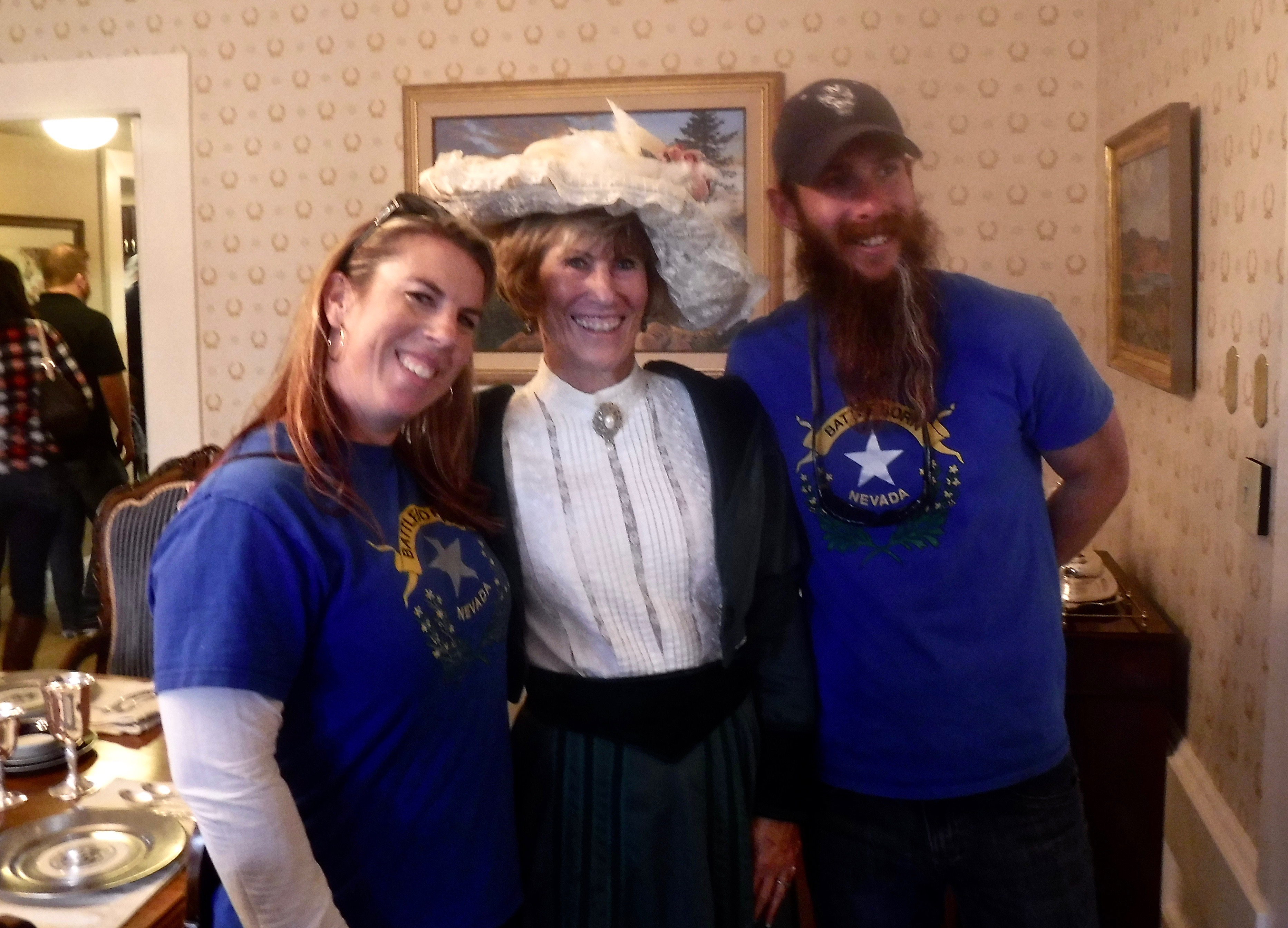
After the bake sale, I made my way over to the Governor’s Mansion where Jerri and several other ladies dressed in vintage costumes and told people about each room in the mansion. Hundreds of people attended this open house, met the governor and his wife and partook of treats in the mansion back yard. I might note that all these people had their picture taken with Governor Sandoval and his wife.

Nevada Day with the Guv

Nevada Day with the Guv

Jolee, Darcy (in front), Mrs. Sandoval, Governor Sandoval, Scott and Jason. Scott had just won a blue ribbon in the Nevada Day beard contest. The gray streak is natural!

Jolee, Darcy (in front), Mrs. Sandoval, Governor Sandoval, Scott and Jason. Scott had just won a blue ribbon in the Nevada Day beard contest.

Jolee, Jerri and Scott in the mansion formal dining room

Jolee, Jerri and Scott in the mansion formal dining room

Riding the purple dino to another beer. Never a dull moment with these two nephews!

Ride that purple dino! Never a dull moment with these two nephews!

I loved every minute of this adventure but I was glad to get home and sleep in my own bed.

A 50th What? September 30 – October 2, 2016

7 Nov

Way back last year, noises were being made that my graduating class from Chapman College (now Chapman University) was going to celebrate a 50-year reunion. What? How can that be when I’m not even 50 years old yet? At least that’s how I feel most days. Fifty years is a long time and the thought of the reunion caused me to do some reminiscing, retrospection and just plain thinking about where did all those years go and how did the time pass so quickly.

I dallied with the idea of not attending because of cost, reverting back to my somewhat shy days of never being good enough and not measuring up to my buddies, and if the celebration would be worth all the hassle. BUT, curiosity about classmates and the ever changing campus prevailed and my long time buddy, Connie Gibson Raub, convinced me that it would be FUN, that we could room together, and we could attend the events together. So it is that we made arrangements and we went to celebrate.

The trip was quick and I apologize to my Orange County friends for not stopping by to see you and catch up. My duties at the Nevada State Museum and other obligations prevented me from spending more time down south. I will try to do better next time I’m down south.

I’ve only been in Minden for 3 ½ years but it seems that many things have changed or become worse (i.e. traffic) since I’ve been in Orange County. Or maybe I’ve become very used to almost nil traffic here in northern Nevada. Chapman has certainly grown and changed and it was fun to see the new buildings and tour many of them.

The neighbors from the old ‘hood knew I was coming down and arranged a very nice dinner party for me and we all had a good time talking about the changes in the neighborhood and finding out what each was doing. Thank you, Cerritos folks!

Don’t forget to double click the images if you would like to enlarge them

Capturing the Disneyland Magic

Connie had some old Disneyland passes that are true relics and we found some magic at the Magic Kingdom. DLand is a great place to feel young at heart.

We spent the next three days participating in the many events that had been planned for alumni and the community. It WAS a lot of fun.

We spent the next three days participating in the many events that had been planned for alumni and the community. It WAS a lot of fun.

Hangin' with the newly inaugurated Chapman president Danielle Struppa

Hangin’ with the newly inaugurated Chapman president Danielle Struppa

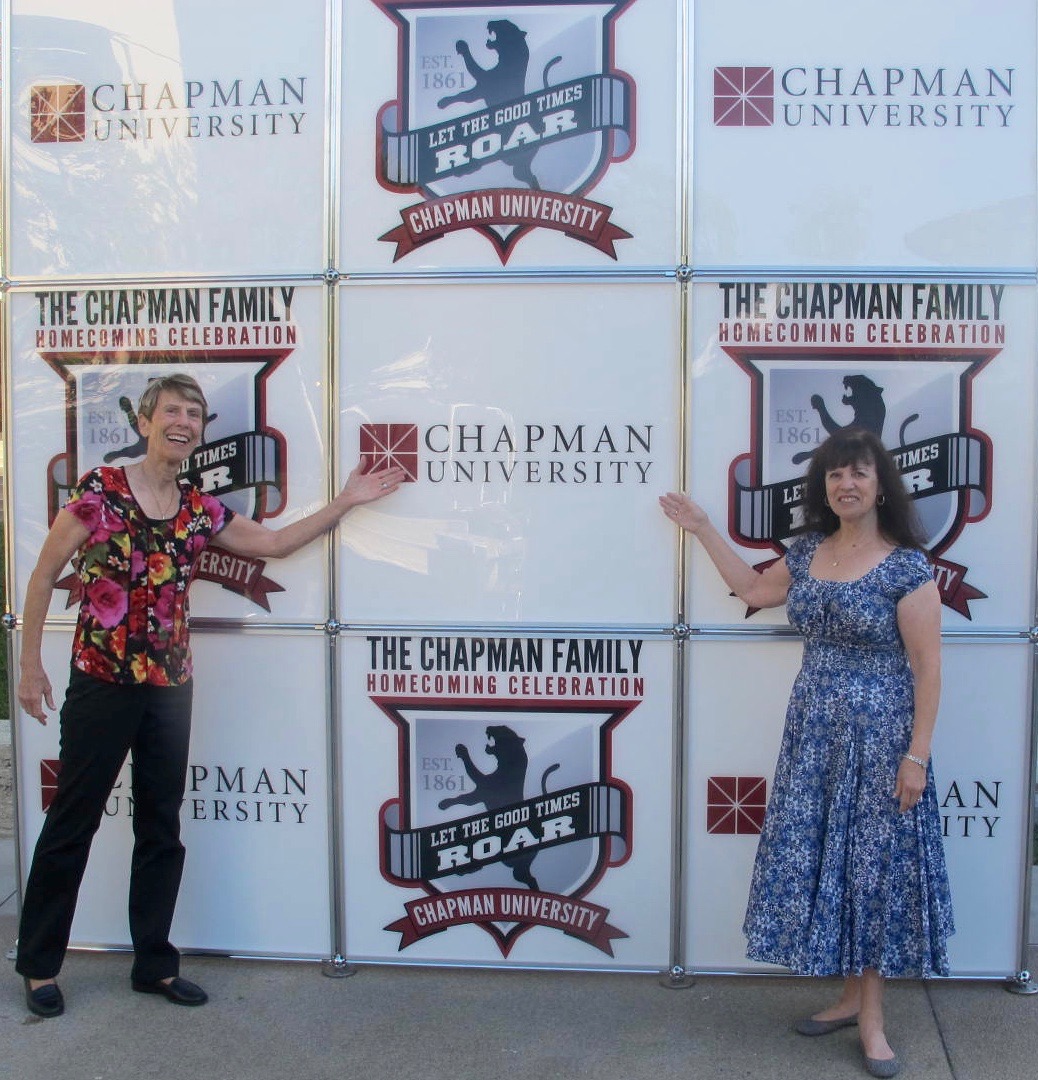
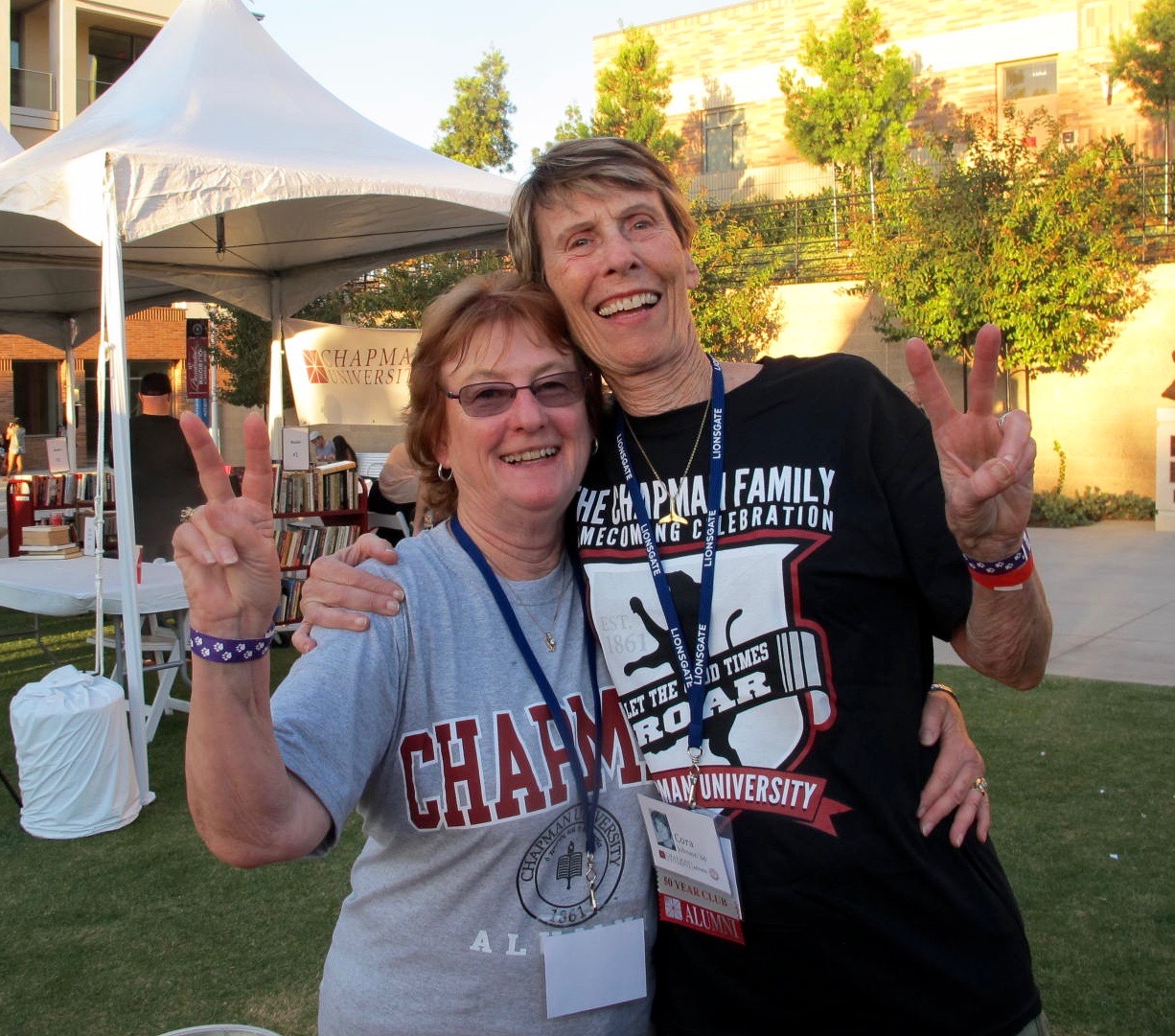
The Class of ’66 joining the 50 Year Club. Sadly, not many attended.

The Class of ’66 joining the 50 Year Club. Sadly, not many attended.

Judy Rostagno Boroskin was one of my roomies during our undergraduate work. We were at the chili cookoff prior to the football game that night. This was new for us since Chapman didn’t field a team when we were in school. Judy and I were on the Chapman basketball team together

Judy Rostagno Boroskin was one of my roomies during our undergraduate work. We were at the chili cookoff prior to the football game that night. This was new for us since Chapman didn’t field a team when we were in school. Judy and I were on the Chapman basketball team together

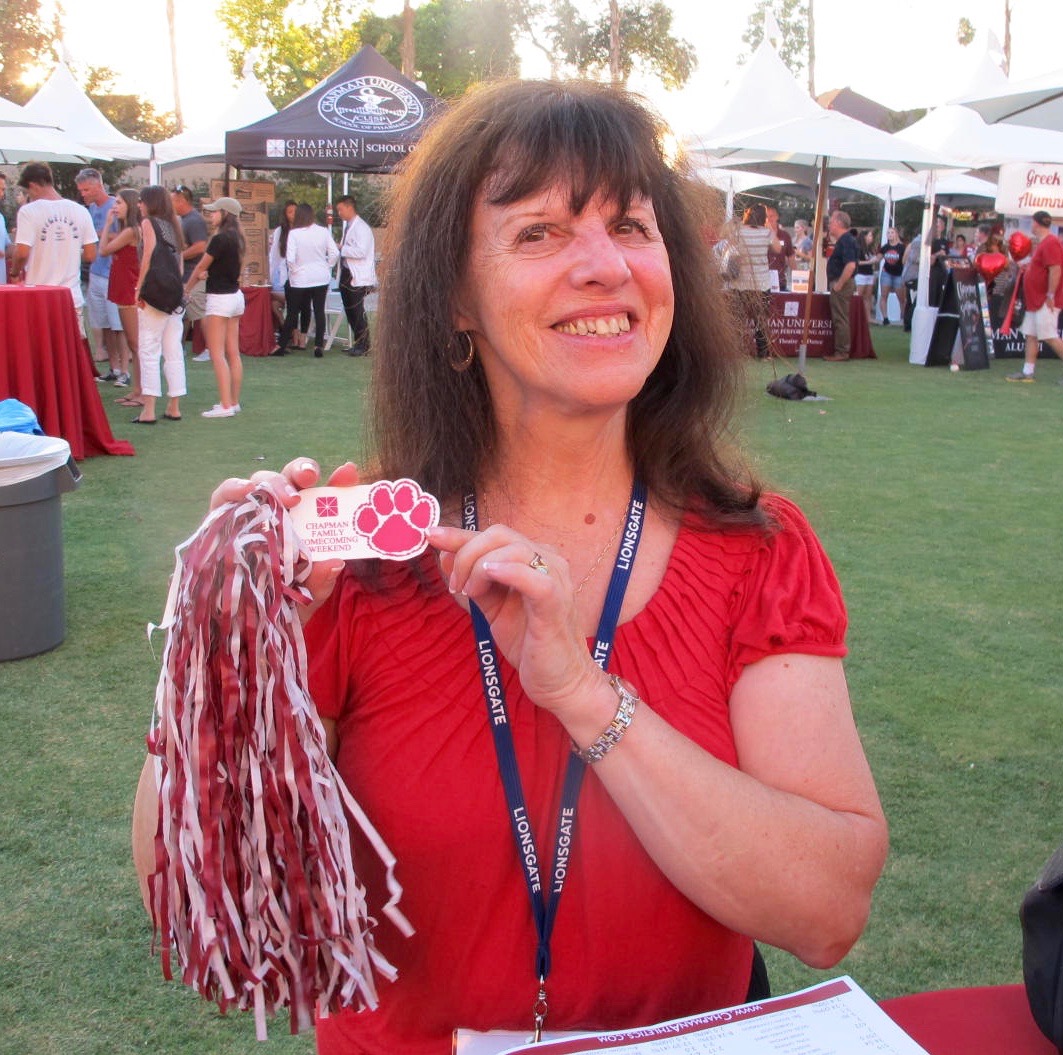
Connie is showing off her school spirit.

Connie is showing off her school spirit.

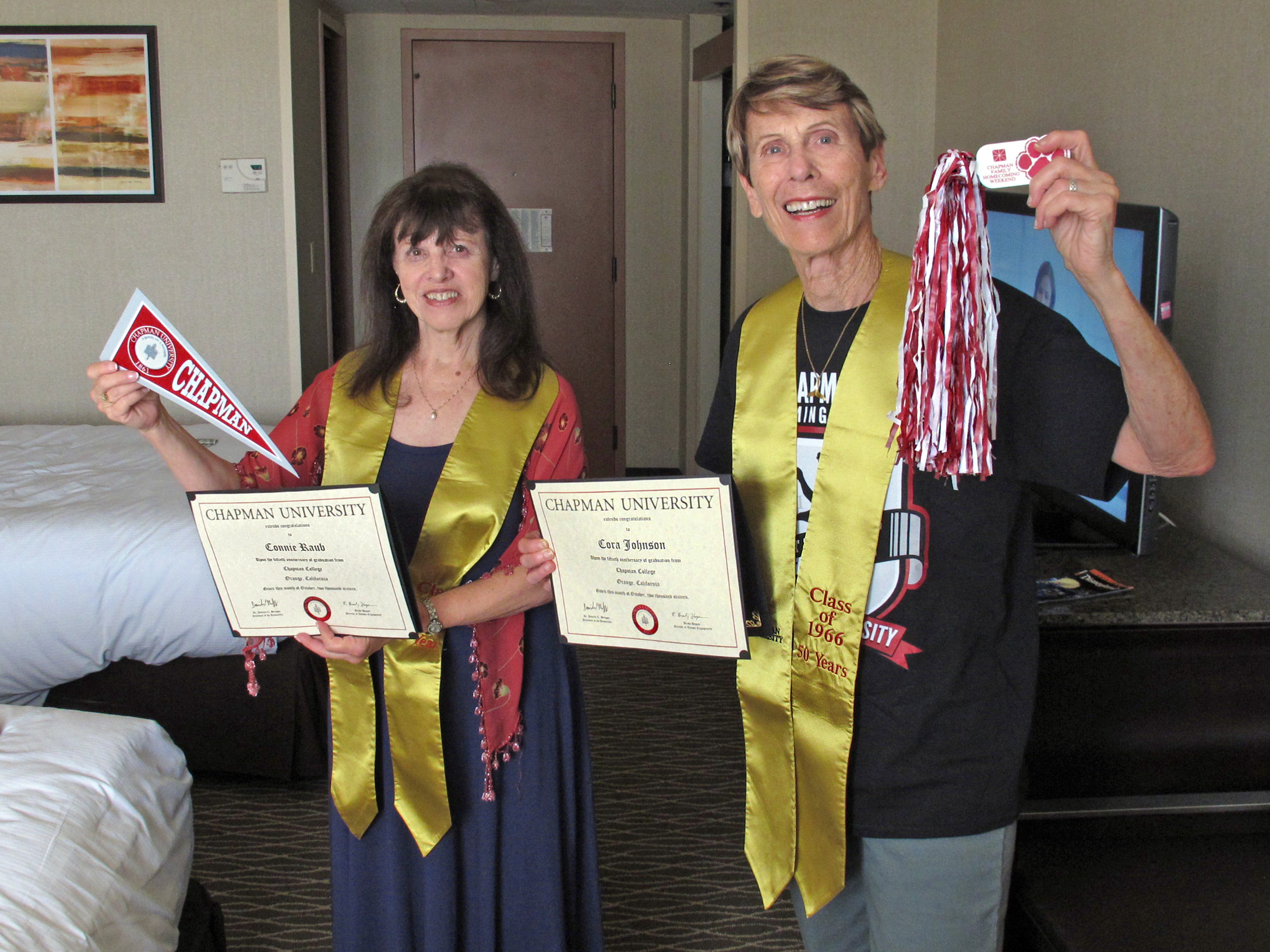
 Our regalia

Our regalia

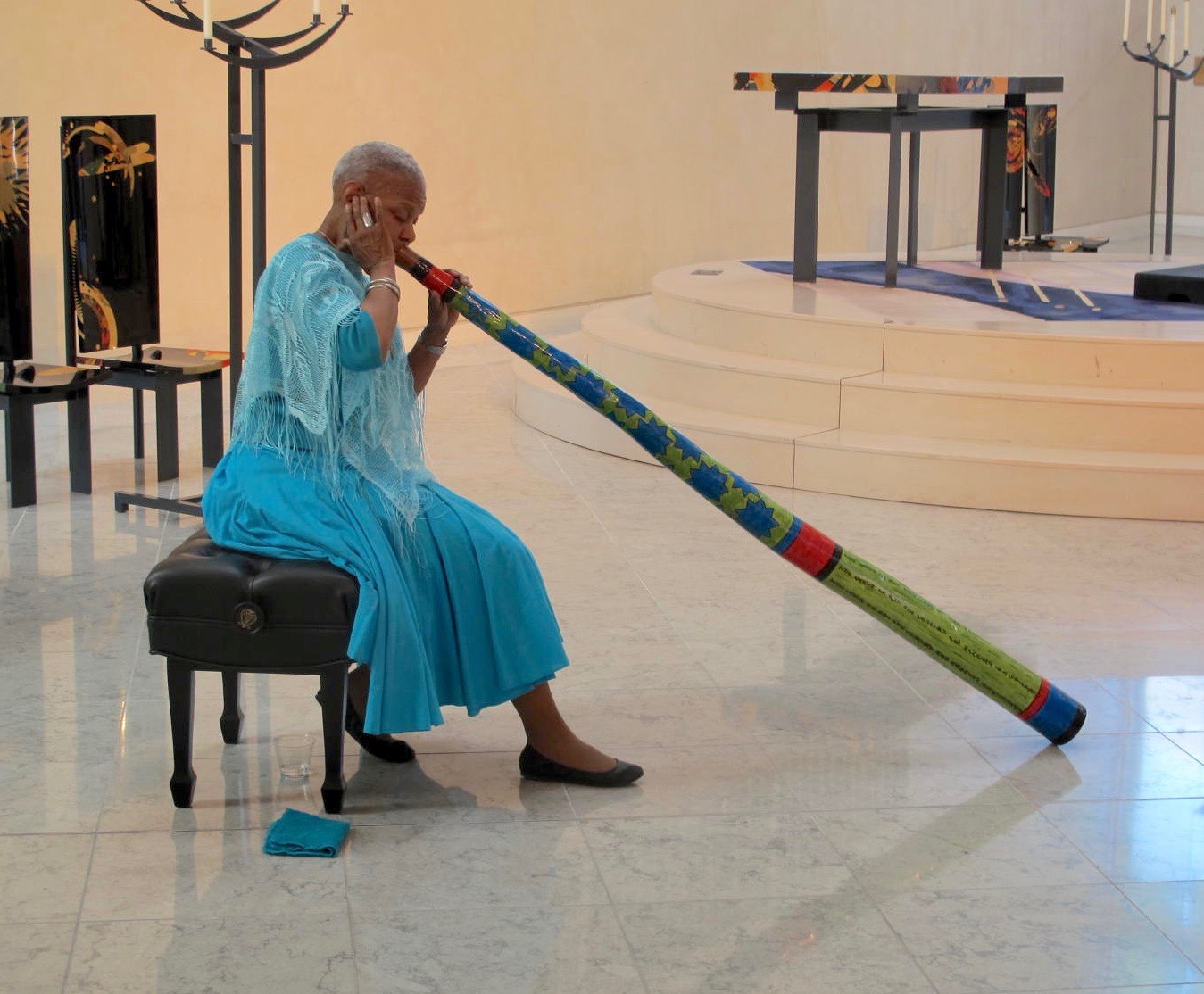
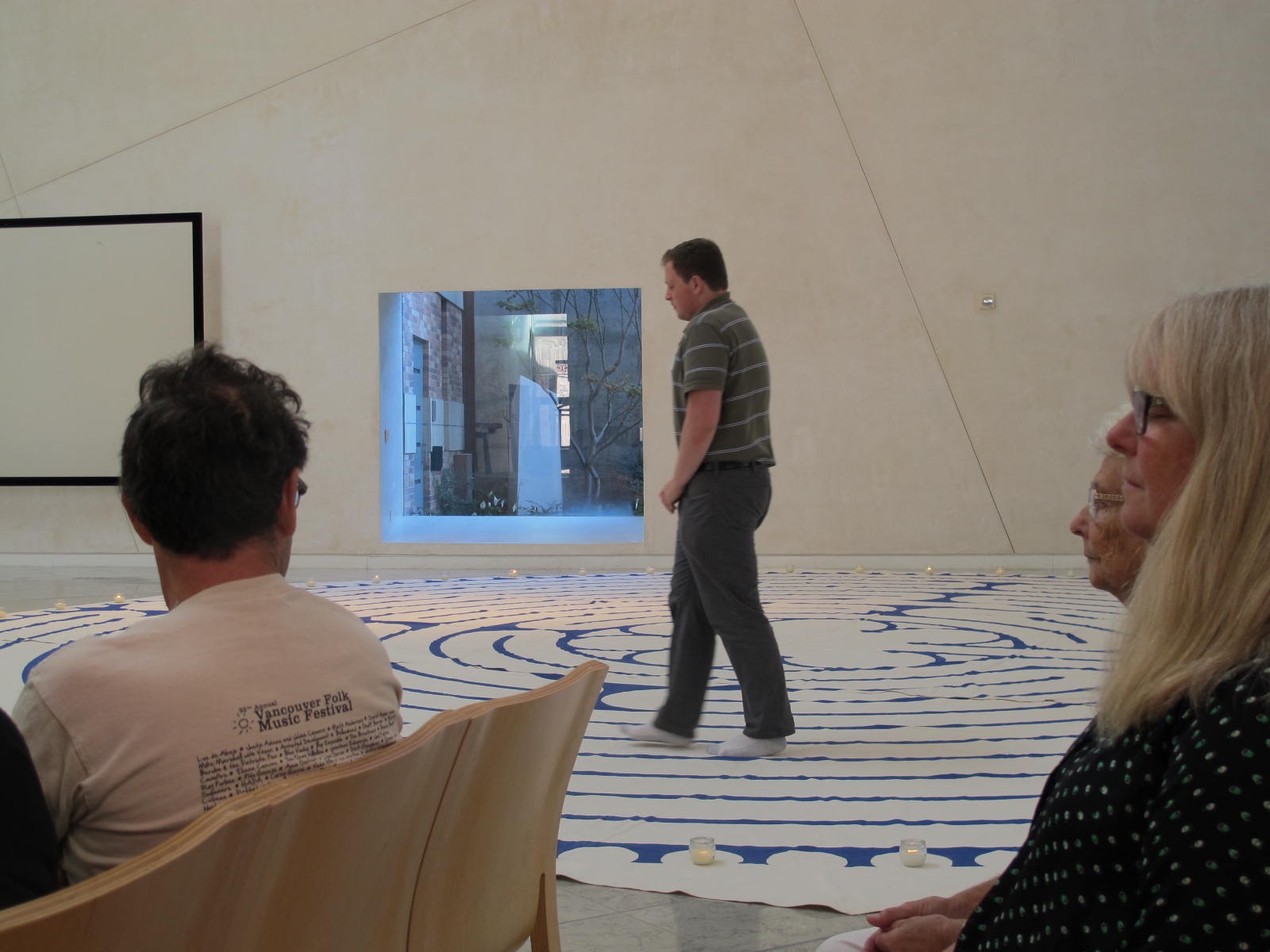
Connie and I attended an interfaith service and had the privilege to hear Emma play her didgeridoo. I had never heard one played before and I found it to be melodious and very relaxing. She played while those who chose to do so, walked in a meditative labyrinth.

Connie and I attended an interfaith service and had the privilege to hear Emma play her didgeridoo. I had never heard one played before and I found it to be melodious and very relaxing. She played while those who chose to do so, walked in a meditative labyrinth.

img_3511

It’s supposed to be very relaxing but I didn’t find it so because I was too concerned about running into people on the narrow passageways. Given more practice I might find it very spiritual.

The last thing we did at Homecoming was to attend a Big Band Bubbly Brunch. It was fun and tasty with a nice buffet. The Chapman Swing Band played while some Chapman dancers strutted their stuff.

The last thing we did at Homecoming was to attend a Big Band Bubbly Brunch. It was fun and tasty with a nice buffet. The Chapman Swing Band played while some Chapman dancers strutted their stuff.

There were many more weekend activities in which we participated and I thought we were done when we went to the brunch. But there was one more big surprise! As we walked into our hotel lobby, we were met by our good friend and buddy, Dick Schmidt. He took us to a lovely dinner and we ended the evening watching the Disneyland fireworks. What a treat and awesome weekend!

There were many more weekend activities in which we participated and I thought we were done when we went to the brunch. But there was one more big surprise! As we walked into our hotel lobby, we were met by our good friend and buddy, Dick Schmidt. He took us to a lovely dinner and we ended the evening watching the Disneyland fireworks. What a treat and awesome weekend!


Galápagos Adventure #5 – Española and San Cristobal – August 15 -16, 2016

1 Sep
Please click the photos you wish to enlarge

Please click the photos you wish to enlarge

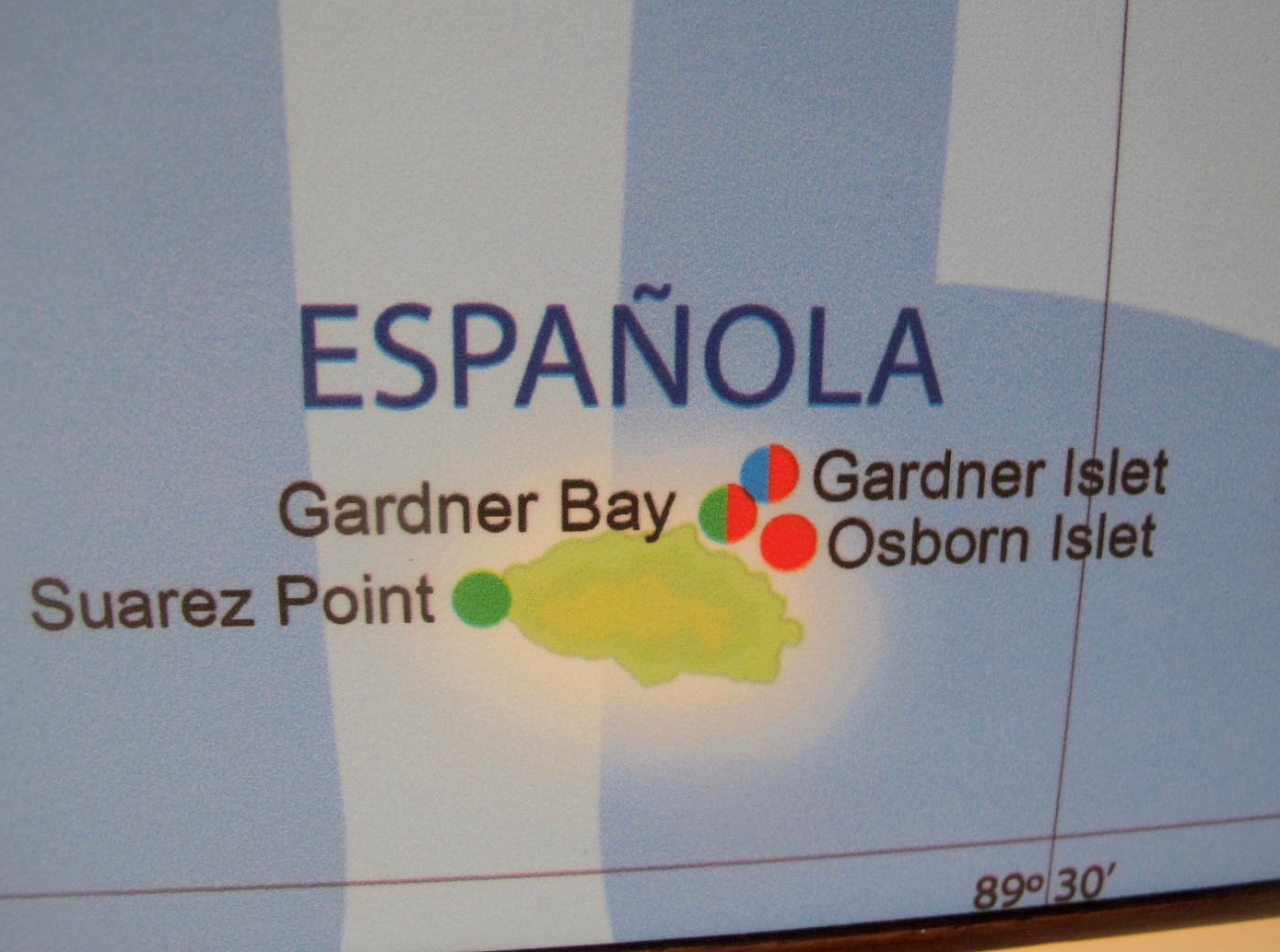
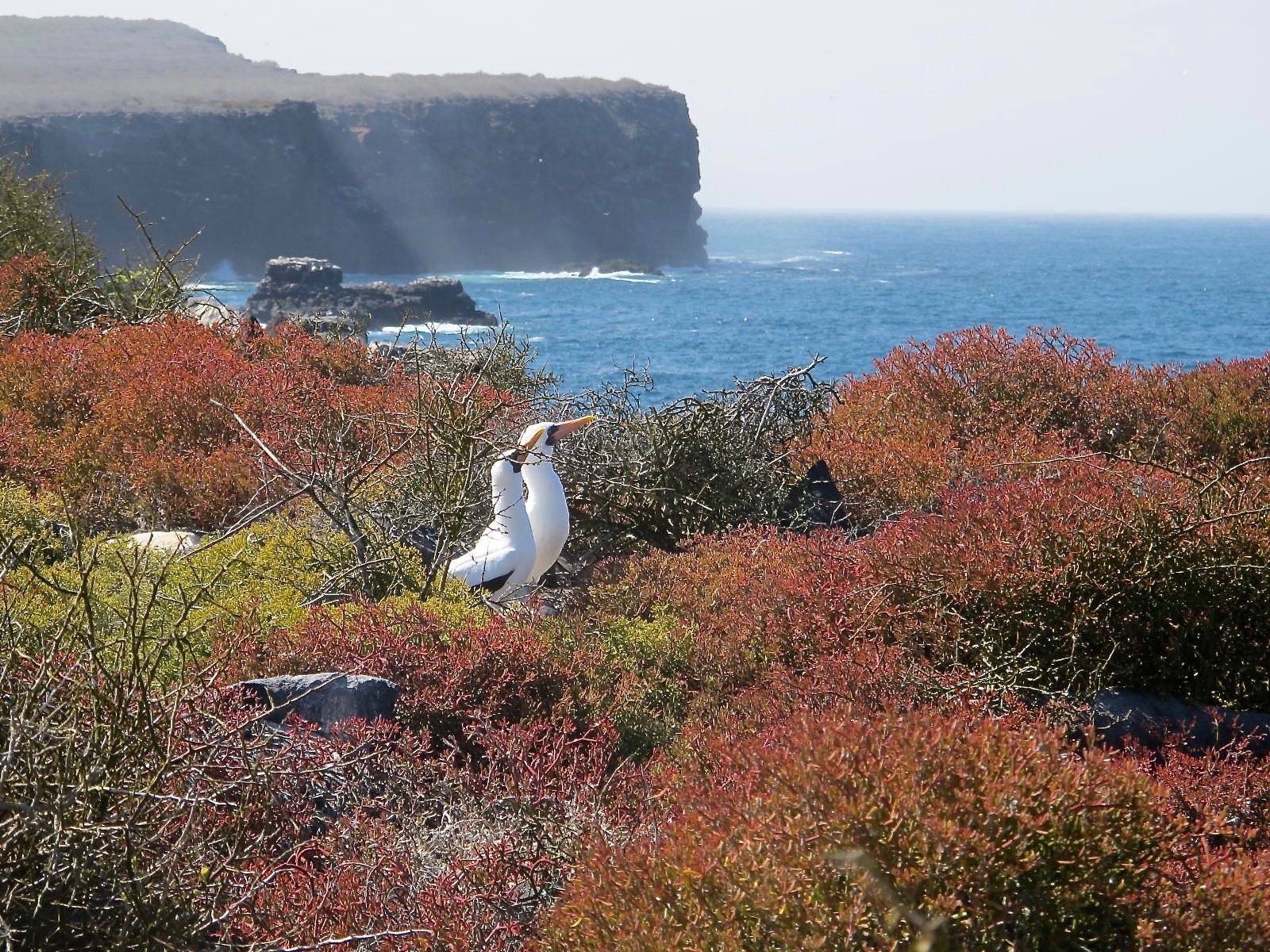
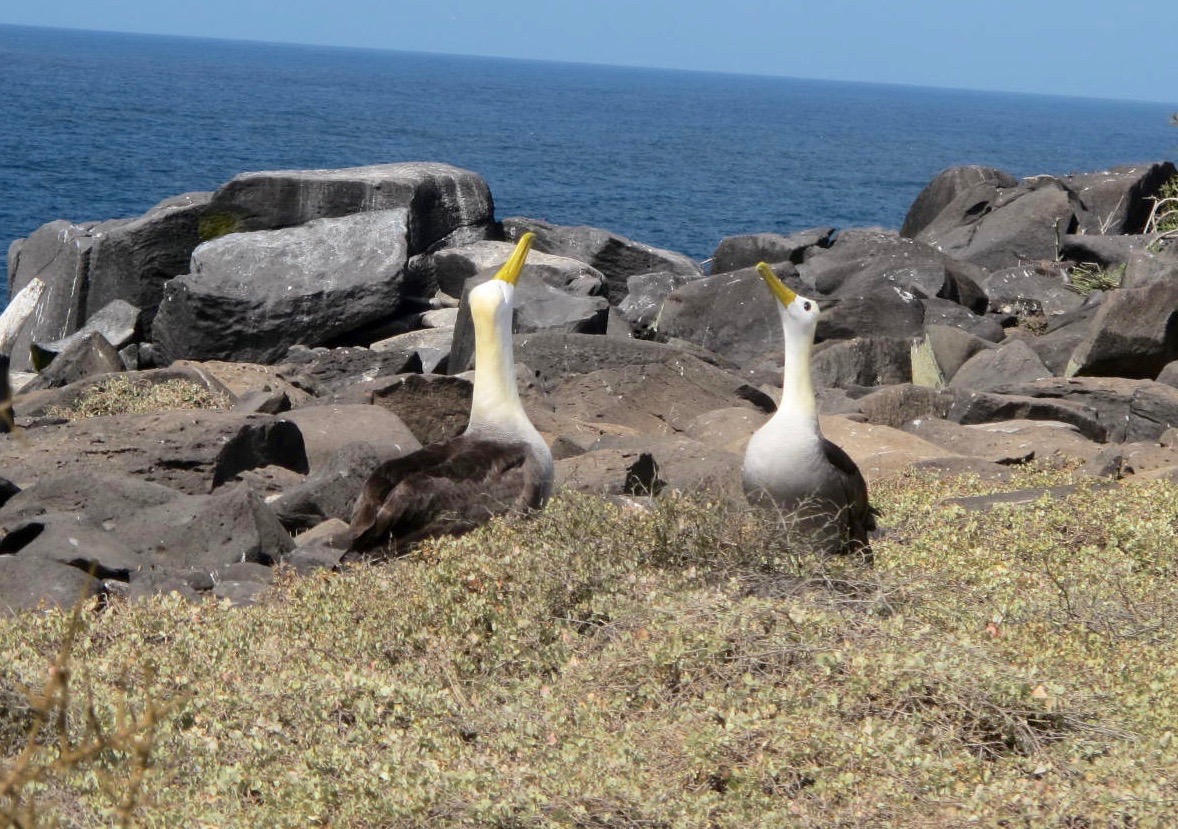
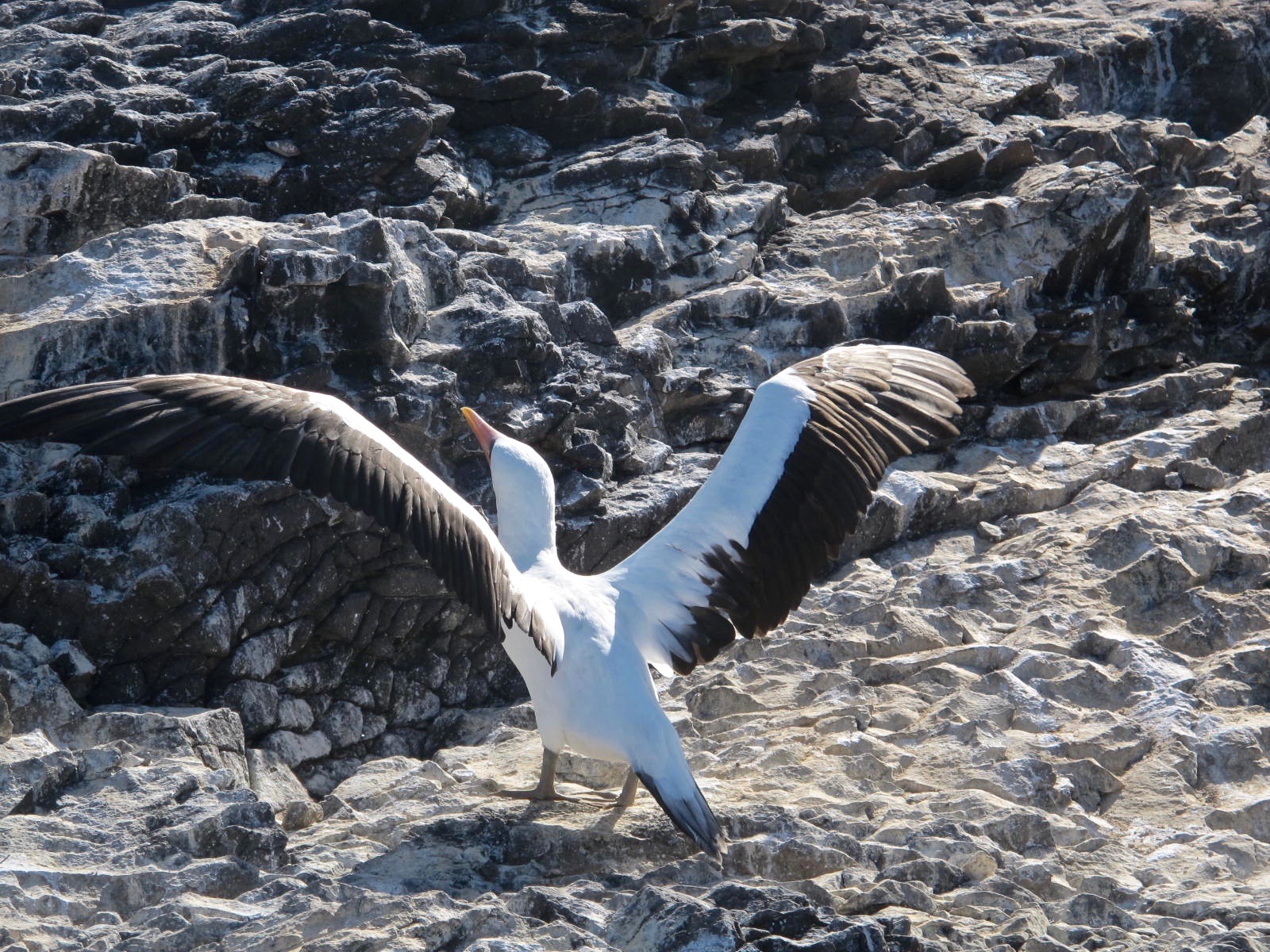
 Española is the southern-most island in the Galápagos and is the only breeding site in the world for the Waved Albatross.

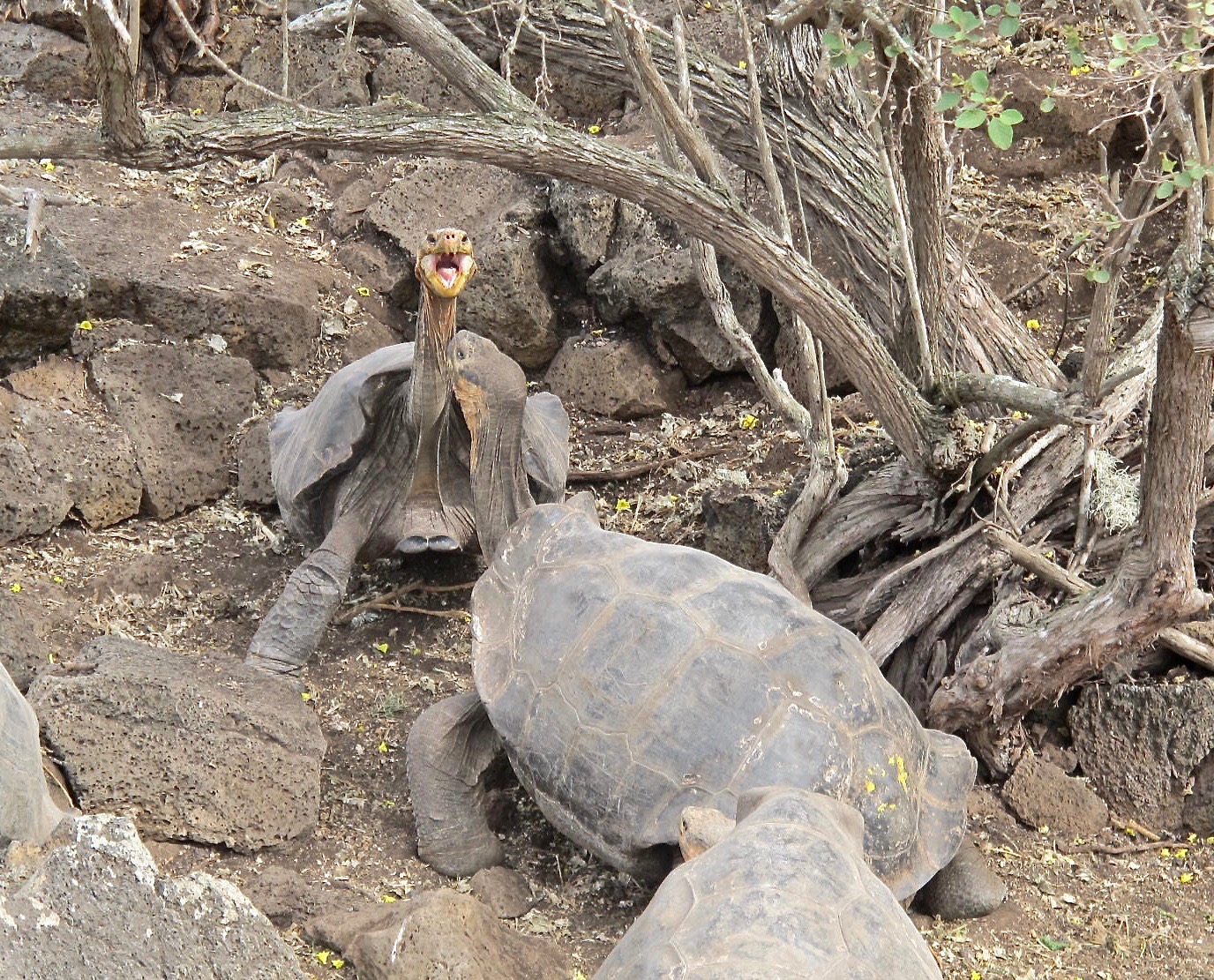
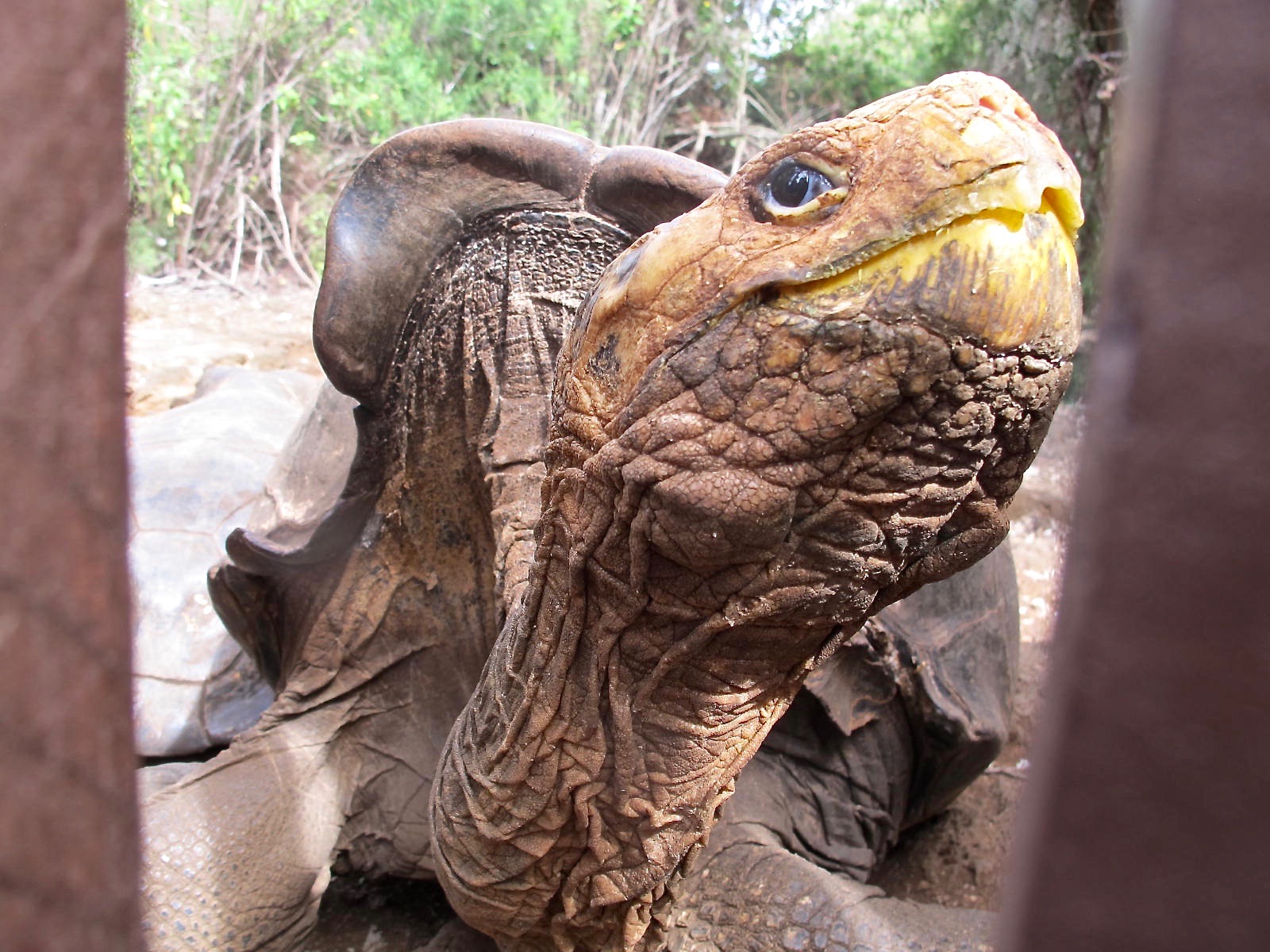
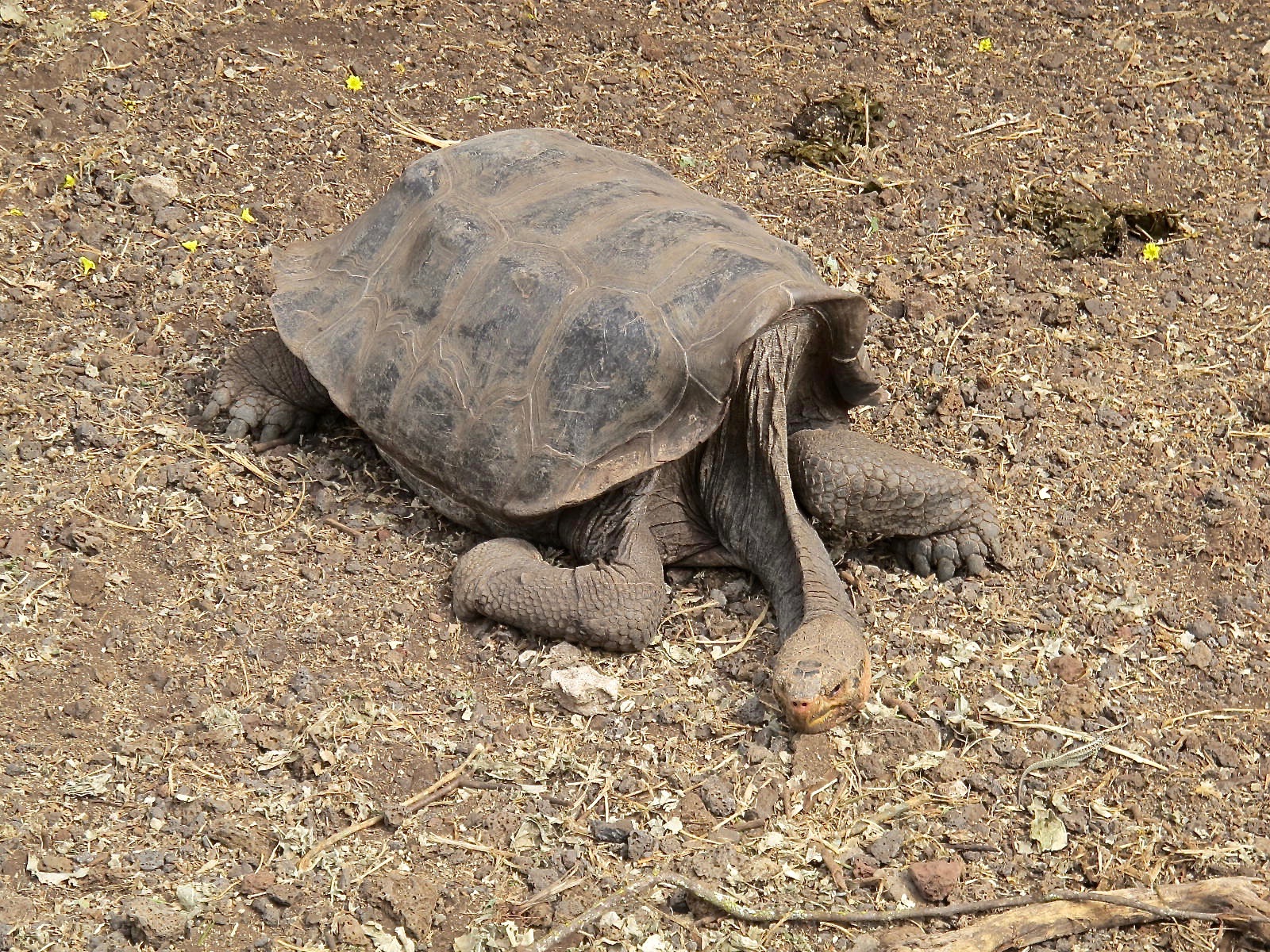
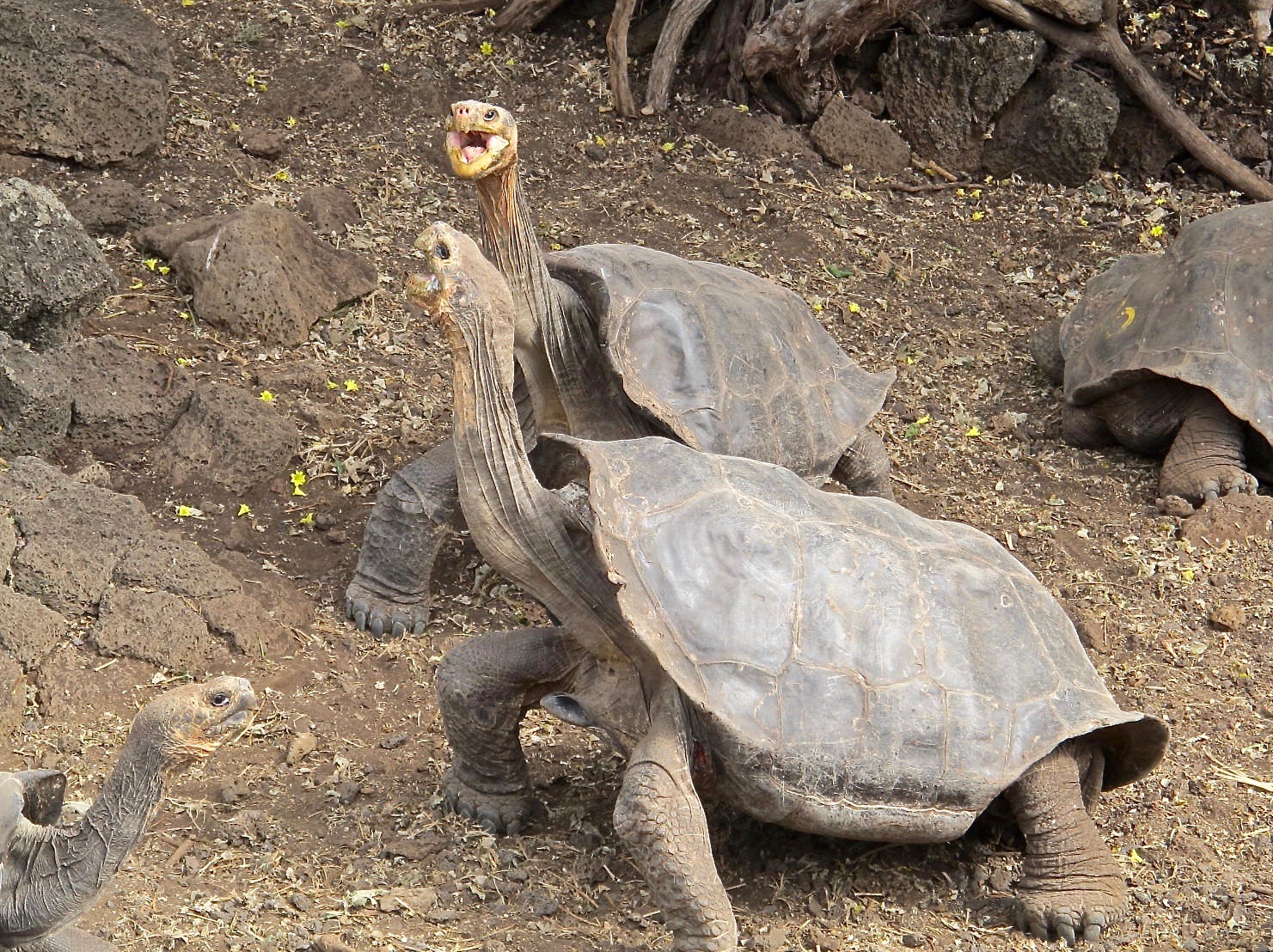
Although I didn’t see any giant tortoises on Española, there are many. In the 1960s only 14 Española giant tortoises were living on the island. Thanks to breeding efforts at the Charles Darwin Station, more than 2,000 have been released and the species is once again thriving. I vaguely recollect that Super Diego might have had something to do with that.

Our first exploration of the day was at Suarez Point that involved a hike to see the Waved Albatross. I was excited to see them up close and personal! As we neared our landing spot, we were greeted by several sea lion pups playing in the water and LOUD barks from a big alpha sea lion. Erick told us the sea lion mamas were out fishing and the bull was a babysitter. He was making sure no one (animal or human) got out of line. Believe me, we didn’t want to mess with him.

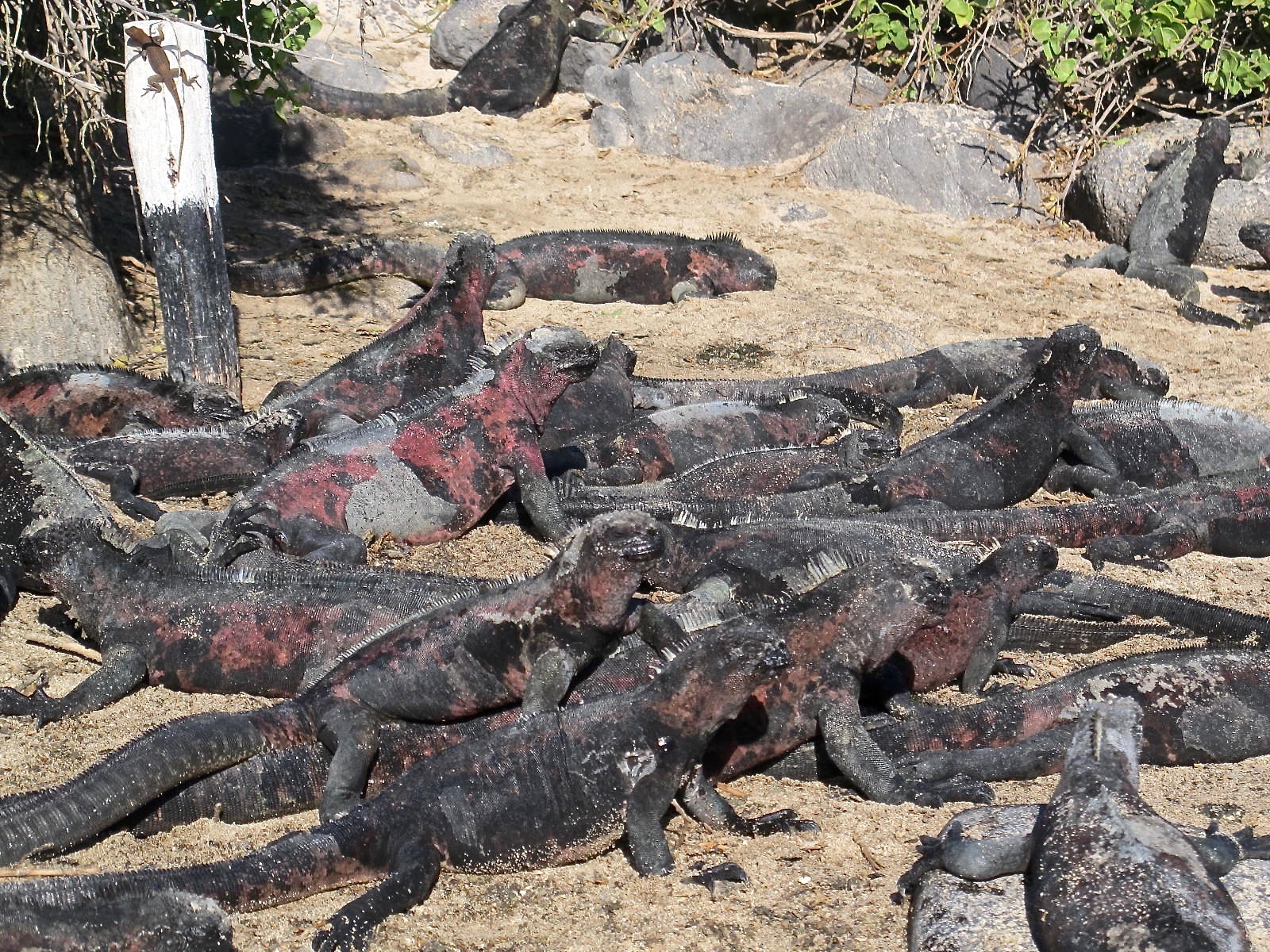
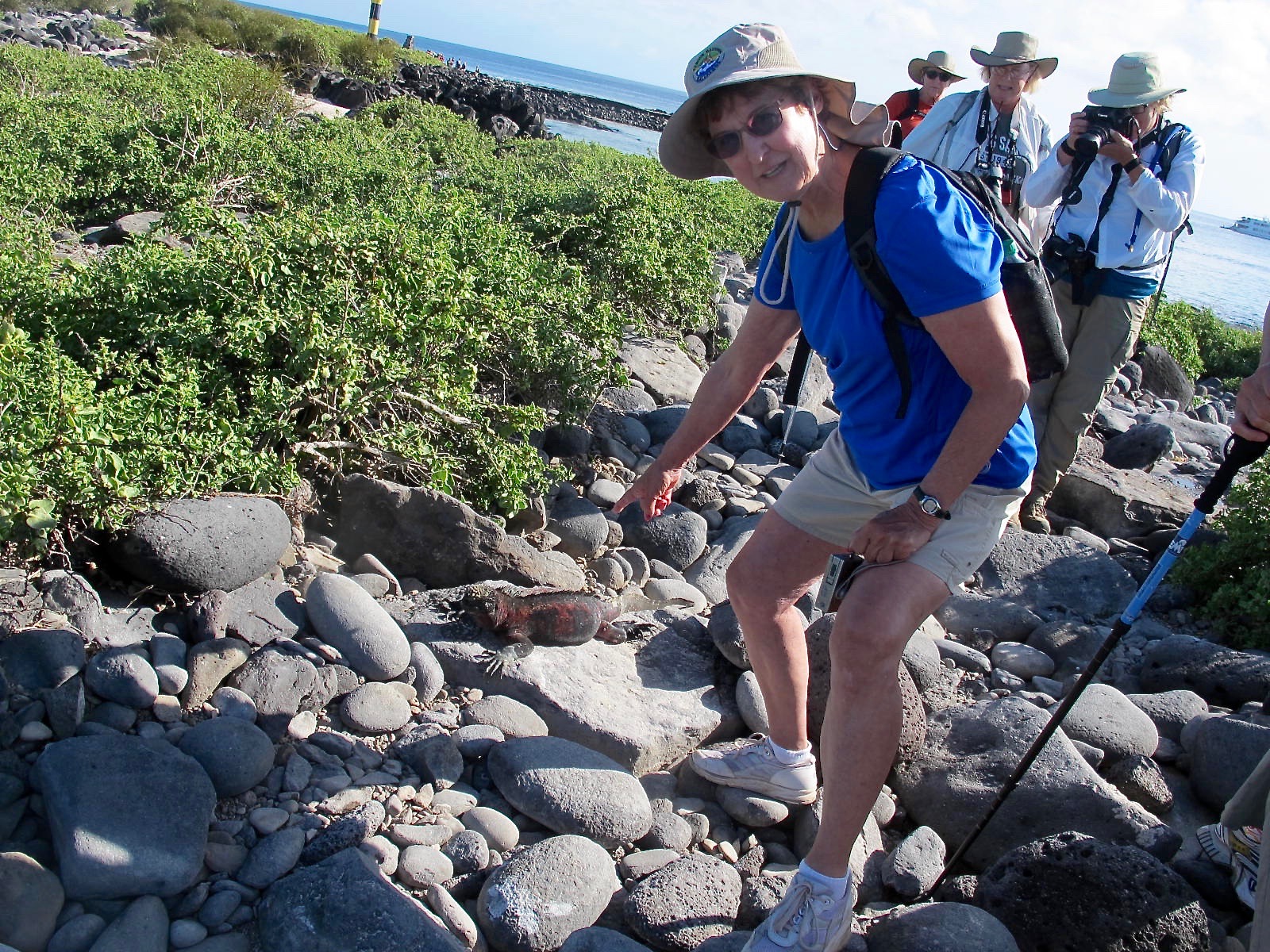
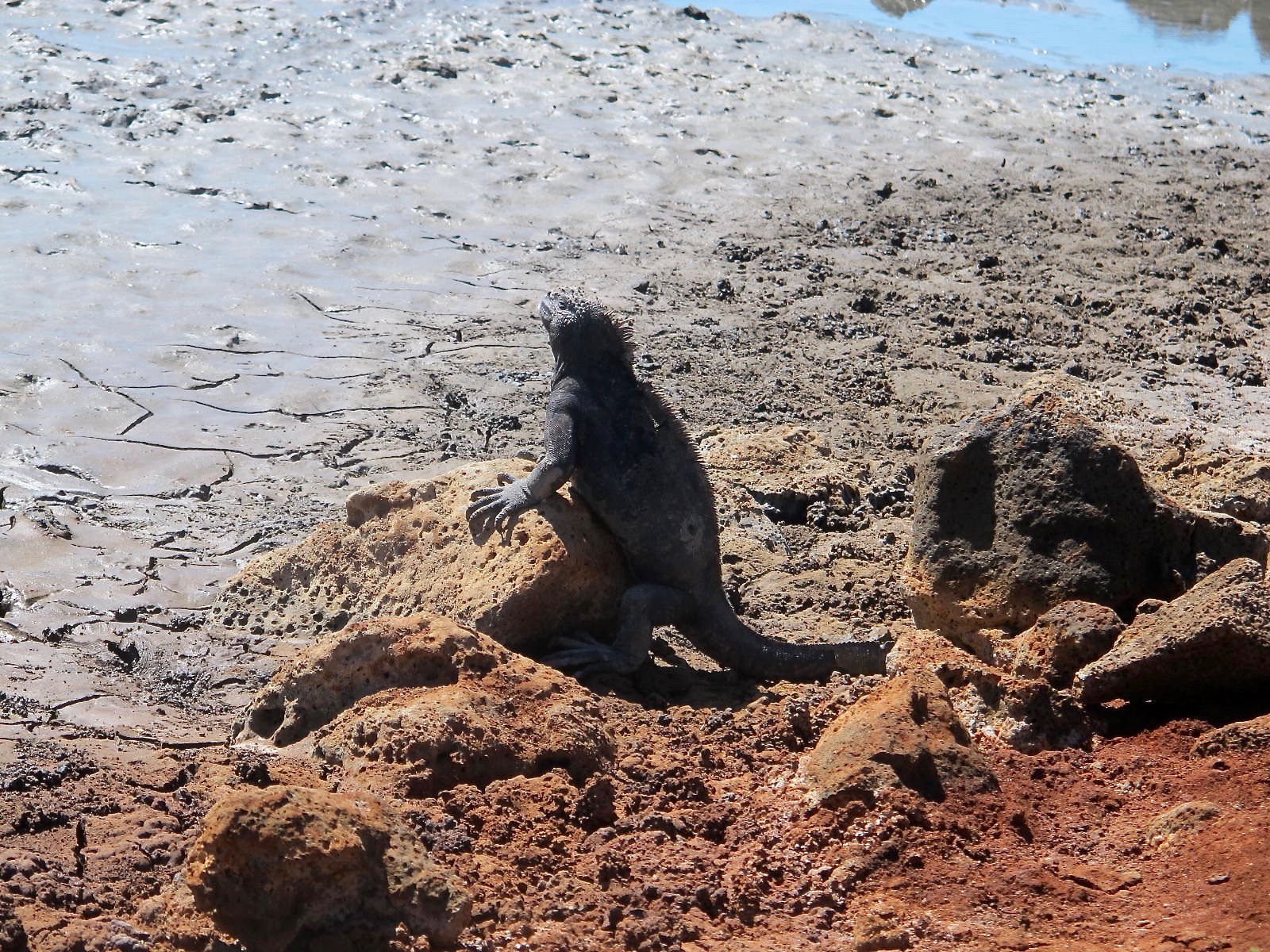
Once we landed, we almost immediately saw a mess (term for a group) of marine iguanas. They were busy getting warmed up enough to go swimming to eat their lunch. It takes them several hours to get warm enough and then can only last about 15 minutes per swimming session.   The red on their hides is left over from the mating season. Some were redder than others. Note the lava lizard on the post.   To the right of the white post is our path to the albatross nests, thus forcing us to break the rule of staying several feet from each animal. We just watched our step and walked right by them. They didn’t flinch.

A mess o' marine iguanas

A mess o’ marine iguanas

An up close and personal of a marine iguana

An up close and personal of a marine iguana

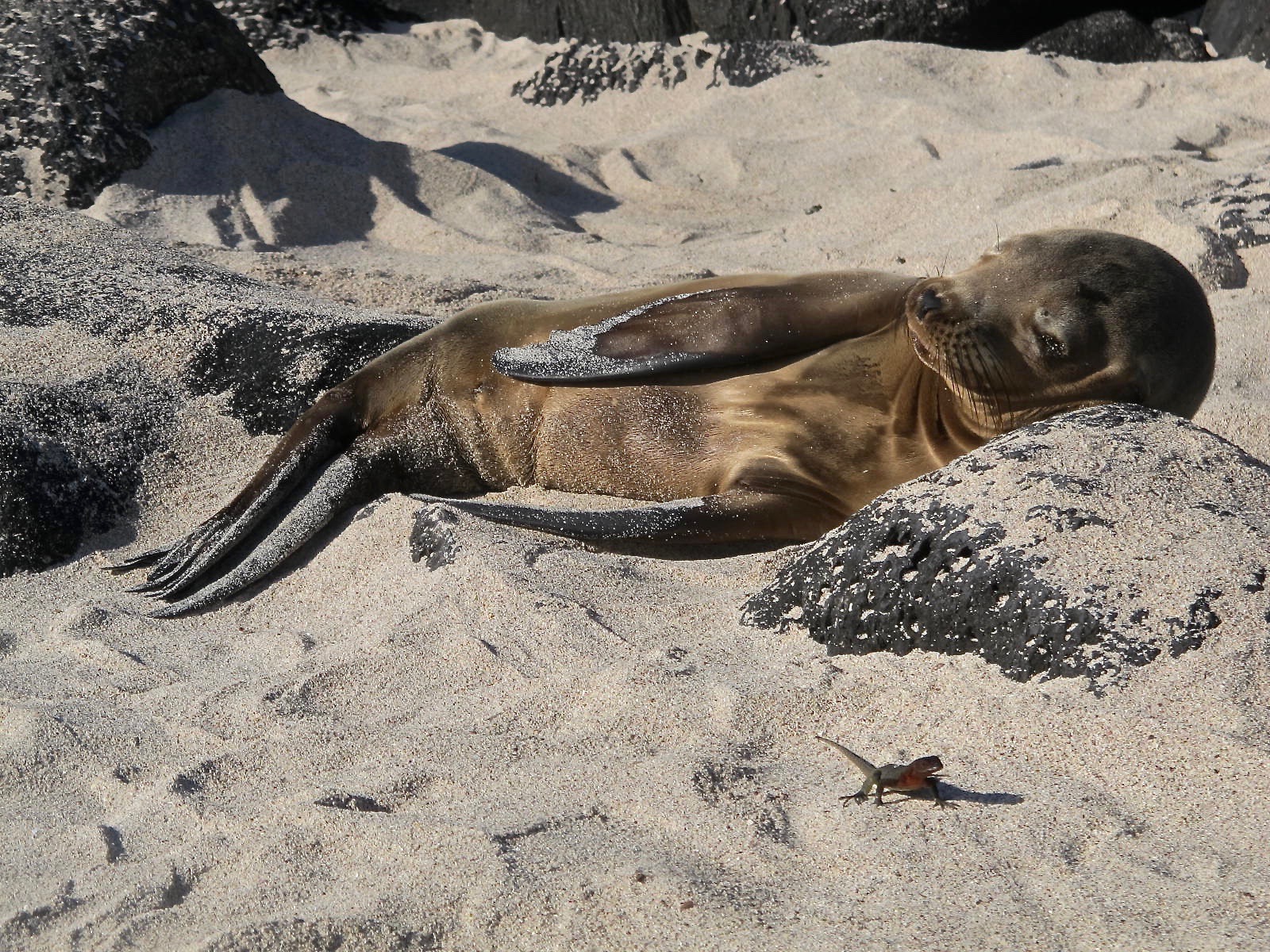
A young sea lion with his buddy, the lava lizard.

A young sea lion with his buddy, the lava lizard.

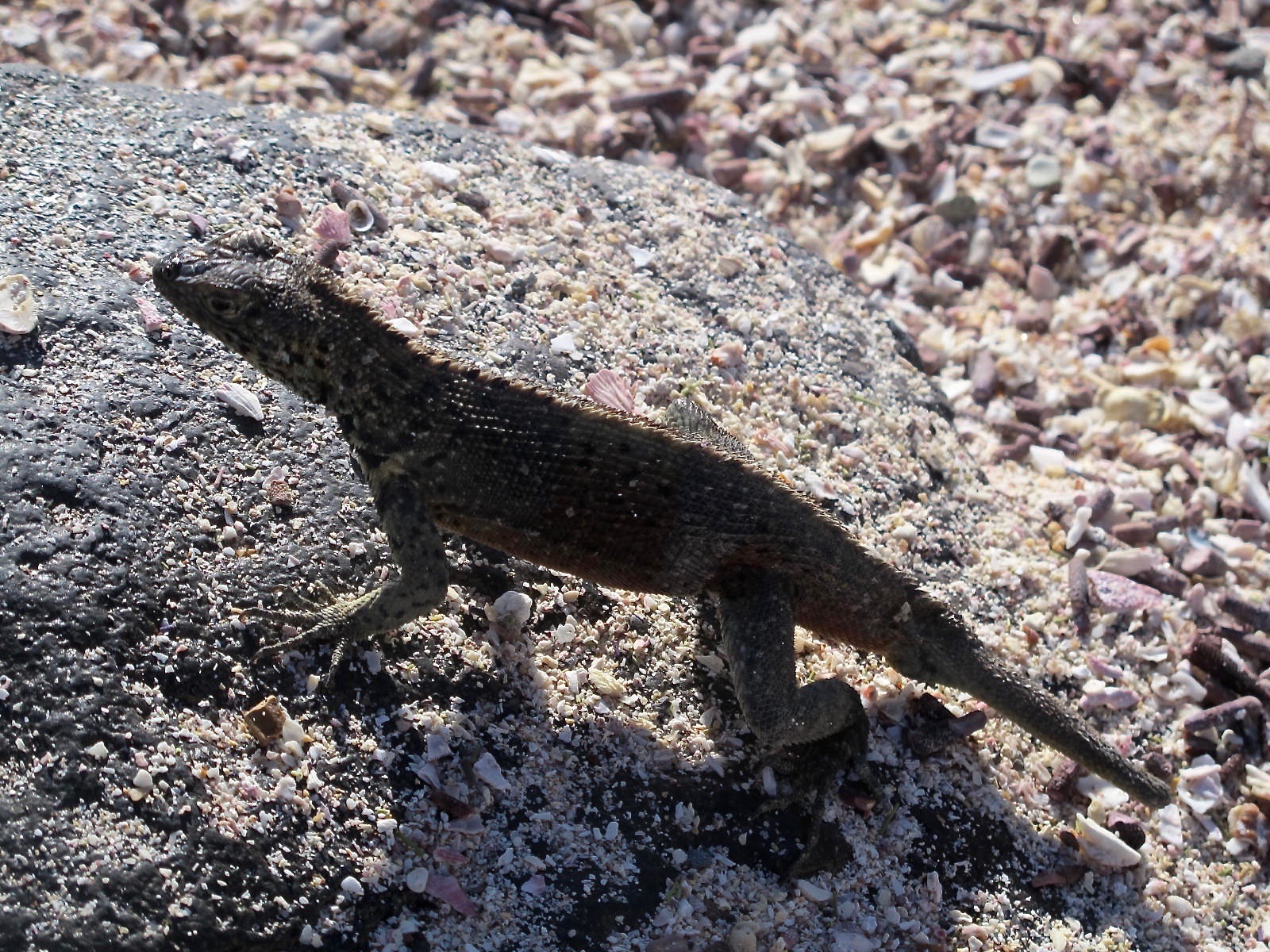
As we walked farther into the trail, we continued to see many marine iguanas and lava lizards. We watch one lava lizard try to court a female. He would do his push ups (as we might have seen lizards in our area do). The female would kind of dance around as I remember and then he’d do some more advancing. But after a bit, the female walked away. He looked dejected but perhaps he because his tail was short. Perhaps he lost it in a fight or maybe a bird tried to get him.

A courting lava lizard

A courting lava lizard

Speaking of birds, we saw the Española mockingbird with his curved beak. He, too, was as curious as the Galápagos mocker we had seen on other islands. He would walk right up to us trying to check out our gear.

Speaking of birds, we saw the Española mockingbird with his curved beak. He, too, was as curious as the Galápagos mocker we had seen on other islands. He would walk right up to us trying to check out our gear.

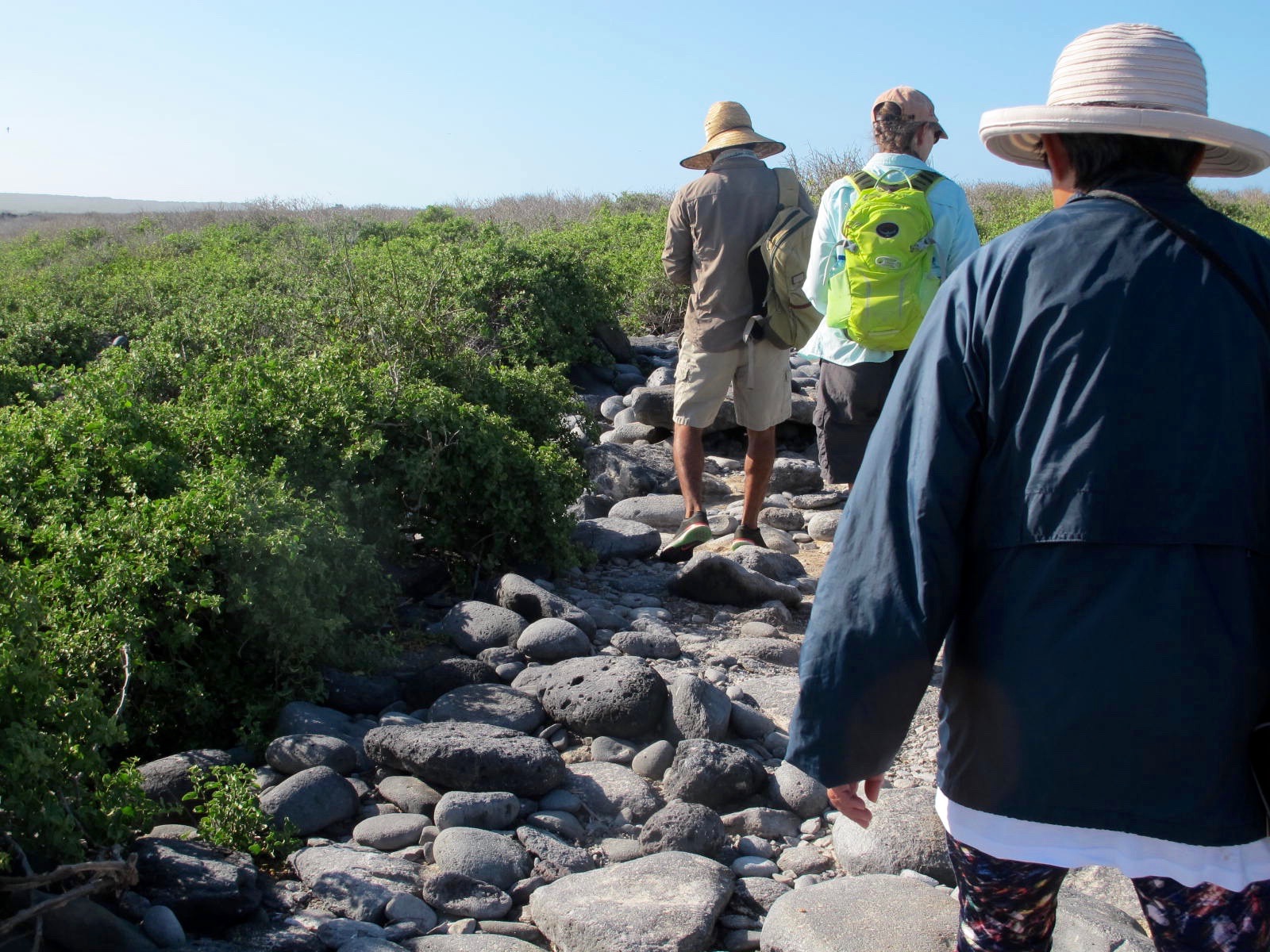
Soon we left the easy sand and began to walk on a pretty rough path. We all had to watch our step…for more than one reason. A marine iguana and a seal lion were on the path each doing it’s own thing.

A rocky trail

A rocky trail

Shirley and a marine iguana

Shirley and a marine iguana

I can snooze anywhere!

I wish I had one of those new number mattresses

It didn’t take long before we were seeing birds all over the place.

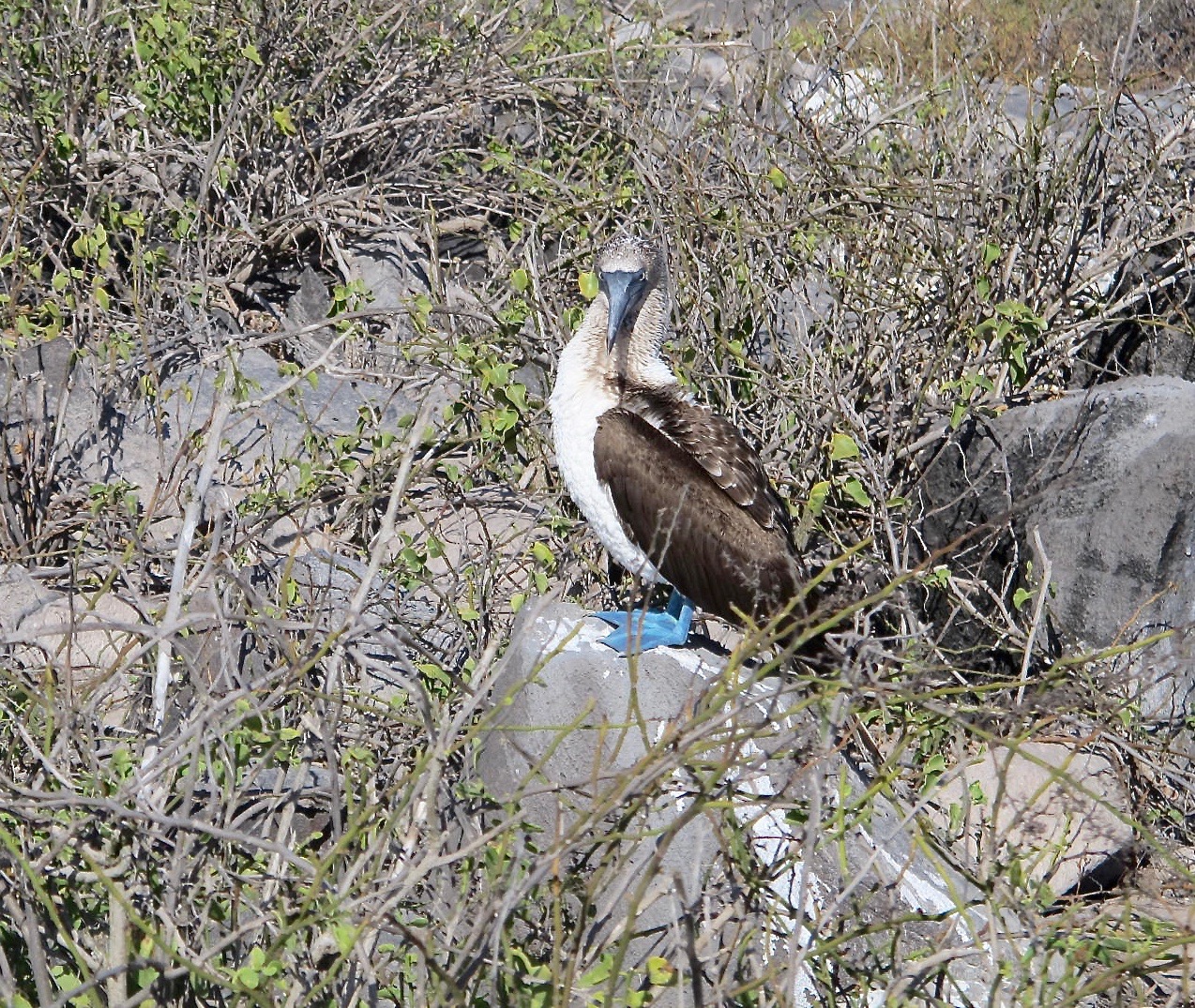
Blue-footed booby

Blue-footed booby

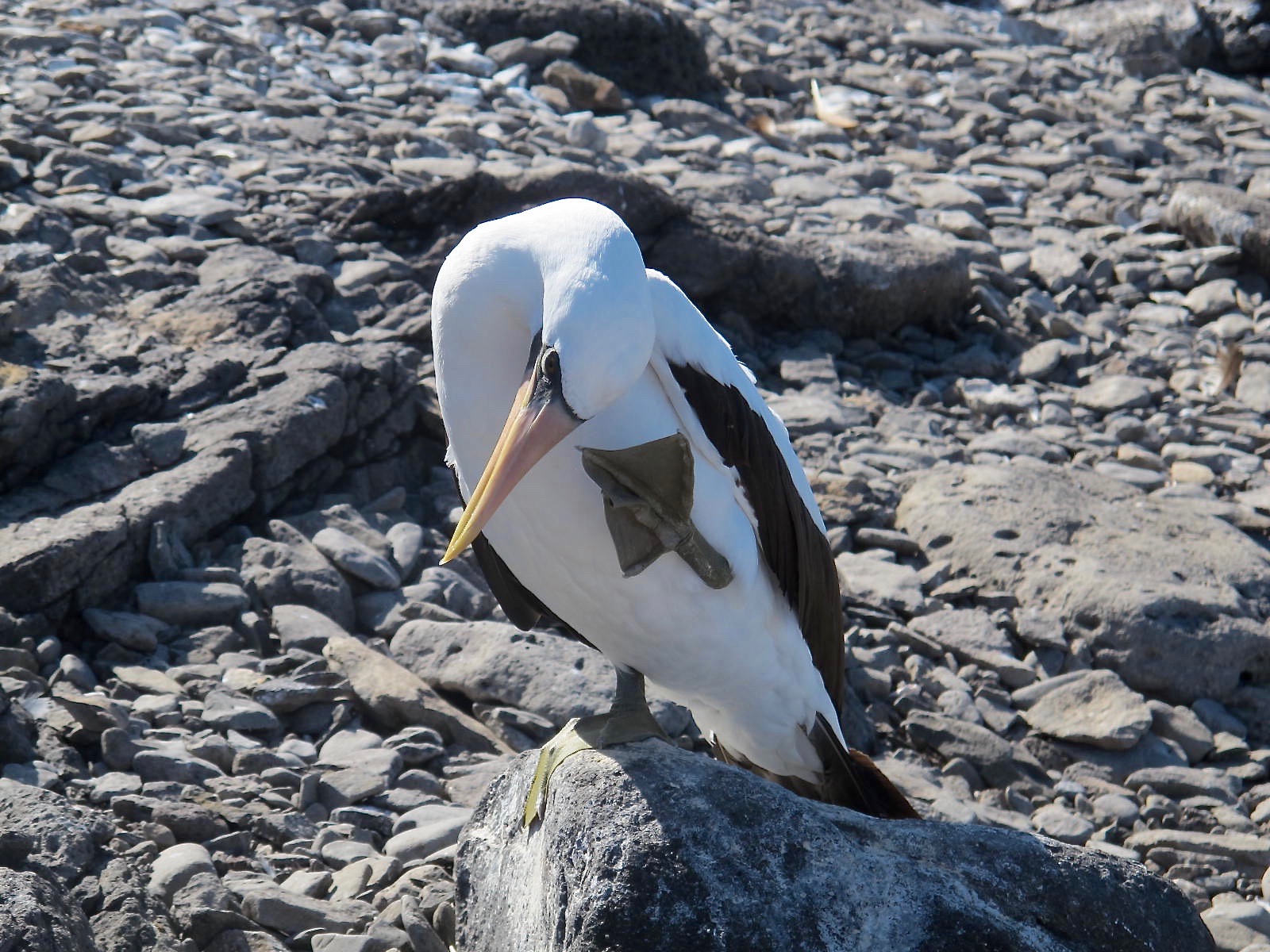
Nazca booby

Nazca booby

This is the before picture.

This is the before picture.

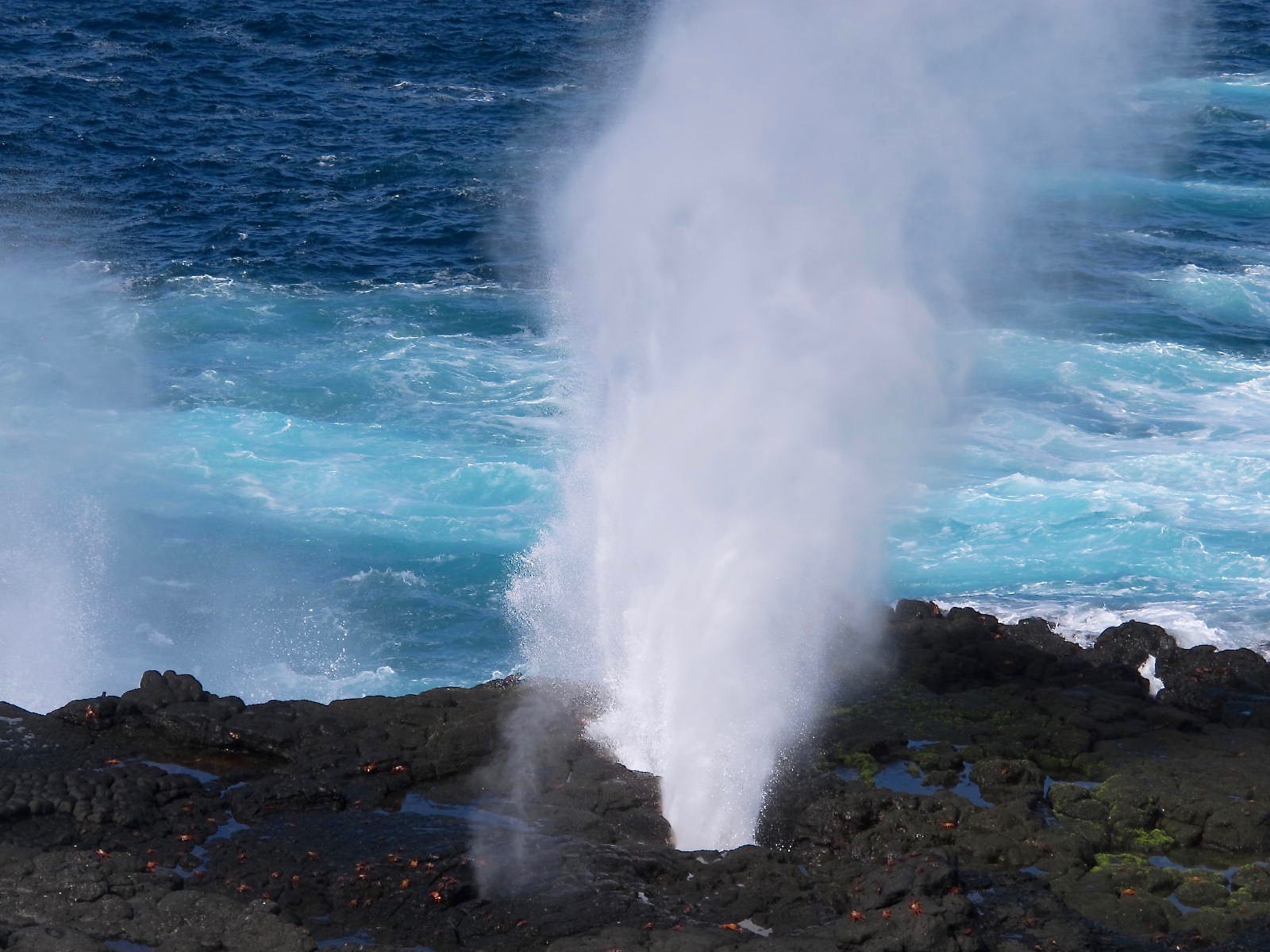
Blowhole in action

Blowhole in action

This magnificent blowhole might be the tallest one I’ve ever seen. But, then, it was difficult to get a perspective of size because we were looking down on it. The red spots around the blowhole were Sally Lightfoot crabs. I wonder how often they crawl too far down the blowhole and get blown up in the sky.

I turned around from the blowhole and saw these Nazcas sunbathing in rays of light.

I turned around from the blowhole and saw these Nazcas sunbathing in rays of light.

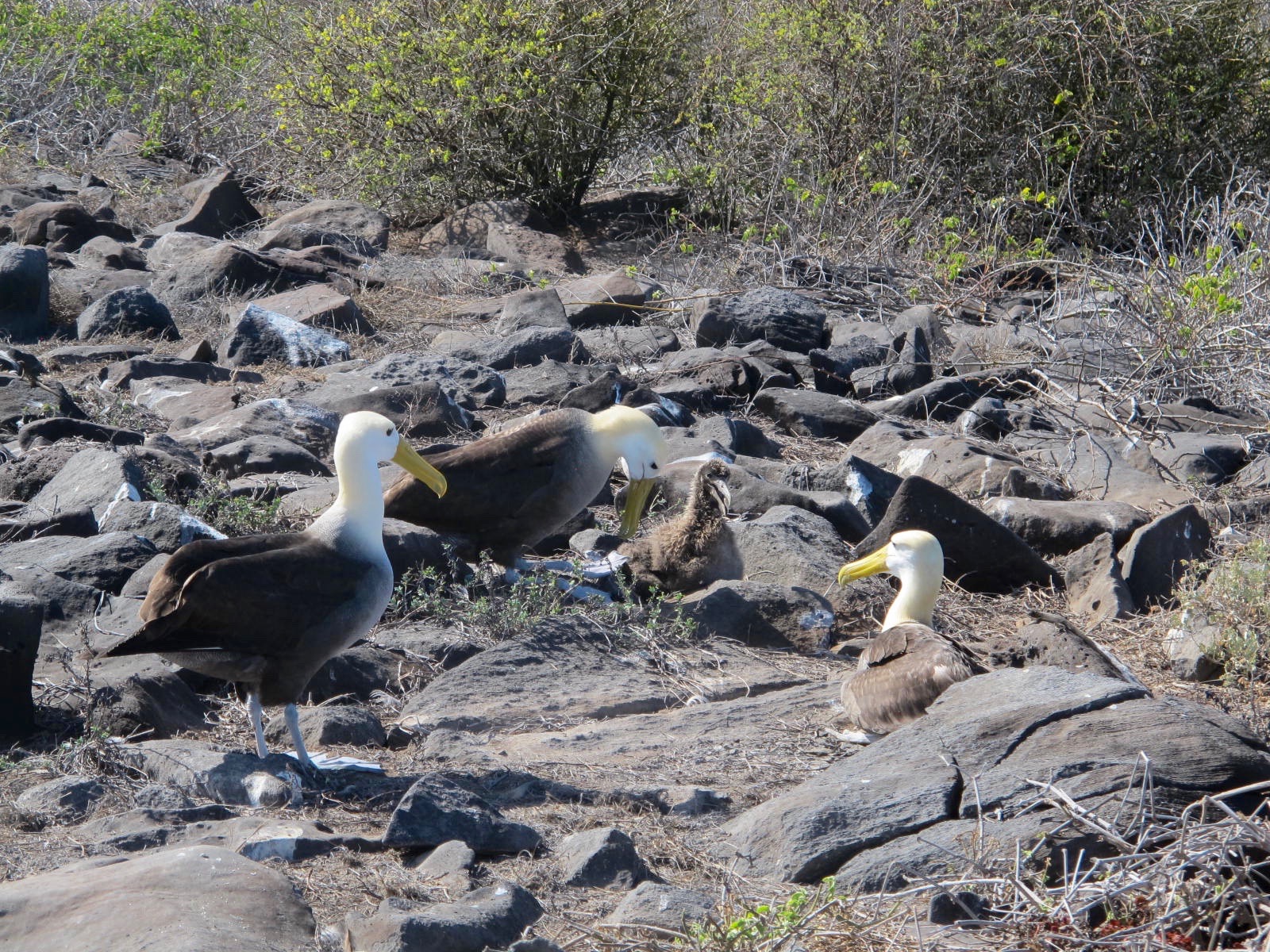
We walked a bit farther and saw albatross and their chicks. What a great sight!

We walked a bit farther and saw albatross and their chick. What a great sight! The chicks aren’t very cute but they do grow up to be beautiful birds.

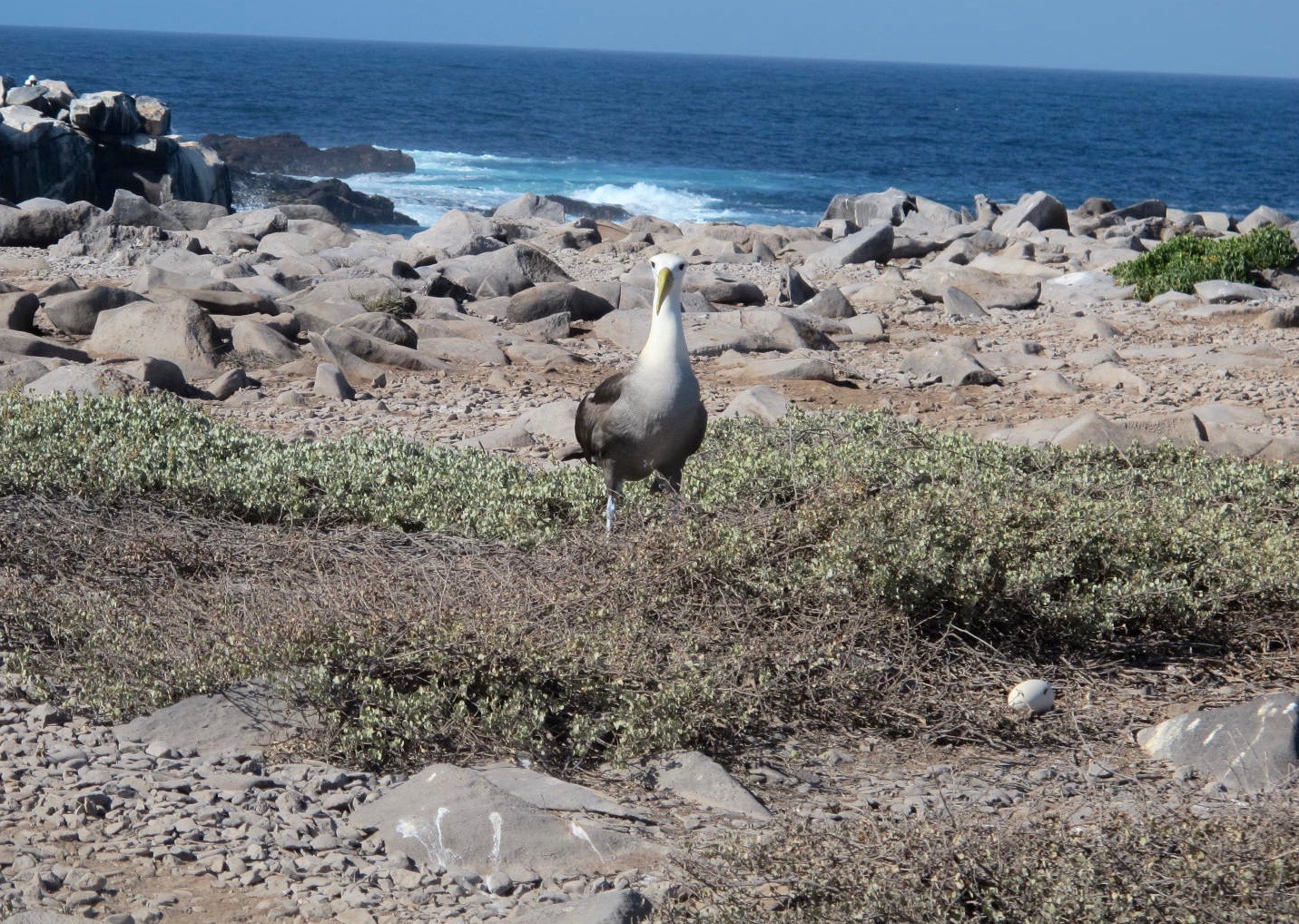
Erick thought the egg didn’t belong to this albatross, but it still makes a good shot.

Erick thought the egg didn’t belong to this albatross, but it still makes a good shot.

Right in the midst of all the albatross was a marine iguana high on a bluff. I wondered why he was so high above the surf line. Shirley and I took advantage and had our portrait taken with him.

Right in the midst of all the albatross was a marine iguana high on a bluff. I wondered why he was so high above the surf line. Shirley and I took advantage and had our portrait taken with him.

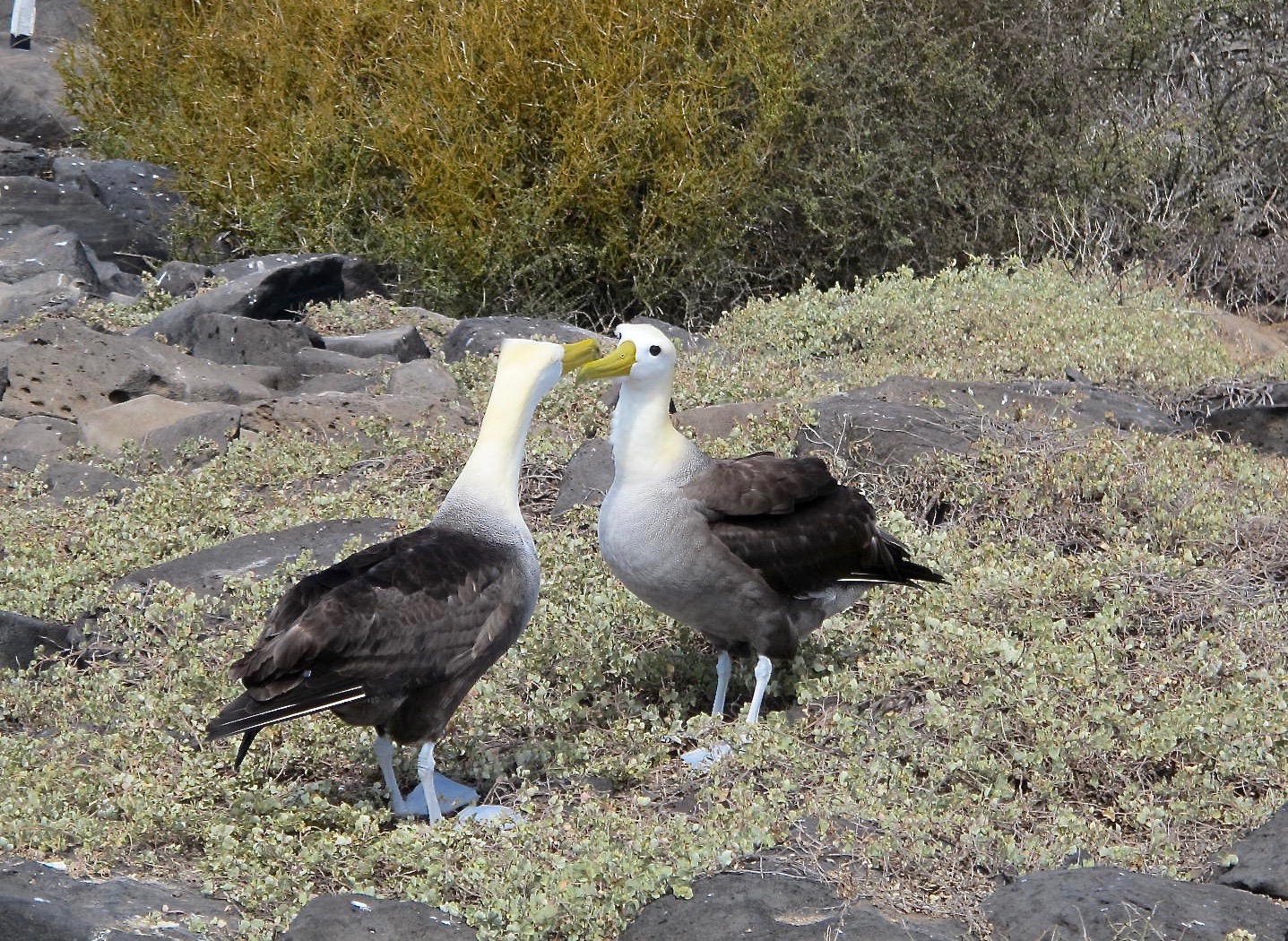
We were privileged to see two pairs of albatross do their mating dance and even though I felt like I was intruding, I took some photos of them. This dance is quite elaborate and these are just four steps to it. I was quite impressed to watch it but I don’t know the outcome. Did she or did she not accept?400Part of albatross mating dance

402Albatross mating dance404mating dance406mating dance

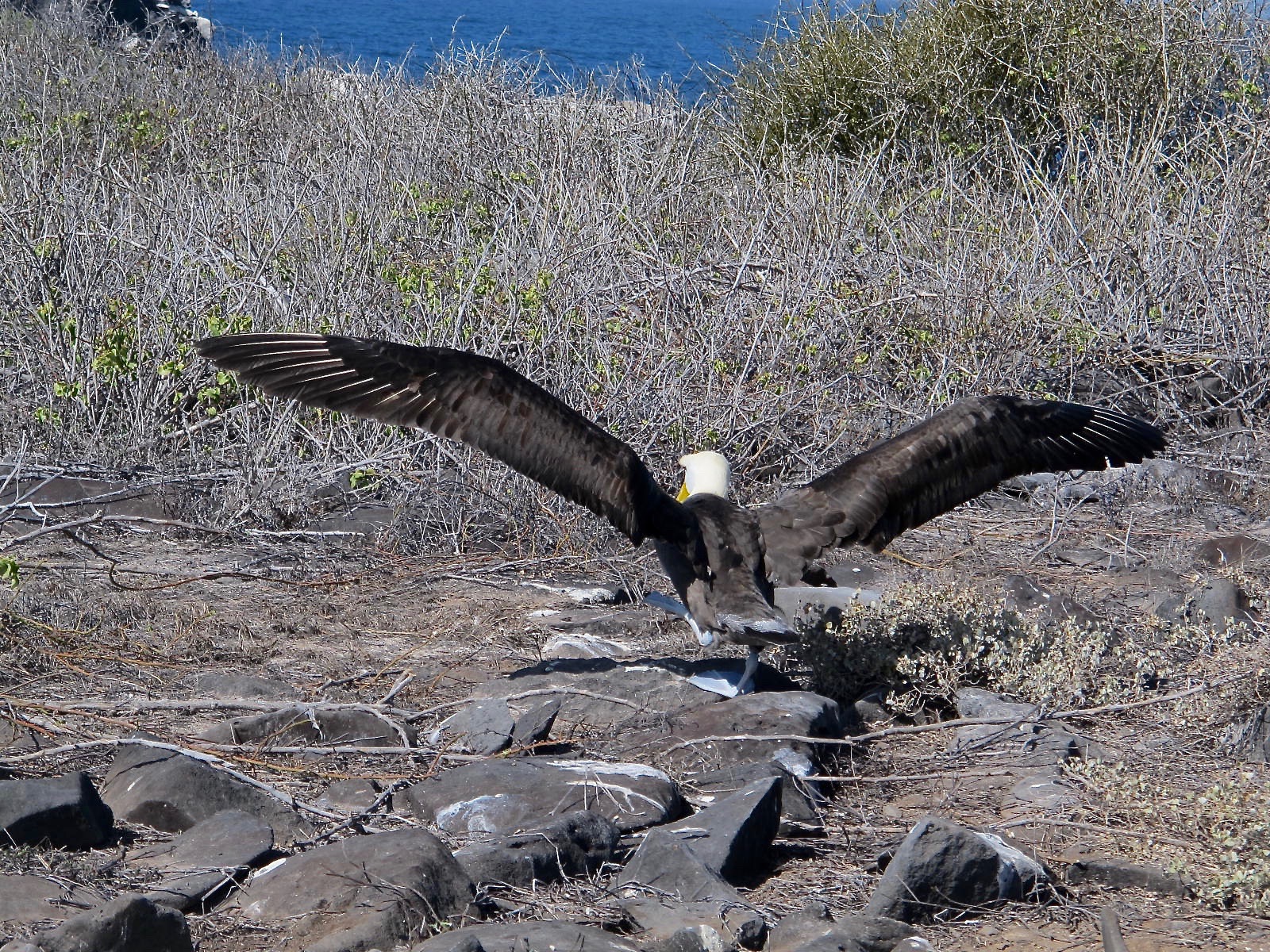
A picture of an albatross doing his version of running fast enough to get enough lift to take off.

A picture of an albatross doing his version of running fast enough to get enough lift to take off.

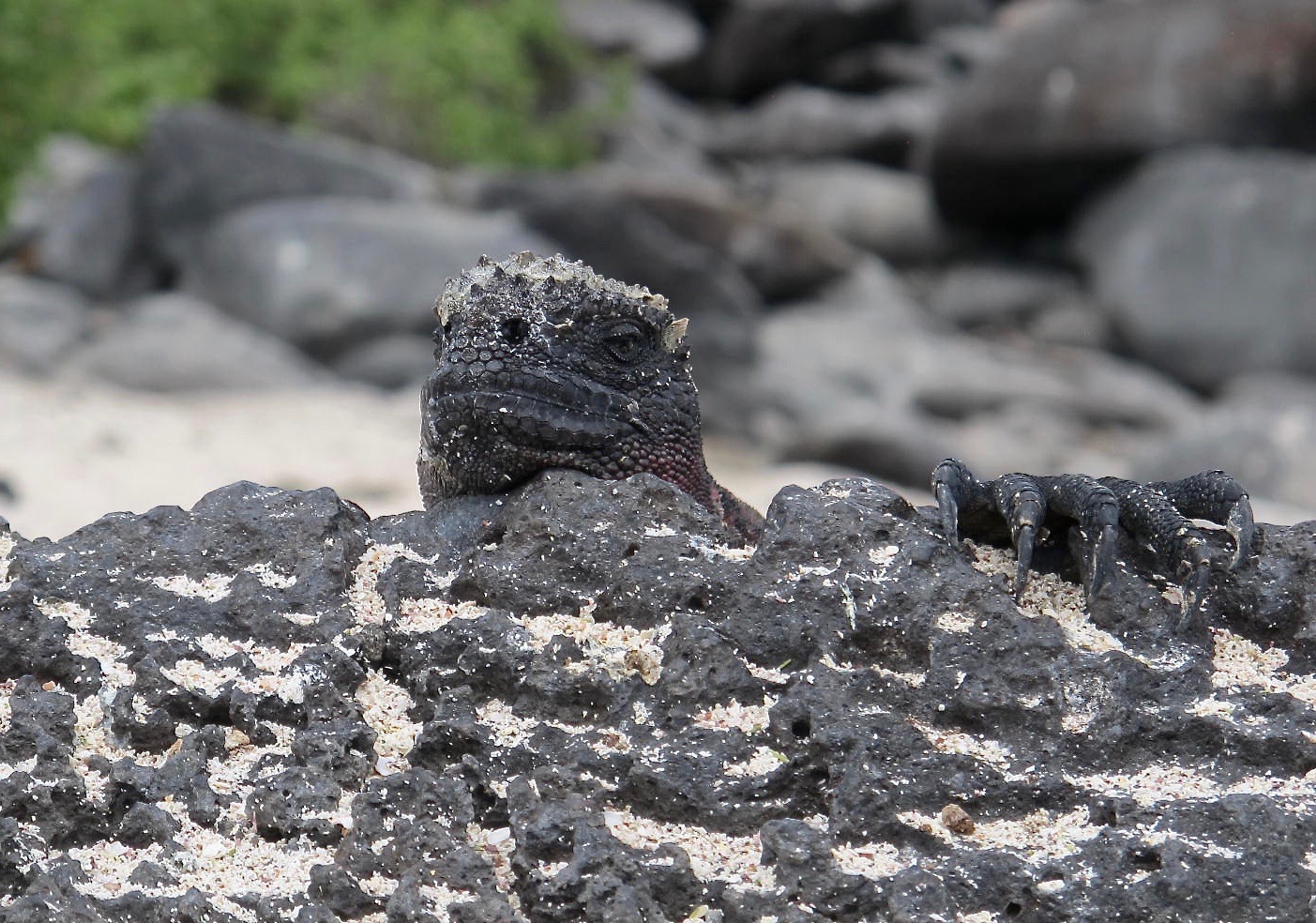
On the way back to our Zodiac, I took this picture of the “Creature from the Black Lagoon.” Note how sort of smushed its face is. This is an adaptation that allows the iguana to crop the algae even closer to the rock.

On the way back to our Zodiac, I took this picture of the “Creature from the Black Lagoon.” Note how sort of smushed its face is. This is an adaptation that allows the iguana to crop the algae even closer to the rock.

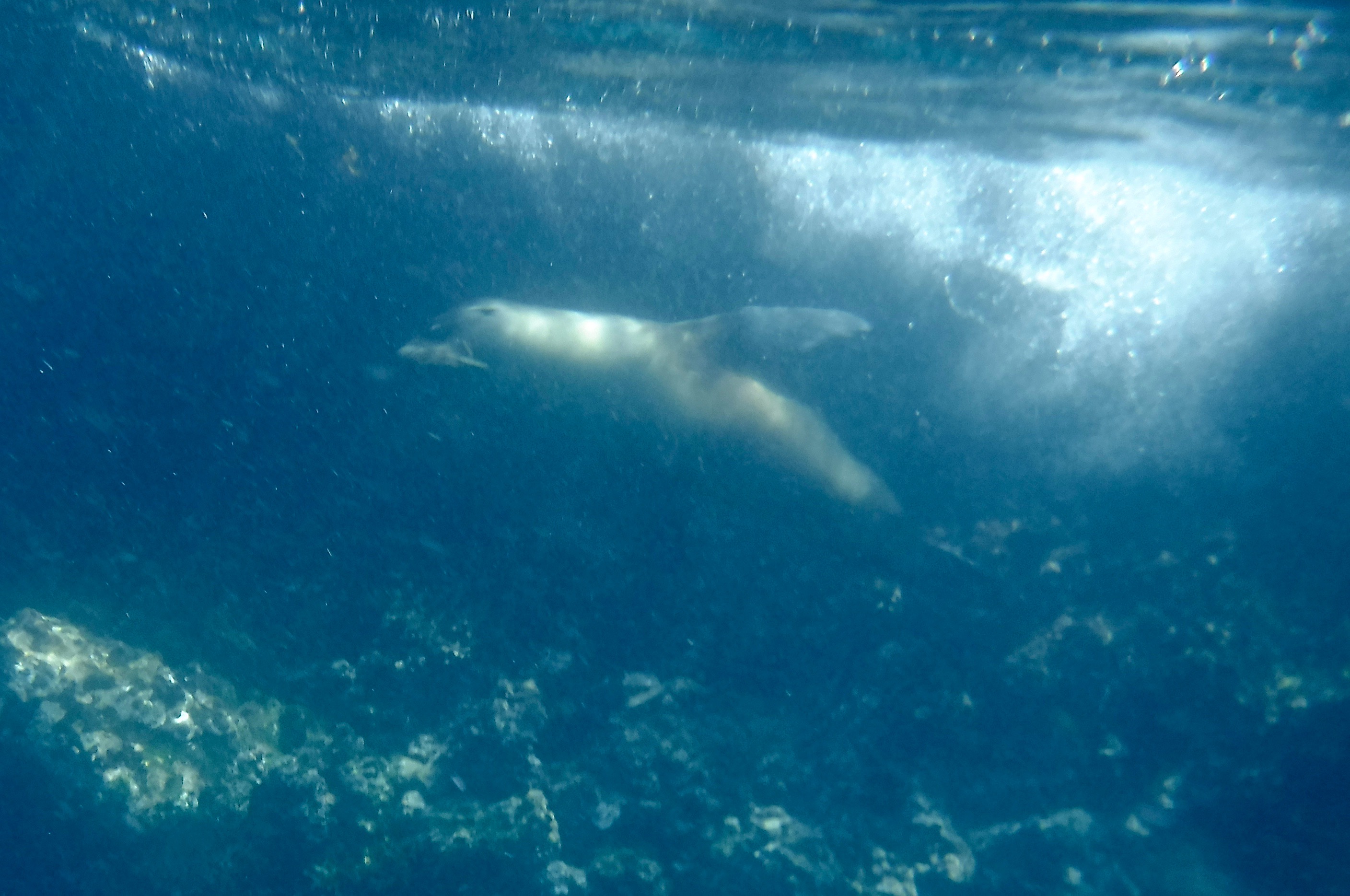
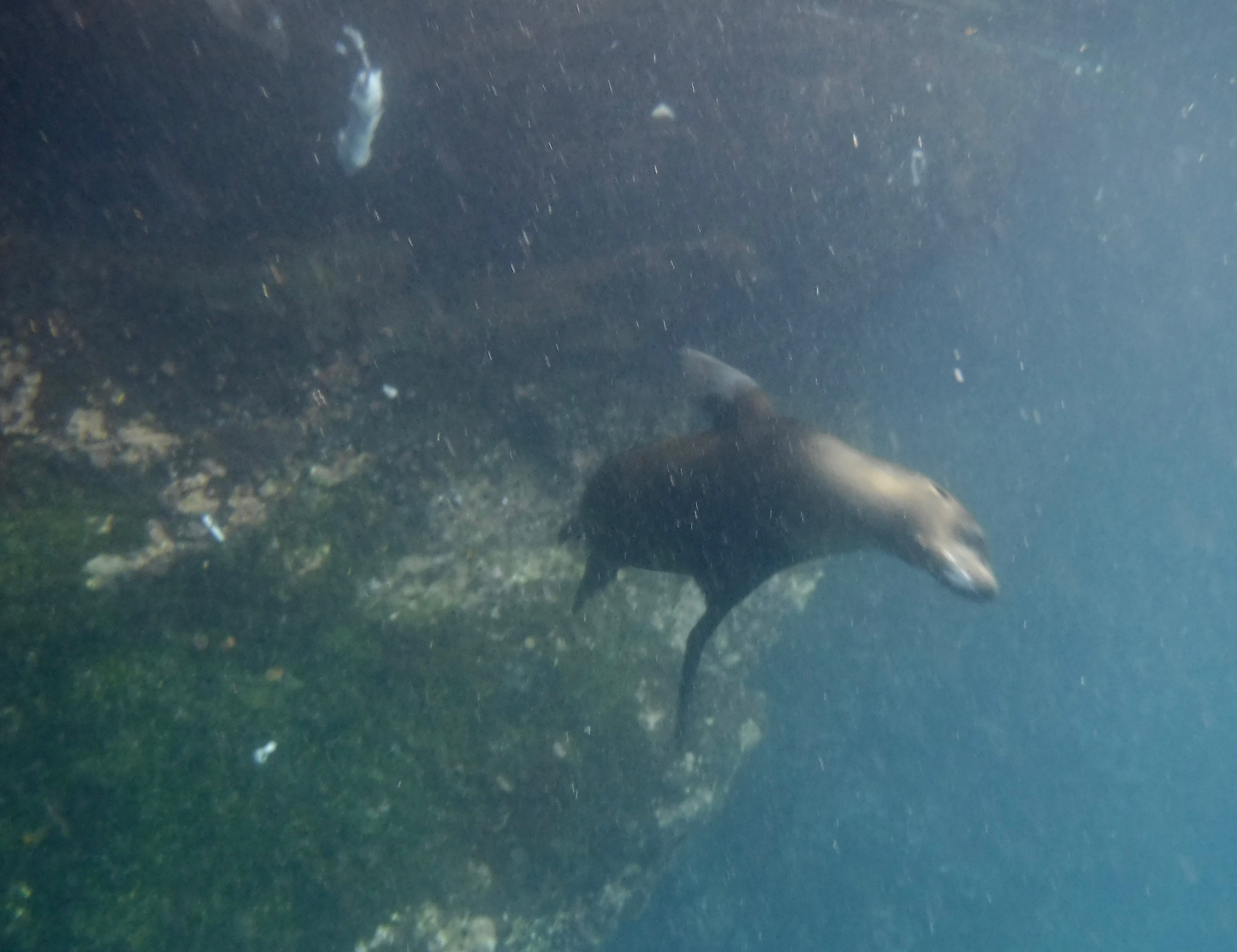
We left Suarez Point and sailed to Gardiner Bay, on the eastern side of the island. This was our last chance to snorkel and see some fun animals. Pato took us into a cove where we were greatly entertained by sea lion pups. They were learning how to fish were often successful. One guy would take his catch up on the rocks and proceed to whack the poor fish on the rocks. Then he would eat it. Perhaps he was tenderizing it. Who knows?

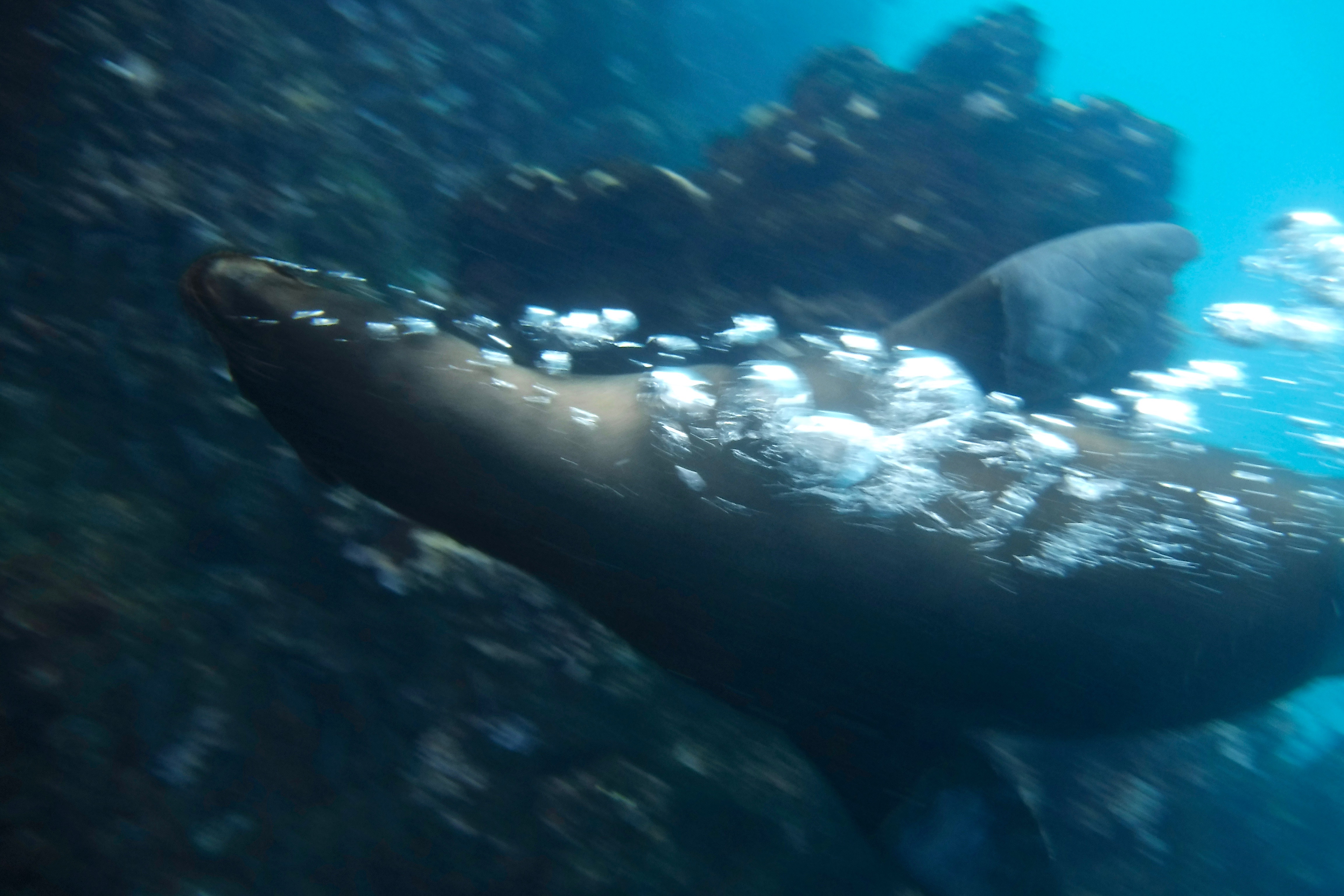
I'm forever blowing bubbles...

I’m forever blowing bubbles…

This guy has a fish in his mouth

This guy has a fish in his mouth

The white stuff in the water is parts of fish.

The white stuff in the water is parts of fish.

Snorkelers in the cove

Snorkelers in the cove

You might be wondering why we wore wetsuits when we were so near the equator the entire time. A good question. We learned that cold, strong currents from Antarctica were flowing into the area and meeting northern currents. This caused a welling of particles in the ocean that brings fish and birds. That is one reason why the Islands teem with birds and fish. Genovesa was relatively warm but Española was a lot colder. That blotchy white thing in the left side of the rocks is a pup beaching himself.

After our adventure with the sea lions, we had some time on Gardiner Bay beach and then we boarded the Galaven to head toward San Cristobal.

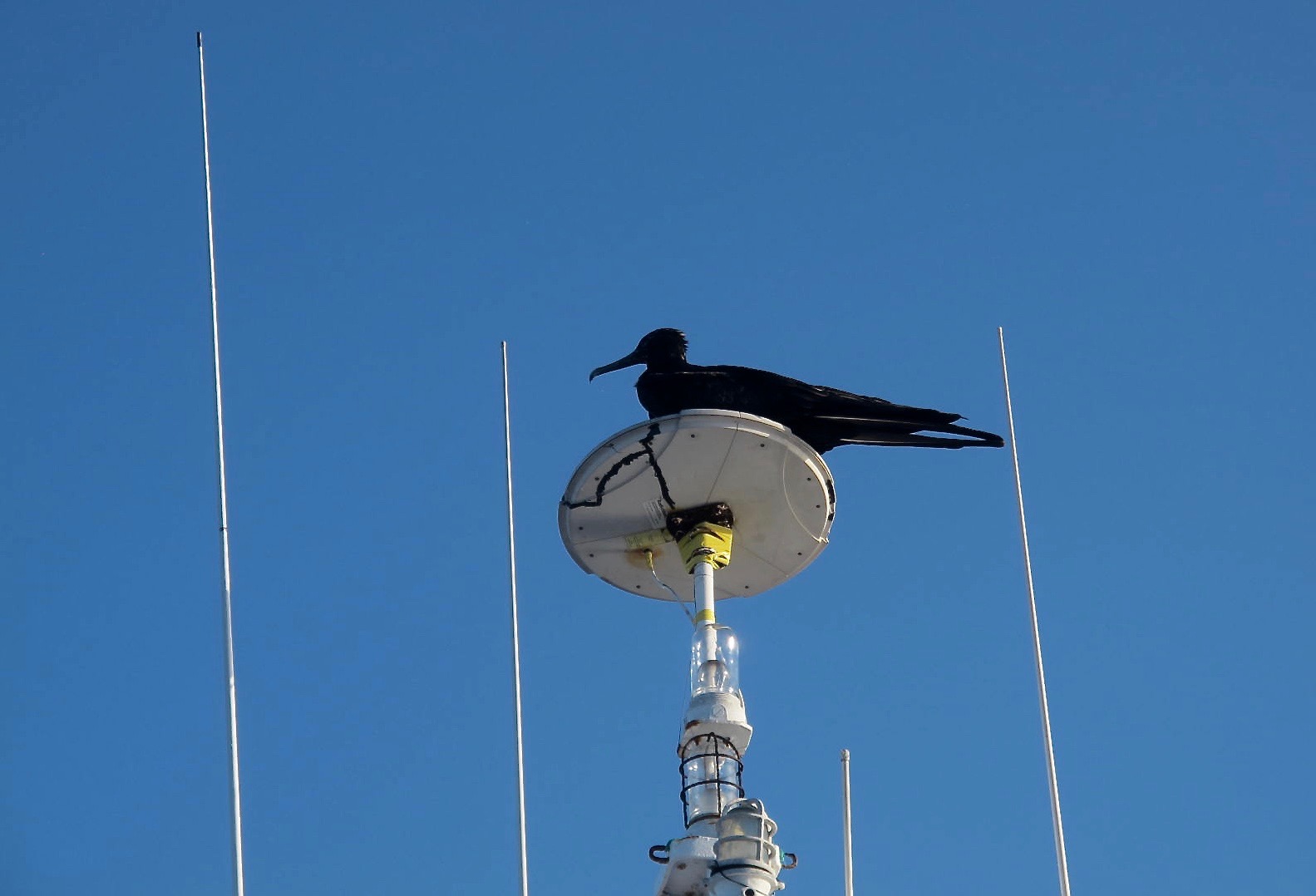
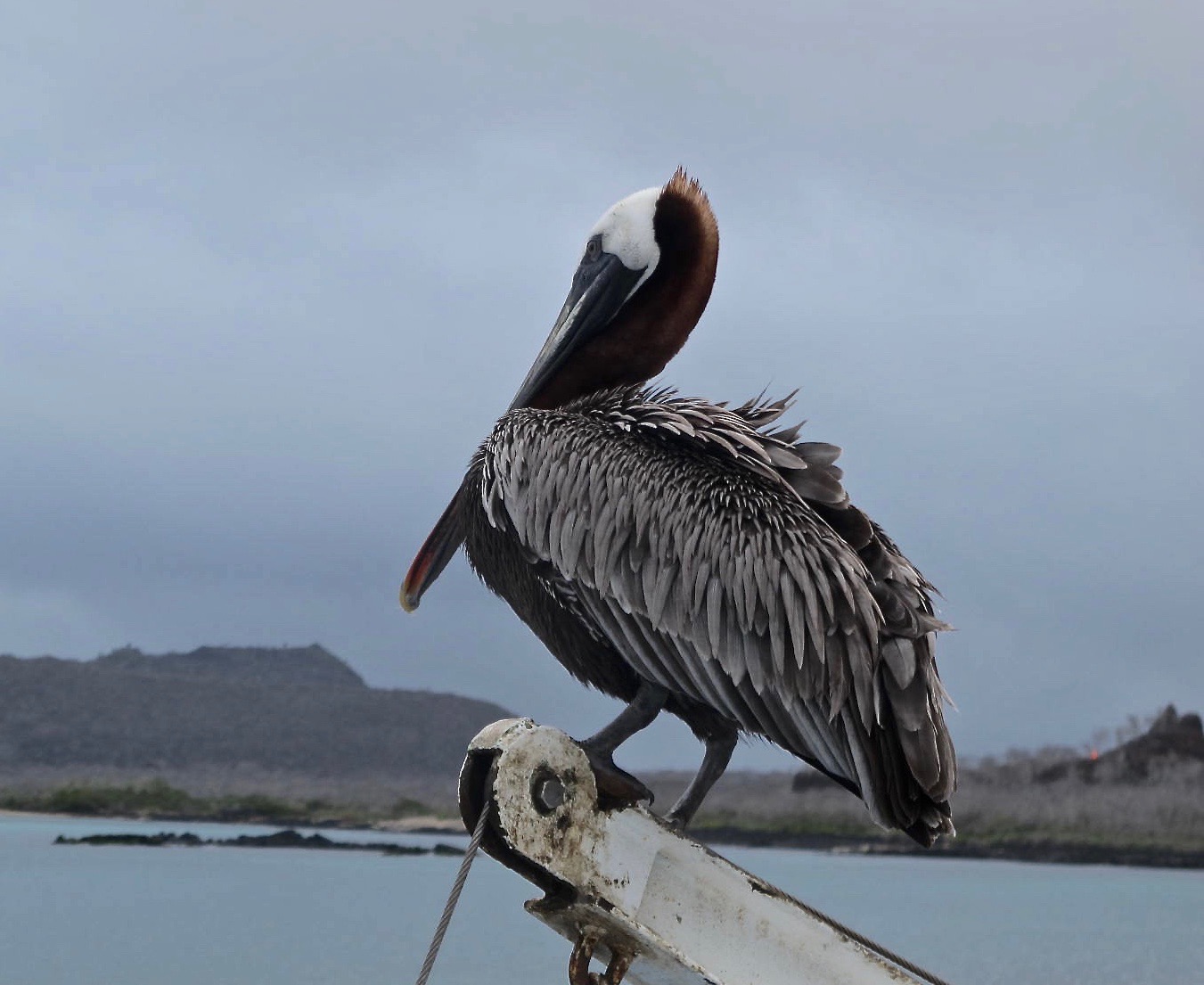
We discovered we had some hitchhikers on our voyage to San Crisotbal.

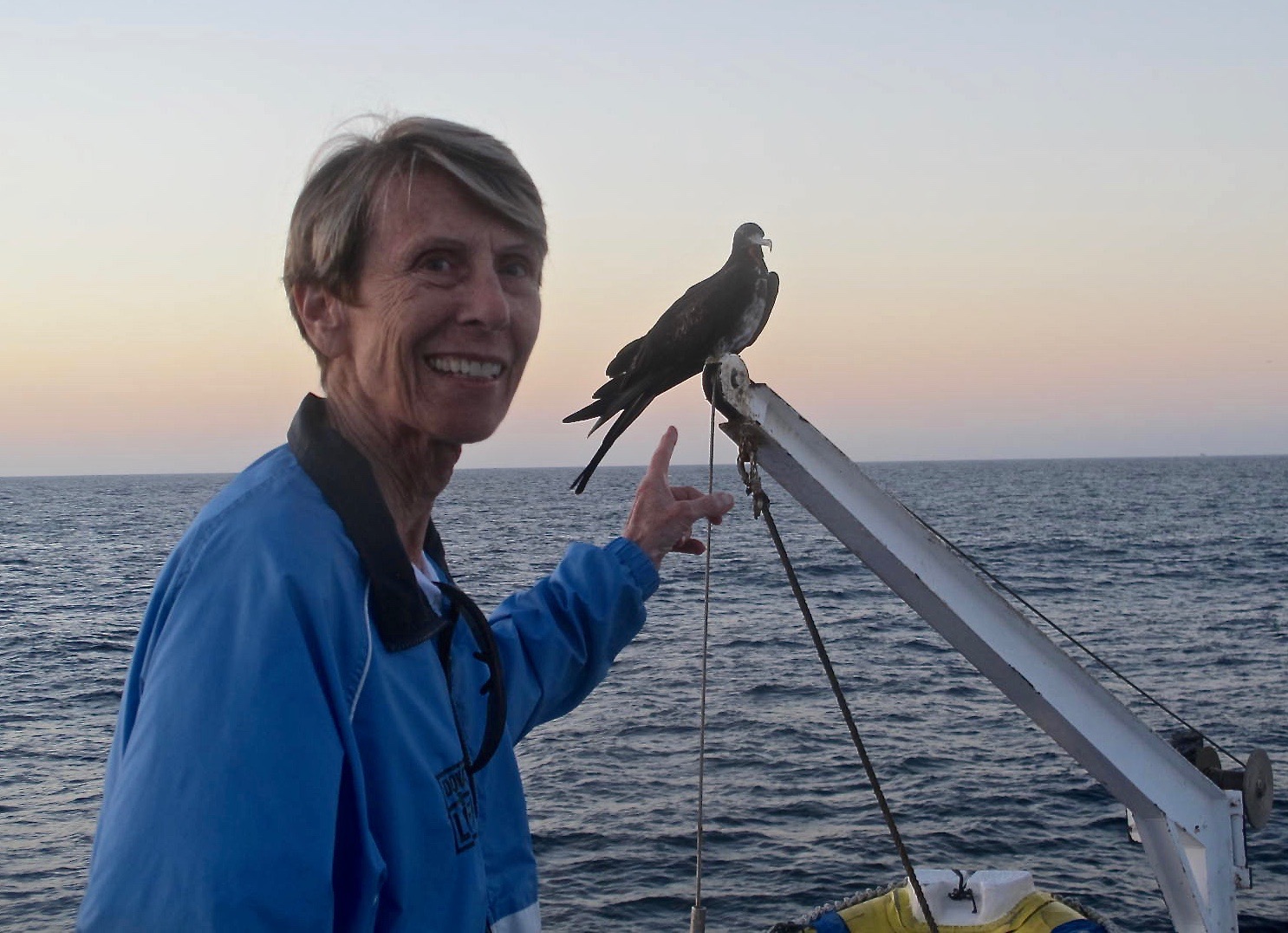
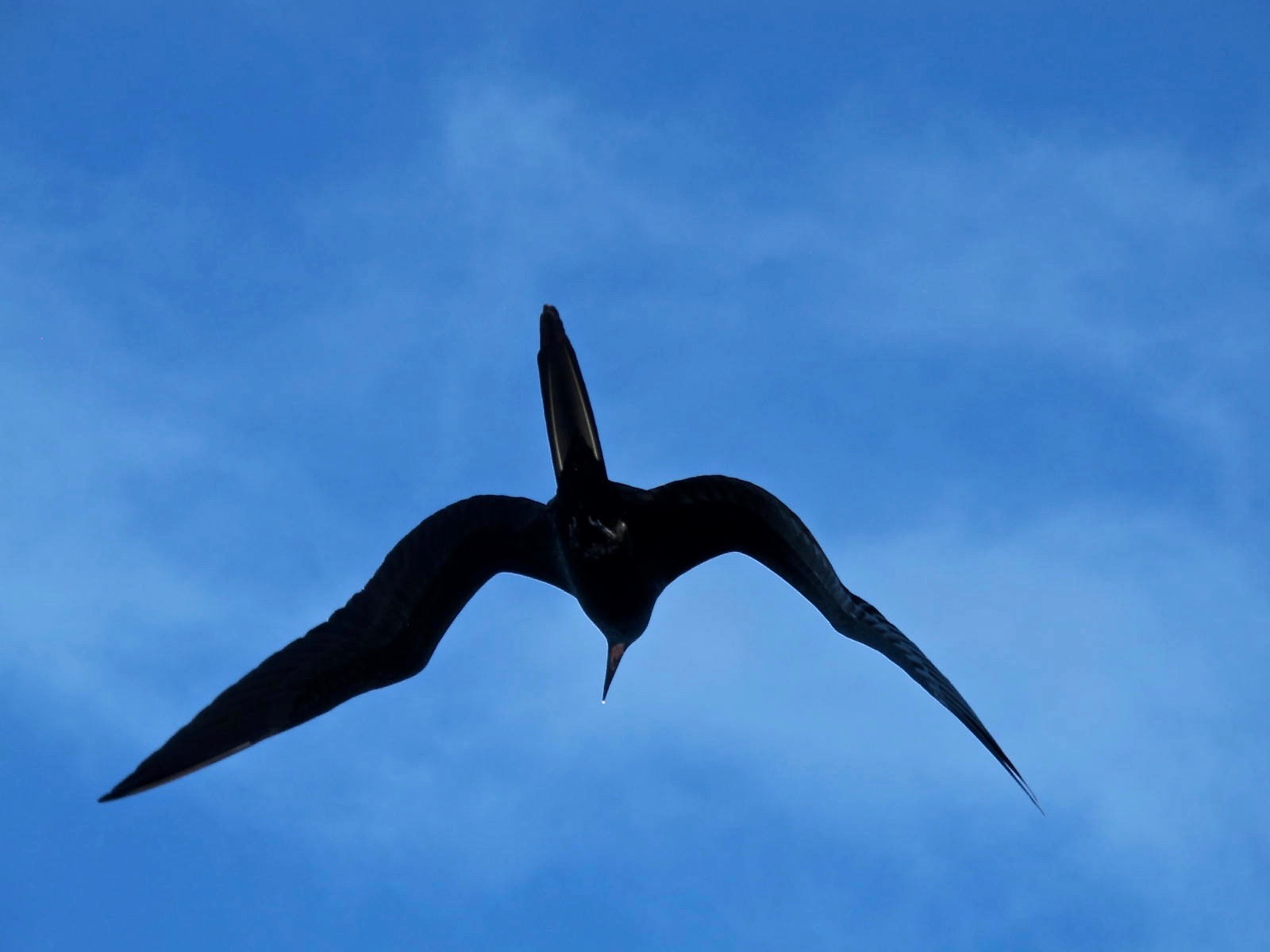
A female frigatebird on the radar mast. She fought off a male who wanted to roost there.

A female frigatebird on the radar mast. She fought off a male who wanted to roost there.

A pelican on the crane.

A pelican on the crane.

A frigatebird on the crane

A frigatebird on the crane

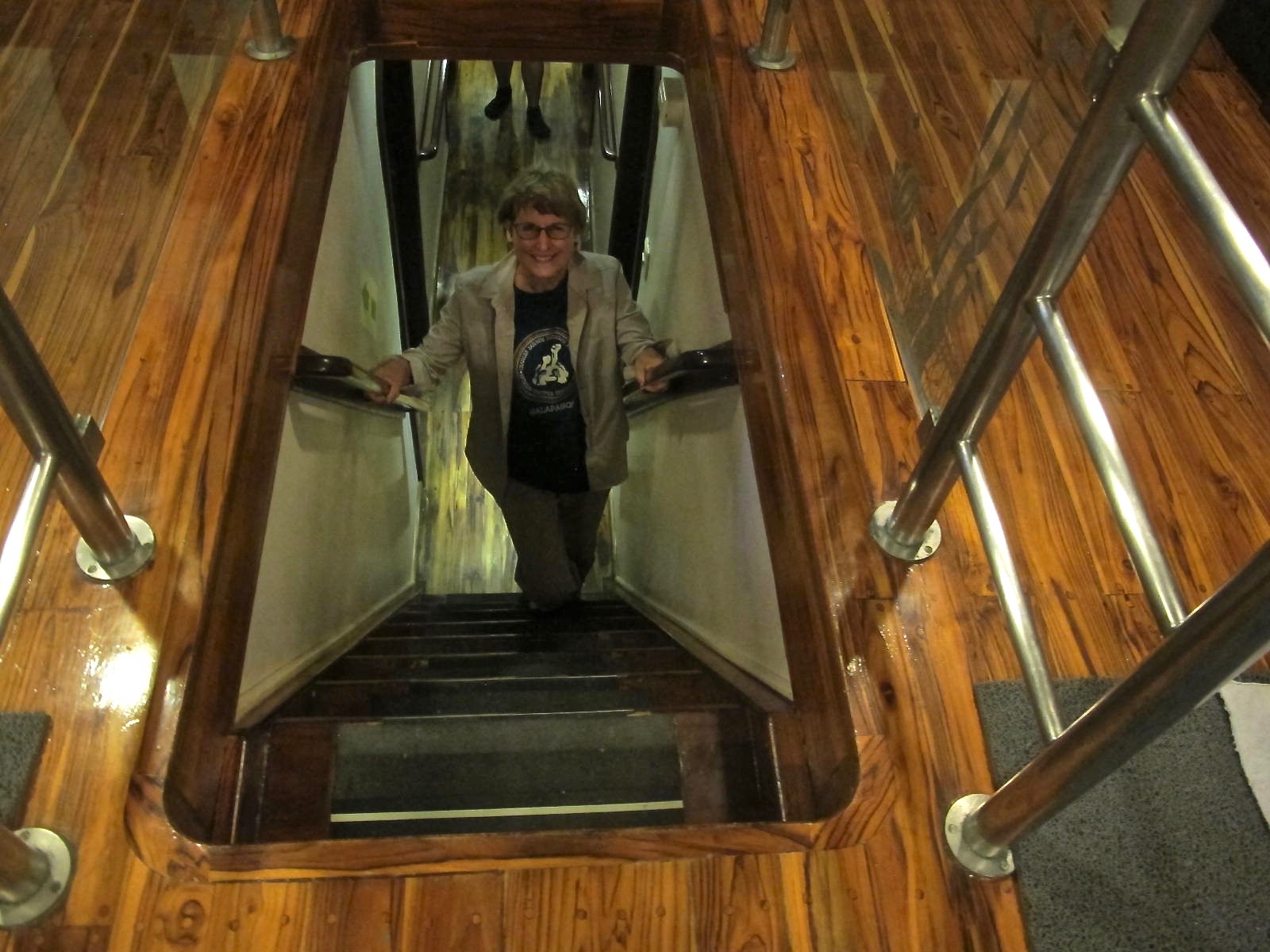
Throughout the voyage, all of us who lived below the main deck would go up and down these steep stairs. If you went down straight, your calves soon became bruised from banging on the narrow steps. I ended up going down sideways quite often to avoid those bruises.

Shirley is at the bottom of the stairs to indicate their steepness.

Shirley is at the bottom of the stairs to indicate their steepness.

A nice sunset, but we didn’t see the green flash.

A nice sunset, but we didn’t see the green flash.

51San CristobalWe woke up the next morning in Puerto Basquerizo Moreno on the Island of San Cristobal. We ate our last breakfast aboard the Galaven and left our gear for the crew to take to the airport. We all went to the Interpretation Center where we enjoyed expositions on natural history, human history and conservation. We had been hearing about conservation the entire trip, as it is so important to protect the wildlife and natural environment on the Islands.

A great blue heron in the port.

A great blue heron in the port.

That afternoon, we took off from San Cristobal and flew to Quito to spend the night. We rose again at the ungodly hour of 2:15 to get our bus back to the airport to get ready for the flight from Quito to Miami. It was a very long day that didn’t end until midnight at Shirley’s place in Grand Junction. But it was worth it! I loved the trip and would do it again.
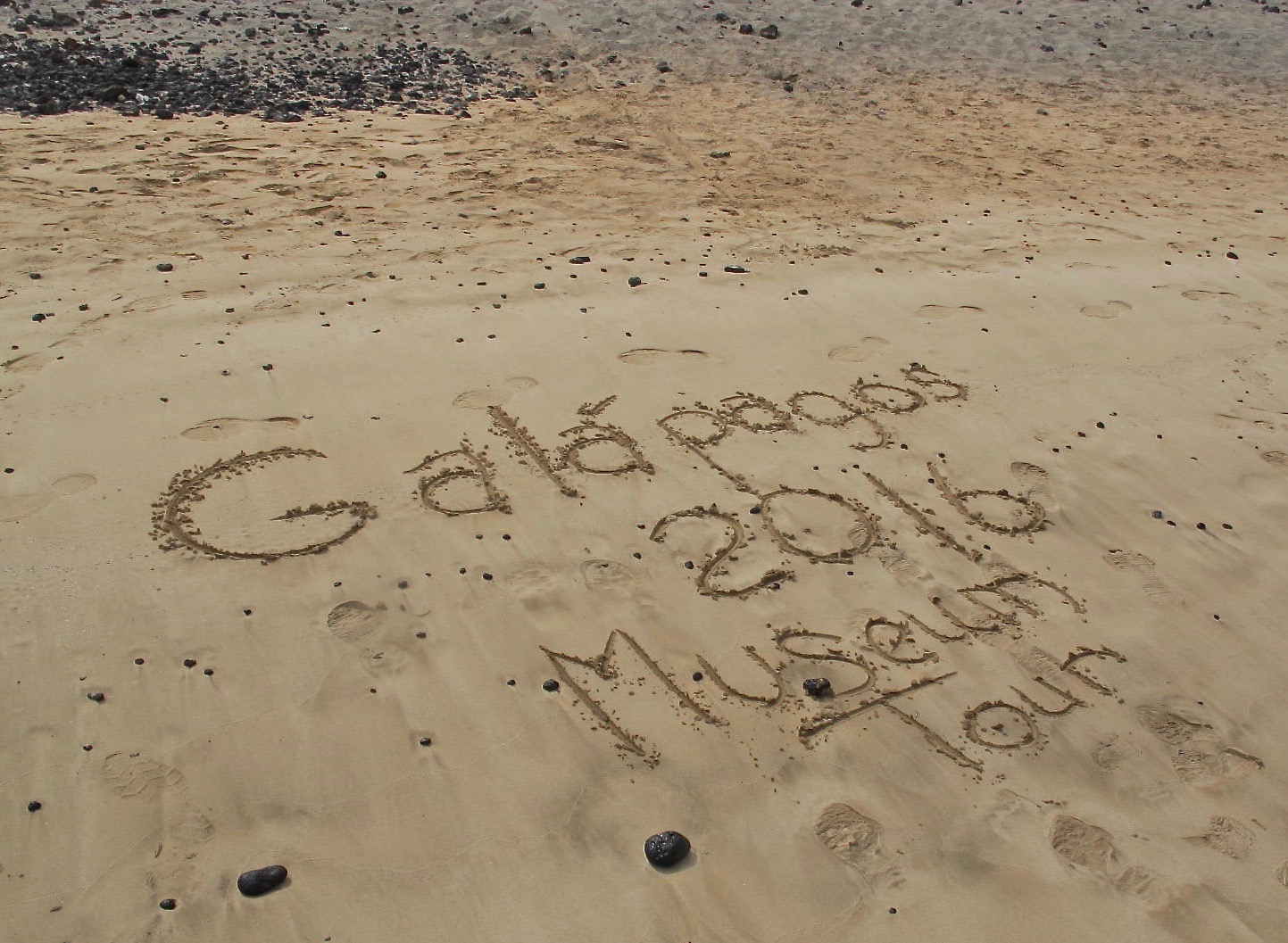
I want to thank Julia, our mighty tour leader, who provided us with some great handouts and clues about the trip. I have shamelessly plagiarized from those notes to give some of the historical perspective. Julia organized a great trip and we all benefited from her research and preparation.Sand Title


SOME OUTAKES

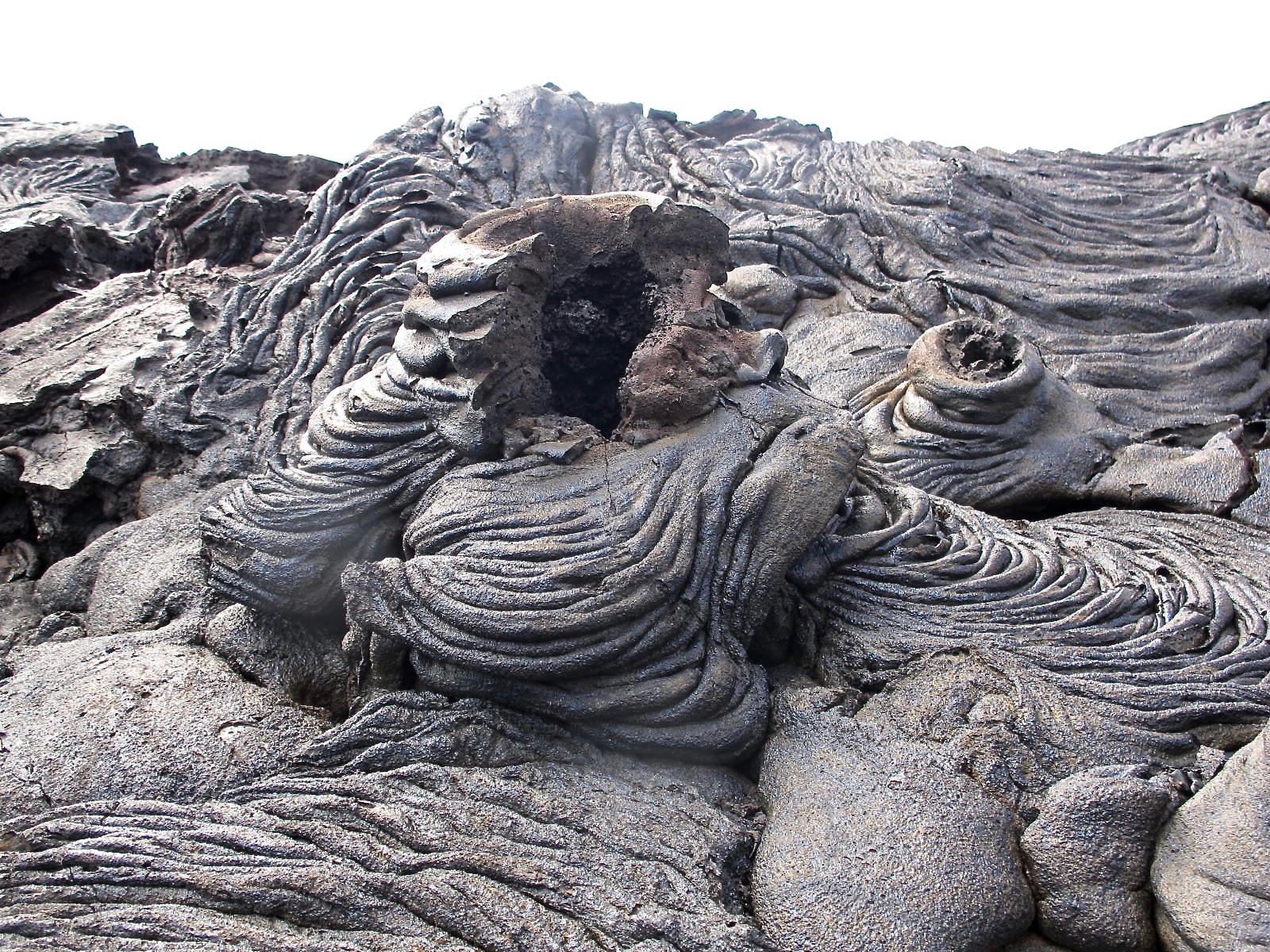
A puka (Hawaiian for hole) in the lava on Rábida

A puka (Hawaiian for hole) in the lava on Rábida

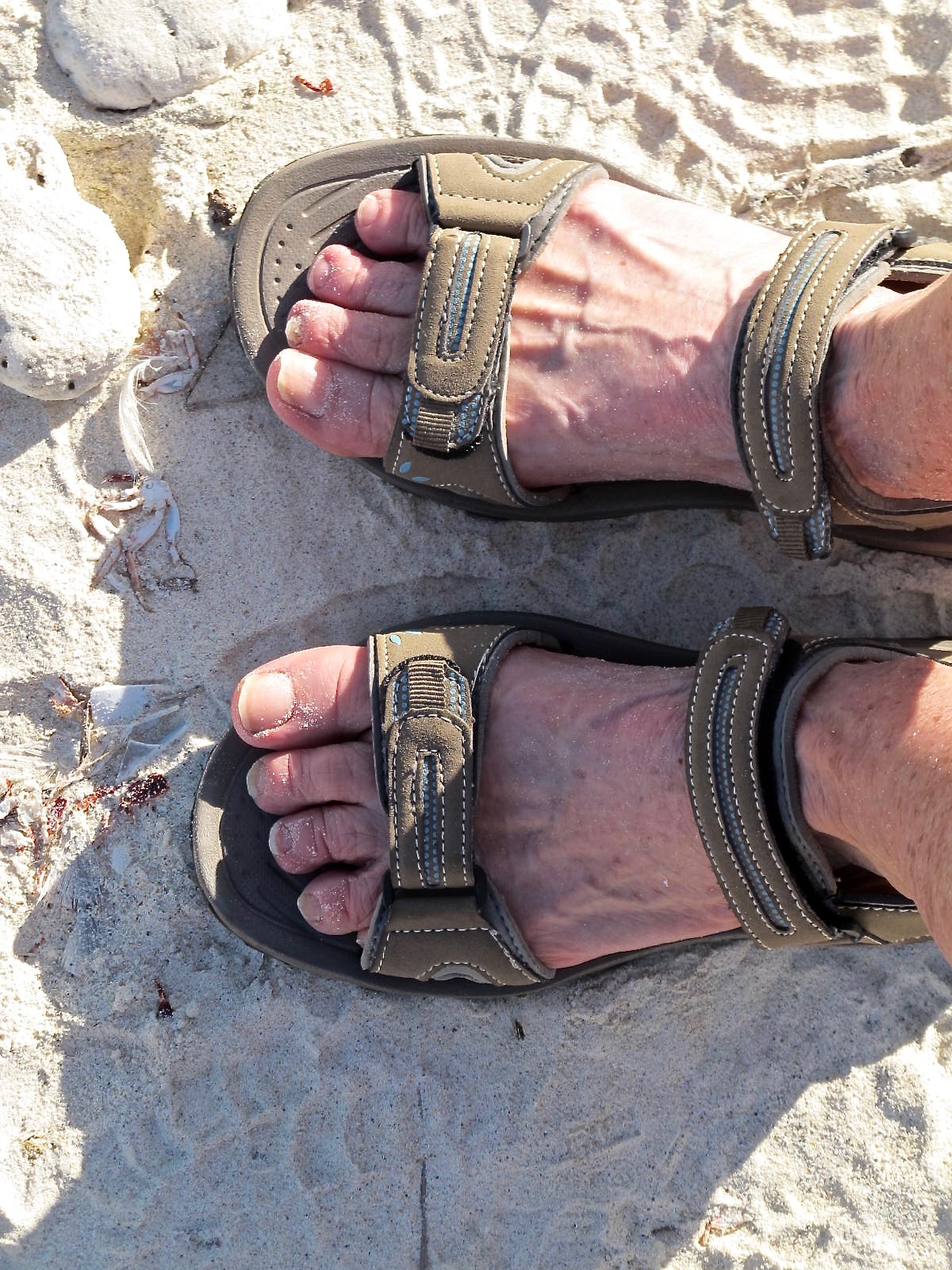
Cora’s wrong footed sandals at Darwin Bay

Cora’s wrong footed sandals at Darwin Bay

Nazca booby taking off

Nazca booby taking off

Pato at Post Office Bay when my lens cover didn’t open up all the way.

Pato at Post Office Bay when my lens cover didn’t open up all the way.

What happens when you don’t follow directions.

What happens when you don’t follow directions.

Looking forlorn

Where’s Mom?

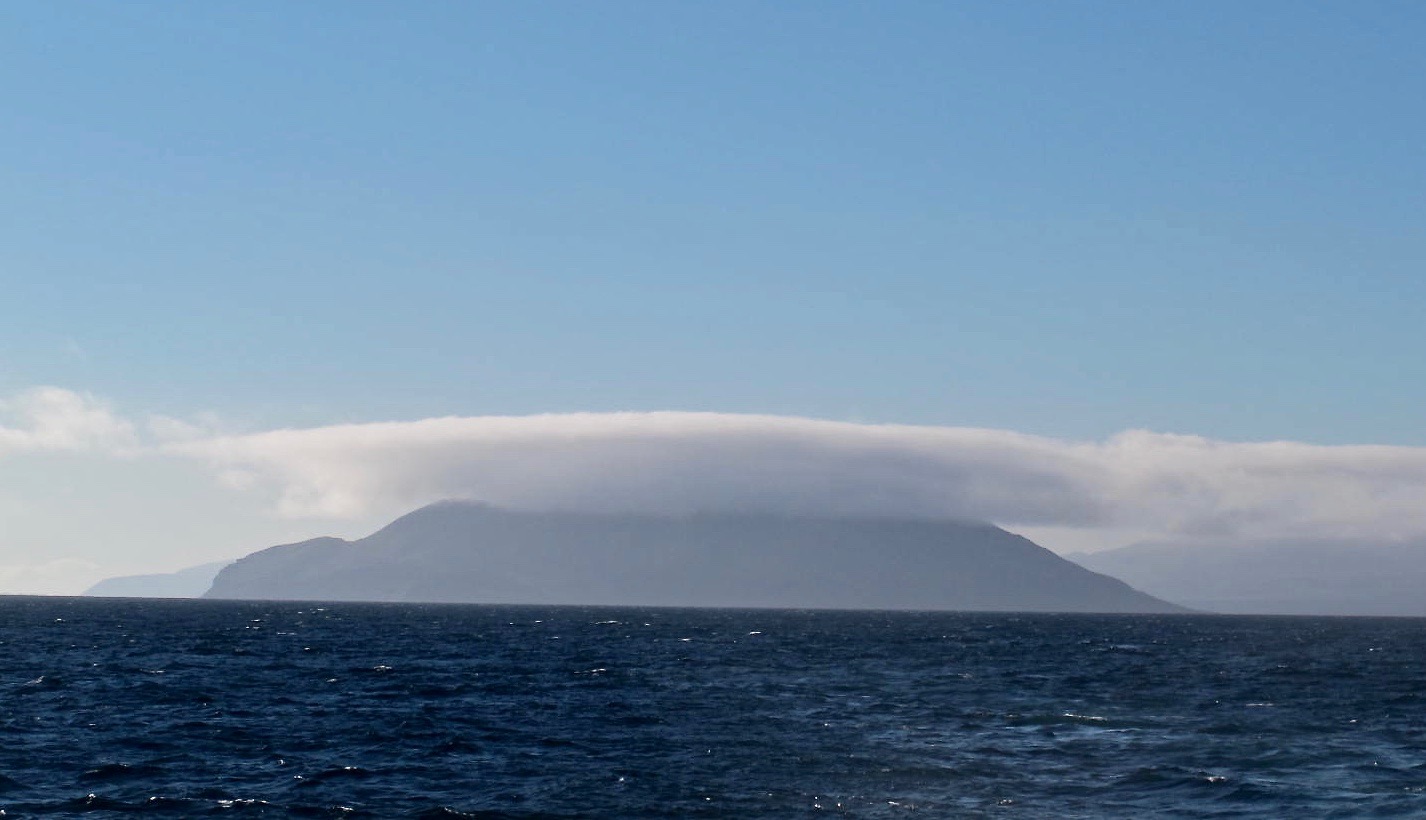
Passing by a cloudy island. Do you think Captain Nemo might have harbored the Nautilus there?

Passing by a cloudy island. Wonder if it was raining.

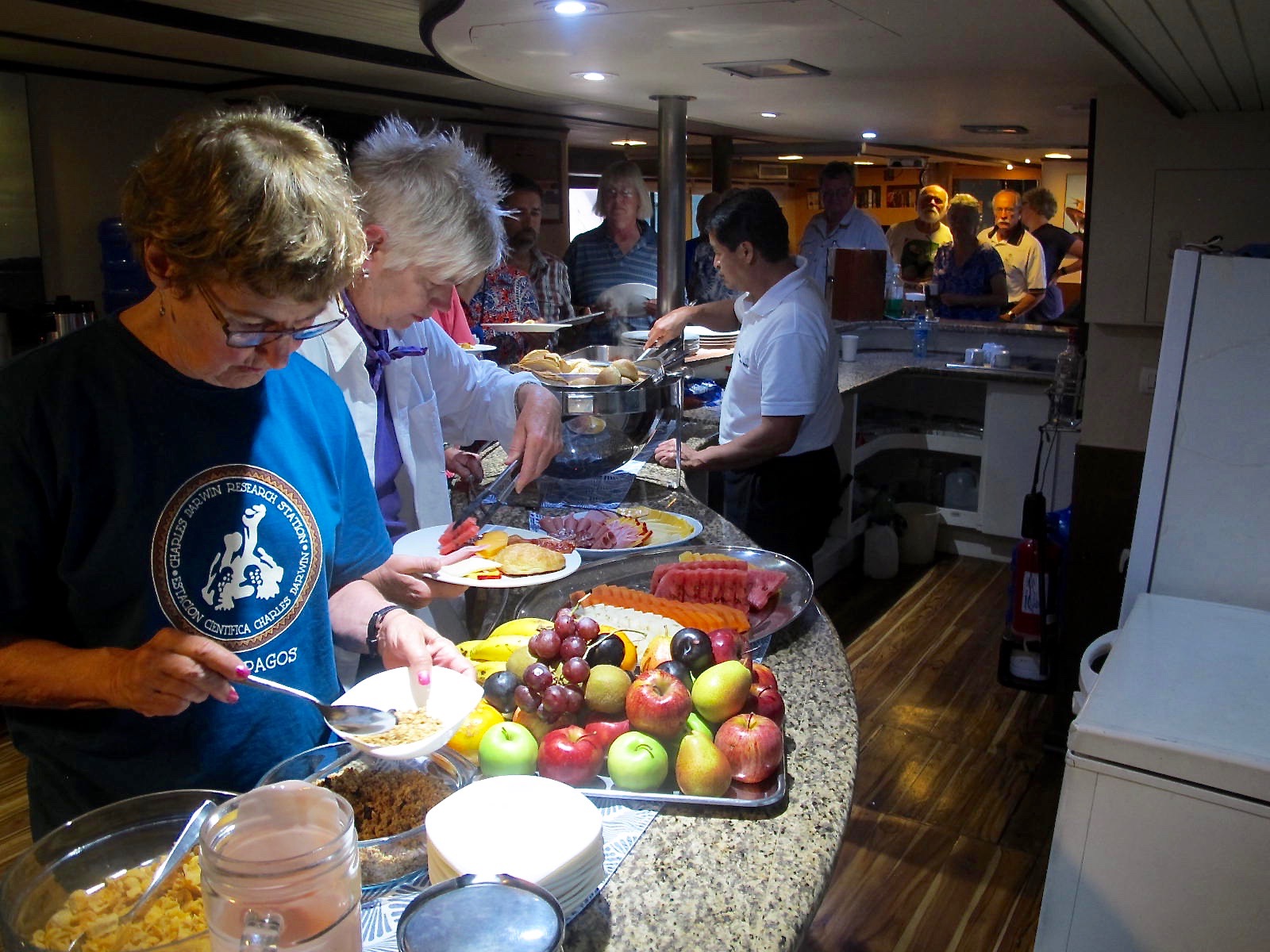
Breakfast line

Breakfast line


Galápagos Adventure #4 – Santa Cruz and Floreana – August 13-14, 2016

1 Sep
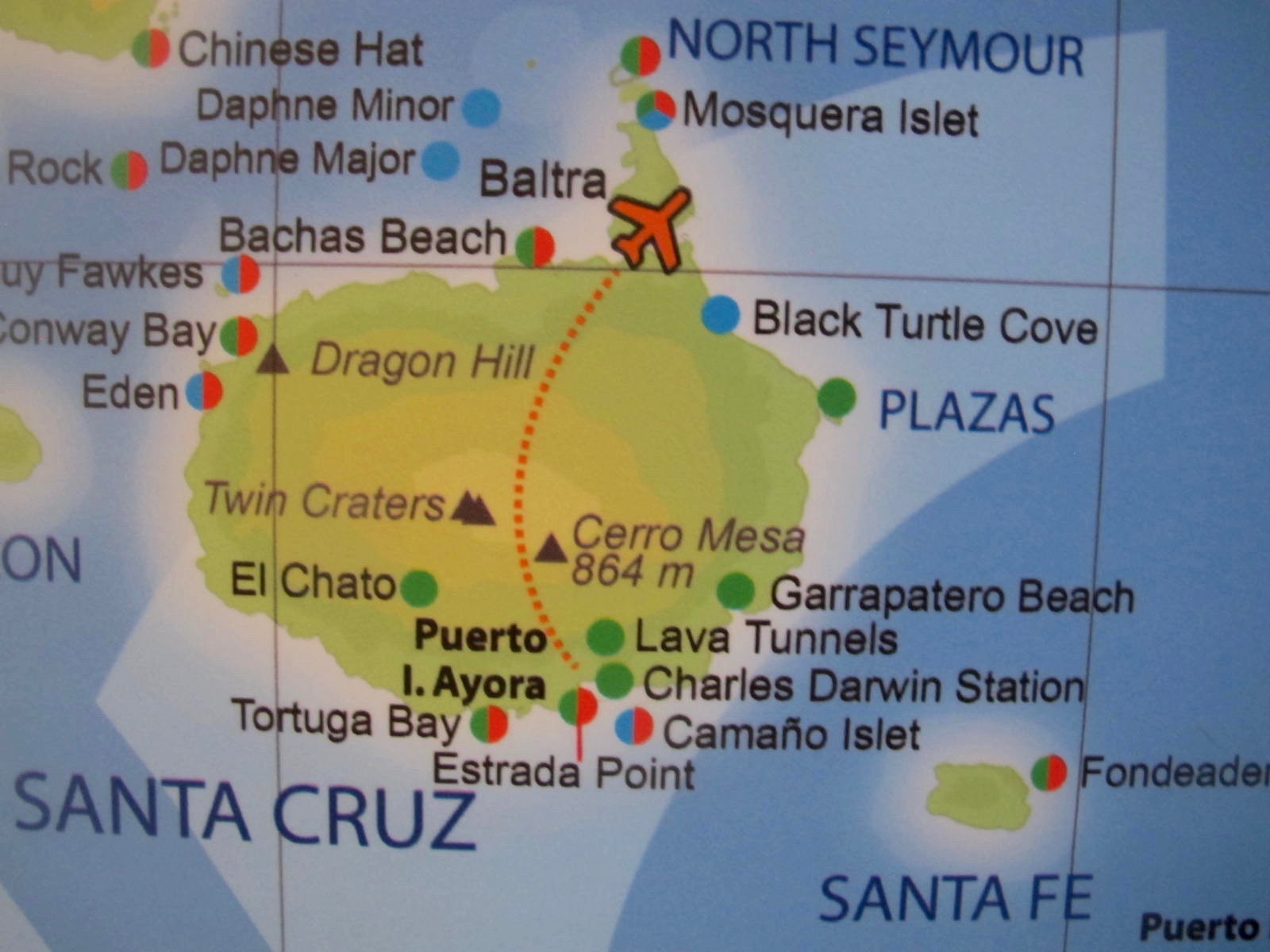
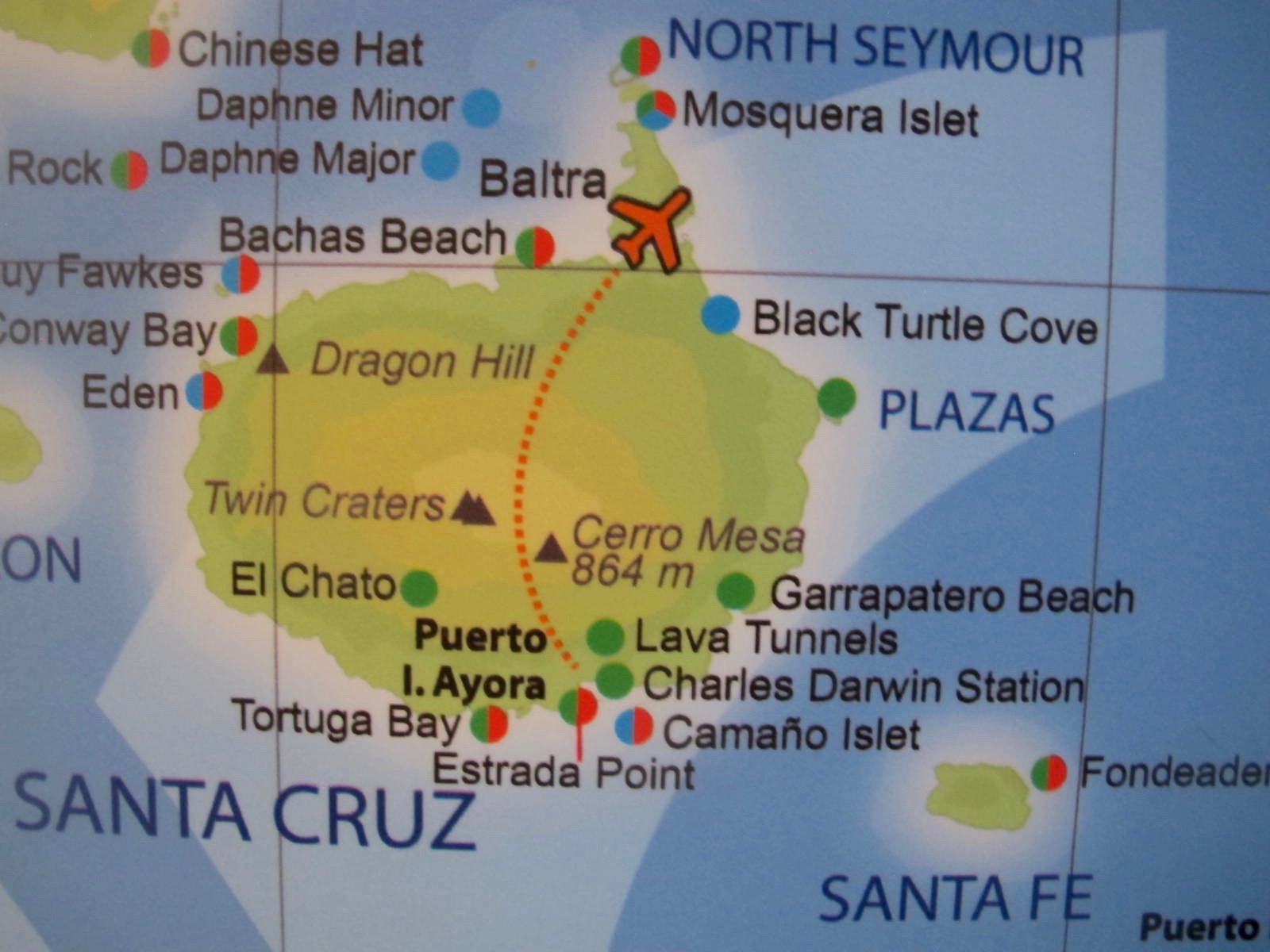
46Santa Cruz Map

Please click on a photo to enlarge it.

I forgot that Dragon Hill and Bachas Beach were on the island of Santa Cruz or would have included this part in #3.

Dragon Hill is one of the newest visitor sites accessible to tourists in the Islands. One of our longest hikes took us along a beach and up a trail to the lagoon lookout where the view is wonderful. On the way, we saw some marine iguanas, black headed stilts, herons, native cotton plants (amazing to see tiny bolls) and land iguanas!
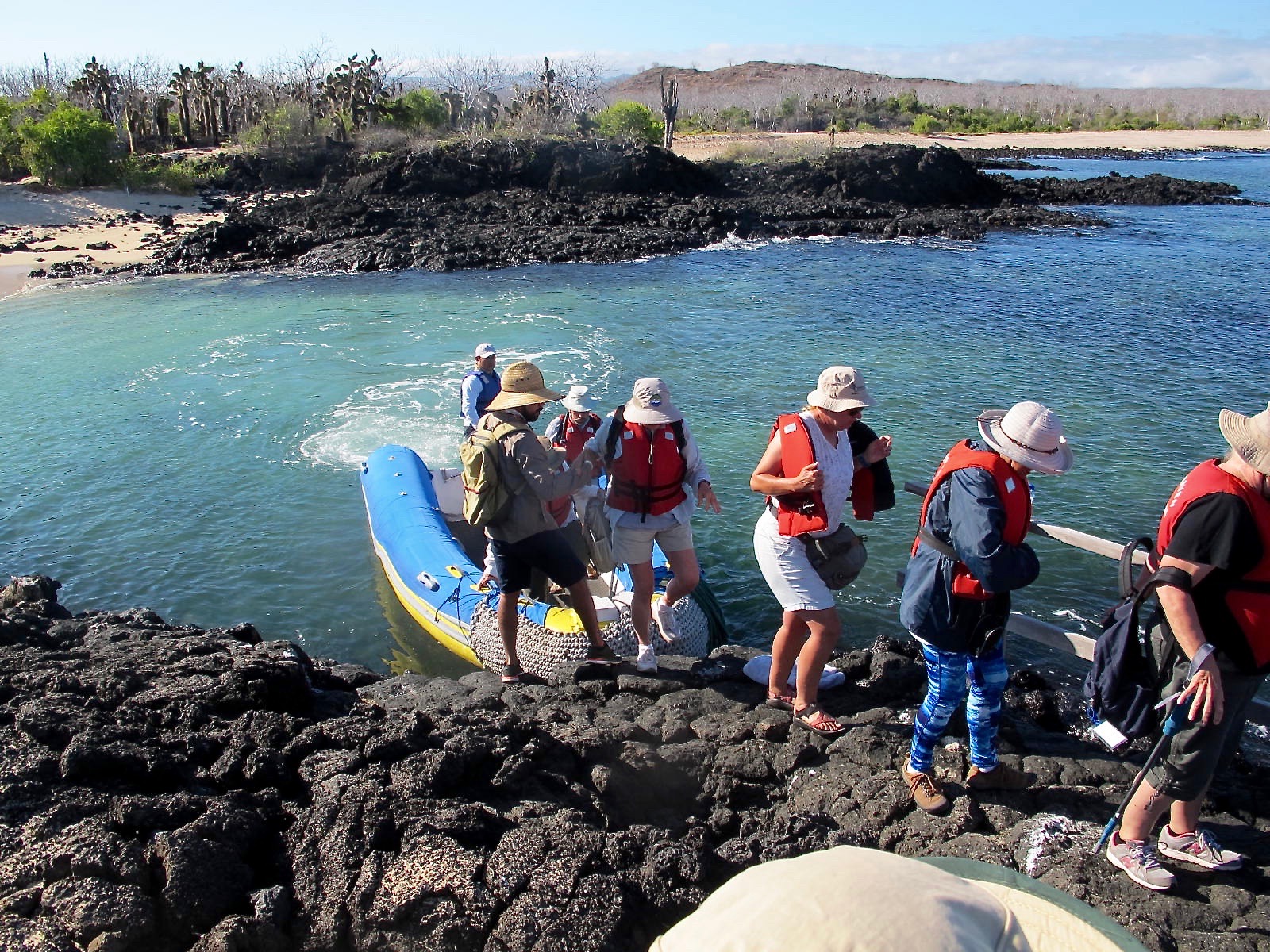
Landing on the beach

Landing on the beach

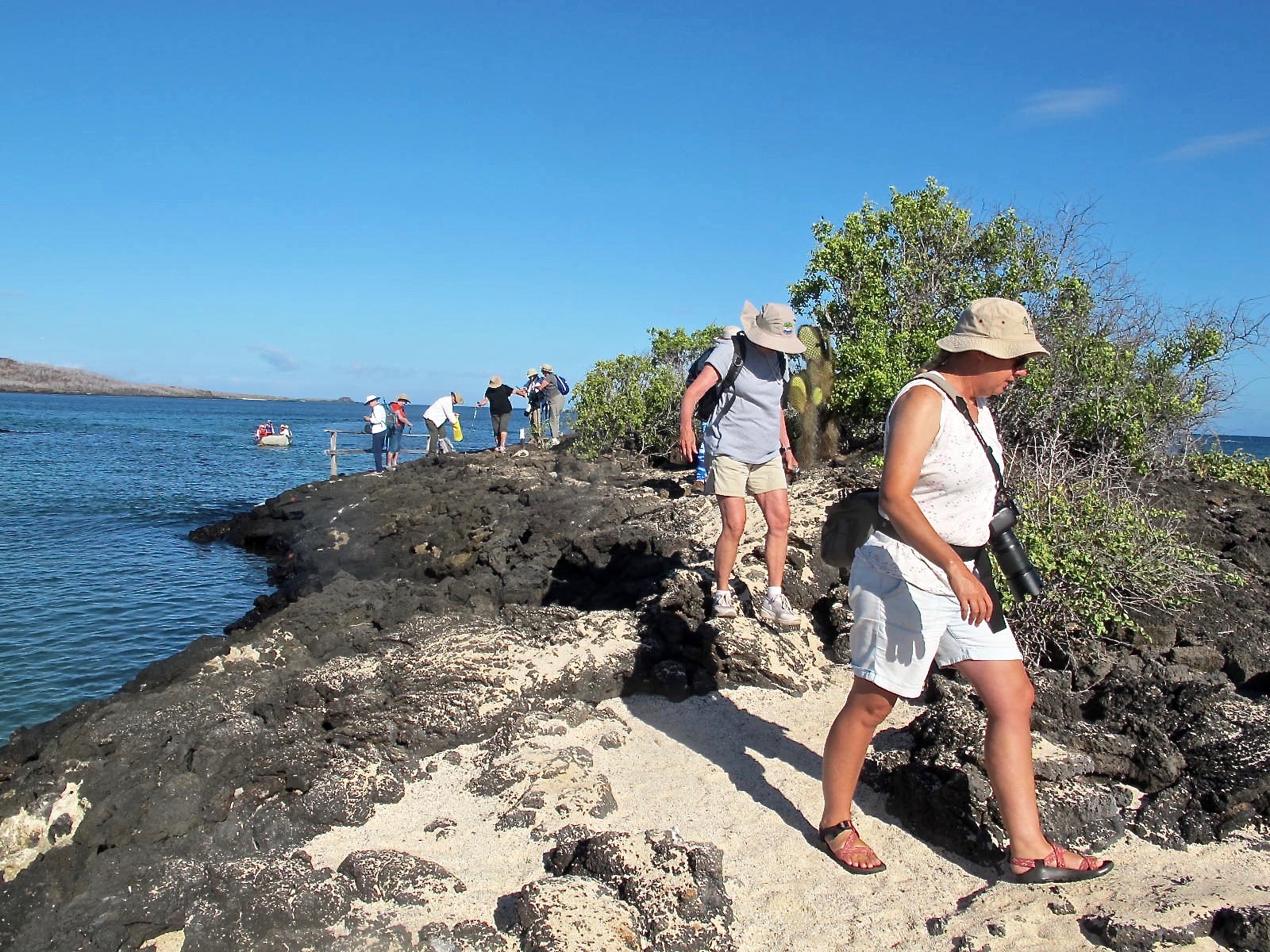
Beginning the trail

Beginning the trail

And for my next song…

And for my next song…

Marine iguana tracks

Marine iguana tracks

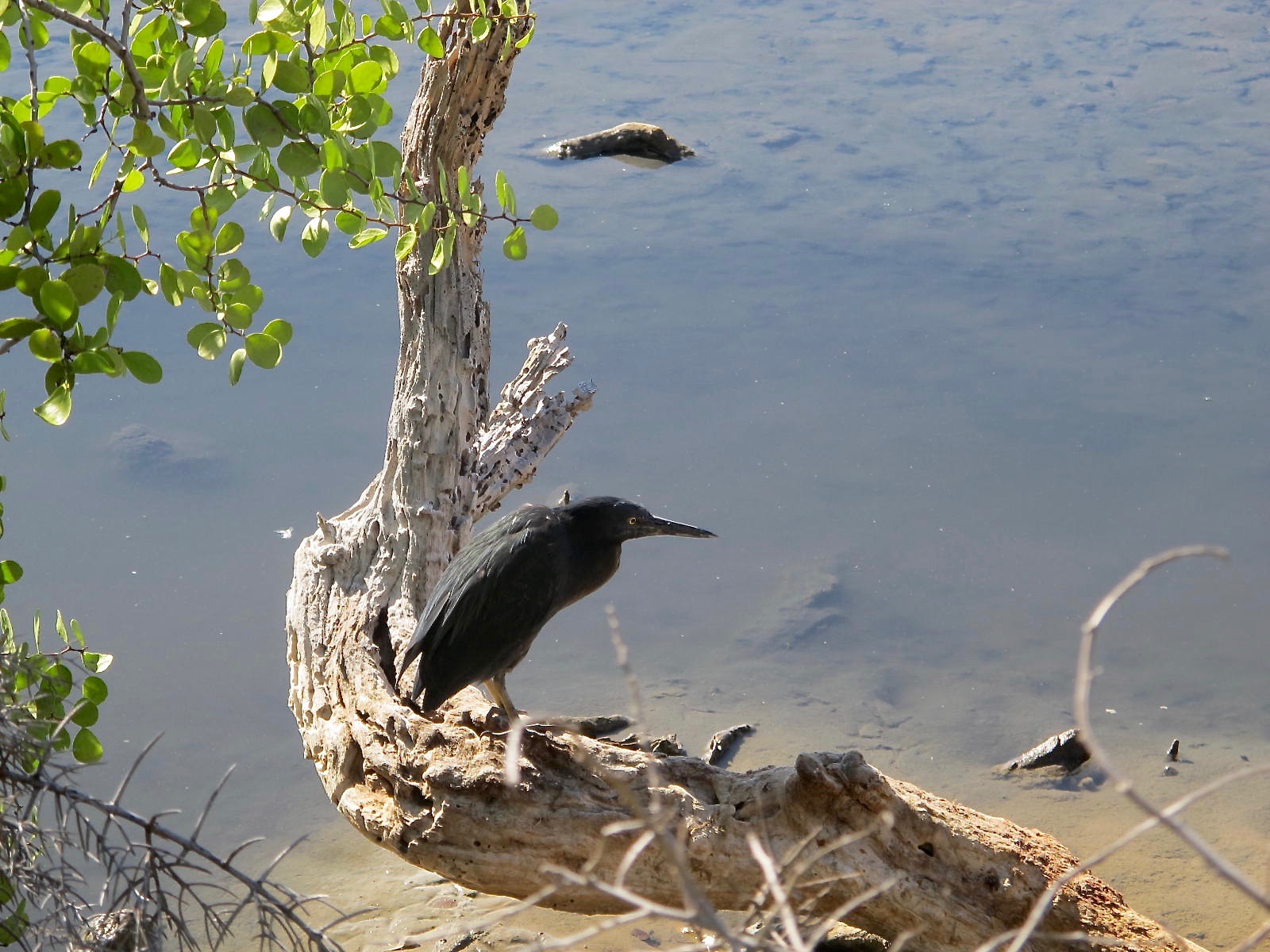
Striated heron

Striated heron

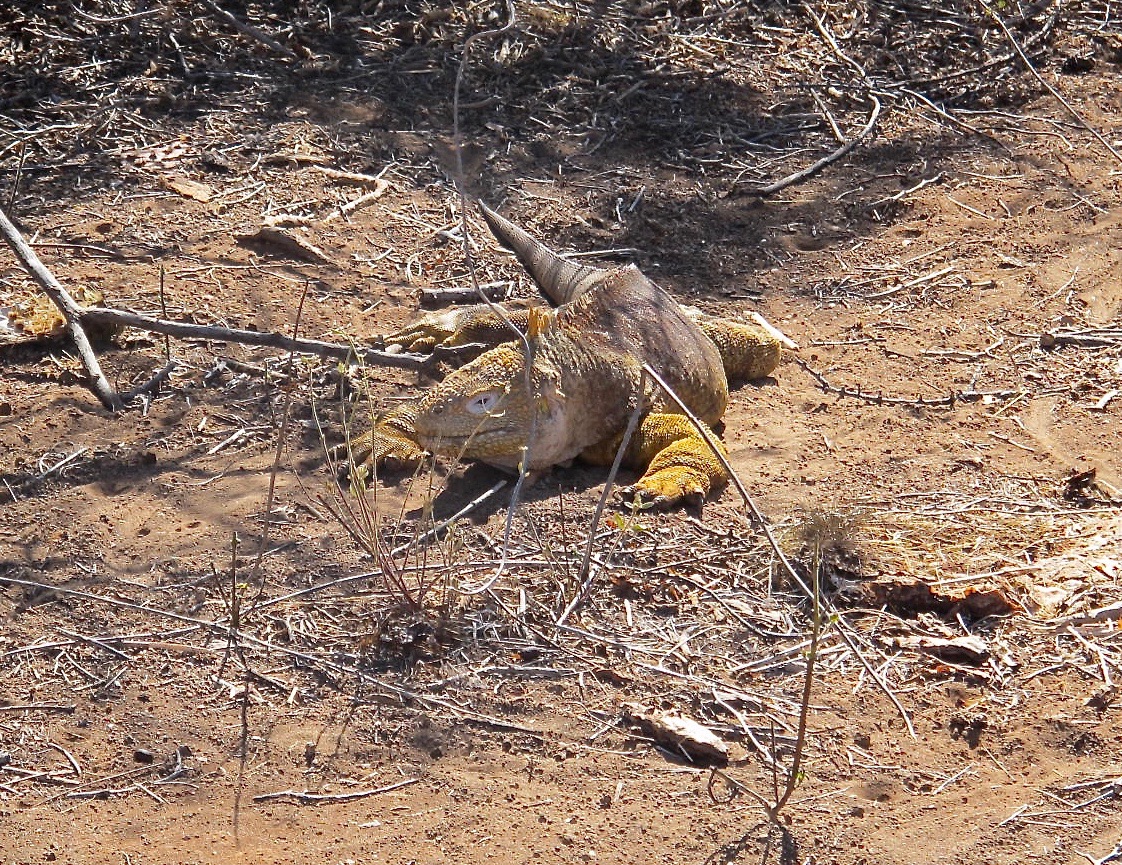
I can see why land iguanas were sometimes mistaken for dragons. They have a long tail, scary looking face, spines on the back, and a scaly skin. They reach only a max length of 3 ½ feet.

I can see why land iguanas were sometimes mistaken for dragons. They have a long tail, scary looking face, spines on the back, and a scaly skin. They reach only a max length of 4 feet

We learned that they don’t have sweat glands and secrete salt from their eye socket. It accumulates around the eye and when there is enough, the iguana shakes his head and off it goes. I saw it happen once and thought that could add to the scary image of the iguana. We walked right by them and they just looked at us. They appeared to be very docile but perhaps they could move quickly when they wanted to. We didn’t find out.

We learned that they don’t have sweat glands and secrete salt from their eye socket. It accumulates around the eye and when there is enough, the iguana shakes his head and off it goes. I saw it happen once and thought that could add to the scary image of the iguana. We walked right by them and they just looked at us. They appeared to be very docile but perhaps they could move quickly when they wanted to. We didn’t want to find out.

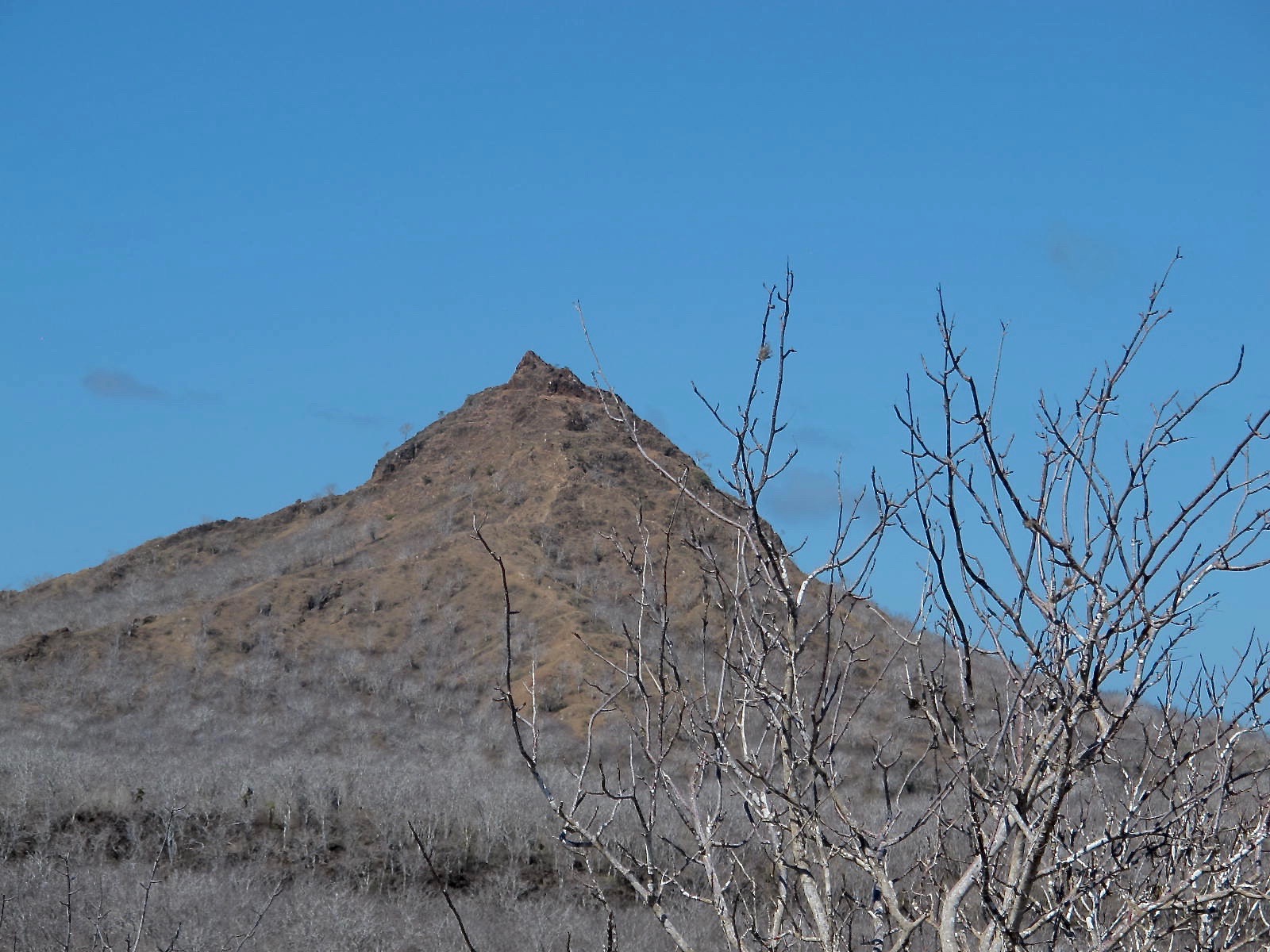
Dragon Hill or Cerro Dragon.

Dragon Hill or Cerro Dragon.

Land iguanas are bred under captive protection at the Charles Darwin Research Station on the southern side of Santa Cruz. We saw a few of them in pens the previous day. Once the iguanas have safely reached a size to be able to fend off wild dogs or cats, they are released into the wild on the northwestern side of Santa Cruz, so that the species can again take up residence on Cerro Dragon.

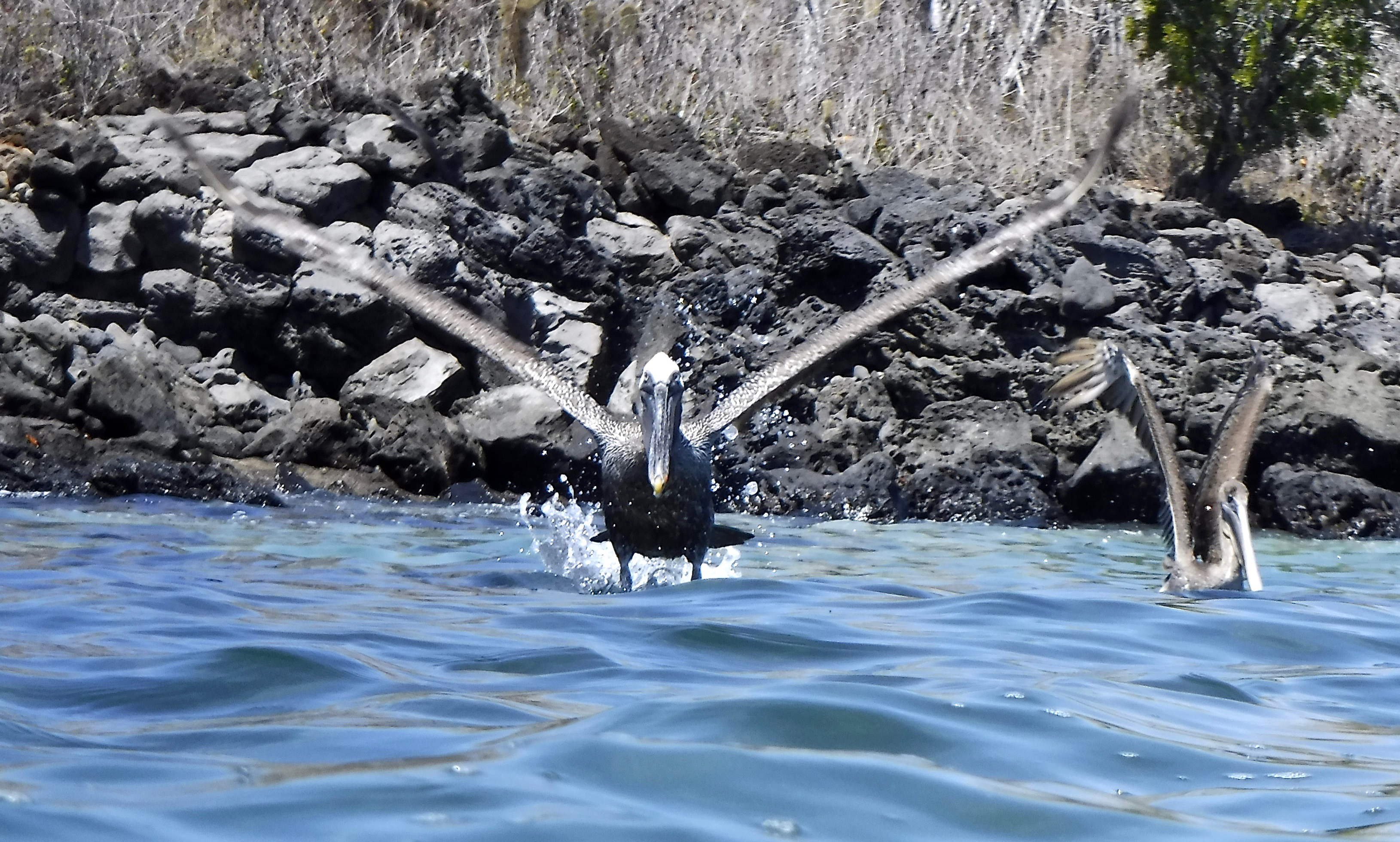
Later that morning, we were able to snorkel in deep water near the Dragon Hill area. I took many underwater pictures, but my best shot was of this pelican coming right at me (not underwater) :-)

Later that morning, we were able to snorkel in deep water near the Dragon Hill area. I took many underwater pictures, but my best shot was of this pelican coming right at me (not underwater) 🙂

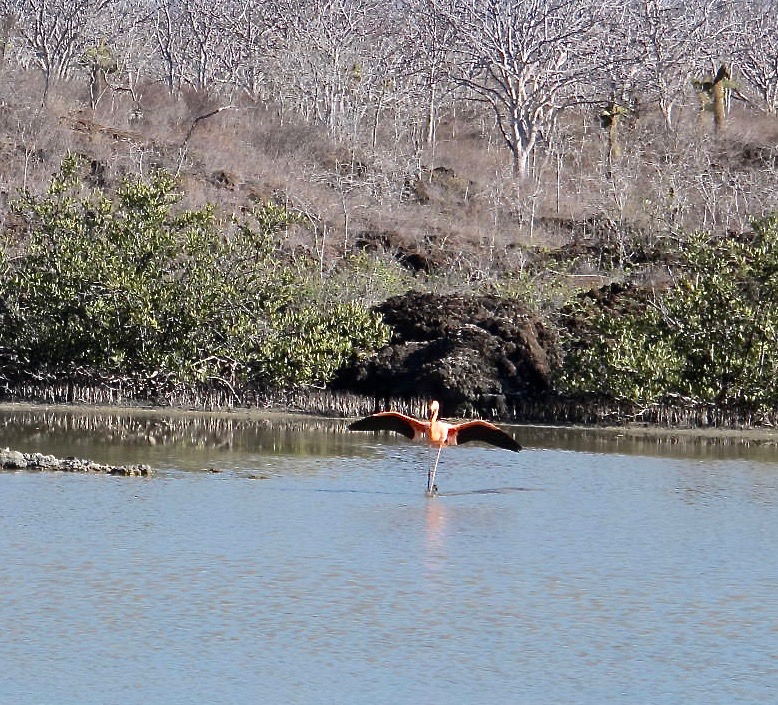
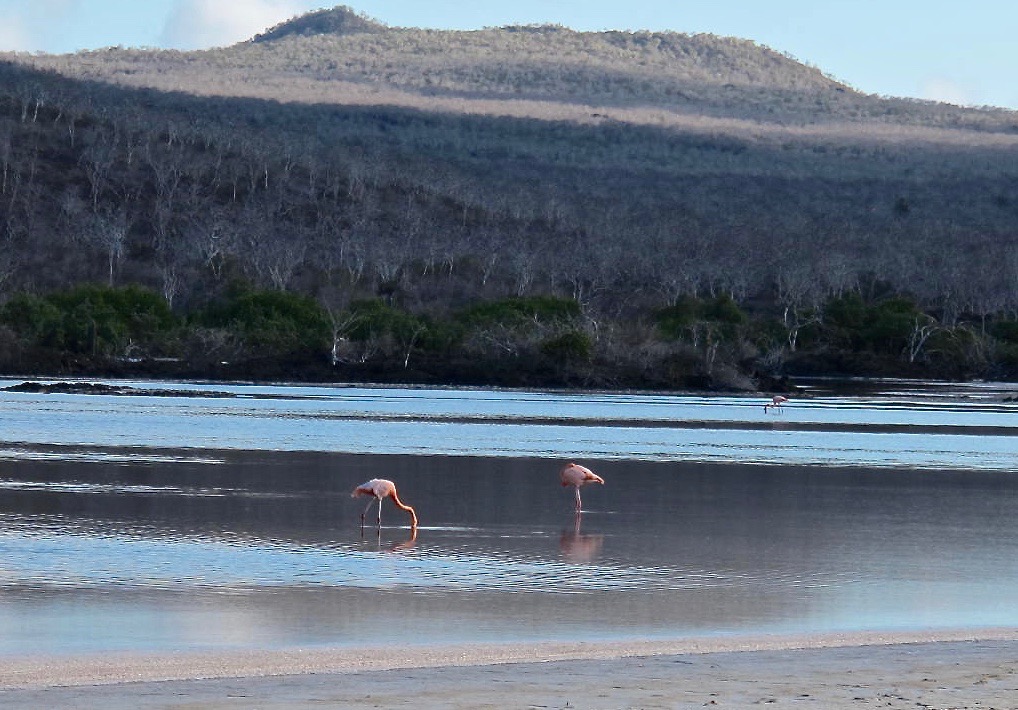
Later that day we went to Bachas Beach. Some folks swam and saw some more penguins and sea turtles. BUT, I did get to see a flamingo landing in a muddy marshy area and that was pretty cool.

Flamingo landing in lagoon

Flamingo landing in lagoon

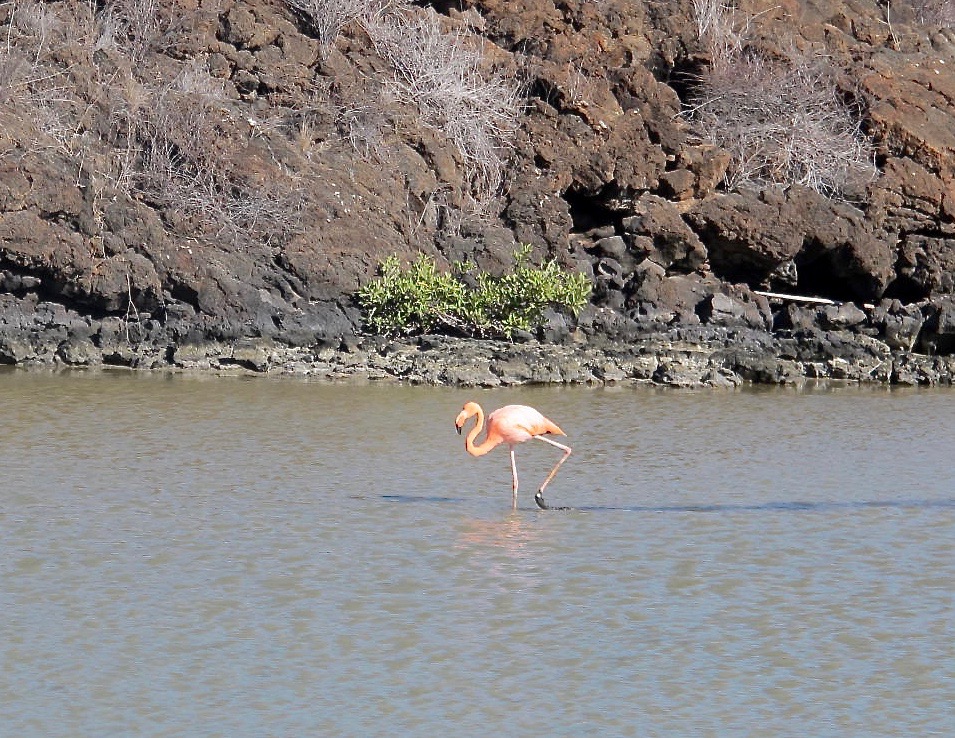
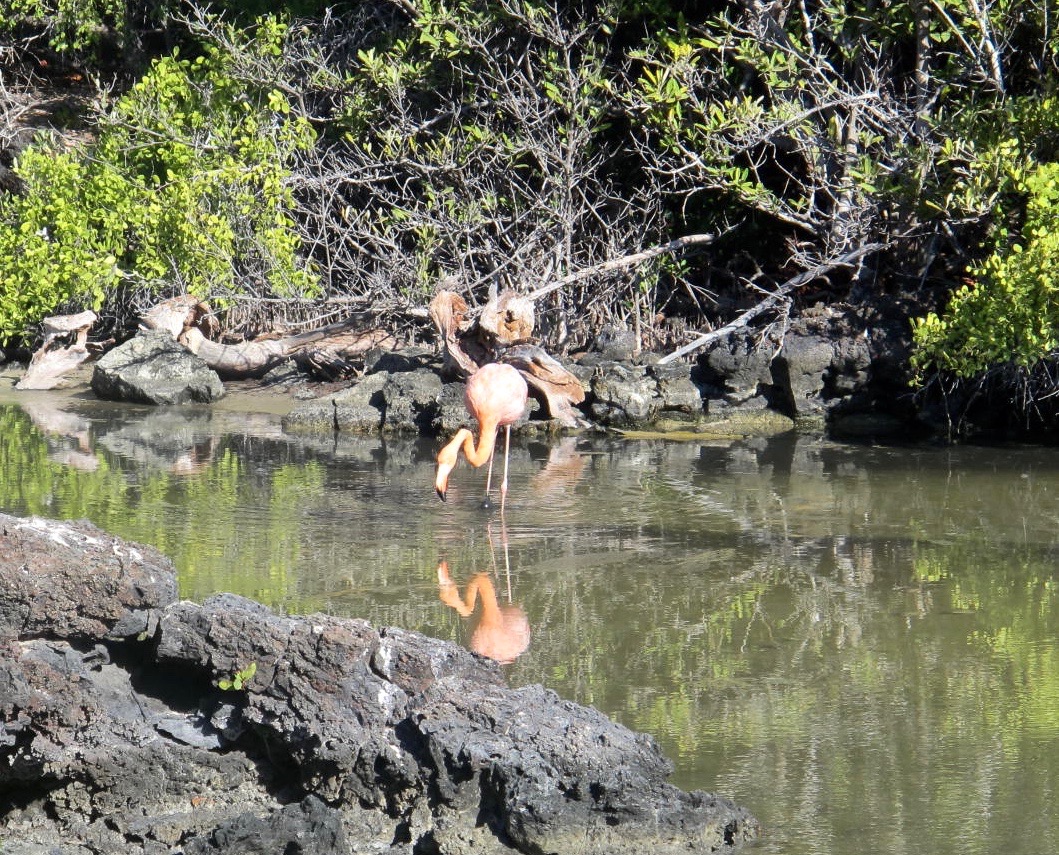
I was so excited about this bird that I took more than 40 pictures of him landing and then walking around. He was quite a distance from me, so the pictures have been cropped a lot, but I think he shows up ok. This was another highlight of the adventure that made me very happy I went to the Galápagos.

Looking for vittles

Looking for vittles

Feeding in a small lagoon

Feeding in a small lagoon

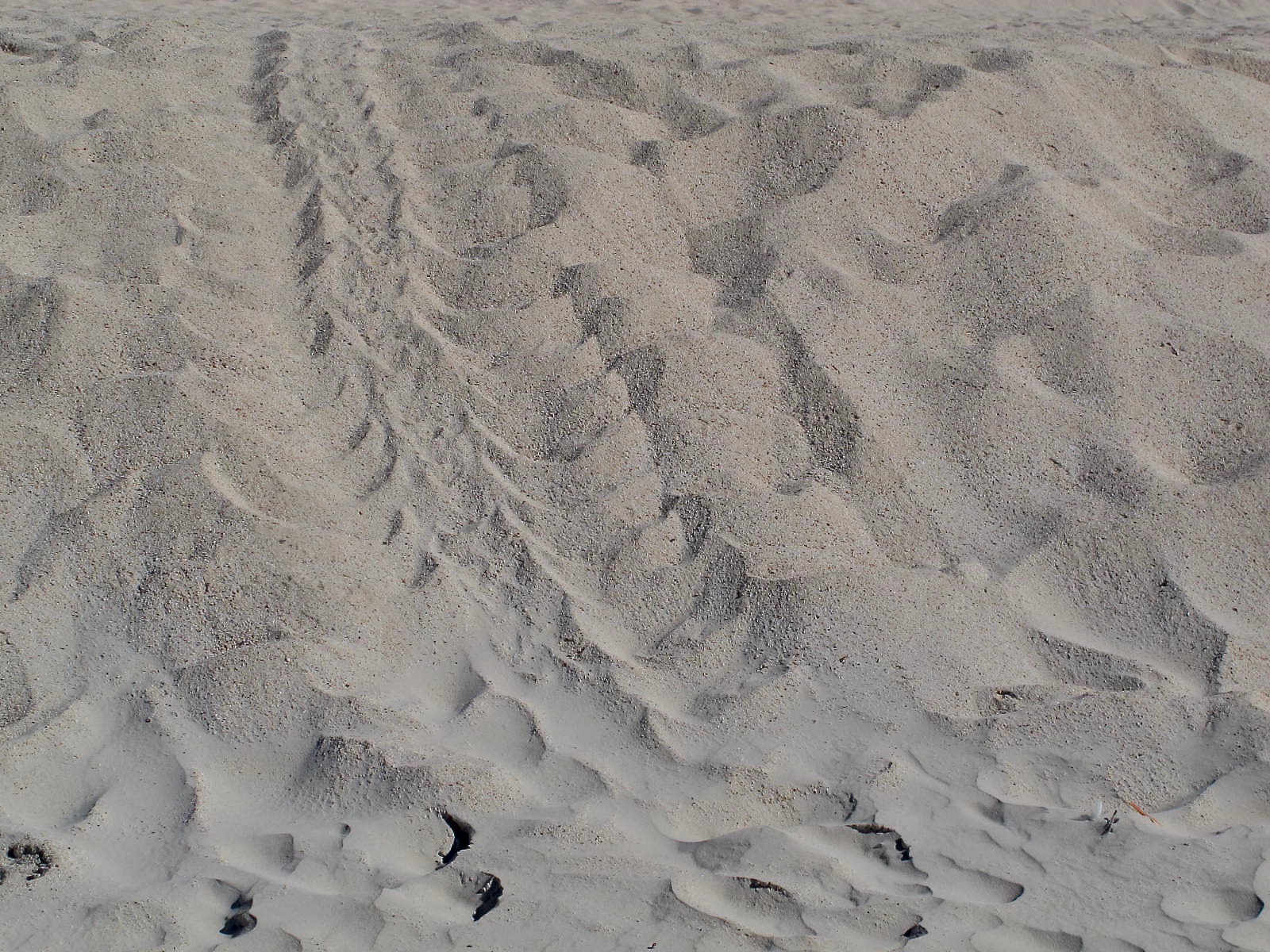
Bachas Beach is noted for a nesting place for sea turtles and we could see tracks of mamas who were going up the sandy berm to find a perfect place to lay their clutch of 100 to 180 eggs. Their tracks reminded me somewhat of a Caterpillar tractor tread.

sea turtle tracks

sea turtle tracks

Karen and Shirley relaxing at Bachas Beach

Karen and Shirley relaxing at Bachas Beach

Floreana

Floreana

A bit more background of the islands before I talk about our visit to Floreana.

They were discovered officially in 1535 by Fray Tomás de Berlanga (Bishop of Panama).

In the late 1500s to early 1700s, the islands were used by pirates as a refuge and base for their raids on Spanish colonial ports. The pirates would stock up on fresh water and tortoise meat, thus beginning the inroads on the tortoise population.

In the late 1700, whaling and hunting of fur seals began in the Galápagos and lasted well into the 1800s. Fur seals were nearly hunted to extinction, whale populations were heavily hit and whole races of tortoises were removed for meat. Some estimates indicate that ~100,000 tortoises were killed during this interval.

The Galápagos islands were officially annexed by Ecuador in 1832.

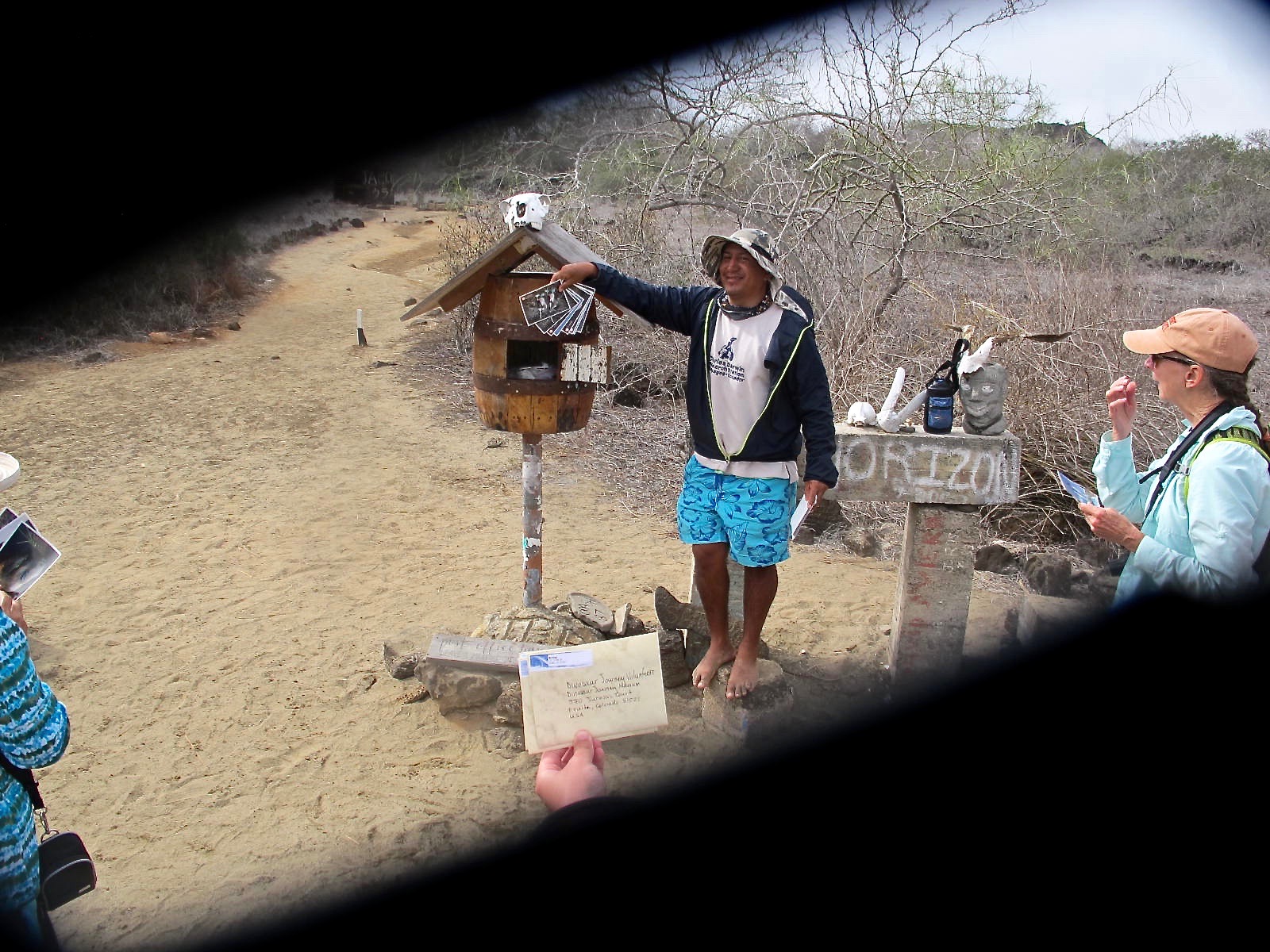
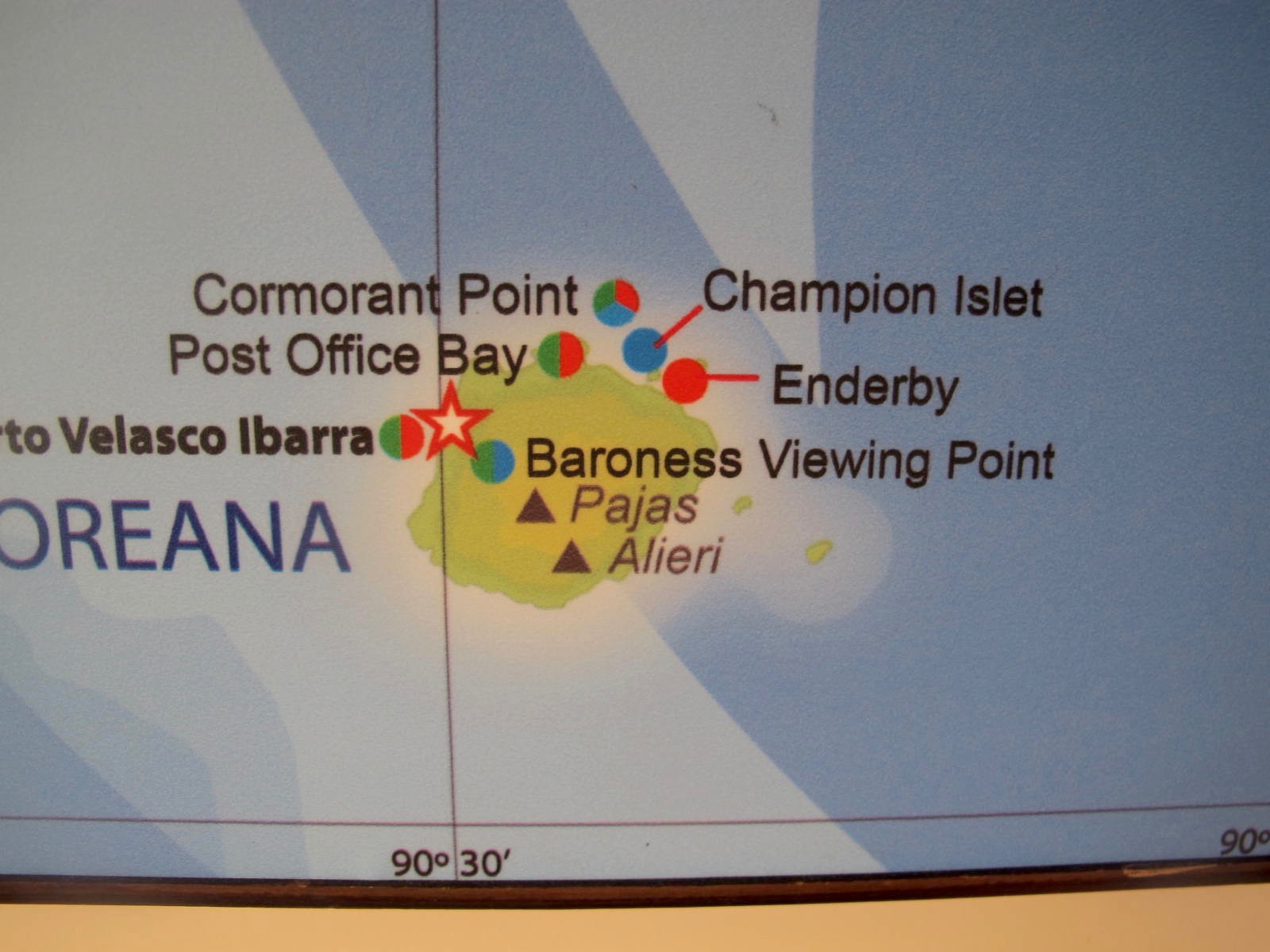
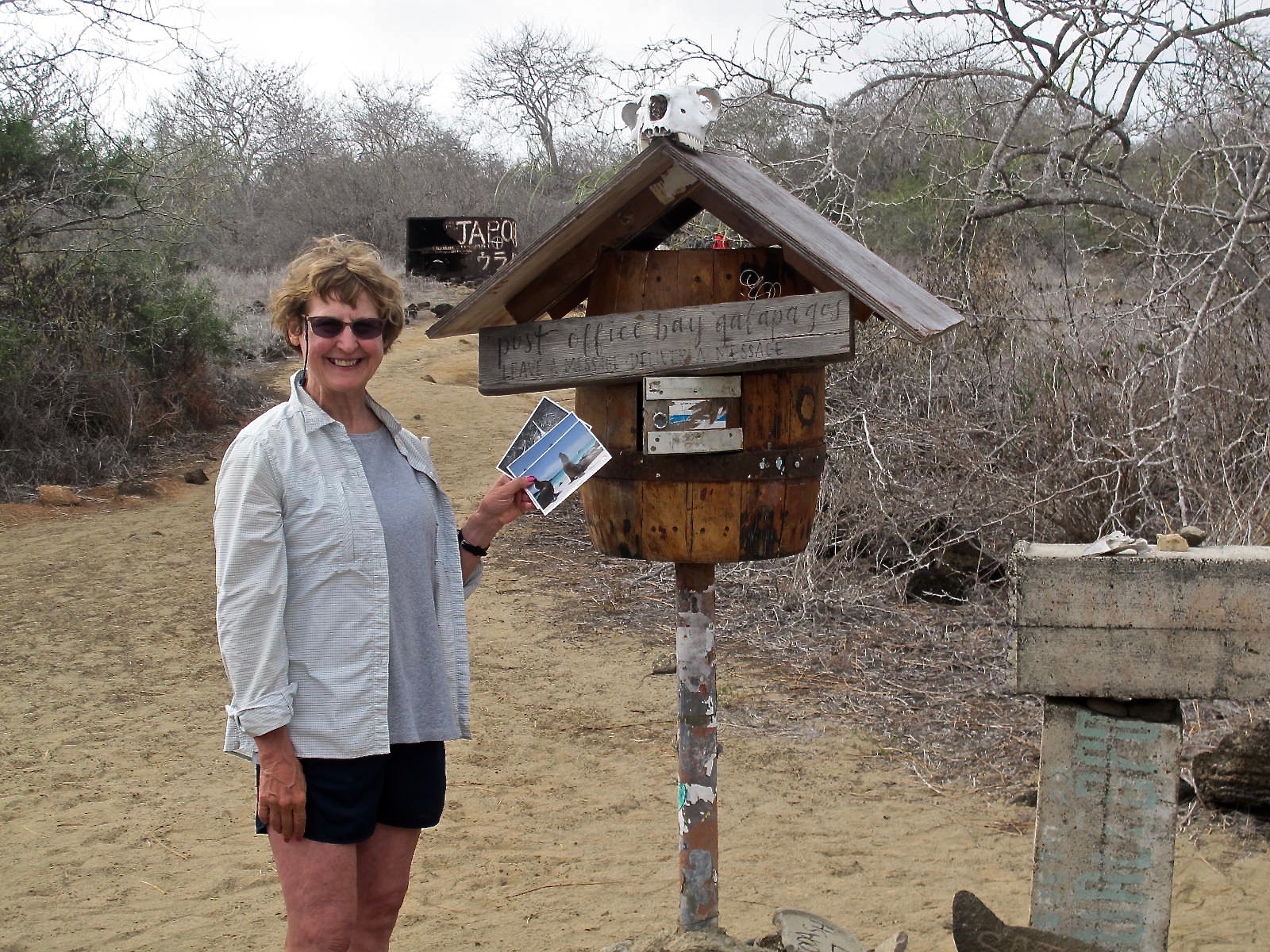
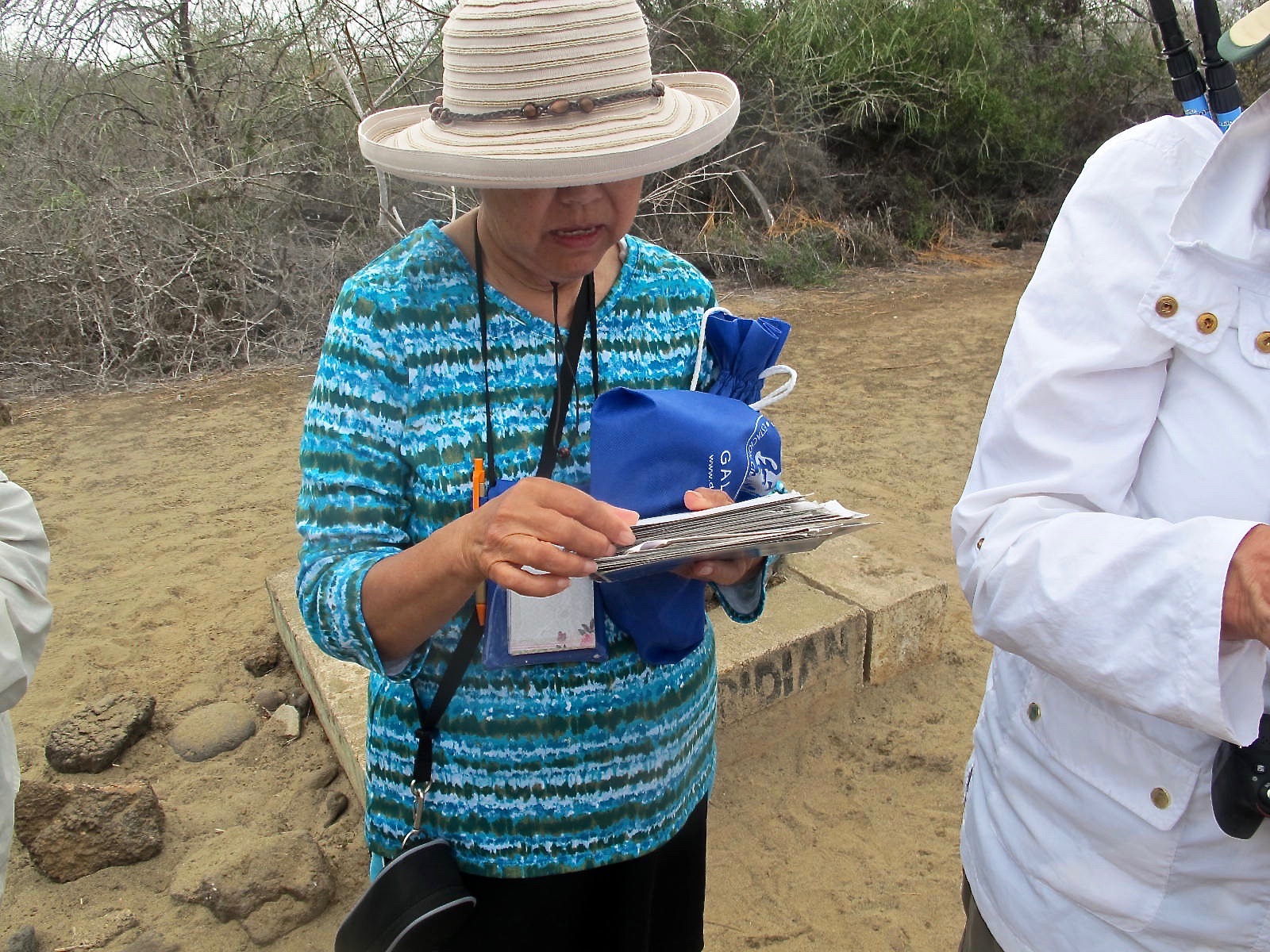
So why all this background? I wanted you to understand a bit of the history that led up to the first place we landed in Floreana, Post Office Bay. This was the first “post office” on the islands and was established in 1793 by whalers. They placed a barrel just a bit inland and then wrote letters to be placed in the barrel. When another crew came there, they checked the letters and took the ones where they would be going. Sometimes it would take years for the letters to arrive but they did and were delivered by hand.

The tradition still lives on and we were welcome to deposit letters in the barrel and take a letter back to the mainland.

The tradition still lives on and we were welcome to deposit letters in the barrel and take a letter back to the mainland.

All of us sorted through many post cards to try to find some close to where we live or ones that we thought we could eventually deliver in person. I mailed two and took three to be delivered in Reno and California. I wonder how long it will take to get my post cards to Megan and Dalan.

Flo sorting through the many cards to be mailed

Flo sorting through the many cards to be mailed

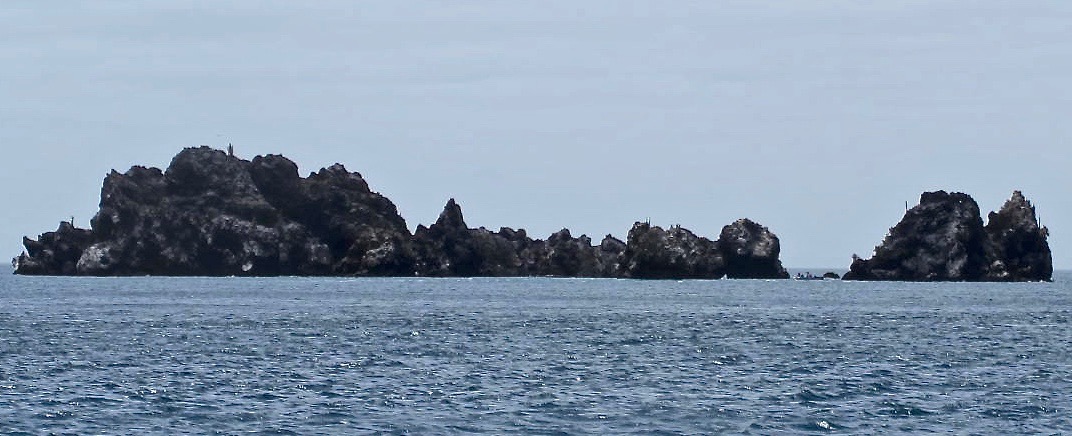
On our way to Cormorant Point, we stopped at Devil’s Crown to do some deep water snorkeling. This is what Galápagos.com has to say about this place. One of the best snorkeling sites in the Galapagos, this volcanic crater has been eroded by the waves leaving the northern and southern sides poking out of the water. The coral reef in the middle is perfect for attracting marine life. Snorkelers enjoy the variety of marine life and exciting currents that rush through the crown, creating an exhilarating experience.

I think the profile of Devil's Crown looks dangerous and intimidating. How about you?

I think the profile of Devil’s Crown looks dangerous and intimidating. How about you?

Those “exciting” currents were VERY strong currents for the majority of our snorkelers. We got off the Zodiac to the right of the right hand peak and before we could get ourselves oriented to landmarks and such, we had drifted alongside the far (western?) side of the Crown. Those rocks didn’t look friendly. I didn’t see much marine life in that area and kept checking on Shirley to make sure she was ok. I was glad to see that she got back into the Zodiac before we drifted around the left end of the Crown, as I know she doesn’t care for rough water.  She was able to get back into the water when she had caught her breath.  She wasn’t the only one who got out of the water.

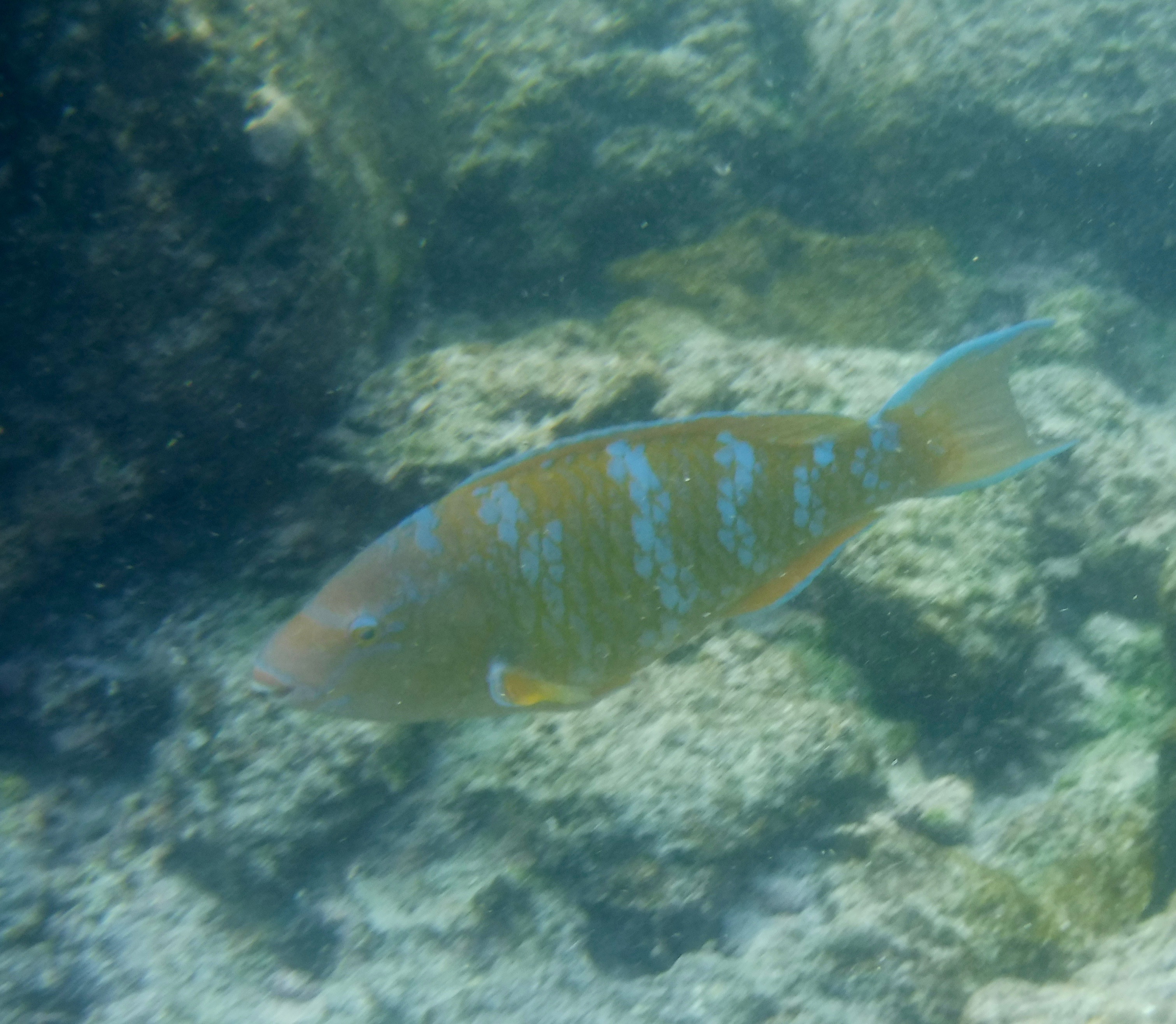
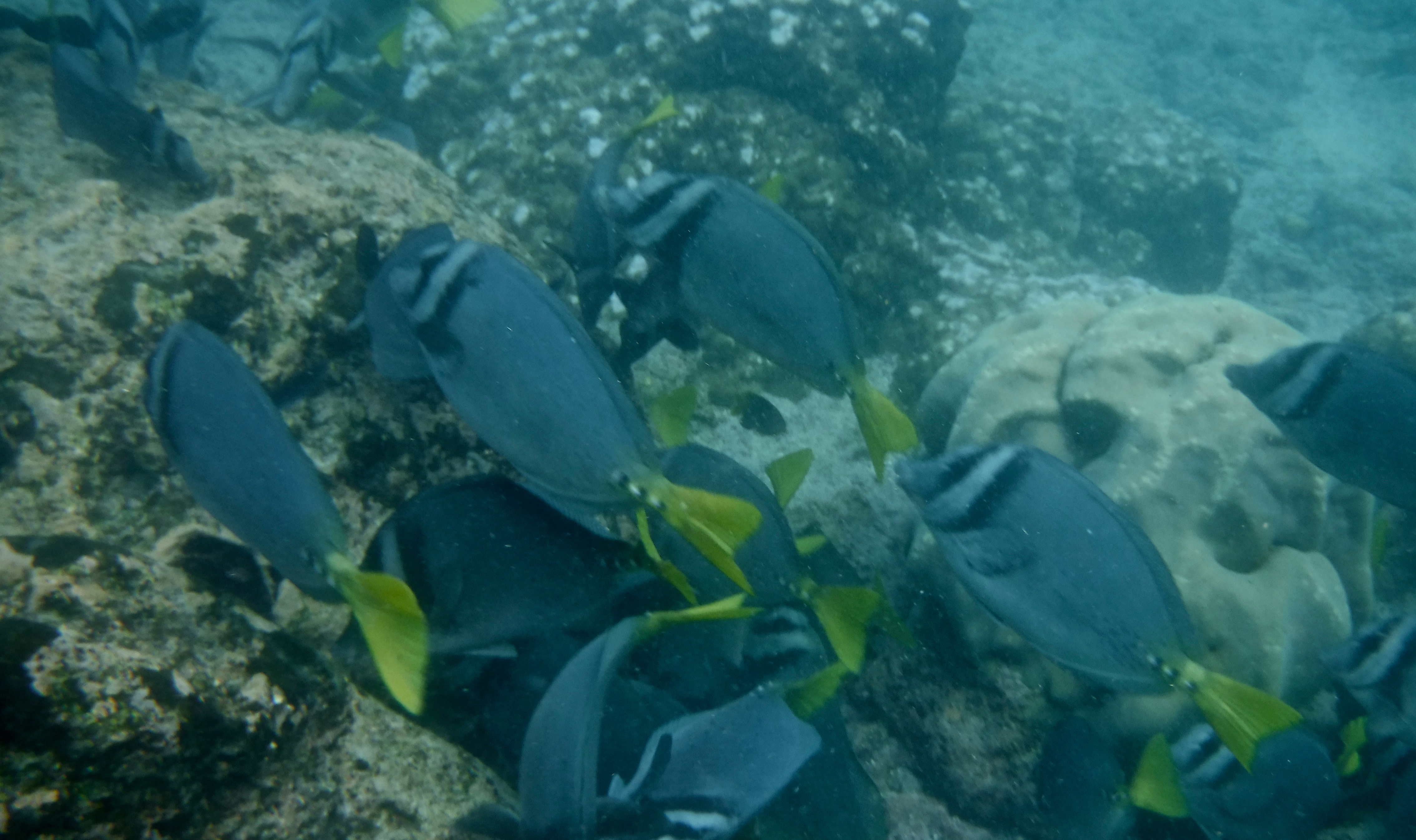
The current coming out of the Crown was quite strong but I was able to swim against it and get in the middle where it was a bit calmer and clearer. I didn’t see the advertised white tipped sharks hammerheads or sea lions, but did see some surgeonfish, coral and parrotfish.

Juvenile parrotfish

Juvenile parrotfish

Razor Surgeonfish

Razor Surgeonfish

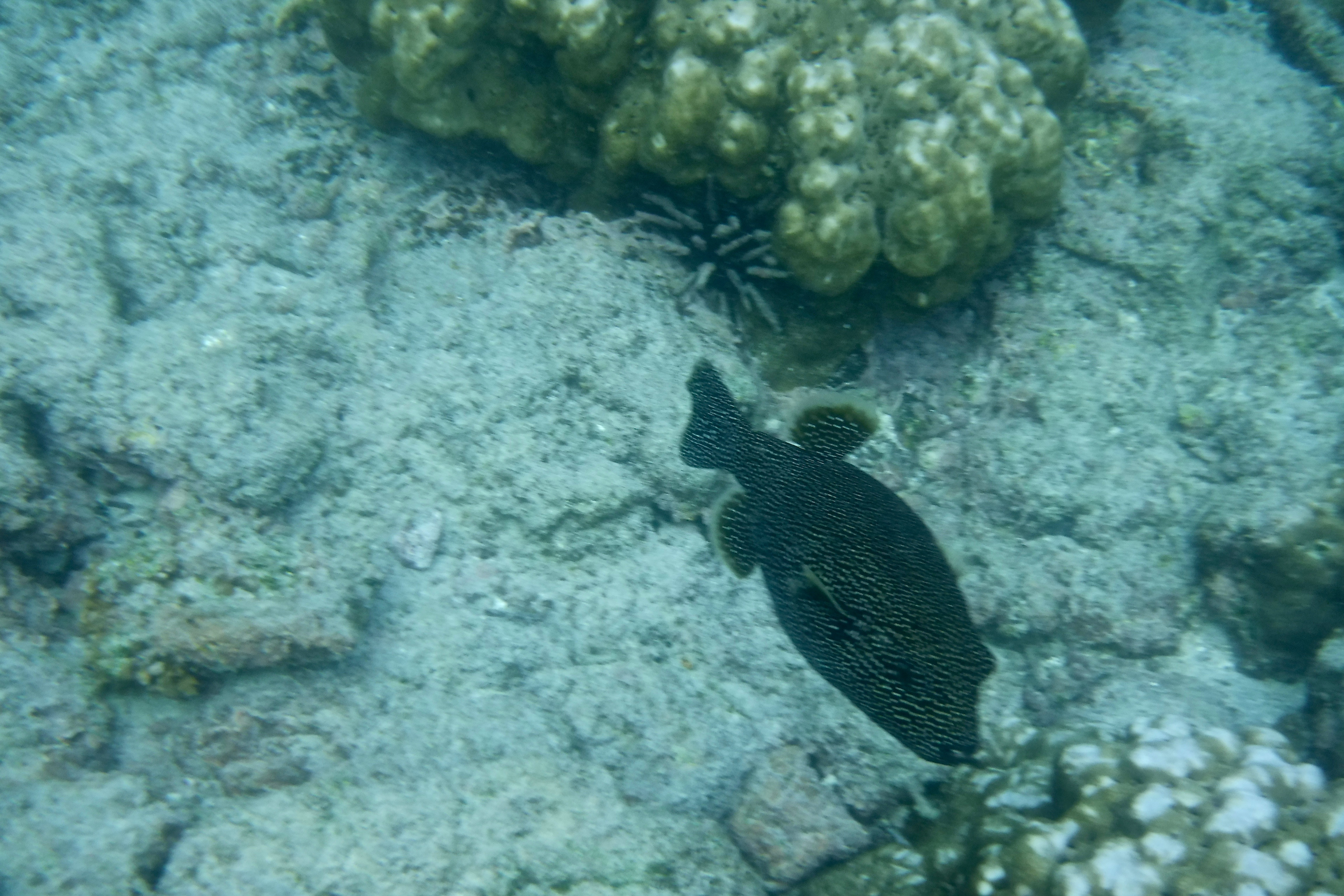
coral with a Guineafowl pufferfish

Coral with a Guineafowl pufferfish

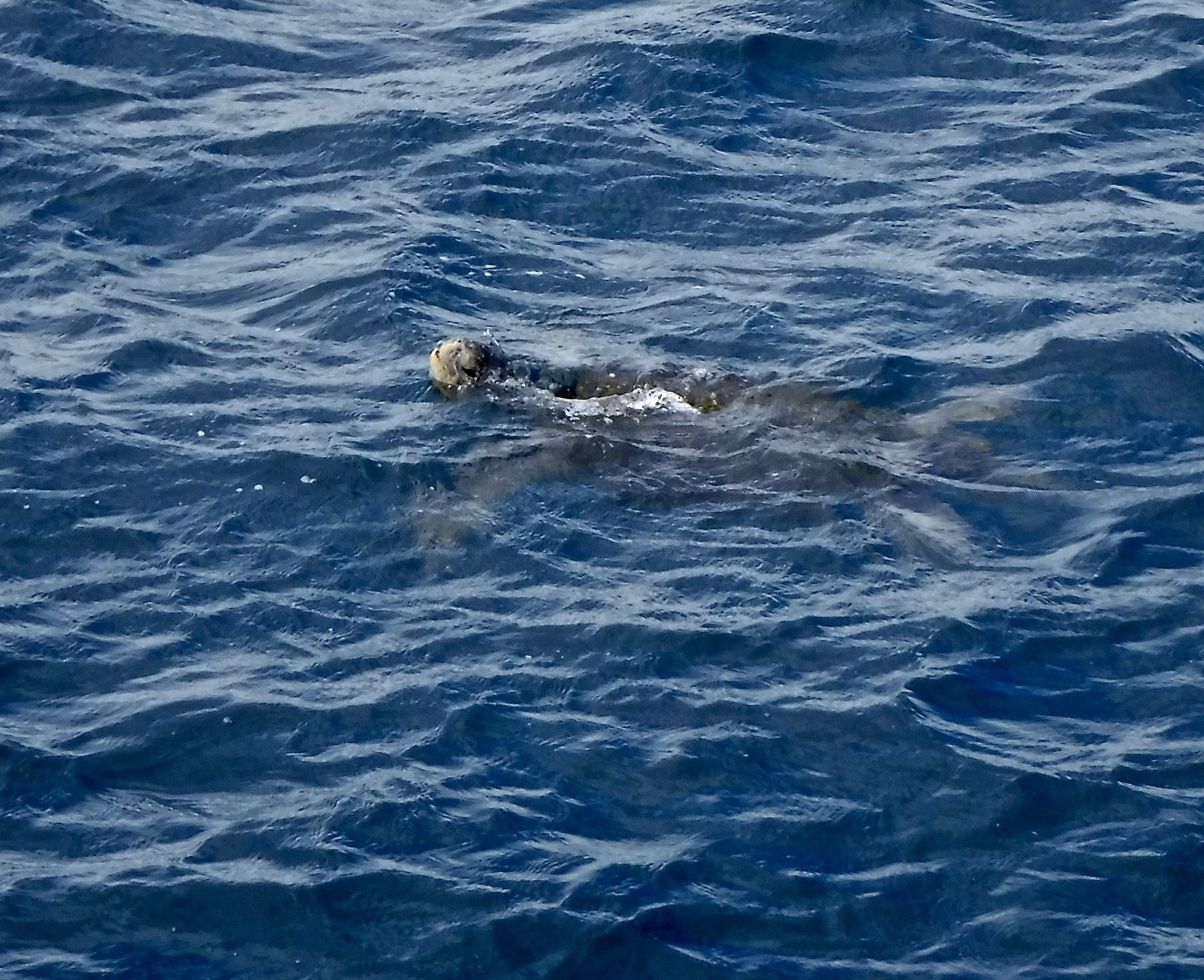
Just before we got into the Zodiac to go over to the Devil’s Crown, I espied a couple of sea turtles right beside the boat.

Just before we got into the Zodiac to go over to the Devil’s Crown, I espied a couple of sea turtles right beside the boat.

We had time to shower and get cleaned up a bit before we set off for Cormorant Point.   It’s noted for blue-footed booby nesting areas, some flamingos and a green beach. Despite its name, we never saw any cormorants.

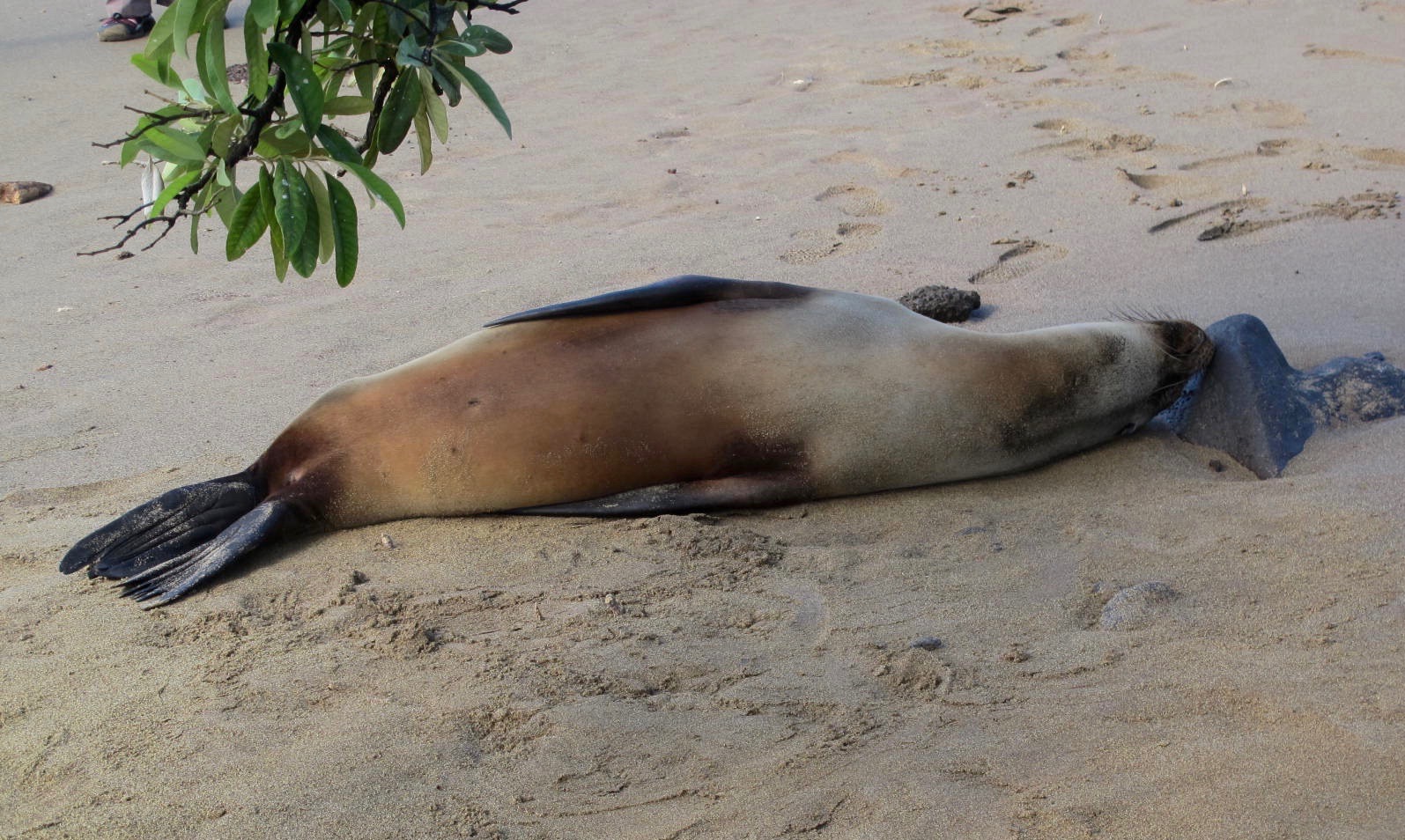
This sleepy head is resting on the Green Beach, so called because olivine (a green mineral) is prominent in the sand.

This sleepy head is resting on the Green Beach, so called because olivine (a green mineral) is prominent in the sand.

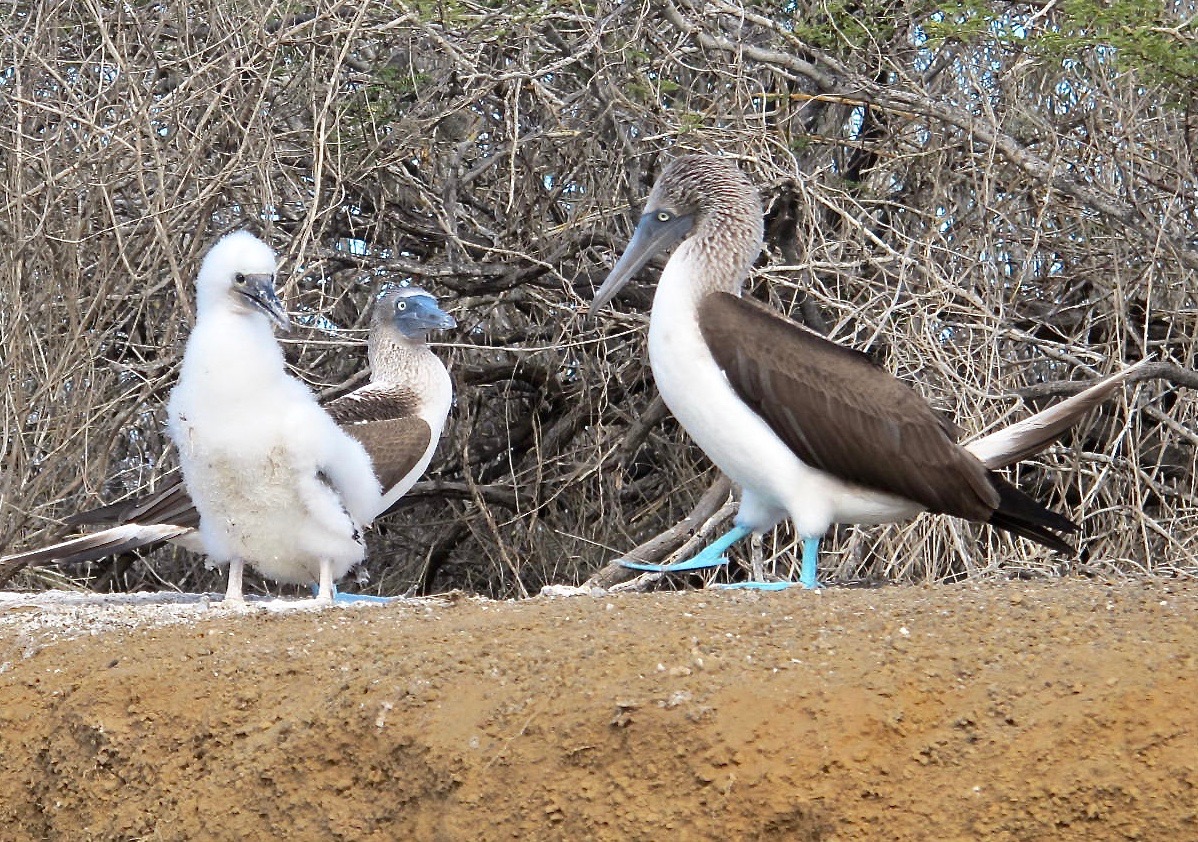
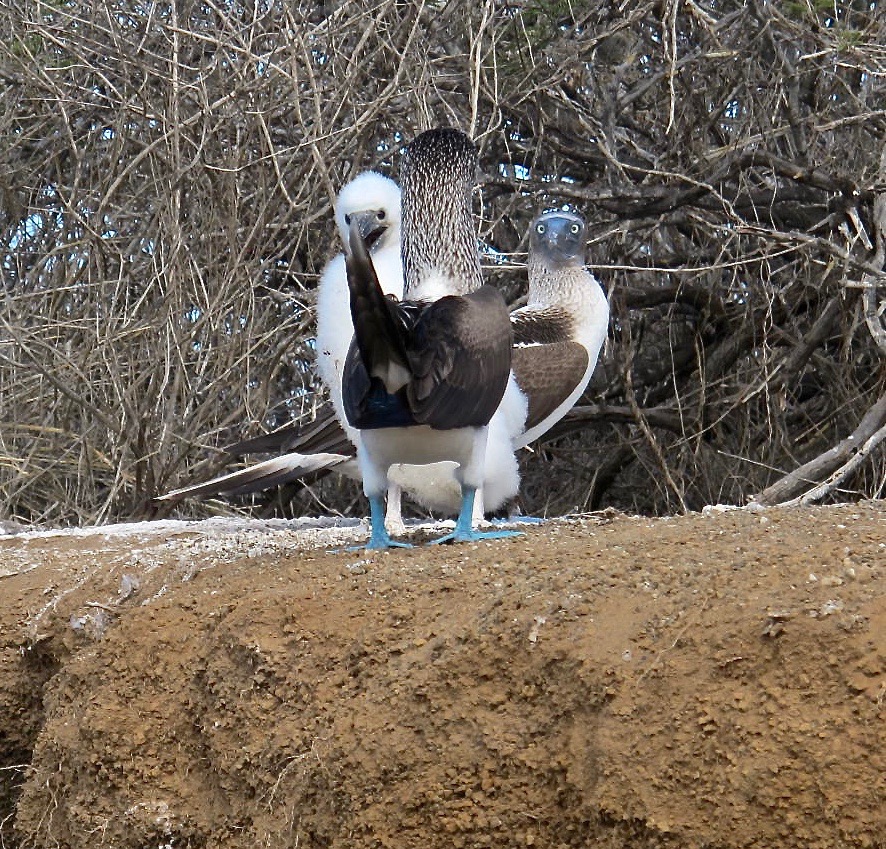
This blue-footed booby family was nesting on a short bluff above the sea lion.

This blue-footed booby family was nesting on a short bluff above the sea lion.

I loved the expression on the face of the mama booby in the background. “You just did what to those people in back of you?”

I loved the expression on the face of the mama booby in the background. “You just did what to those people in back of you?”

This saltwater lagoon is a flamingo area.

This saltwater lagoon is a flamingo area.

These tiny yellow warblers are all over the islands. This was the first time one was close enough to get a decent picture. He was hopping around on a dried portion of the flamingo lagoon.

These tiny yellow warblers are all over the islands. This was the first time one was close enough to get a decent picture. He was hopping around on a dried portion of the flamingo lagoon.

I got such a kick out of Julia when she called this Ariel’s Bustier. Technically, it was a broken portion of a sea urchin, but it could have worked for Ariel

I got such a kick out of Julia when she called this Ariel’s Bustier. Technically, it was a broken portion of a sea urchin, but it could have worked for Ariel

It was getting toward dusk when we made a move to return to the ship. There is a rule that all parties must be off the islands by 6 PM and I think we were pushing it a bit.

It was getting toward dusk when we made a move to return to the ship. There is a rule that all parties must be off the islands by 6 PM and I think we were pushing it a bit.

Our Zodiac jaunt took us by mama sea lion and her one-week old pup.

Our Zodiac jaunt took us by mama sea lion and her one-week old pup.

I would not be my father’s daughter if I didn’t take some sunset pictures.

I would not be my father’s daughter if I didn’t take some sunset pictures.

347Sillouetted pelican

Floreana has been the most altered by human inhabitants. Invasive and feral goats devastated much of the natural ecosystems and removal of these goats from the park was only completed in 2007.

I loved Floreana (as I did all the islands) and felt priveleged that we were able to visit it and appreciate what it has to offer.


Coming soon!  The ultimate installment of the Galapagos Adventure.
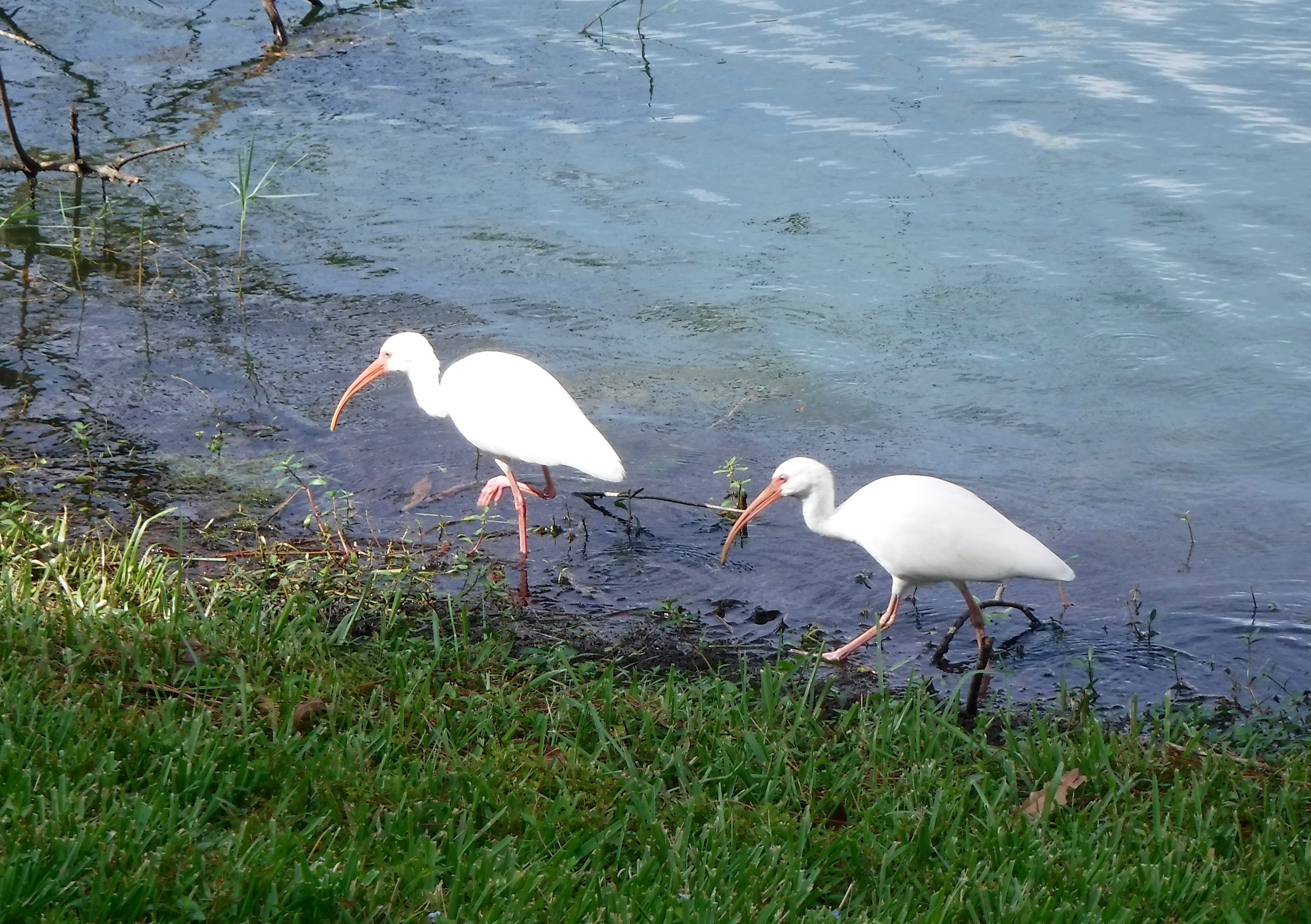


Galápagos Adventure – Santa Cruz Island – August 12, 2016

31 Aug


To enlarge a photo, please click on the image

To enlarge a photo, please click on the image

Santa Cruz Island is the second largest of the islands and is a major hub for tourism (with Baltra just to the north). It is one of the only islands where visitors can access the interior and highlands.

I might add here that only 3% of the Galápagos Archipelago is public land (inhabited areas of Santa Cruz, San Cristóbal, Floreana and Isabela Islands. ) The Galápagos National Park protects the other 97% of the land in the islands (3,091sq. mi). The 234 landmasses of the park are distributed within the Galápagos Marine Preserve, which has a range of 40 nautical miles from the island archipelago. So we were going to see a fair amount (I think) of the 3% public land when we went into the interior and highlands of Santa Cruz. Whatever, it was a great day.

Our day ashore began at Puerto Ayora, a charming port town at the south end of Santa Cruz, where we boarded a bus to go to the Charles Darwin Research Station. Shirley and I had been looking forward to this place, as it’s the first place we would see the famed giant tortoises. The Station is home to tortoises ranging from new hatchlings to about 4 feet long.

Again, it was a photographer’s paradise. Everybody was clicking like mad.

Again, it was a photographer’s paradise. Everybody was clicking like mad, even at us.

The greeter

The greeter

From what I understand, the Station does much research with tortoise DNA to try to get “pure” tortoises back to their home island. Erick told us a story about a particular specie that was dying out and the primary male was not able to do his duty. They put out a worldwide call to zoos asking them to test for a certain DNA strain in a Galapagos tortoise. The San Diego Zoo in California responded positively and shipped a male to the Darwin Station. He was named Diego and he immediately responded. Diego is now SUPER Diego because he’s fathered hundreds of hatchlings.

I felt really lucky as Super Diego was right up in front by the gate when I took his picture. Don’t you think he looks like a happy dude?

I felt really lucky as Super Diego was right up in front by the gate when I took his picture. Don’t you think he looks like a happy dude?

This one looks tired.

I’m tired.

There must have been some sort of conversation going on here. Perhaps they were excited to see folks from Grand Junction, CO!

You win by a nose!

A male Galápagos mockingbird

A male Galápagos mockingbird

A male land iguana. We would see more of them in the wild the next day.

A male land iguana. We would see more of them in the wild the next day.

Cacti showing the adaptation of no lower leaves with sharp needles in areas where there are land iguanas

Cacti showing the adaptation of no lower leaves with sharp needles in areas where there are land iguanas.

A modern day Charles Darwin with a little girl checking out the situation.

A modern day Charles Darwin with a little girl checking out the situation.

Shirley and I walked from the Station back to downtown Puerto Ayora where we were free to do visit some of the many shops selling some cool souvenirs. We had been told that they would take credit cards but we soon found that most didn’t. That was disappointing.

Here is another aside. The currency of the Galápagos and Ecuador is the U.S. dollar. That is due to a depression that pretty much destroyed their economy. They asked the U.S. for help and somehow our currency became their currency. I don’t pretend to understand all of this but it worked for us on this trip.

Due to some miscommunication about tips and whatnot, Shirley and I needed to visit an ATM in hopes our cards would work. The first ATM we visited was scary because it said for $600, one would be charged $300. I hemmed and hawed about this and finally decided to go for it, in hope we misread the cues. The ATM didn’t have a decimal point and the charge was $3. In the end, it all worked out; we breathed a sigh of relief and got what we needed to tide us over. On with the shopping!

We boarded our bus once again for a trip in the highlands to Rancho Ortiz for lunch. It was a pretty trip as we passed many farms, pastures and a couple of small towns. The trip reminded me of going into the highlands of Maui. Trees, farms, and pastures and the air felt the same. The main difference was that on occasion, we could see a giant tortoise wandering around a pasture. Amazing!

We arrived at the Rancho Ortiz and found that Erick’s family lives there. They have a ranch and have fashioned a restaurant/bar area where they host luncheons and dinners. It was really fun and the food was tasty.

The view from the restaurant. There are 3 tortoises in this photo. Can you find them? Floreana is the island on the horizon.

The view from the restaurant. There are 4 tortoises in this photo. Can you find them? Floreana is the island on the horizon.

We met Joaquin, Erick's son, who loves trucks, cars and buses. He checked out our bus.

We met Joaquin, Erick’s son, who loves trucks, cars and buses. He checked out our bus.

After lunch, we wandered the ranch a bit and here is what we saw.

I had to take a picture of these unique bar stools

I had to take a picture of these unique bar stools

Kinda pastoral, eh?

Kinda pastoral, eh?

Rich was just sitting on the ground and this young tortoise walked within a couple of feet of him.

Rich was just sitting on the ground and this young tortoise walked within a couple of feet of him.

Shirley and her new friend.

Shirley and her new friend.

One reason we’re not fooling around in these pictures is that we were warned many times not to get too close to the animals or make sudden motions. So we tried to abide by that and then forgot we could make silent expressions or gestures. Oh well.

Too soon, lunch time and our little tour was over and it was time to head on to El Chato Tortoise Reserve. It allows visitors to observe giant tortoises in the wild during the dry season and also learn even more about the animals.

What a great way to learn more about the giant tortoises!

What a great way to learn more about the giant tortoises!

224Pato and shell

Pato is demonstrating how the tortoise shell looks inside and some of us got to try on a shell.

Shirley

Shirley

Cora

Cora

Julia, our tour leader

Julia, our tour leader

We walked around the Reserve and saw many tortoises doing what they do every day…walking, sleeping, eating and soaking in mud.

The mud's fine!

The mud’s fine!

I need a napkin.

I need a napkin.

Cora, Nancy, Shirley with a poser.

Cora, Nancy, Shirley with a poser.

Tortoise drinking with a follower into the pond

Tortoise drinking with a follower into the pond

One unexpected attraction at El Chato was the huge lava tunnel that was 80 meters long. It was long and perhaps 15 feet tall at its highest point. It was also very humid in the tunnel. Where the illuminating lights were, little plants were growing. I’ve never seen anything like that in the lava tunnels in Hawaii.

One unexpected attraction at El Chato was the huge lava tunnel that was 80 meters long. It was long and perhaps 15 feet tall at its highest point. It was also very humid in the tunnel. Where the illuminating lights were, little plants were growing. I’ve never seen anything like that in the lava tunnels in Hawaii.

When one drinks a lot of water, certain things have to happen. Of course I had to visit the restroom and was well aware of the custom in the Galápagos to not toss the toilet paper into the toilet bowl. It’s not gross. It’s just the way it is. I was not prepared for the fact that in this particular restroom, the toilet paper was not in the stall. A big roll was hung on the wall by the sinks. Of course, I didn’t discover this fact until I had finished my business. Oops!!!

Oops! My bad for not being more observant

Too soon we had to leave El Chato and head back to Puerto Ayora. It was so interesting to me to see all those tortoises doing what tortoises do naturally, without any gates or fences.   I forgot to tell you that we did not see any hatchlings because they are kept in a special secure area where they are kept from people trying to steal them or predators like big birds eating the babies.

On our way back to the main road, we encountered this big guy strolling along the dirt road. Of course we had to stop for him until he moved enough to let us pass….a bit different than stopping for wild horses in the road in Virginia City, NV

On our way back to the main road, we encountered this big guy strolling along the dirt road. Of course we had to stop for him until he moved enough to let us pass….a bit different than stopping for wild horses in the road in Virginia City, NV

We had a bit of time to stroll around Puerto Ayora upon before boarding our Zodiacs to return to the Galaven. We discovered that the area around the port is quite active around dusk. We watched teams of men play volleyball while many, many locals watched the competition. A lot of cheering and hooting was going on during the games while kids played on playground toys nearby. Vendors were hawking their wares and it seemed like everyone was having a good time. I enjoyed that short time watching the people.

This was the view of the little port as we wended our way back to the Galaven that was anchored in the bay.

This was the view of the little port as we wended our way back to the Galaven that was anchored in the bay.


Galápagos Adventure Santiago and Rábida Islands August 11, 2016

30 Aug
48Santiago map

Please click on an image if you wish to enlarge it

Spaniards mined salt from Santiago in the 12800s and by various companies in the 1920s and 1960s. But we went there to see huge pahoeoe and a’a lava flows as well as explore the beach and snorkel. Pahoehoe is basaltic lava that has a smooth, billowy, undulating or ropy surface. These surface features are due to the movement of very fluid lava under a congealing surface crust. A’a is basaltic lava characterized by a rough or rubbly surface composed of broken lava blocks called clinker. We didn’t see much a’a on Santiago, but did get to see some on Rábida. I was interested to find out that pahoehoe and a’a are of Hawaiian origin and are accepted geologic terms.

We landed on the gray pahoehoe band began to walk around checking out various designs in the lava. All of a sudden Erick pointed to a penguin that was on shore and moving toward the water. By the time I got my camera ready, he was in the water. This was my best shot…at least you can see the head. I think I do better with land shots.

A Galapagos penguin

A Galapagos penguin

Folks trying to see the penguin

Folks trying to see the penguin

There were so many patterns in the lava and I took many pictures. But I’ll only list a few here so as not to bore you too much.

There were so many patterns in the lava and I took many pictures.

This formation is called an oven or hornitos. You might call it a burst bubble

This formation is called an oven or hornitos. You might call it a burst bubble

Shirley and I are standing in front of lava with different colored minerals showing.

Shirley and I are standing in front of lava with different colored minerals showing.

You would think that nothing would be growing in this vast lava field. But, surprisingly, “pioneer” plants begin a precarious existence here and there.

You would think that nothing would be growing in this vast lava field. But, surprisingly, “pioneer” plants begin a precarious existence here and there.

We spent quite a while on the lava field learning about different types and seeing so many different patterns. Some of our ladies were trying to figure out how to incorporate those patterns into weaving or dying. Too complicated for me. I’ll leave that to the artistic folks.

BOB (Back on Board), we grabbed a snack provided by our faithful bartender/waiter, Fabián. Then several people changed into snorkeling gear and rode off to deep water snorkel alongside the lava field. I didn’t go because I didn’t think I’d see much wildlife due to an overcast sky. It’s usually better when there is a bright sky. Big mistake. They saw sea turtles, penguins and other good stuff. However, Shirley went and became so cold that she was shaking uncontrollably at the end. Luckily, there was hot water in the shower when she got back to the boat to help her warm up.  In contrast to that, it must have been the luck of the draw, but I never got a hot shower while on board.  Oh well, I was no worse for the wear.

Snorklers on their way

Snorklers on their way

I chose to walk along the beach and enjoyed myself there. When our Zodiac neared the shore, a sea lion pup reared his head, just like a dog when his family comes home. The pup slipped into the water and came to meet the boat. When we disembarked and were standing on the shore, he swam back and forth in front of us, as if to say, “Come play with me!”

The greeter. He was so darned cute!

The greeter. He was so darned cute!

 A view of Bartolome Island and The Pinnacle on the left from Sullivan Bay. Bartolome was just across a small strait

A view of Bartolome Island and The Pinnacle on the left from Sullivan Bay. Bartolome was just across a small strait

This is a Sally Lightfoot crab and the next picture is its tracks

This is a Sally Lightfoot crab and the next picture is its tracks.

140crab tracks

BOB (Back on Board), our boat drivers put the Zodiacs on board the big ship and we left to go to Rábida Island.

BOB (Back on Board), our boat drivers put the Zodiacs on board the big ship and we left to go to Rábida Island.

Rábida Island is one of the most colorful and volcanically varied islands in the archipelago. It’s noted for its maroon colored beach, sea lions and pelican nesting sites.

There are no tortoises or land iguanas on Rábida, so the cacti can grow their leaves (nopales) down to the ground. They also have soft needles that almost feel like hair. They don’t poke the skin. Islands with the iguanas and tortoises have cacti adapted to have sharp needles and no leaves close to the ground. An example of how critters and plants have adapted to the island conditions.

There are no tortoises or land iguanas on Rábida, so the cacti can grow their leaves (nopales) down to the ground. They also have soft needles that almost feel like hair. They don’t poke the skin. Islands with the iguanas and tortoises have cacti adapted to have sharp needles and no leaves close to the ground. An example of how critters and plants have adapted to the island conditions.

Erick and Pato went barefooted except on trails with boulders and sharp rocks. There was no way my tenderfeet could do that.

Erick and Pato went barefooted except on trails with boulders and sharp rocks. There was no way my tender feet could do that.

Plants appear to grow directly out of the rocks. It’s amazing to me how they can grow in their tiny niche and thrive.

Plants appear to grow directly out of the rocks. It’s amazing to me how they can grow in their tiny niche and thrive.

A nursing sea lion pup

A nursing sea lion pup

166Galapagos mockingbird

We were warned about Galápagos mockingbirds because of their curiosity and desire to get water from visitors’ water bottles. I didn’t hear them sing, but I would imagine they have their special tunes they sing to their mates.

A preening pelican in her nest.

A preening pelican in her nest.

I love the sun!

I love the sun!

166Galapagos mockingbird

We were warned about Galápagos mockingbirds because of their curiosity and desire to get water from visitors’ water bottles. I didn’t hear them sing, but I would imagine they have their special tunes they sing to their mates.

Several frigate birds soared alongside the Galaven while we were sailing . A good thing to remember would be to not open your mouth while they were overhead.

Several frigate birds soared alongside the Galaven while we were sailing . A good thing to remember would be to not open your mouth while they were overhead.

We were told there would be whales to see while underway on this steretch of the ocean, but Shirley was the only person to sight one.

We were told there would be whales to see while underway on this stretch of the ocean, but Shirley was the only person to sight one.

My memory is probably faulty on the exact day, but I believe our overnight journey from Rábida to Santa Cruz is when many of us became quite ill with the mal de mer, myself included. The seas were quite rough and the boat was really tossing to and fro. You know I had to be sick to skip a meal. Shirley was a real sailor and didn’t suffer any ill effects. The rest of us were ok the next morning for our terrific journey ashore on Santa Cruz Island. That was a real treat of a day and will be in the the next episode.