Archive | Uncategorized RSS feed for this section

Another Taste of a Nevada Spring – April 23, 2016

25 Apr

We had a good storm last Friday that dumped not only rain here in Carson Valley but up to 12” of new snow in the high country. This was very welcome and, again, no one complained.  We love weather that brings us moisture.

The next day, Jerri and I went to Virginia City (about 30 miles northeast of here), to do some business for the Friends of the Nevada State Museum. It is a gain of about 2000’ in altitude and is sometimes very cold there. We hit a gorgeous, sunny day with some lingering clouds drifting overhead. For those of you not familiar with VC: It is the principle site of the Comstock Mining District in the latter half of the 1800s. Millions of dollars were made here mining silver and gold. It is one reason why Nevada is called the Silver State.  (Don’t forget double click on the photo to enlarge it)

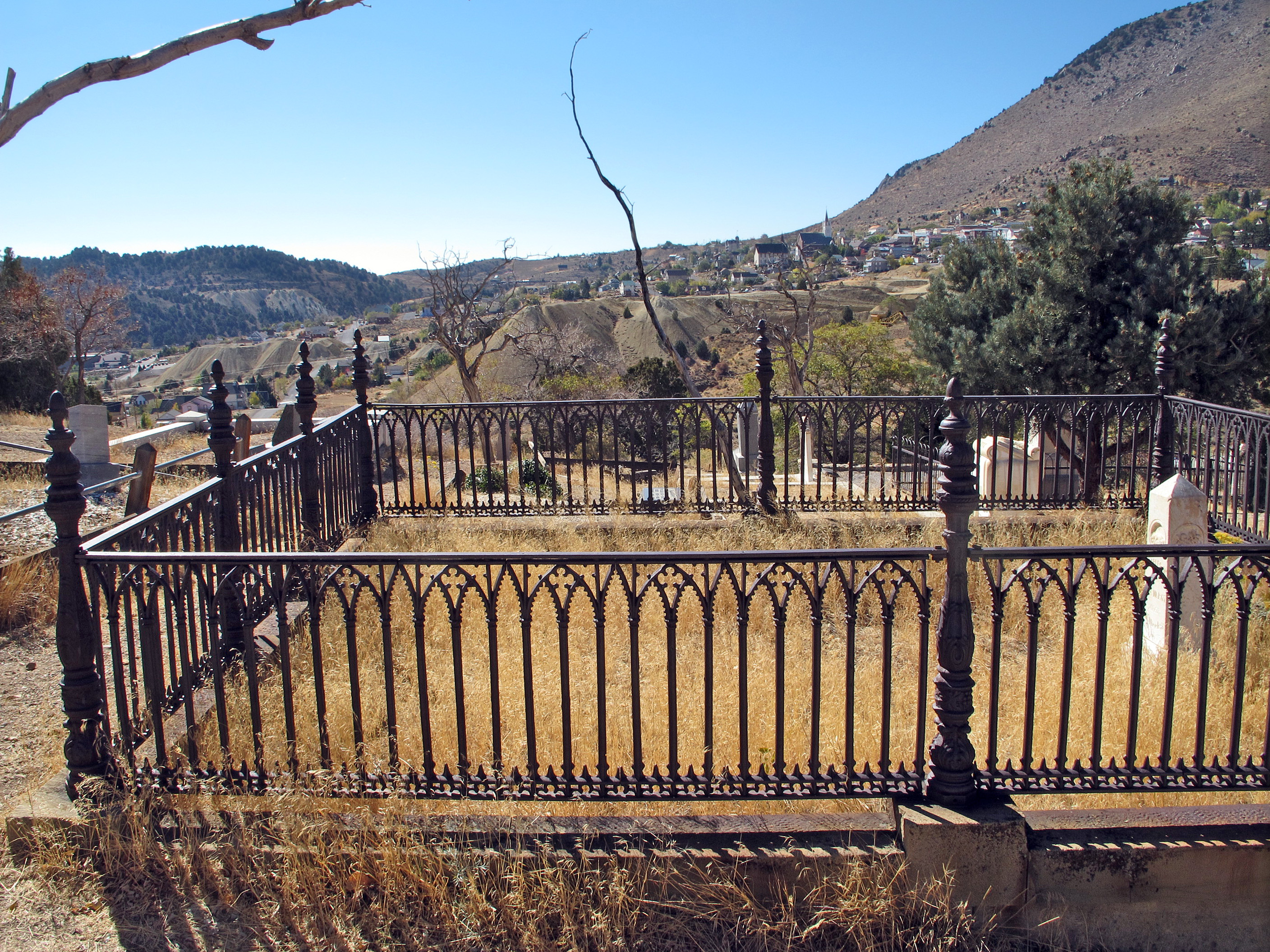
A view of VC from the cemetery. What looks like piles of dirt are tailing...debris from mines

A view of VC from the cemetery. What looks like piles of dirt are tailings (debris from mines) Photo by RD Schmidt, 2013

Upon completing the business, we zipped over to Red’s, our favorite VC ice cream store, and treated ourselves to some very tasty cones.

Wild horses are quite numerous in the VC area and we decided to take the truck route (a bit longer and gentler slope) home in hopes we could see some. Nary a horse did we see, BUT we were treated to spectacular display of high desert flowers. Jerri has been in northern Nevada for almost 29 years and has never seen them so numerous and colorful. We stopped several times to feast our eyes in an up close and personal nature.

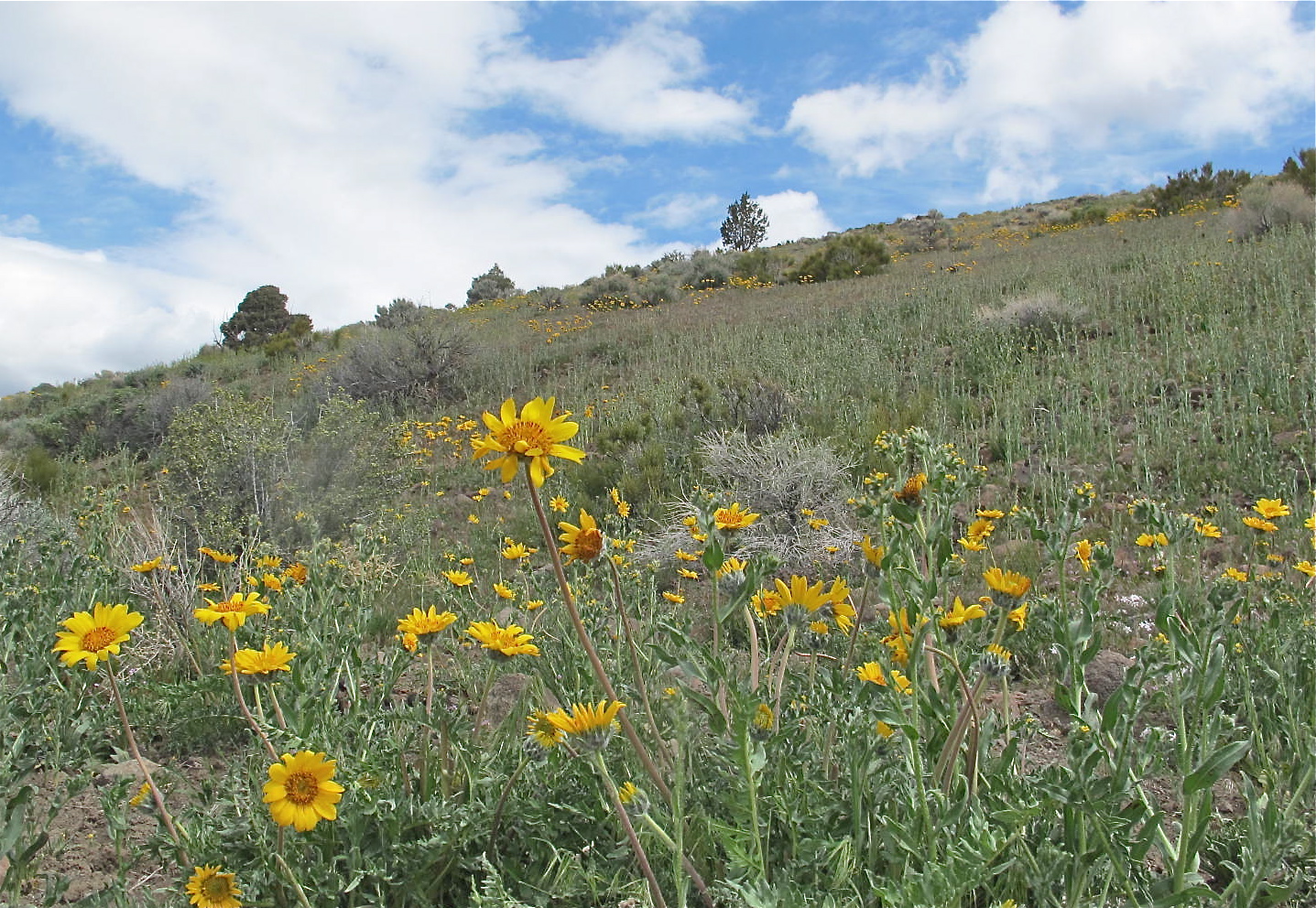
The bright yellow of the arrow-leafed balsam-root caught our eyes first. They are so perky as if they are reaching toward the sun with all their might.

The bright yellow of the arrow-leafed balsam-root caught our eyes first. They are so perky as if they are reaching toward the sun with all their might.

Growing in the Virginia Mountains

Growing in the Virginia Mountains

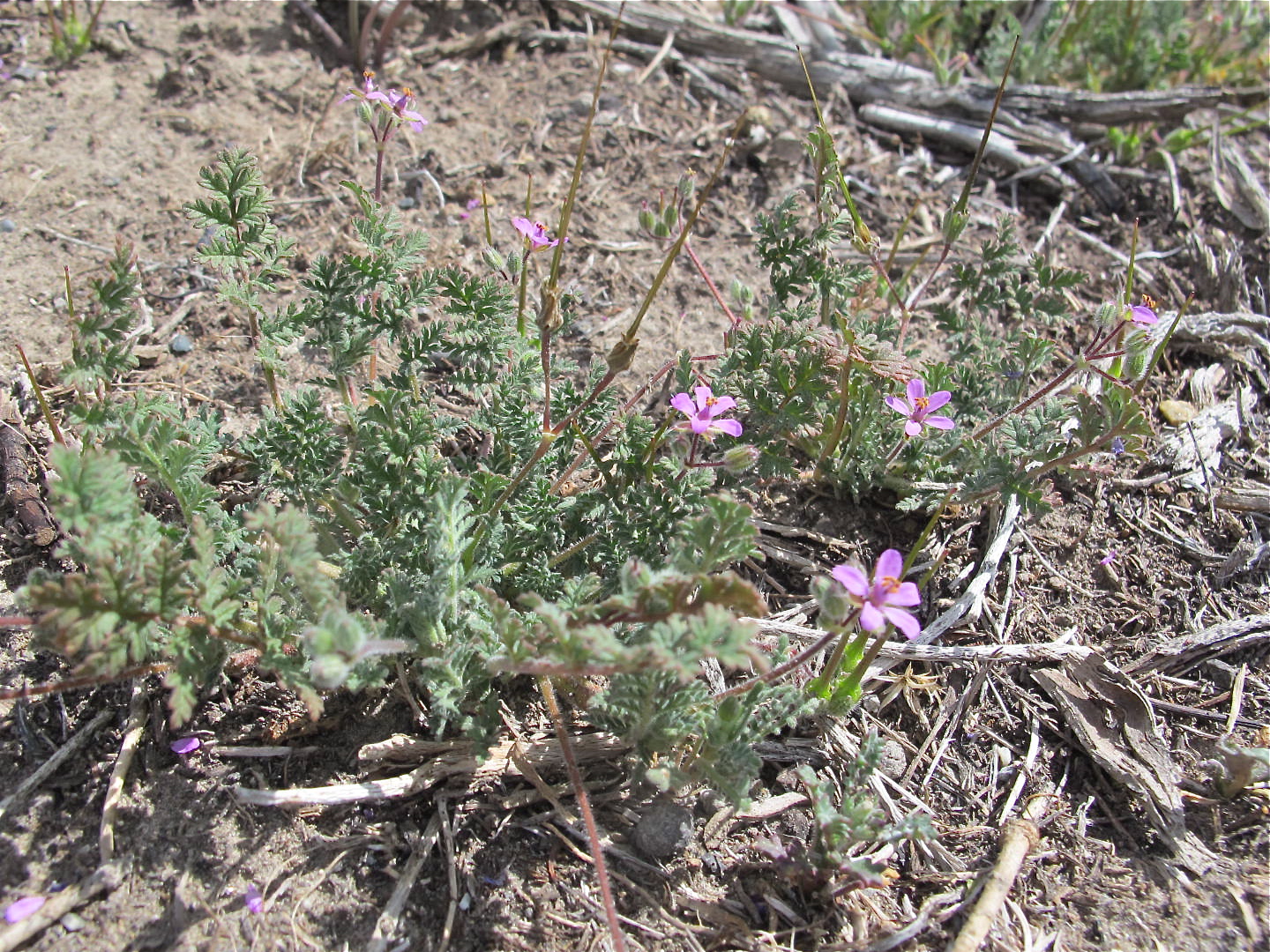
I like the tiny flower of the red-stemmed filaree. But these little posies are really a weed that we used make play scissors out of their spikes. When the spikes dry out, they turn like corkscrews, thus driving the seeds into the ground.

I like the tiny flower of the red-stemmed filaree. But these little posies are really a weed. We used make play scissors out of their spikes. When the spikes dry out, they turn like corkscrews, thus driving the seeds into the ground. Spikes haven’t developed yet on this plant.

The spreading phlox looks as though it’s growing out of some rocks.

The spreading phlox looks as though it’s growing out of some rocks.

Note the silvery aspect of the leaves. This is looking southwest and the snow is on the Sierras

Coleville’s lupine has a sweet smell and makes a pretty spot on the hill.

IMG_1314

Note the silvery aspect on the leaves. This is looking southwest and the bit of snow you can see is on the Sierras.

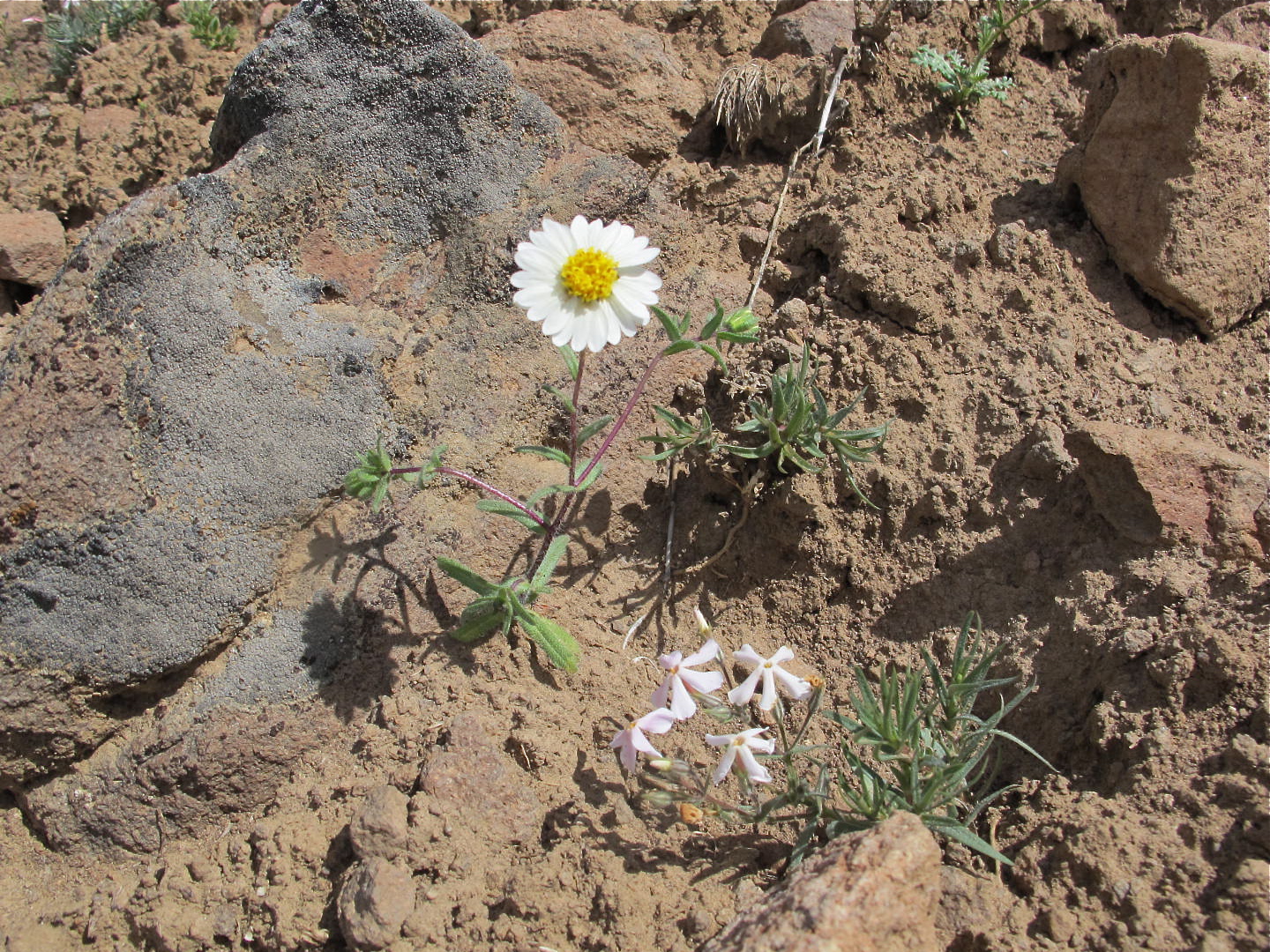
The only white daisy-type flower I found. A tiny phlox plant is in the low center

The only white daisy-type flower I found. A tiny phlox plant is in the low center

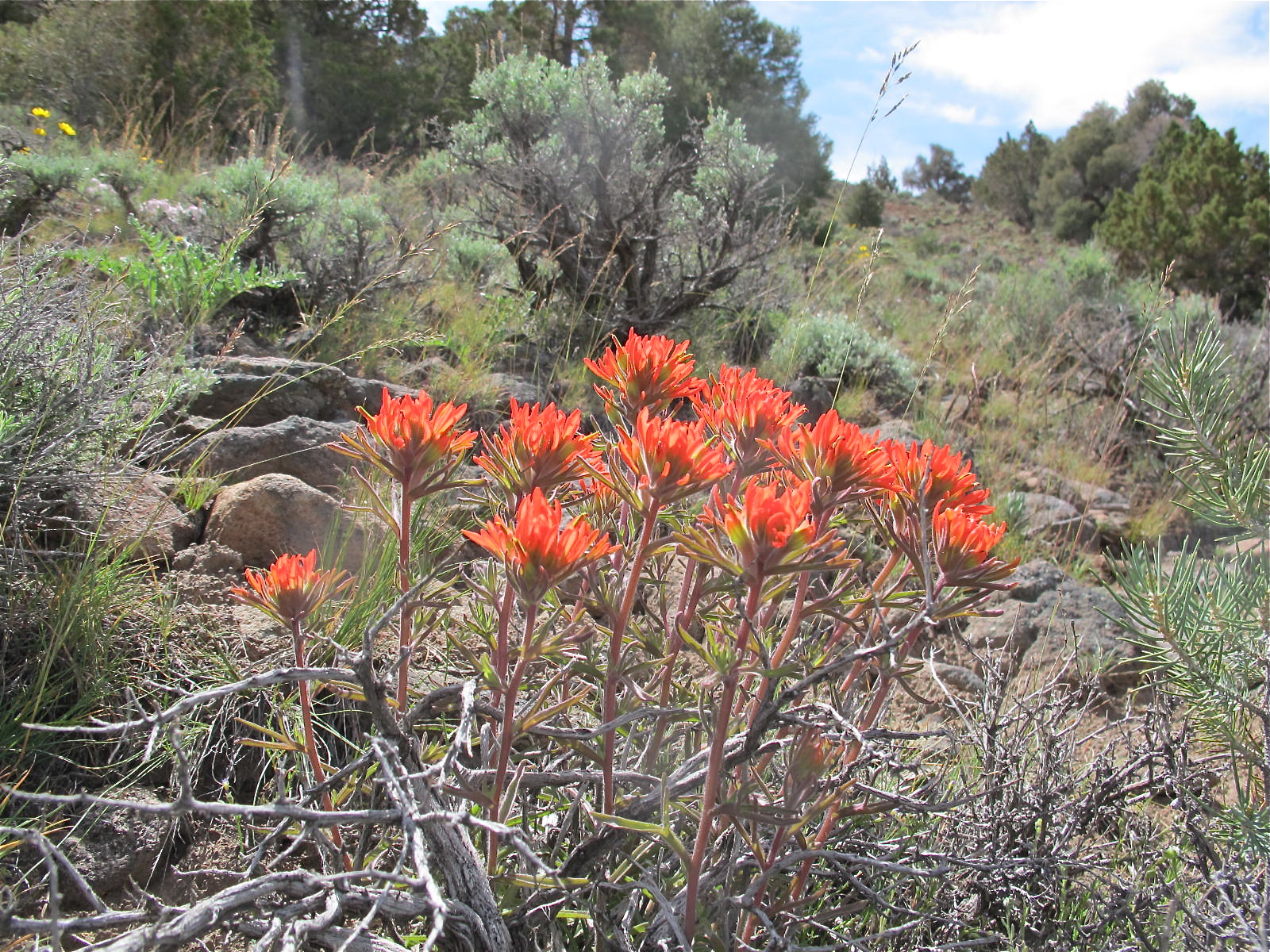
We always called this flower Indian Paintbrush. It must not be PC now to do that and my book put out by the California Academy of Sciences calls it Giant Red Paintbrush or it could be Applegate’s Paintbrush. I’m not sure. At any rate, these plants really stand out in the brush.

We always called this flower Indian Paintbrush. It must not be PC now to do that and my book put out by the California Academy of Sciences calls it Giant Red Paintbrush or it could be Applegate’s Paintbrush. I’m not sure. At any rate, these plants really stand out in the brush.

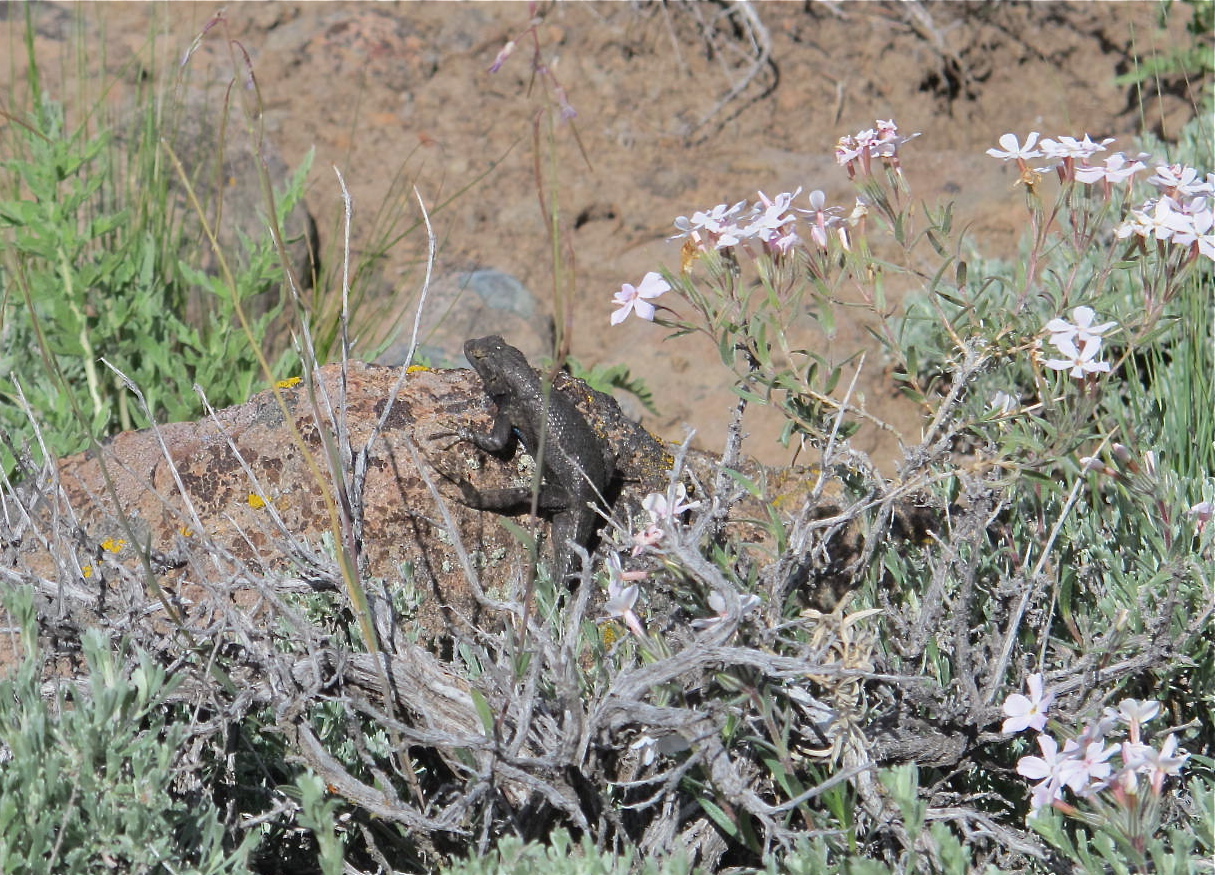
At first, I thought this lizard was a baby chuckawala but I don’t think they live in our area. For lack of a better term, he’s just a fat, black lizard checking out his world.

At first, I thought this lizard was a baby chuckawala but I don’t think they live in our area. For lack of a better term, he’s just a fat, black lizard checking out his world.

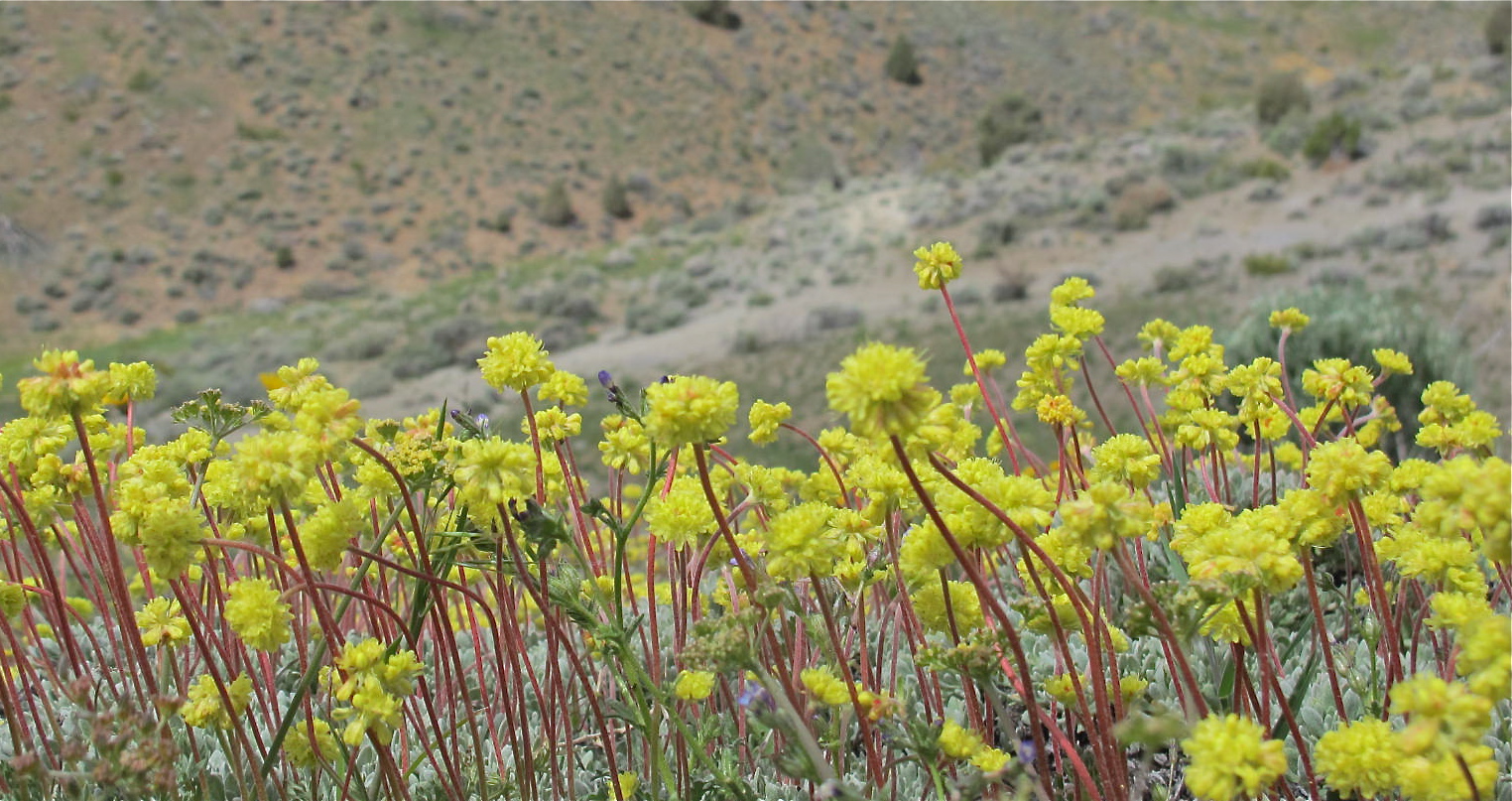
I thought this was a yellow salsify. But another look said no. It might be a hoary buckwheat. Anyway, it's pretty.

I thought this was a yellow salsify. But another look said no. It might be a hoary buckwheat. Anyway, it’s pretty.

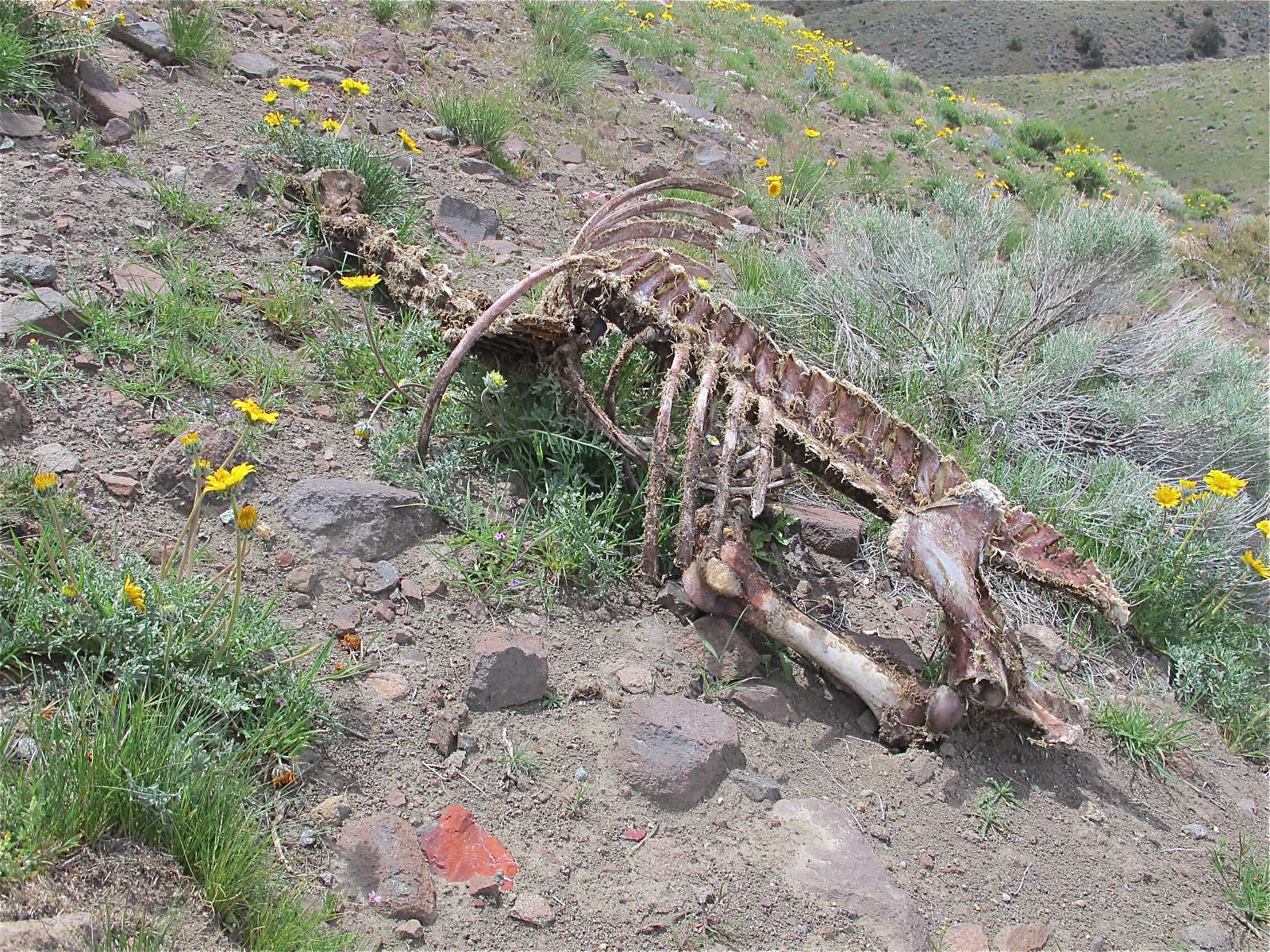
There was much evidence of the wild horses all over the area on which I walked. Hoofprints, horse apples, and, sadly, even a skeleton. I only show this because, even in death, the horse provided life to other creatures, and maybe even gave a bit of nutrient to the flowers that were growing through and around it.

There was much evidence of the wild horses all over the area on which I walked. Hoofprints, horse apples, and, sadly, even a skeleton. I only show this because, even in death, the horse provided life to other creatures, and maybe even gave a bit of nutrient to the flowers that were growing through and around it.


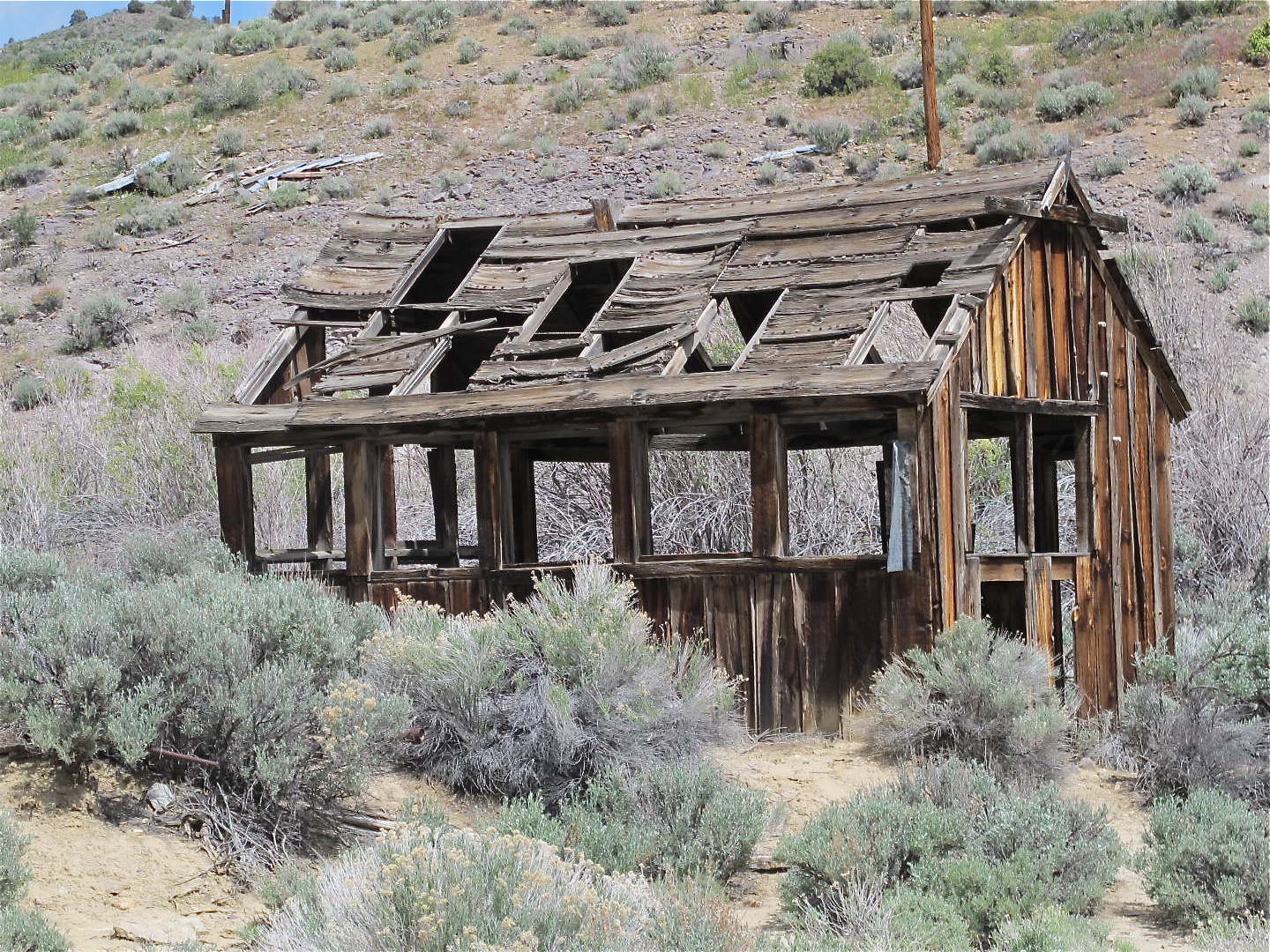
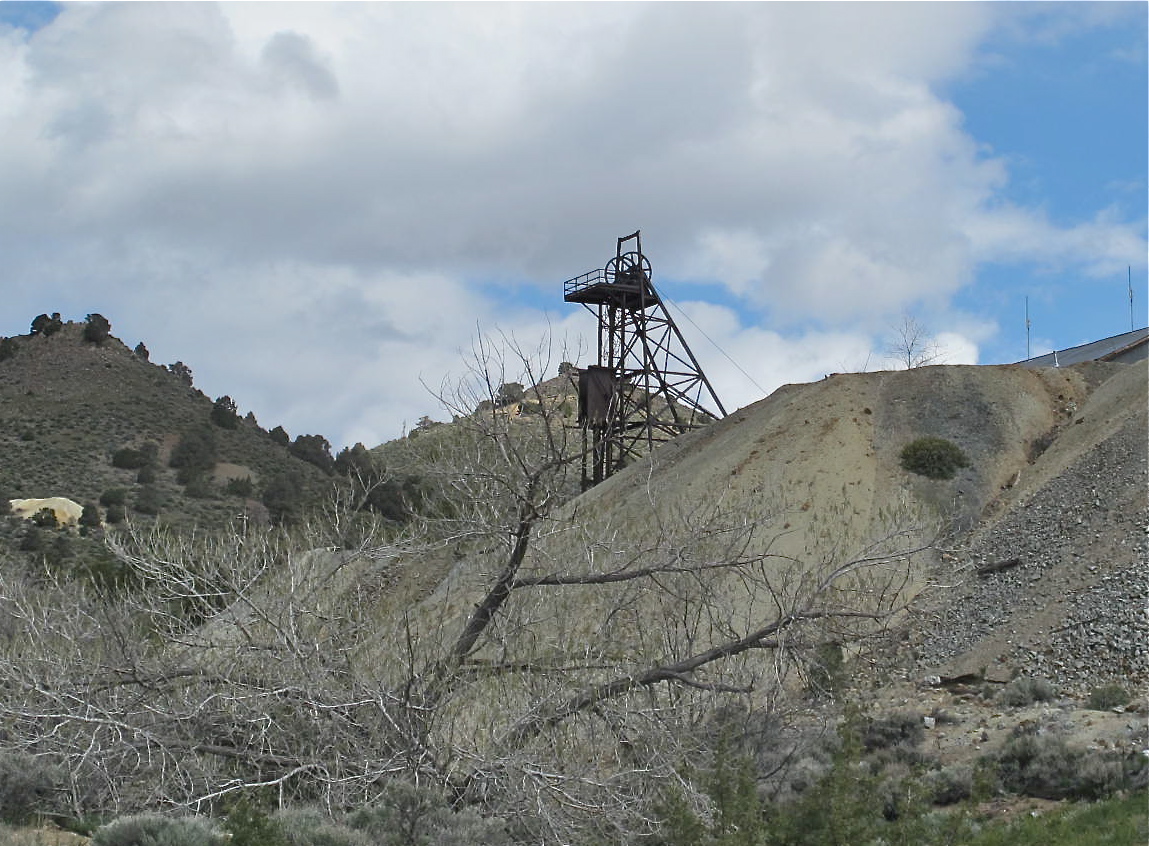
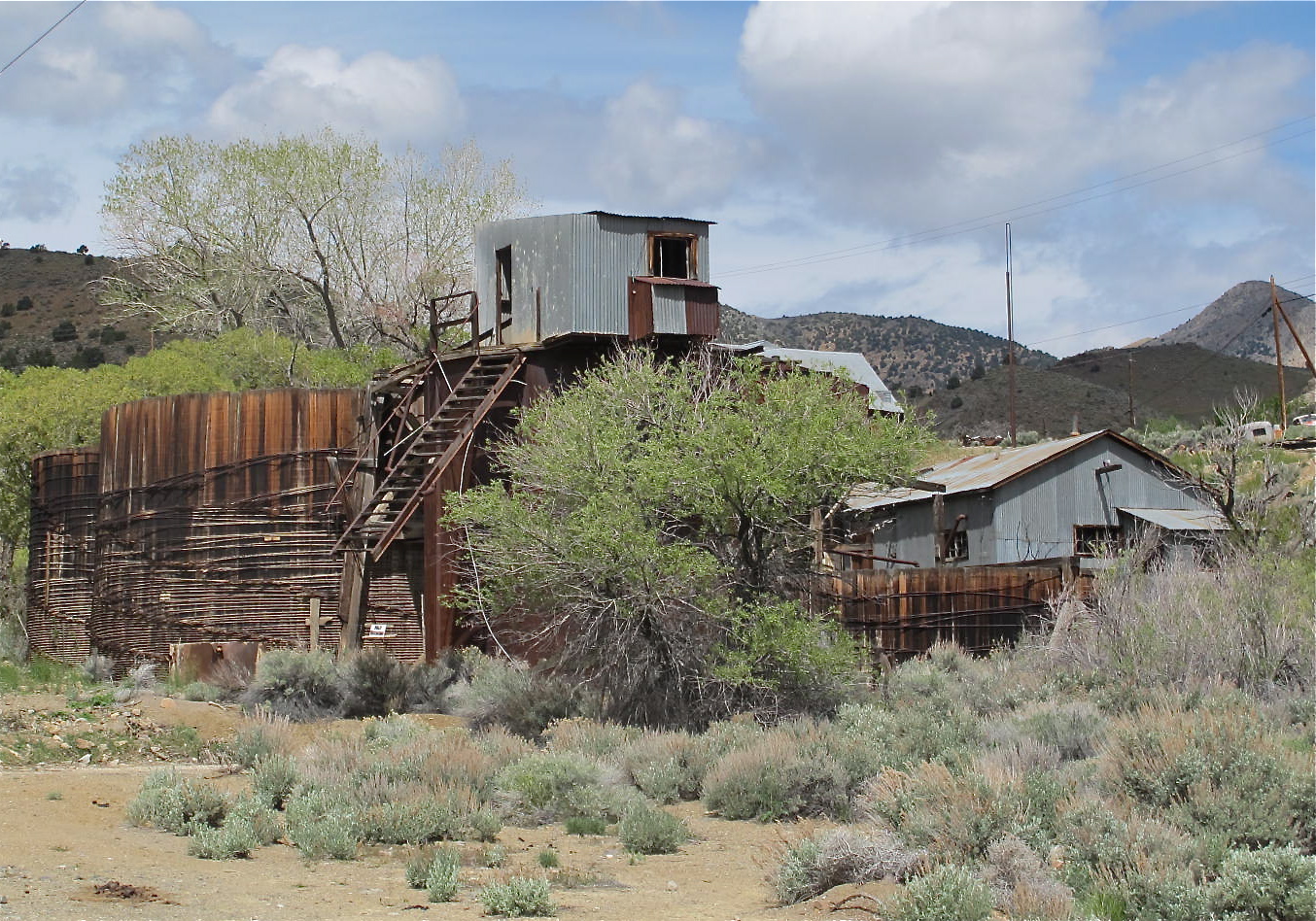
There are abandoned buildings and mining equipment all over the Virginia Mountains. These are all just off the side of the highway.

IMG_1334

A headframe was used to lift ore out of the mine

A headframe was used to lift ore out of the mine

Old buildings

Old buildings and water tanks

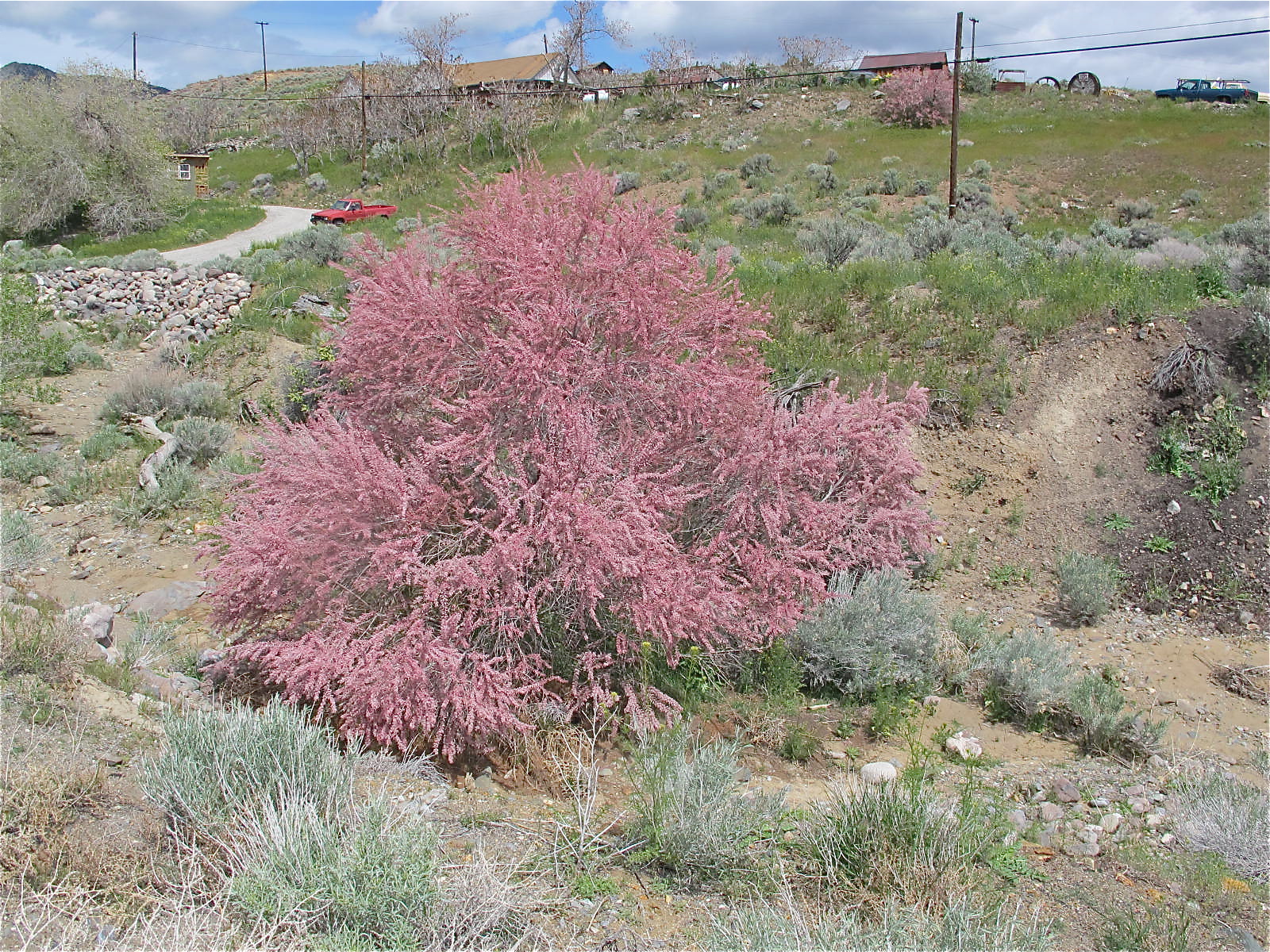
Just a short distance from these abandoned buildings and equipment was this pretty tree/shrub. You can see modern houses and vehicles in the background.

Just a short distance from these abandoned buildings and equipment was this pretty tree/shrub. You can see modern houses and vehicles in the background.


Just about a mile and a half west of my home is a good stand of desert peach. It’s in bloom quite a bit in our valley. One doesn’t want to run into it because it has a nice set of long stickers! Boo!!!

The little bit of snow you see in the background is on the Sierras.

The little bit of snow you see in the background is on the Sierras.

I really enjoy being able to get out and see these different plants and come to realize that each has its own area in which to live. There is just so much to see and learn about. Keeps me busy!


I should probably put a caveat on this epistle.  Jerri and I went together and found this floral display but I didn’t think to take my camera.  So I went back the next day and redid our trip.  Also, I am fairly sure of the names of the plants but could be wrong.  I used The Laws Field Guide to the Sierra Nevada by John Muir Laws.  How could I go wrong with a name like Muir?

Pahranagat Wildlife Refuge Adventure March 7-13, 2016

17 Mar

This is the account of my first adventure to the southeastern portion of Nevada. I joined my good college buddy, Gale, who is camp host this winter at the Pahranagat Wildlife Refuge campground that is alongside US 93 highway.   It’s about an hour and a half northeast of Las Vegas and 3 miles south of Alamo, NV.

The journey began in Minden on a cool morning that became colder as I drove south on US 95. I stopped for a short break in Tonopah, where silver was discovered in 1900 and mines remained in operation for about 50 years. There is a little mining happening these days, but the town carries on with tourism and being a midpoint stop between Reno and Las Vegas. I like Tonopah for its old buildings and supposedly haunted Mizpah Hotel. The elevation is 6,047 feet and it was darned cold when I stopped there. It was trying to snow, sleet, rain and whatever it could do weather-wise, so I zipped into the Mizpah Hotel to use the facilities and have a snack for lunch. Didn’t see any ghosts or spirits. Darn!

You will have to double click on many of these pictures to get more detail or read text.

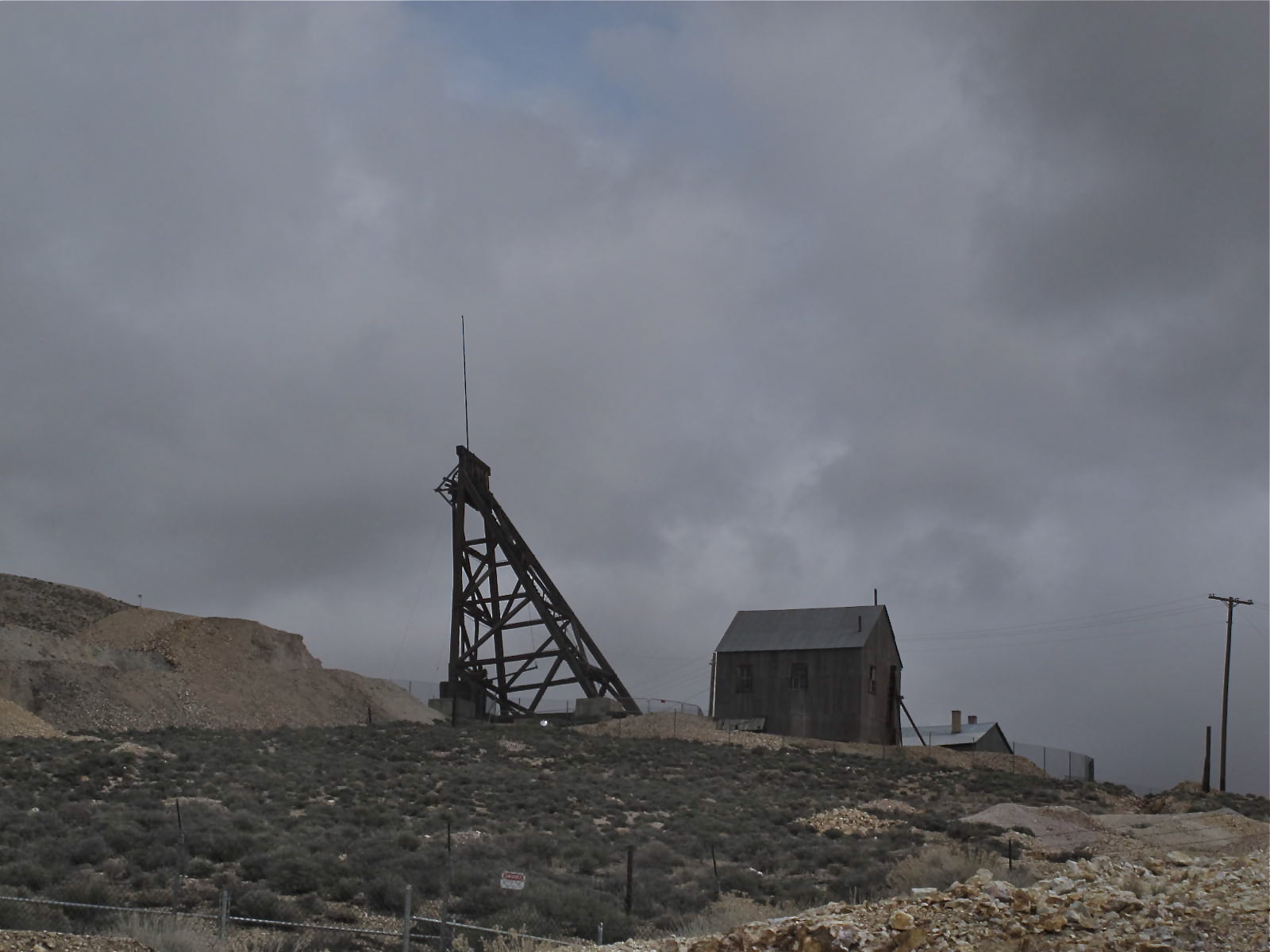
One can see remnants of mines, head frames and other items all over Tonopah. You can even visit a mine museum with large equipment all over said museum. I didn’t go because it’s outside and I was cold in the wind.

One can see remnants of mines, head frames and other items all over Tonopah. You can even visit a mine museum with large equipment all over said museum. I didn’t go because it’s outside and I was cold in the wind.

I turned east at Tonopah and the farther east I went, the worse the weather turned. I finally got into snow and sleet, but it didn’t last long. I turned south on to Hwy 375, which is significant because it goes by Area 51, the U.S. Air Base that the government has denied exists for years. It’s also an area where aliens and UFOs are said to frequent and some people claim to have been abducted by ET aliens here.

Evidence of this (or perhaps a jibe at those folks) is a highway sign.

Evidence of this (or perhaps a jibe at those folks) is a highway sign.

(For those of you who don’t know, Open Range means there are no fences and drivers must be careful not to run into a cow wandering on the road.) You can see how far the road stretches into the horizon. It just seemed to keep on going. Such are Nevada roads between the many mountains ranges. Another FYI is that Nevada has more than 230 named mountains ranges within the state’s boundaries making it the most mountainous state in the USA. (NV Historical Society Quarterly, 2015) I know, I know. Too much info.

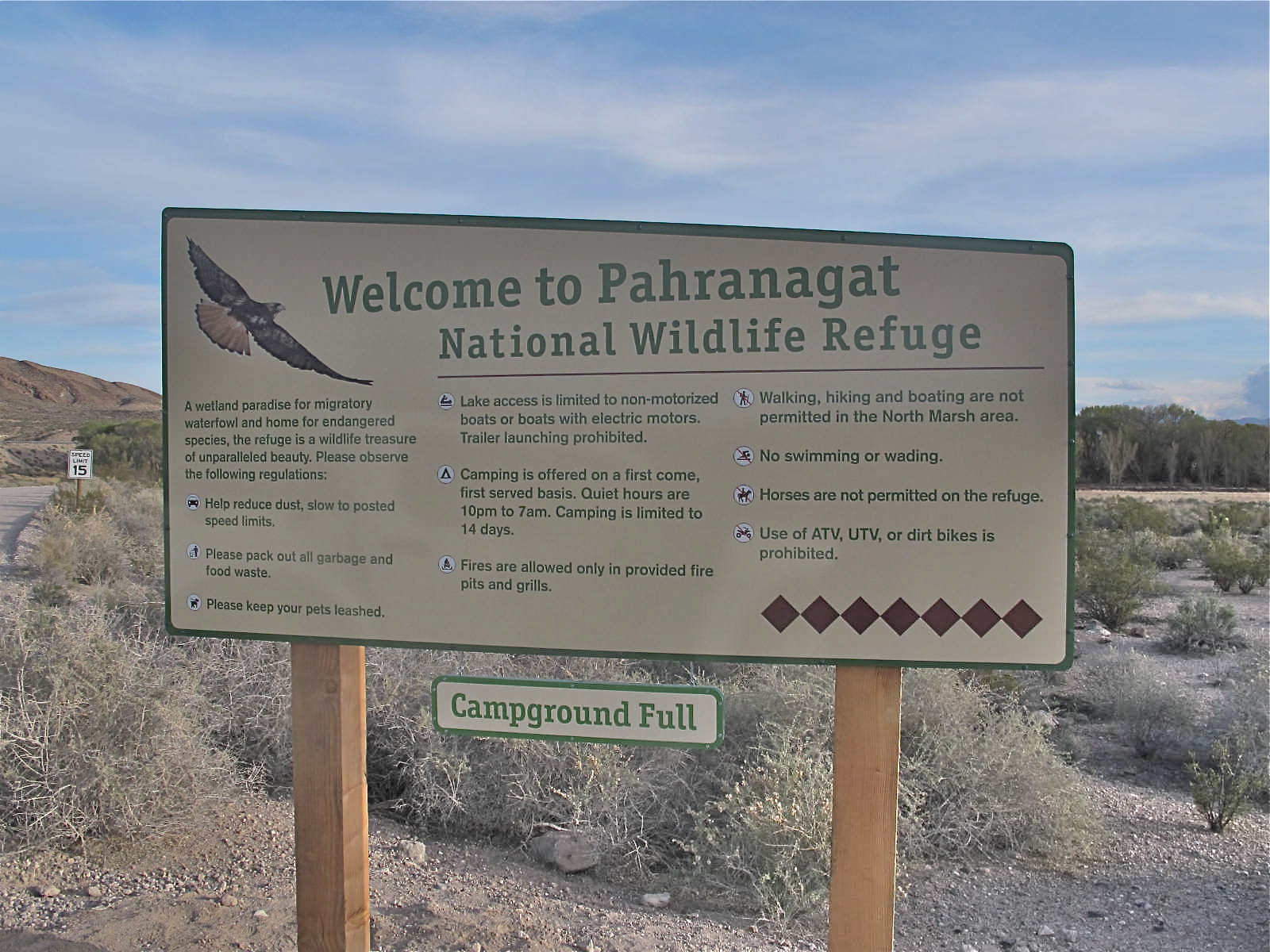
I arrived at Pahranagat (Pah-ran’ a-gat) mid-afternoon and was greeted by this sign.

The seven diamonds are a tribute to the seven local Southern Paiute (Nuwuvi)tribes or bands in the local area.

The seven diamonds are a tribute to the seven local Southern Paiute (Nuwuvi)tribes or bands in the local area.

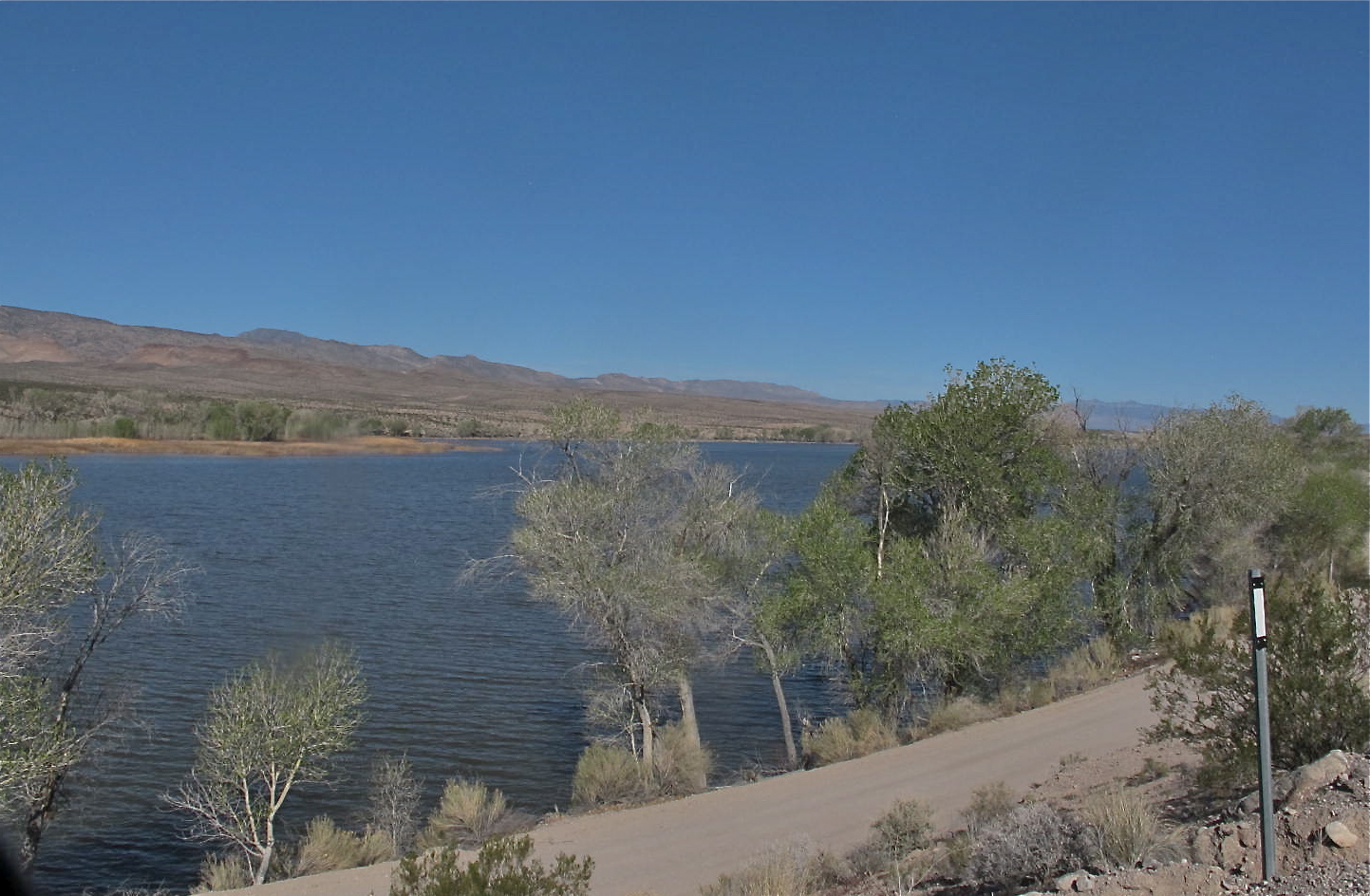
Large thermal springs provide water for lakes and wetlands, making Pahranagat a precious habitat for migrating birds, deer, coyotes and other critters.   Water is stored in Upper Pahranagat Lake (where the campsites are) and released as needed to nurture habitats in the central and southern portions of the refuge.

Upper Lake at the Pahranagat NWR

Upper Lake at the Pahranagat NWR

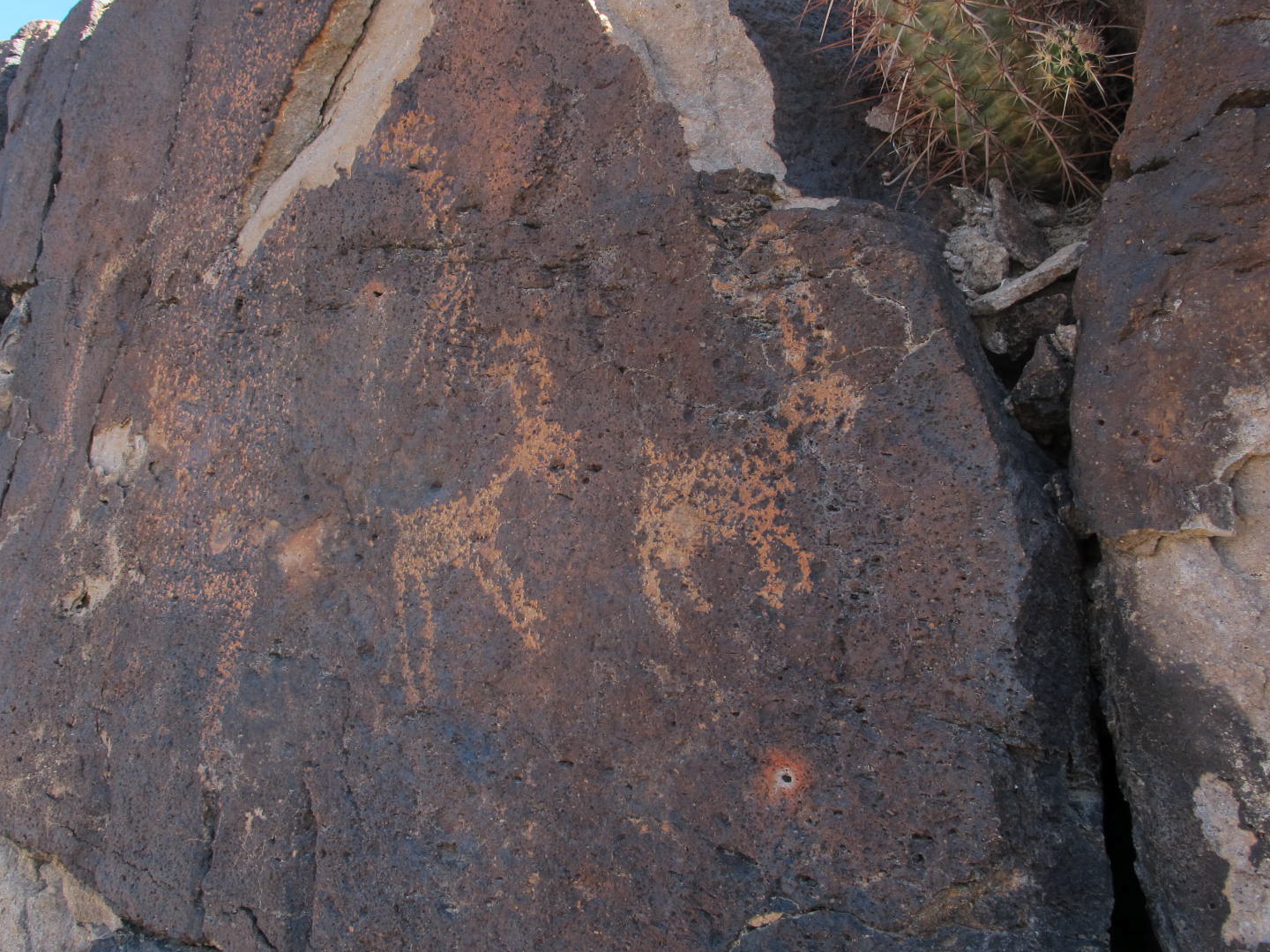
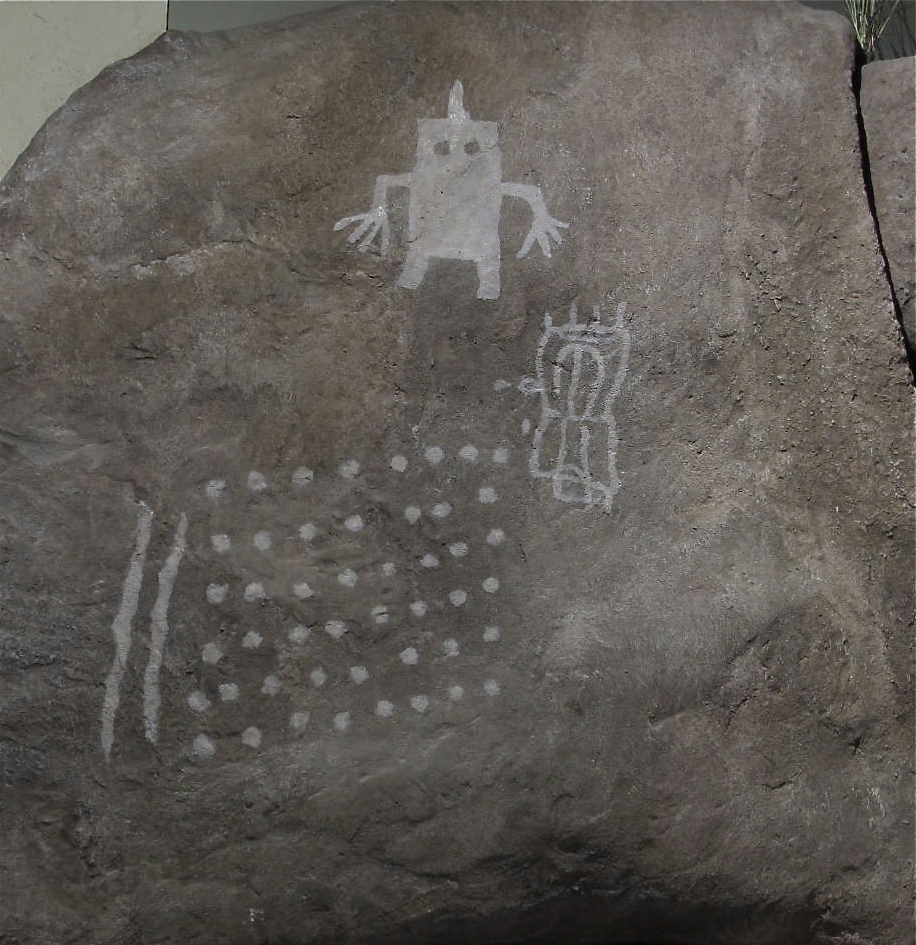
Pahranagat has significant importance to the Paiute (Nuwuvi) people and has been historically utilized by native people for thousands of years. Gale took me to a restricted area (for regular tourists, but she has permission) see some petroglyphs.

Nuwuvi petroglyph

Nuwuvi petroglyph

I climbed up a pretty steep slope to get close and personal to these etchings and they were very impressive. I didn’t realize how high I had climbed until I turned around to look to wave at Gale.

She's pretty far down there!

It was kind of scary particularly when she hollered to me that the nearest hospital is 90 miles away! Oops. Needless to say, I was very careful.

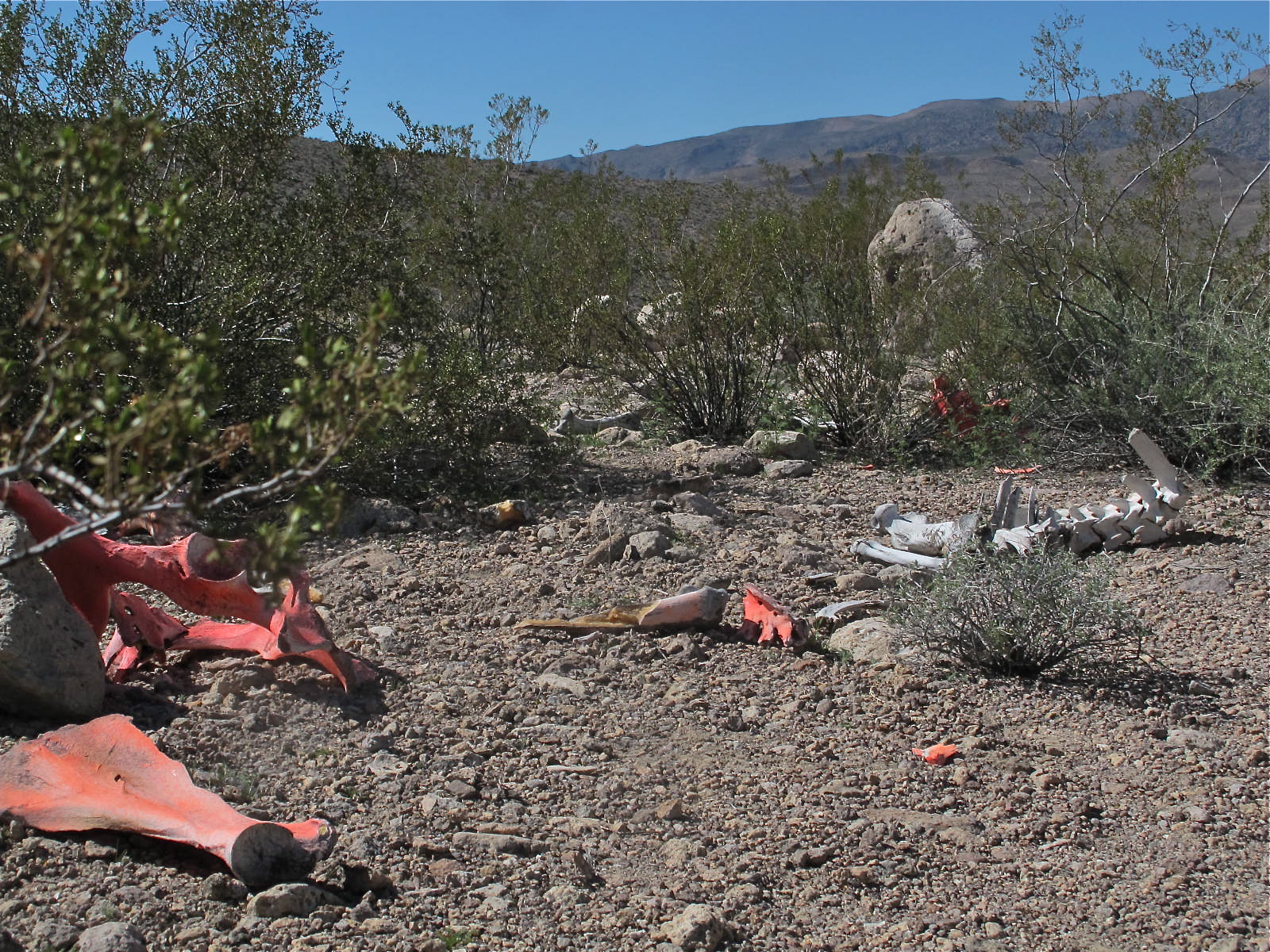
She then took me on a nice drive back into the mountains just east of Pahranagat to see what we could see on what was primarily BLM land. Mostly we saw a few cattle, some ravens, small birds and the weirdest thing was a pink skeleton of a cow or horse or some large animal. People do the darndest things. The bones were painted with a fluorescent pink paint and they were scattered among other sun-bleached bones.   Actually, there were several skeletons…some pink and some white.   Gale thought that someone had been butchering and just dumped the bones in the mountains, not far from the highway.

No pink elephants here!

No pink elephants here!

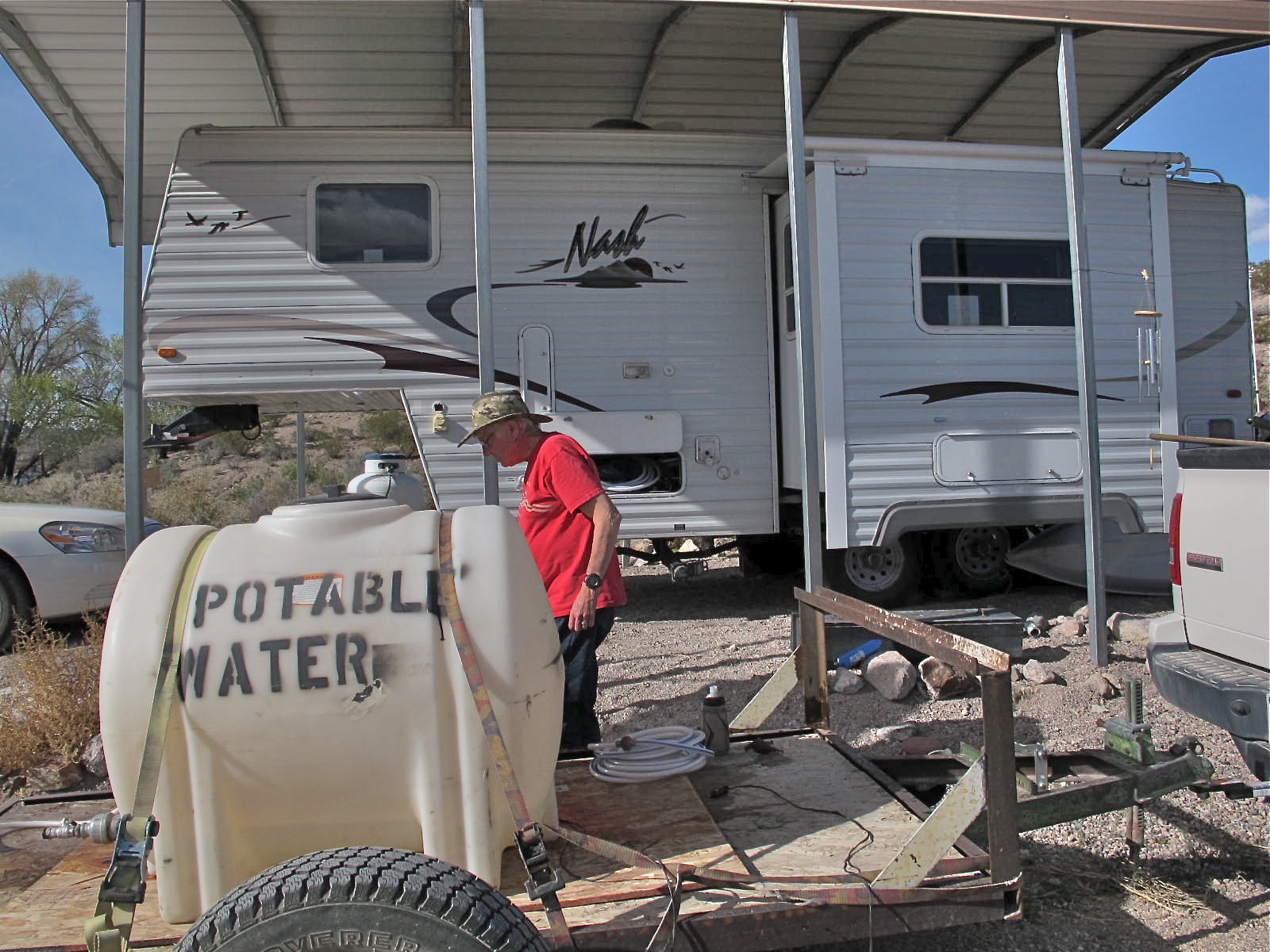
Gale’s campsite has only sewer and electric hookups. So she has to haul water in about once a week from the Visitor’s Center, about 3 miles away. She is so efficient in hooking up a water trailer to her government issued truck, getting the water, hauling it to her camp site and then pumping it into her fifth wheel potable water holding tank. I was very impressed.

Uploading H2O

Uploading H2O

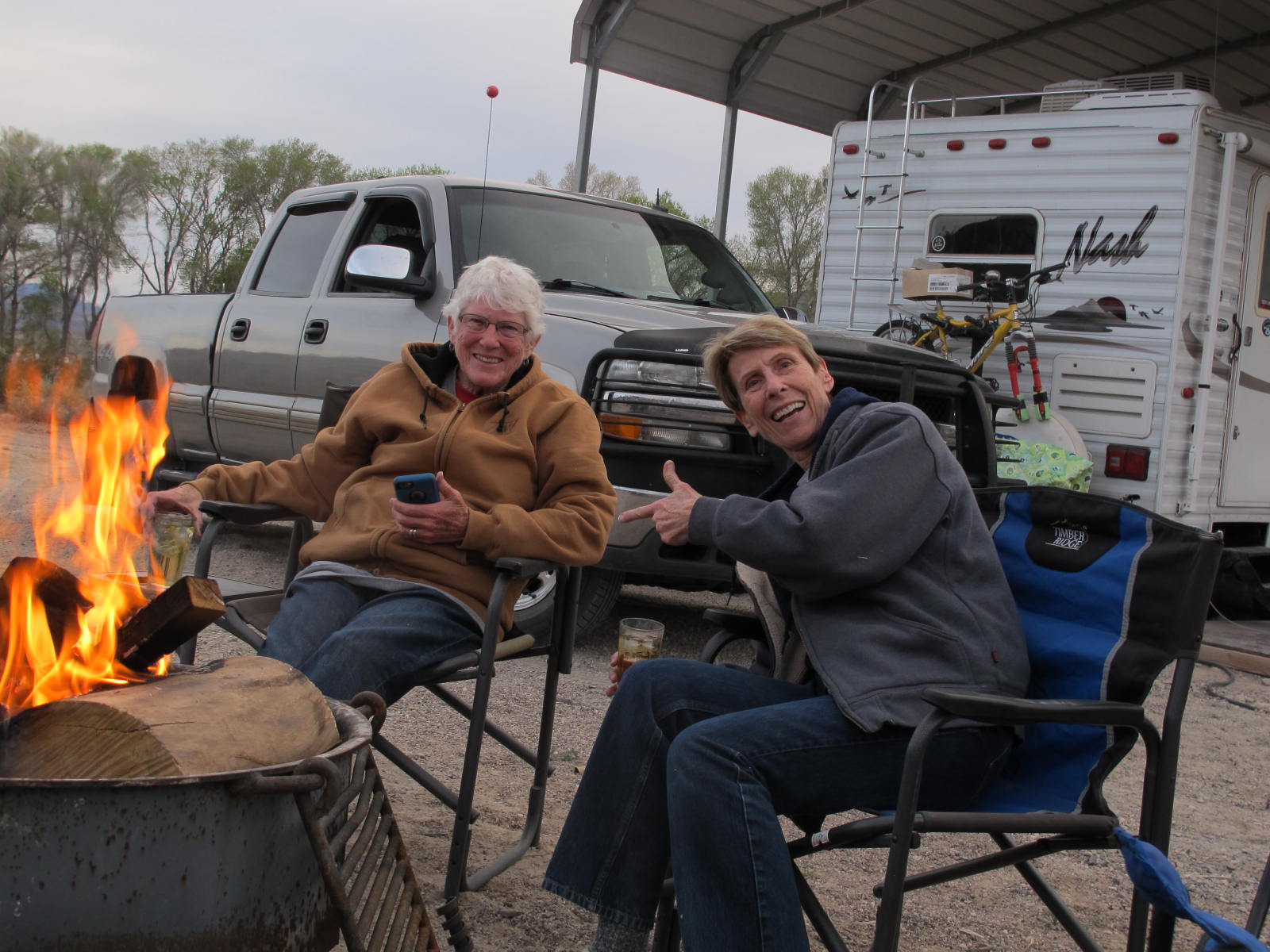
We had a campfire that night even though it was cool…as you can tell by our jackets. It was fun sitting out there; telling stories, and watching the stars come out.

We had a campfire that night even though it was cool…as you can tell by our jackets. It was fun sitting out there; telling stories, and watching the stars come out.

Of course, Gale’s dog, Sissy, was right there with us. She was hoping someone would throw her Frisbee, another toy, scritch her head or perhaps give her a bite of something even though we weren’t eating anything. The white spot on her nose is gravel from playing fetch.

Of course, Gale’s dog, Sissy, was right there with us. She was hoping someone would throw her Frisbee, another toy, scritch her head or perhaps give her a bite of something even though we weren’t eating anything. The white spot on her nose is gravel from playing fetch.

The next day, we headed up to Cathedral Gorge State Park, about an hour north of Pahranagat. This area was once home to the Fremont, Anasazi and Southern Paiutes and now is an area for visitors to camp at and enjoy. It became one of Nevada’s first four state parks in 1935. The original picnic areas were built by the CCC (Civilian Conservation Corps) in the 1930s and are still in use today. I always like to learn about CCC projects because my dad was in the CCC and I think it’s interesting to learn about the various projects they did.

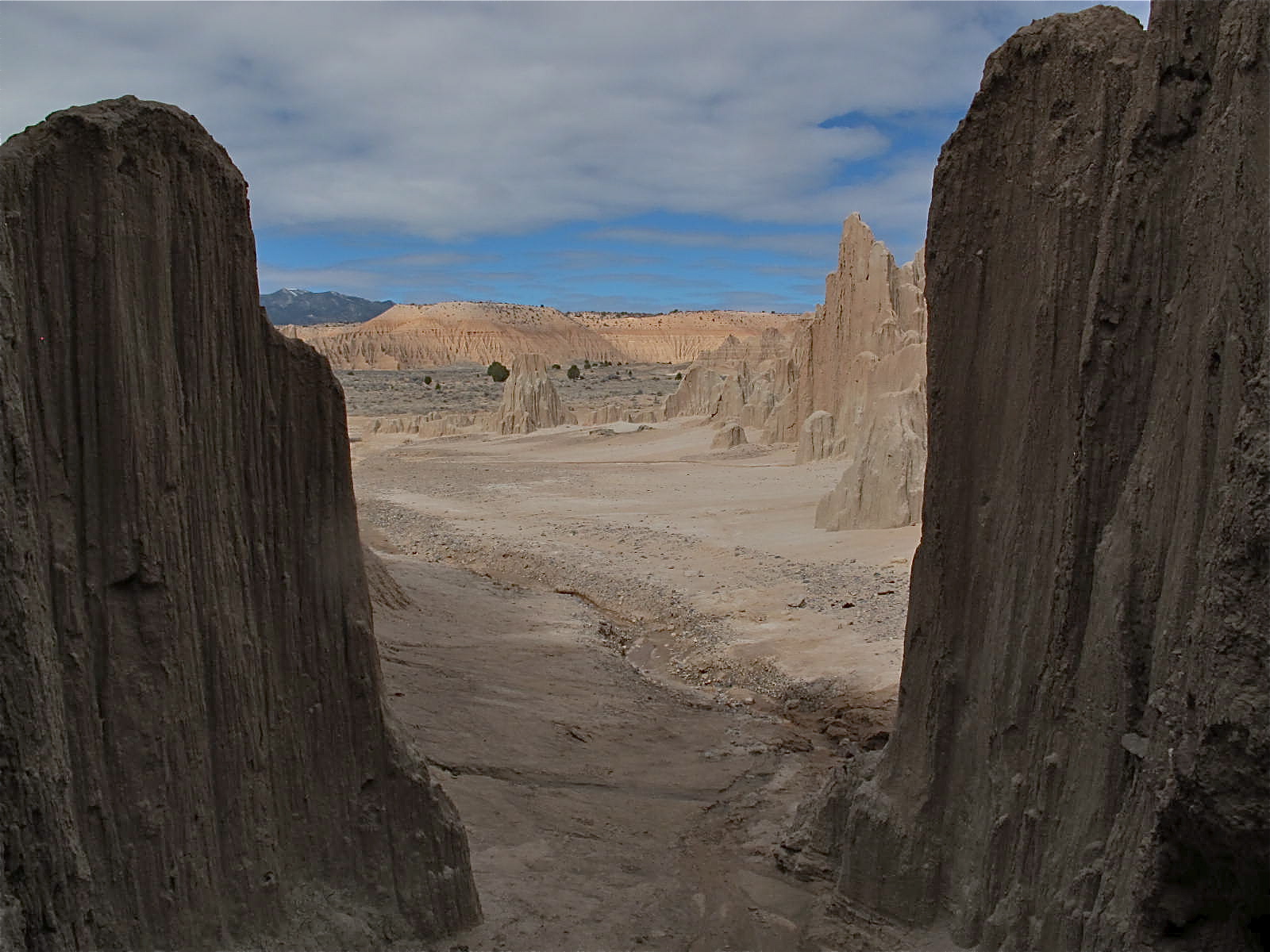
The spires and cliffs are the result of geologic processes occurring over millions of years; volcanic activity, fractures in bedrock, flooding and erosion. Silt, clay, and volcanic ash combined to make Bentonite clay and eroded to make the formations we saw in the Gorge.

The spires and cliffs are the result of geologic processes occurring over millions of years; volcanic activity, fractures in bedrock, flooding and erosion. Silt, clay, and volcanic ash combined to make Bentonite clay and eroded to make the formations we saw in the Gorge.

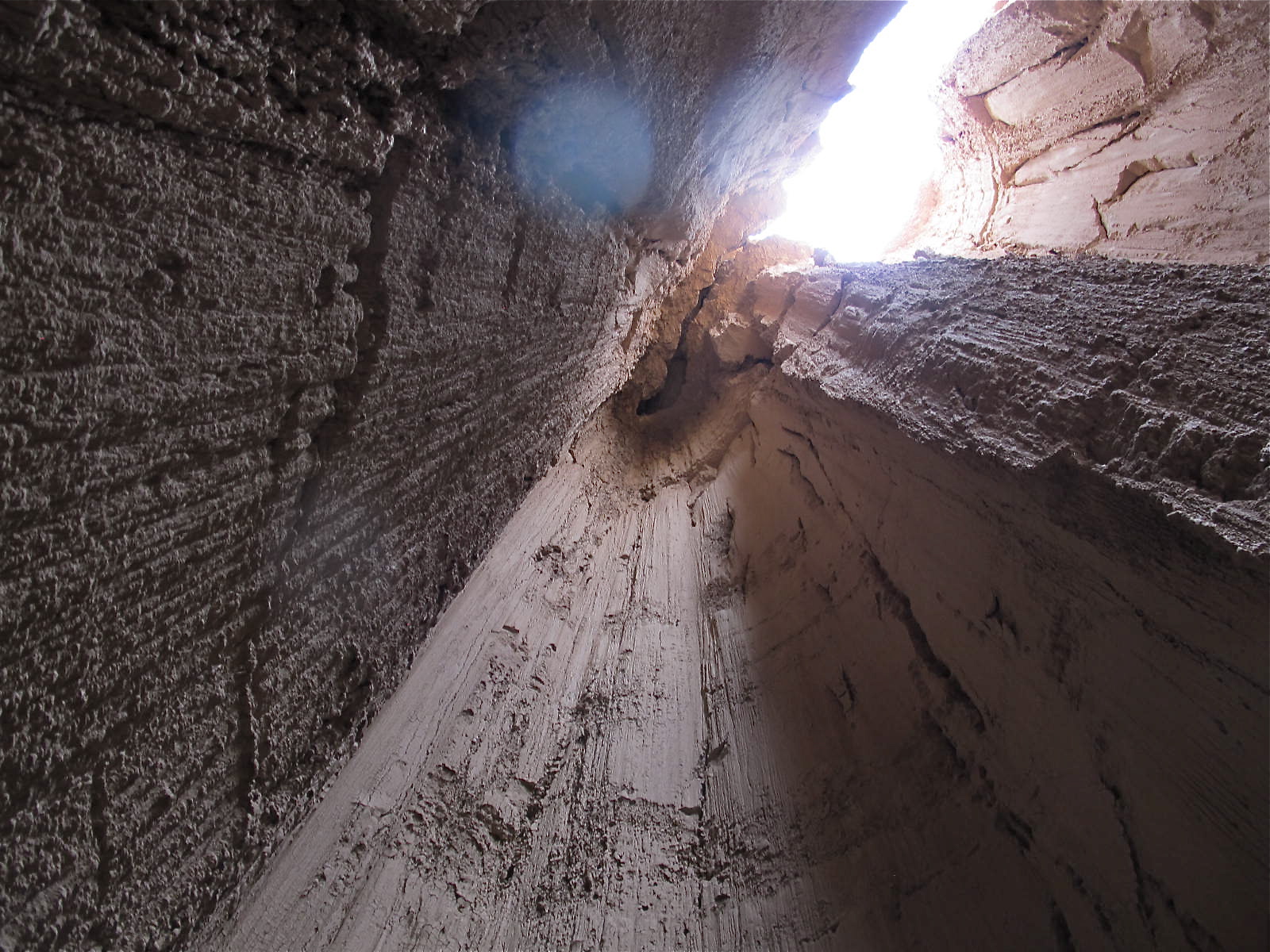
The erosions caused some caves to be made and we could walk in them. Walk we did and they were really impressive. We could see the sky out of some of the caves and I think the walls were more than 30 feet tall

The erosions caused some caves to be made and we could walk in them. Walk we did and they were really impressive. We could see the sky out of some of the caves and I think the walls were more than 30 feet tall

Gale and I had no information on the Gorge, so we tried to figure out how the walls for formed and eroded and came pretty close to the real causes.

Gale and I had no information on the Gorge, so we tried to figure out how the walls for formed and eroded and came pretty close to the real causes.

I imagine the first explorers to see this gorge were duly impressed.

I imagine the first explorers to see this gorge were duly impressed.

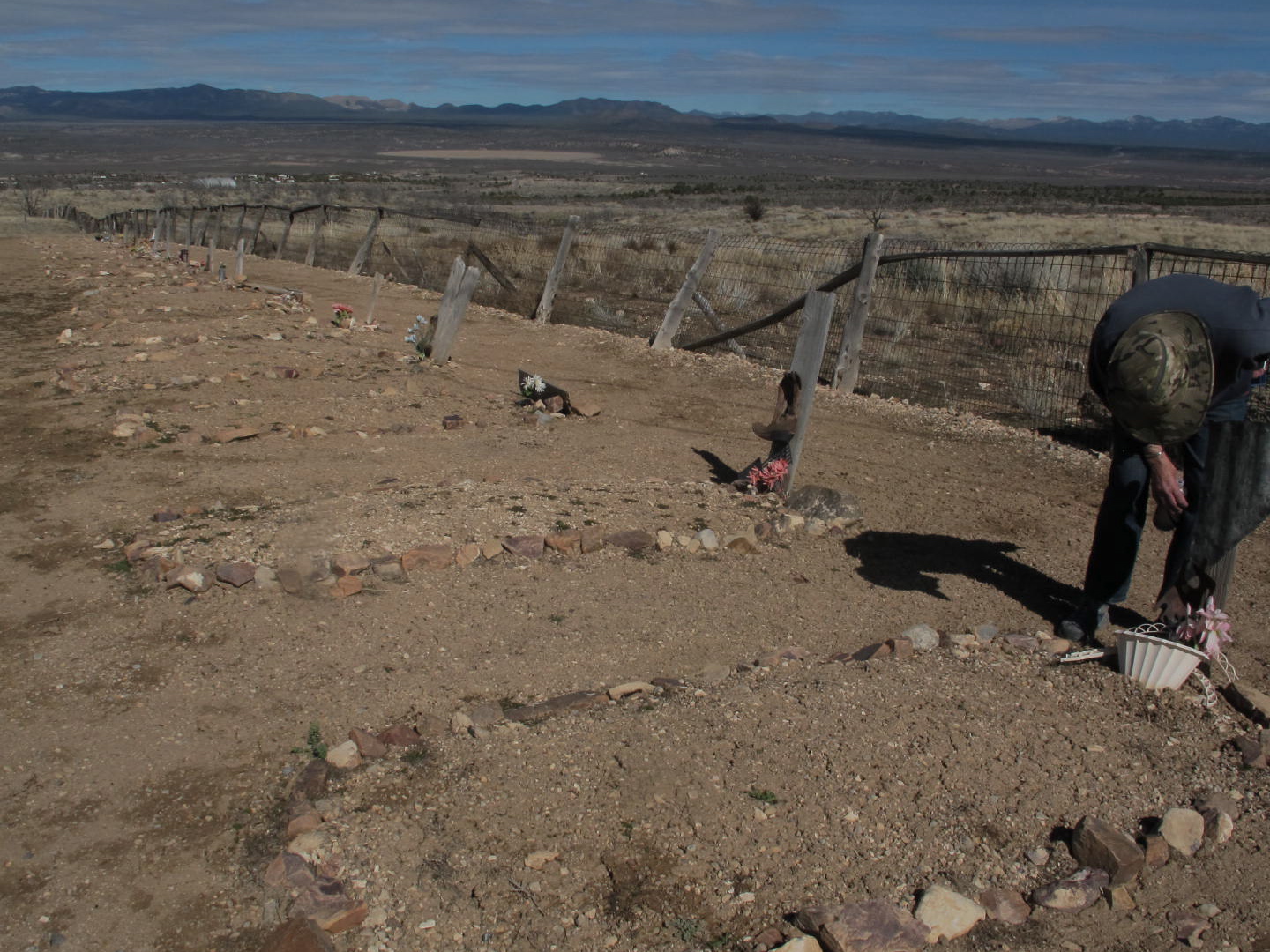
From Cathedral Gorge, we drove to the old mining town of Pioche developed in the 1860s by a Frenchman F.L.A. Pioche. Supposedly, it was the “baddest” town in the West. Perhaps it was. I have read several sources that claim 72 people died from “lead poisoning”(gun shots) before the first person died of natural causes.   We visited the Pioche Boot Hill that has recently been cleared of weeds and such by local citizens. I think I would tend to believe the accounts after reading a few of the wooden headstones.  A Pioche web site said “Murderer’s Row of more than 100 killers was fenced off from graves of the more respectable occupants of the cemetery.”

A portion of Boot Hill

A portion of Boot Hill

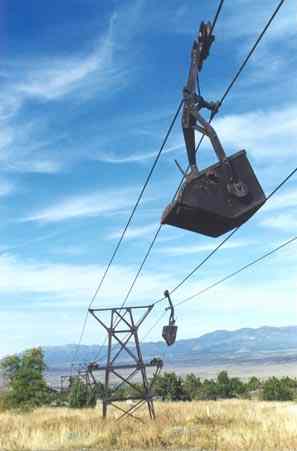
One of the things that intrigued me was the ore bucket tramline that appeared to go from one side of a mountain down to the valley below to what looked like a smelter or some type of ore processor. I had to “borrow” this shot from the web site because mine didn’t show what this one does. This tram went over the “Murderer’s Row” graves.

One of the things that intrigued me was the ore bucket tramline that appeared to go from one side of a mountain down to the valley below to what looked like a smelter or some type of ore processor. I had to “borrow” this shot from the web site because mine didn’t show what this one does. This tram went over the “Murderer’s Row” graves.

I’d like to go back to Pioche some day to spend more time and see the old buildings that still cling to the mountainside.

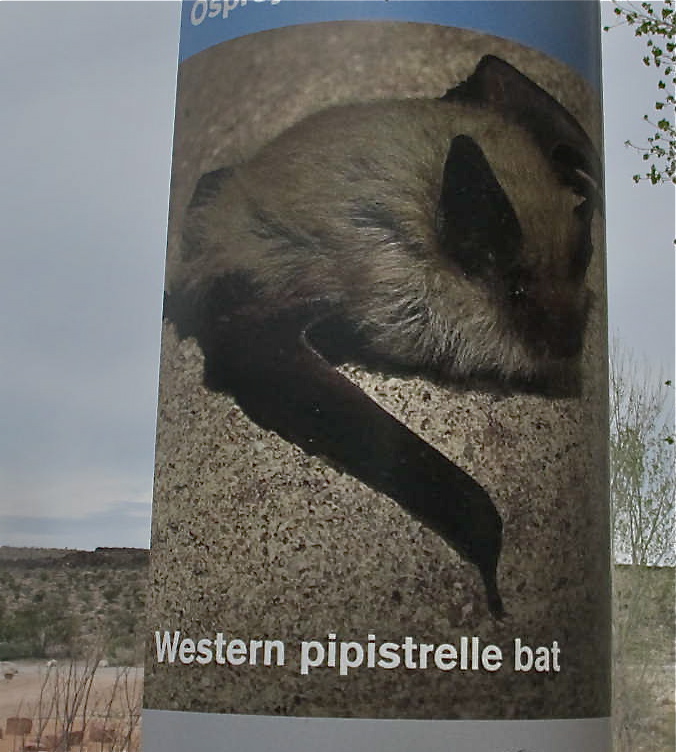
Speaking of clinging. Pahranagat is home to the Western pipistrelle bat, the smallest bat in the USA. They weigh between 0.1 -0.2 ounces and their wingspan is between 7-9 inches. One was roosting in the eave of the main door to the Pahranagat Visitor Center and looked like a tiny brown blob in the corner. They like to eat swarming insects, such as mosquitoes. So we like them to be out and about and we don’t have to be concerned about them biting us (which bats don’t normally do anyway).

An informational post at the center.

This picture was taken from an informational post at the center.

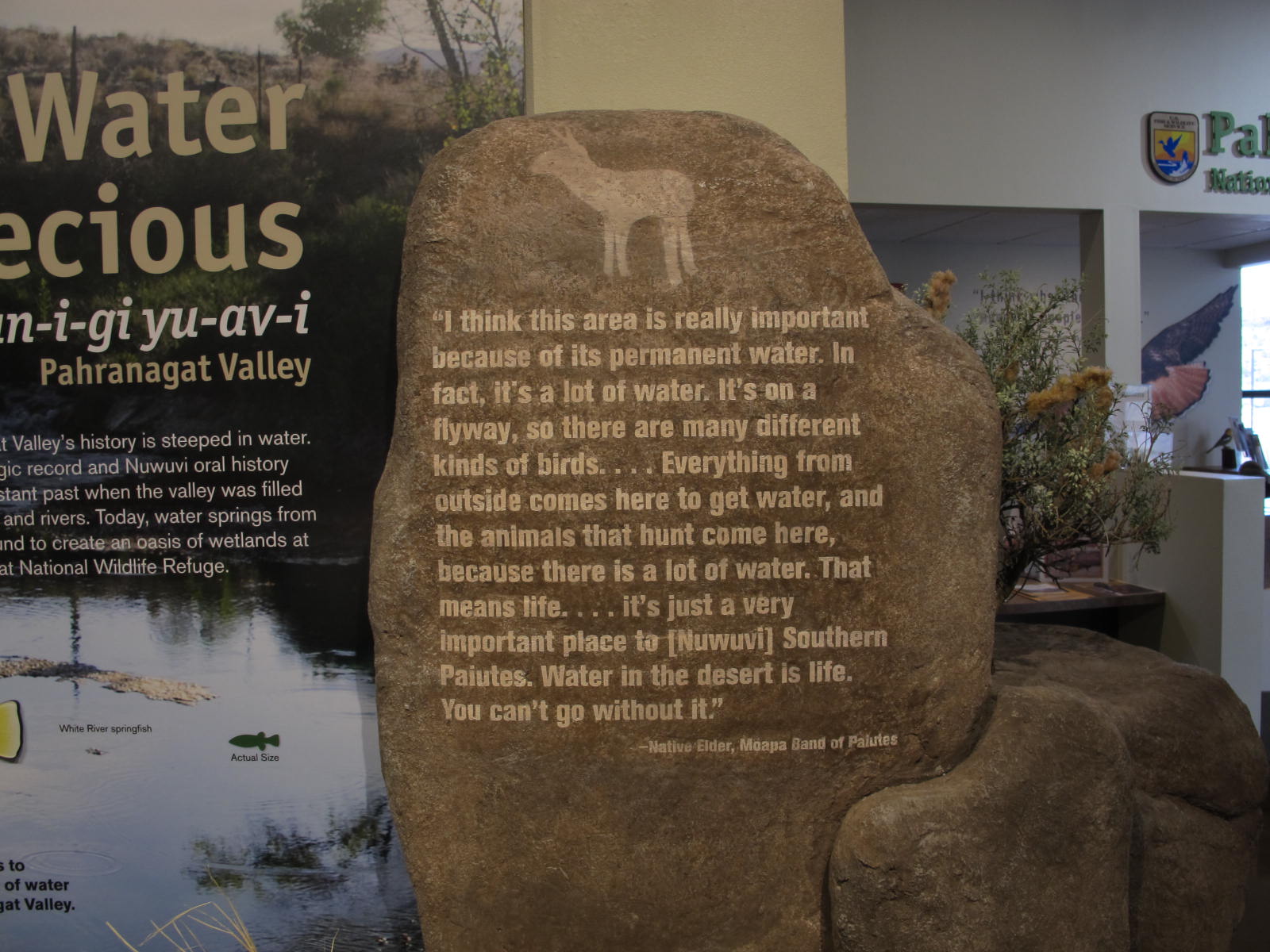
The Visitors Center is very well done and so informational. I particularly liked how the Paiute culture is interwoven with the wildlife story of Pahranagat. Generations of Nuwuvi valued the desert and water resources and maintained strong tied to the living landscape of which people, wildlife and plants are all an integral part.

Pahranagat petro reproduction

Locals call the little guy the Pahranagat Man

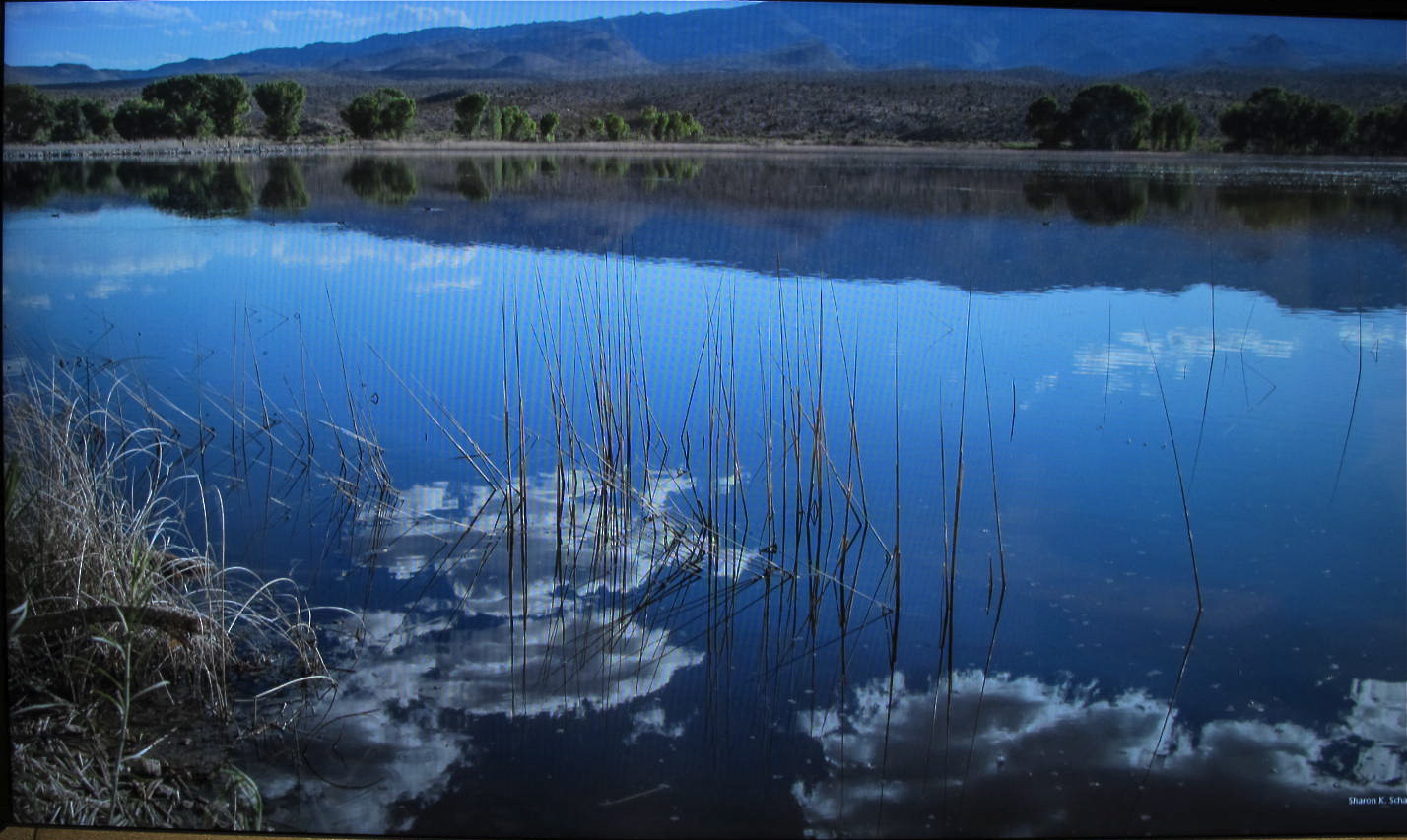
An Upper Lake picture on display at the Visitor Center

An Upper Lake picture on display at the Visitor Center

Observation from a local Paiute

Observation from a local Paiute

“Humankind has not woven the web of life. We are but one thread within it. Whatever we do to the web, we do to ourselves.” Chief Seattle, 1855… and the white man called the First Americans primitive.

I’m including this picture because behind those mountains lies Area 51. At night, we could hear quite a few jets flying over and sometimes sonic booms. I was glad Gale warned me about that because I probably would have thought the world was coming to an end.

I’m including this picture because behind those mountains lies Area 51. At night, we could hear quite a few jets flying over and sometimes sonic booms. I was glad Gale warned me about that because I probably would have thought the world was coming to an end.

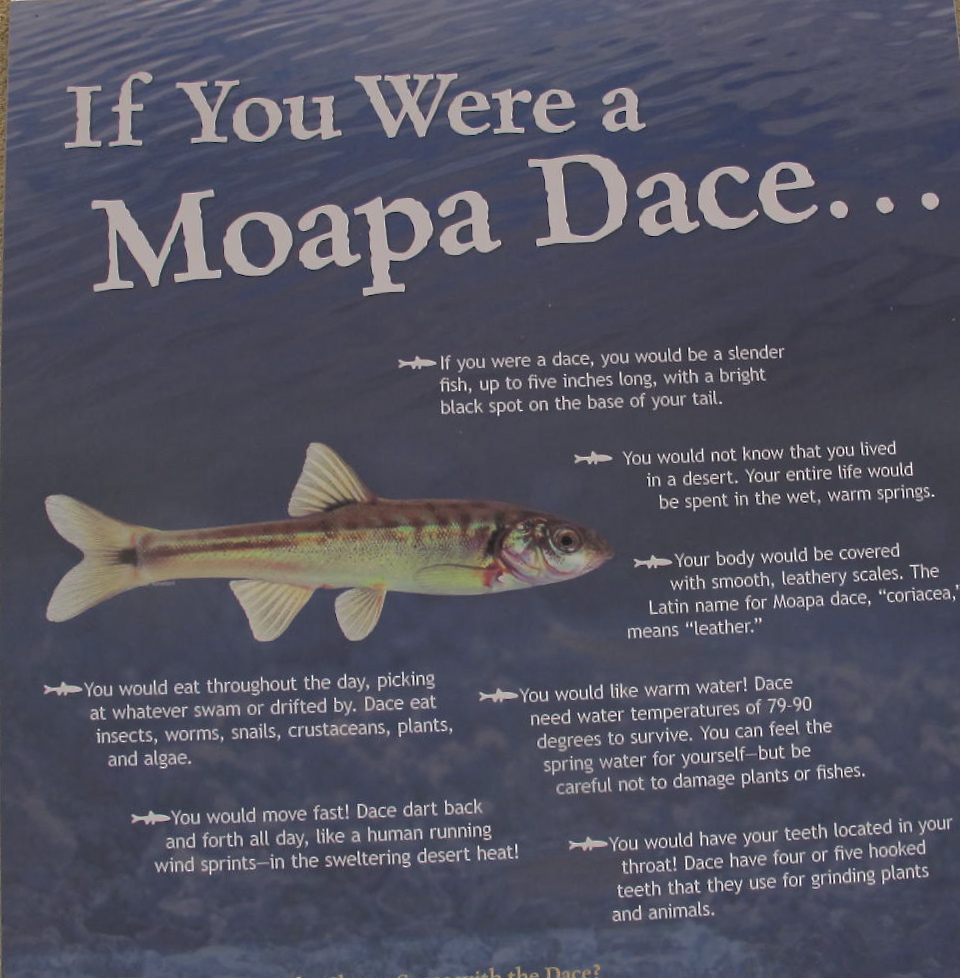
Gale took me to another refuge called the Moapa Valley National Wildlife Refuge. It was created to protect the Moapa dace, a tiny endangered fish. For thousands of years, the Nuwuvi lived and thrived in the area along with the Moapa dace. There are warm springs in the area (averaging about 88 degrees) and those springs became a resort for folks from Las Vegas. They had rv parks, chlorinated pools and snack bars. Additionally, they planted thousands of palm trees, which suck up 500 gallons of water each day! By 1977 only a few hundred dace remained. The Feds bought several hundred acres in 1979 and began the restoration. Work continues at the refuge and will for many more years.

Million year old water is emerging from the springs here.

Million year old water is emerging from the springs here.

You definitely have to double click on this to see the text

You definitely have to double click on this to see the text

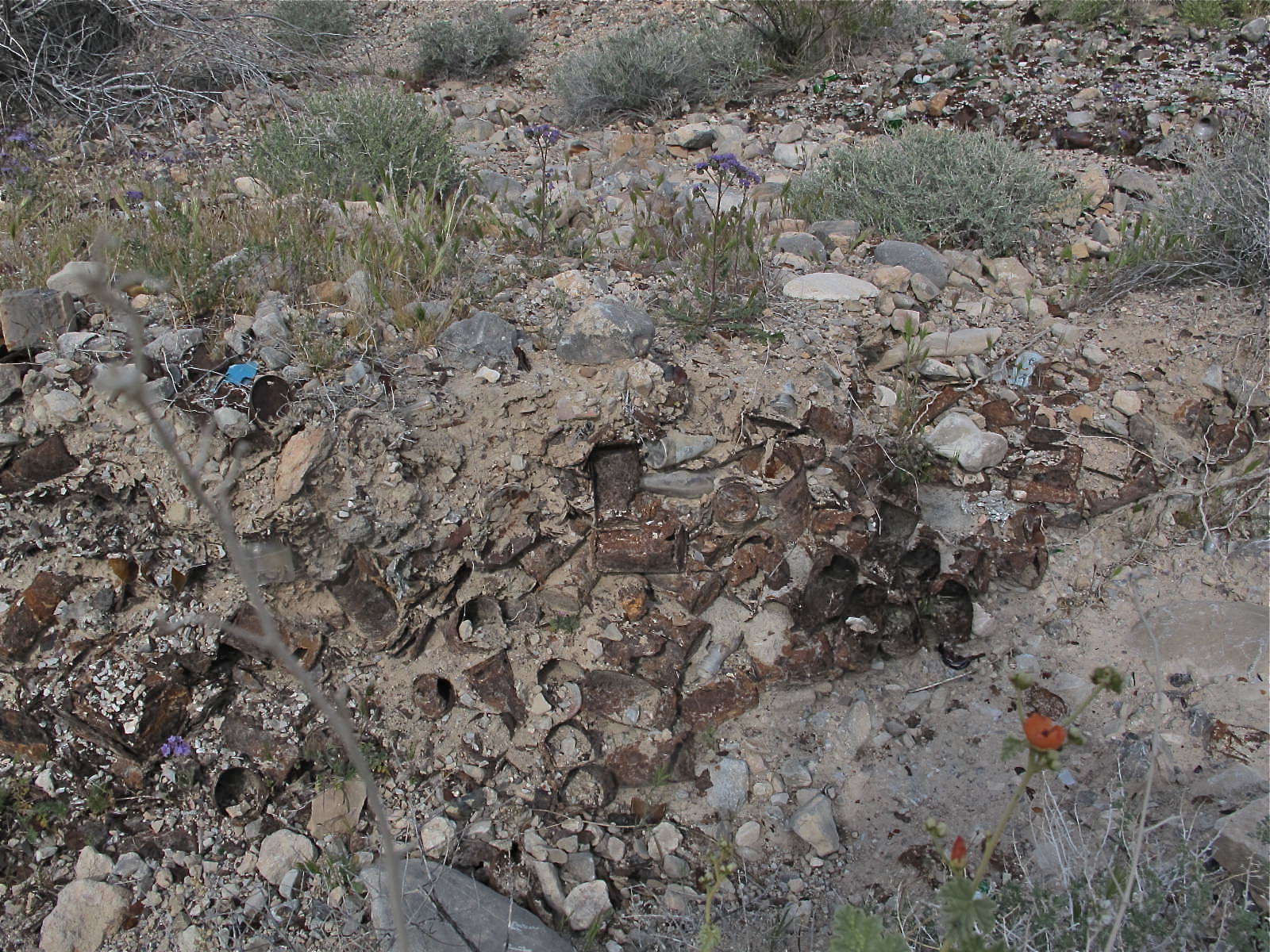
Interestingly, the resort people didn’t dispose of their trash in a proper manner because “It’s just desert. Just dump it over there.” They did dump their trash in a small canyon out of sight from the tourists and did so for many years. One can see this site and see the layers of tin cans, soda bottles, and early pop top beer cans. Because of the extreme summer heat, some of the glass bottles have melted into strange looking Salvador Dali-like shapes.

This can't be removed until the antiquities people come to check it out to see if the dump has historical significance

This can’t be removed until the antiquities people come to check it out to see if the dump has historical significance

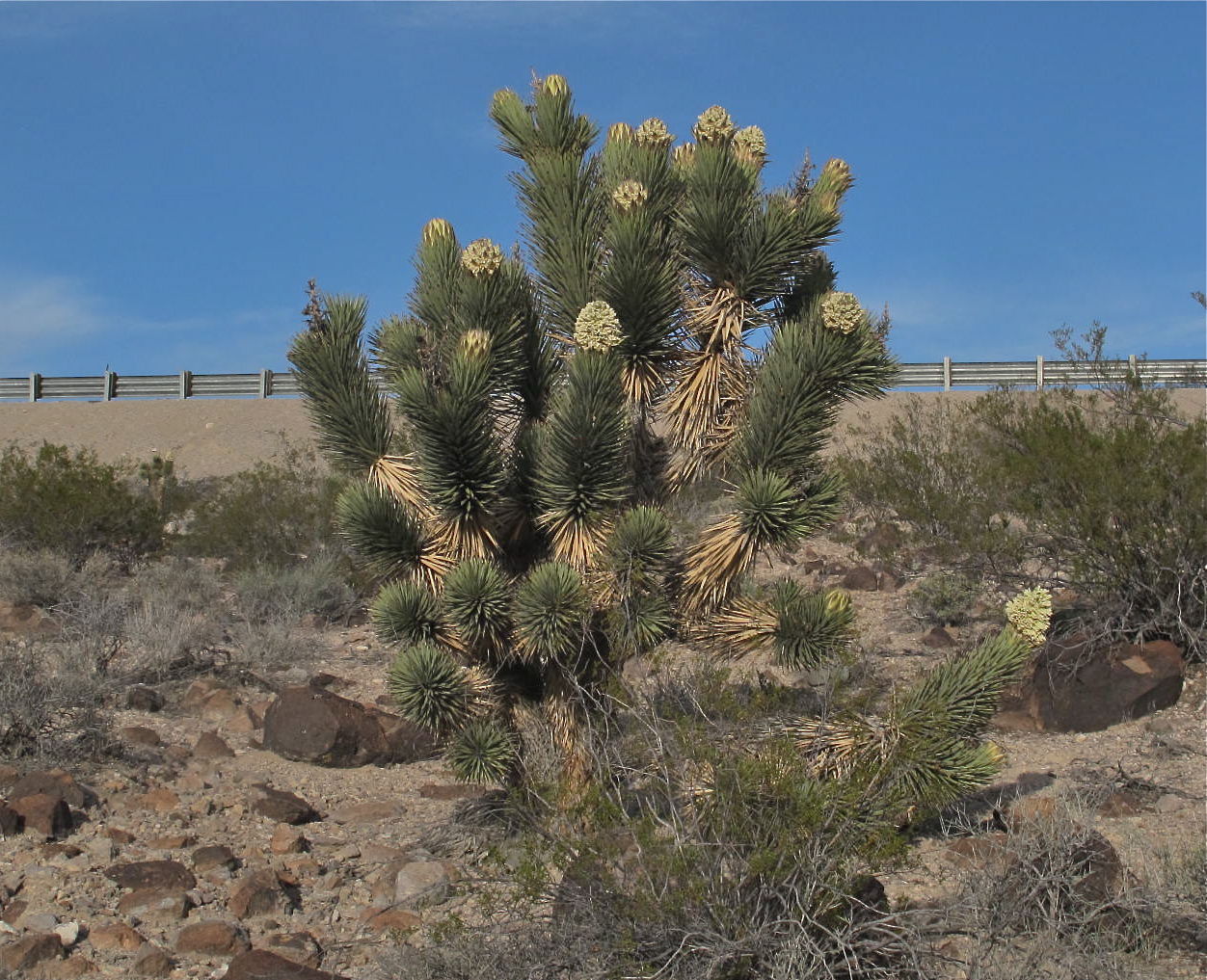
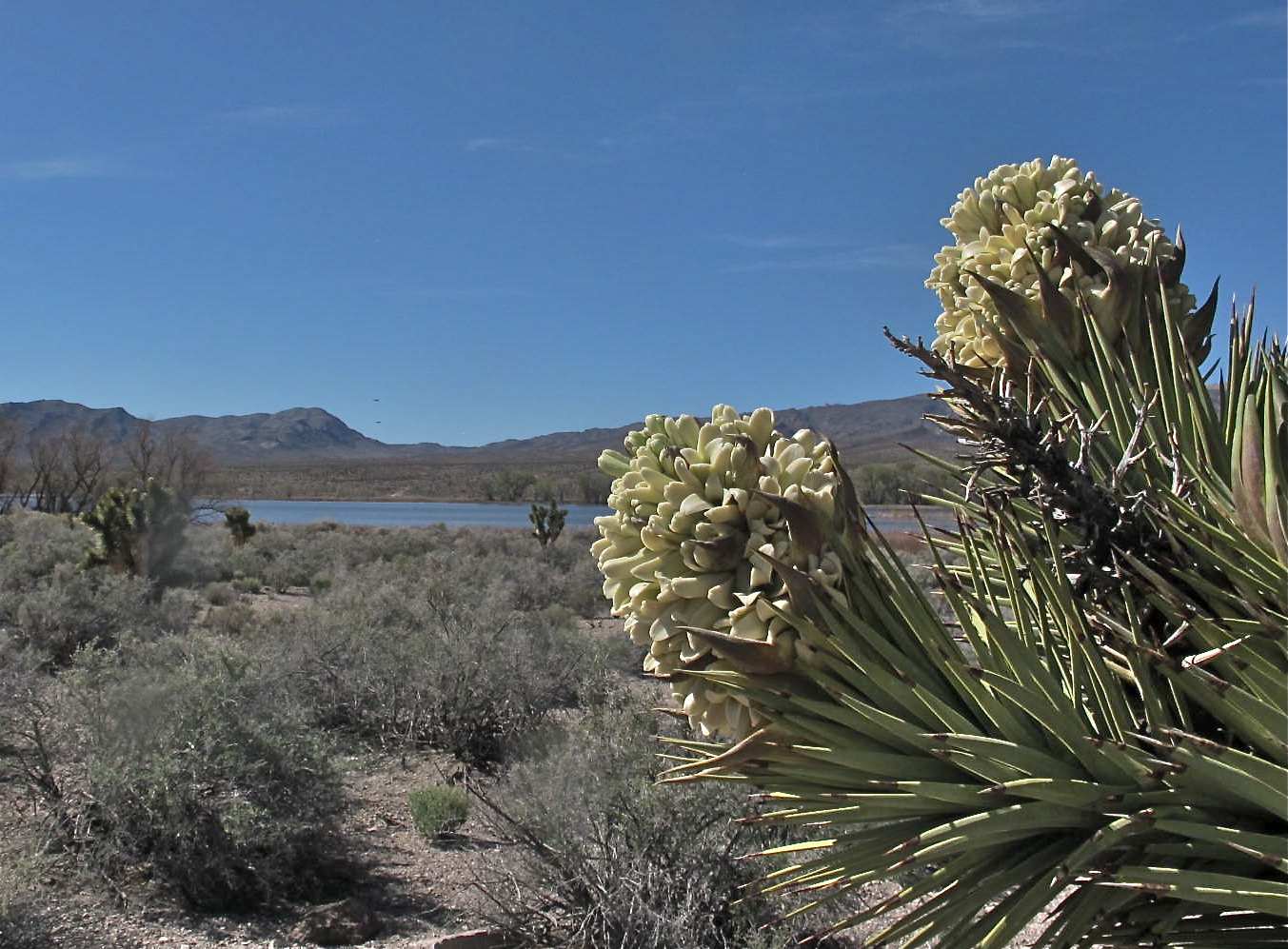
Some desert flowers were in bloom but my pictures did not turn out at all.  But many Joshua trees grow in the Pahranagat area and many were in bloom.  I like their weird shapes with their arms reaching to the sky.  Technically, they are not trees, but that’s their name, so we’ll go with that.

Mormon Pioneers named the Joshua Tree

Mormon Pioneers named the Joshua Tree

Not all Joshua trees bloom each year. It depends upon the rainfall and just right temperatures.

Not all Joshua trees bloom each year. It depends upon the rainfall and just right temperatures.

Sadly, my time with Gale ended too soon and I had to go to Las Vegas to join family to watch my great nephew, Dalan, compete at the state gymnastics championship meet. I hadn’t been to Vegas for many years and this was surely an eye opener. We stayed at the Rio, a resort off the Strip. I soon learned that this is not really a place for me. Too many people, too noisy, and just too much, period. We were out at the pool area (4 different ones, I think), just chatting when we all heard a loud thump. An inebriated guy was walking in a wet area, slipped and fell onto the back of his head. My nephew-in-law, Jason, being a paramedic/EMT, jumped up to help the guy. He stayed with him until the LV paramedics arrived as the guy was bleeding and not up to speed in knowing what was going on. Jason was our hero for the day.

That evening, Dalan competed and we were all very proud of him when he qualified to compete in the Western Regionals to be held in Santa Clara, CA at the end of March.

You go, Dalan! We are so very proud of you!!!

You go, Dalan! We are so very proud of you!!!

Land of Enchantment – New Mexico October 2015

18 Oct
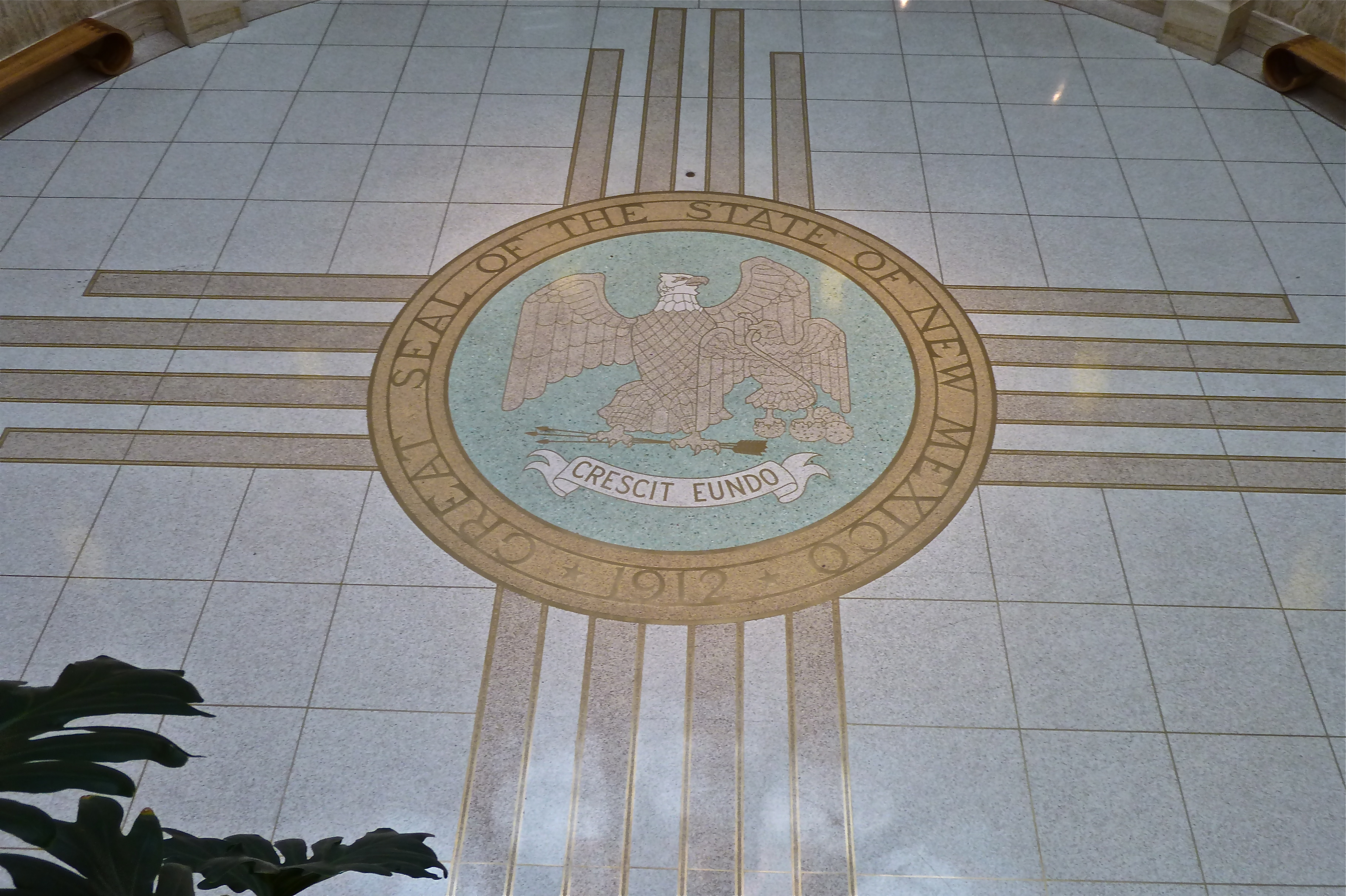
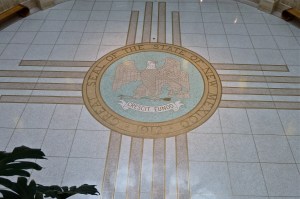
New Mexico's Great Seal in the middle of the Zia symbol

New Mexico’s Great Seal in the middle of the Zia symbol

Jerri and I were certainly enchanted by northern New Mexico…a land of handsome people, savory food, stunning hues and dazzling, yet harmonious vistas. Our sixth Sister Trip was a great success and so much fun!

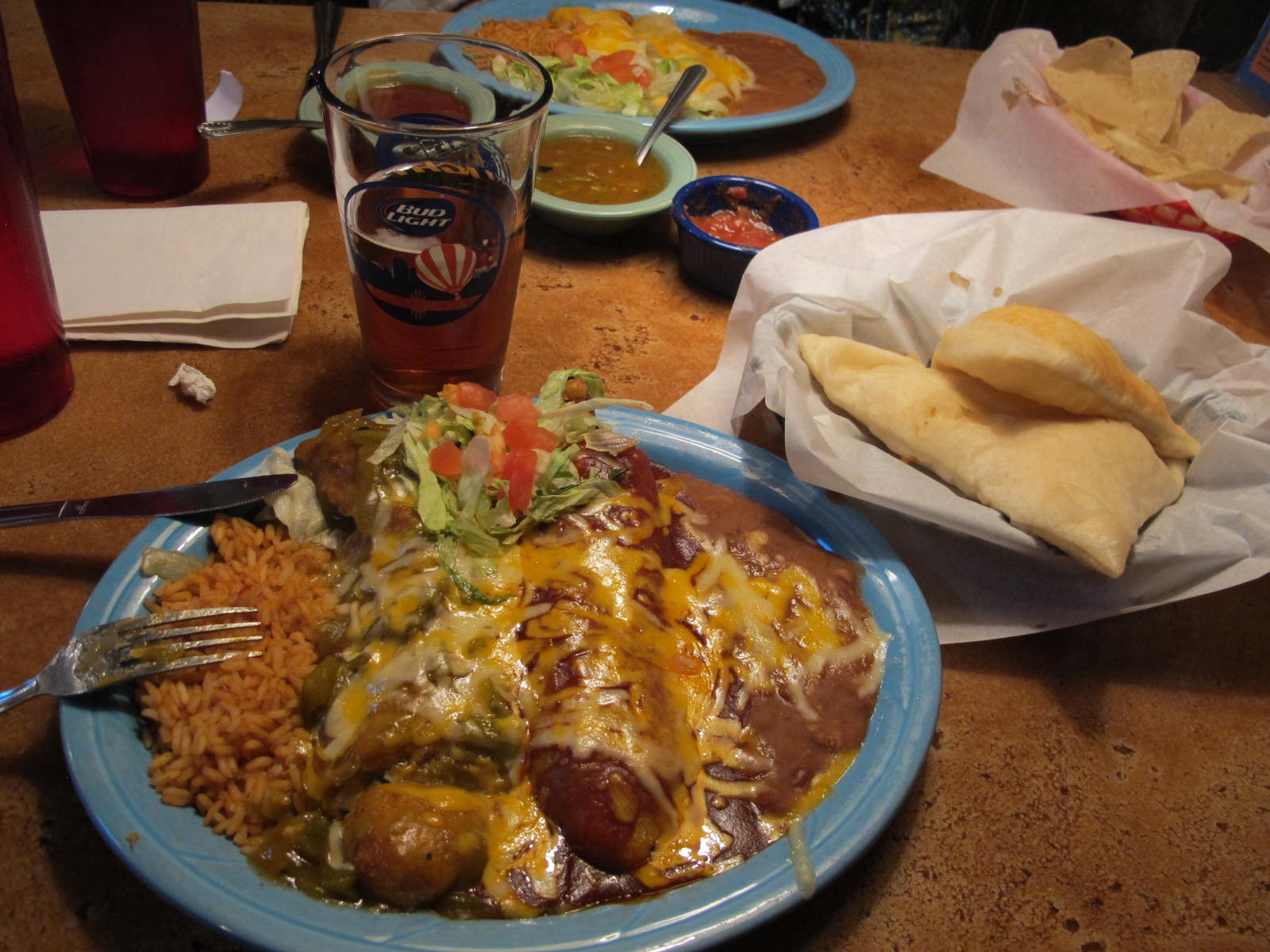
We flew into Albuquerque and drove immediately to Little Anita’s in Old Town where we enjoyed a scrumptious lunch. I covet New Mexican chile and those exquisite sopapillas. Oh my goodness! I was in chile ecstasy! Jerri even liked the tasty tang of the chile.
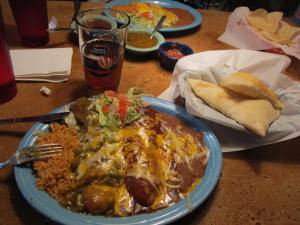
A dish of chile rellenos with the sopapillas on the side.

A dish of chile rellenos with the sopapillas on the side. I also love stuffed sopapillas

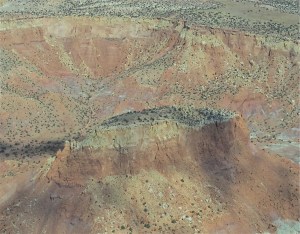
After lunch, we took a very scenic back road to Santa Fe where, the next day, we were scheduled to take a small plane tour over Mesa Verde and then land at Aztec Ruins. That flight was cancelled due to bad weather, but our pilot was able to take us on a wonderful fall foliage, geography and topography tour. The colors were mostly in the Sangre de Cristo Mountains and then we flew over, around and through passes of the Jemez (Hay-mez) Range.    It just so happened that day was the best day in about a week to see the colors. We must have taken hundreds of fall color pictures on this trip.  (Don’t forget to double click on the photos to enlarge them)
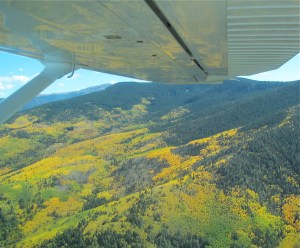
Aspen colors in the Sangre de Cristo Mountains

Aspen colors in the Sangre de Cristo Mountains

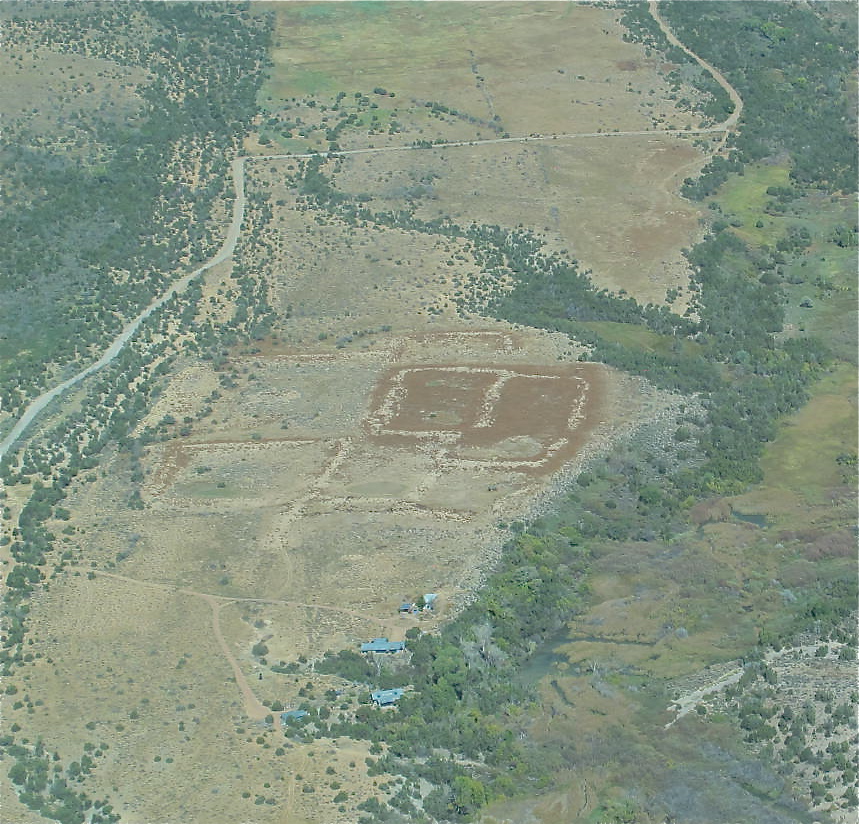
The ancient pueblo outline

An ancient pueblo outline

Quarry where dino bones have been found
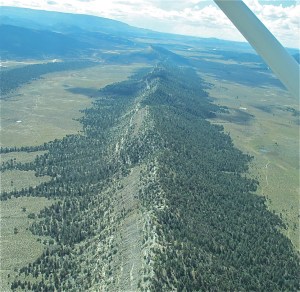
Quarry where dino bones have been found

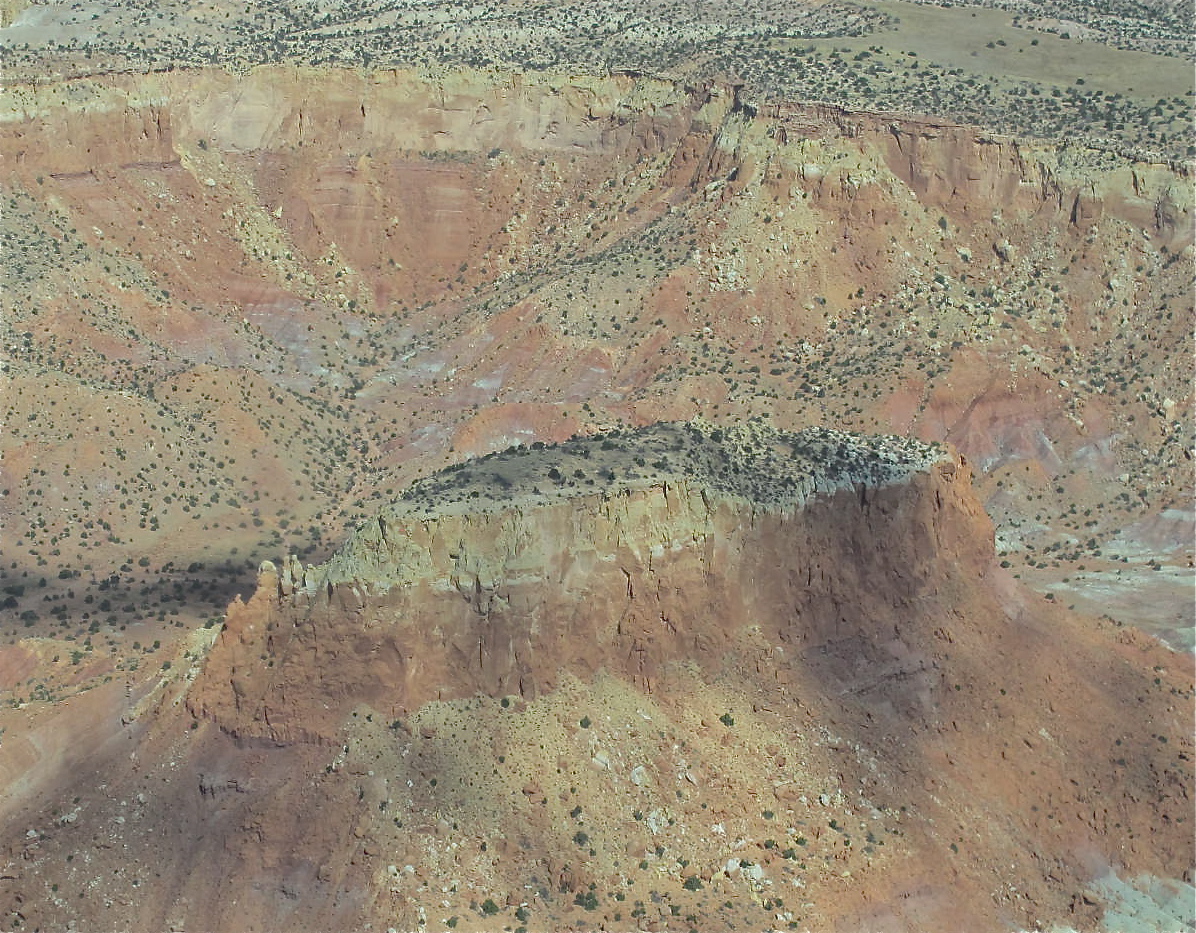
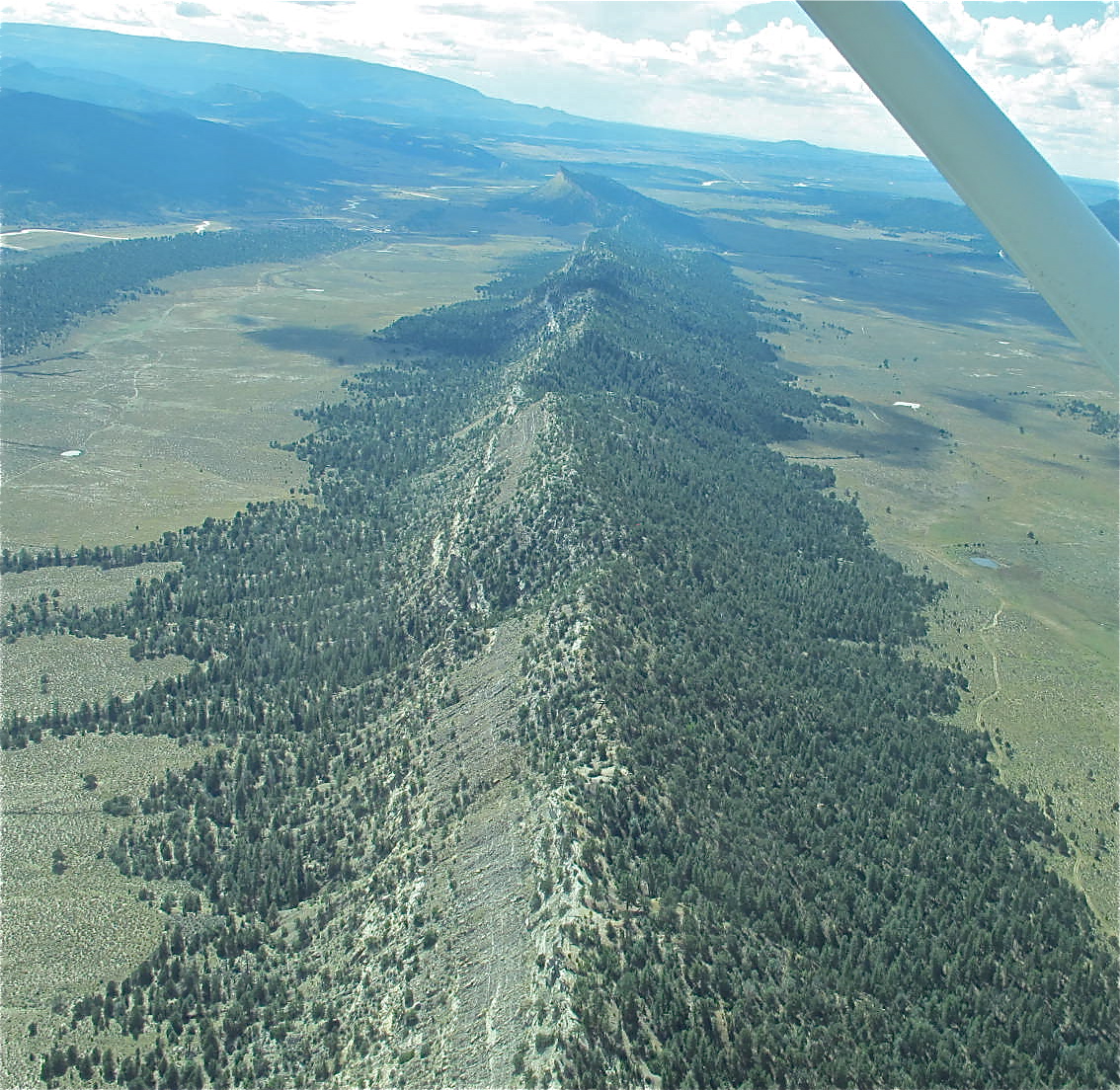
Raised faults

Raised faults

Rio Chama in the Chama River Canyon Wilderness

Rio Chama in the Chama River Canyon Wilderness

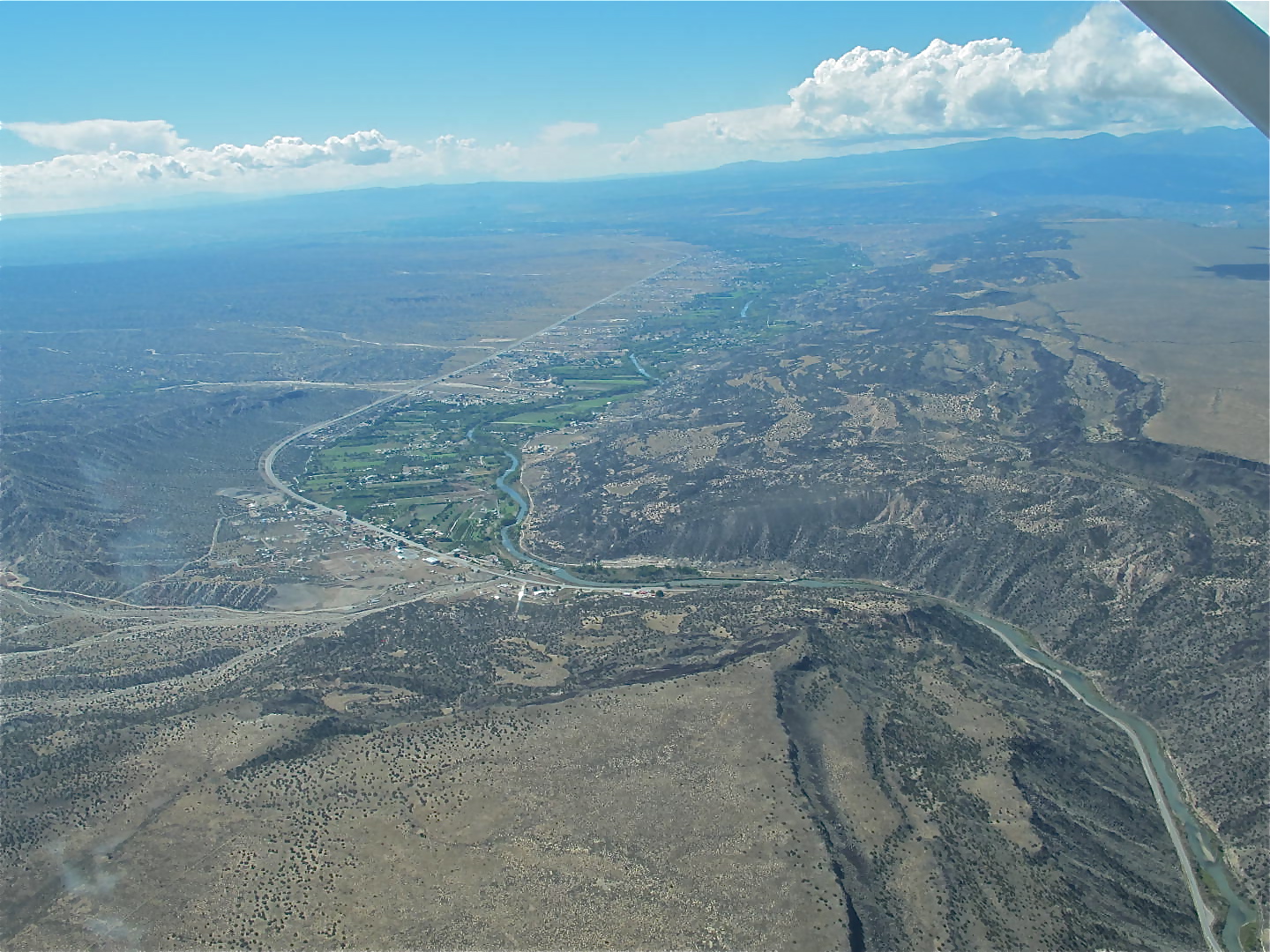
A little town on the Rio Grande
A little town on the Rio Grande

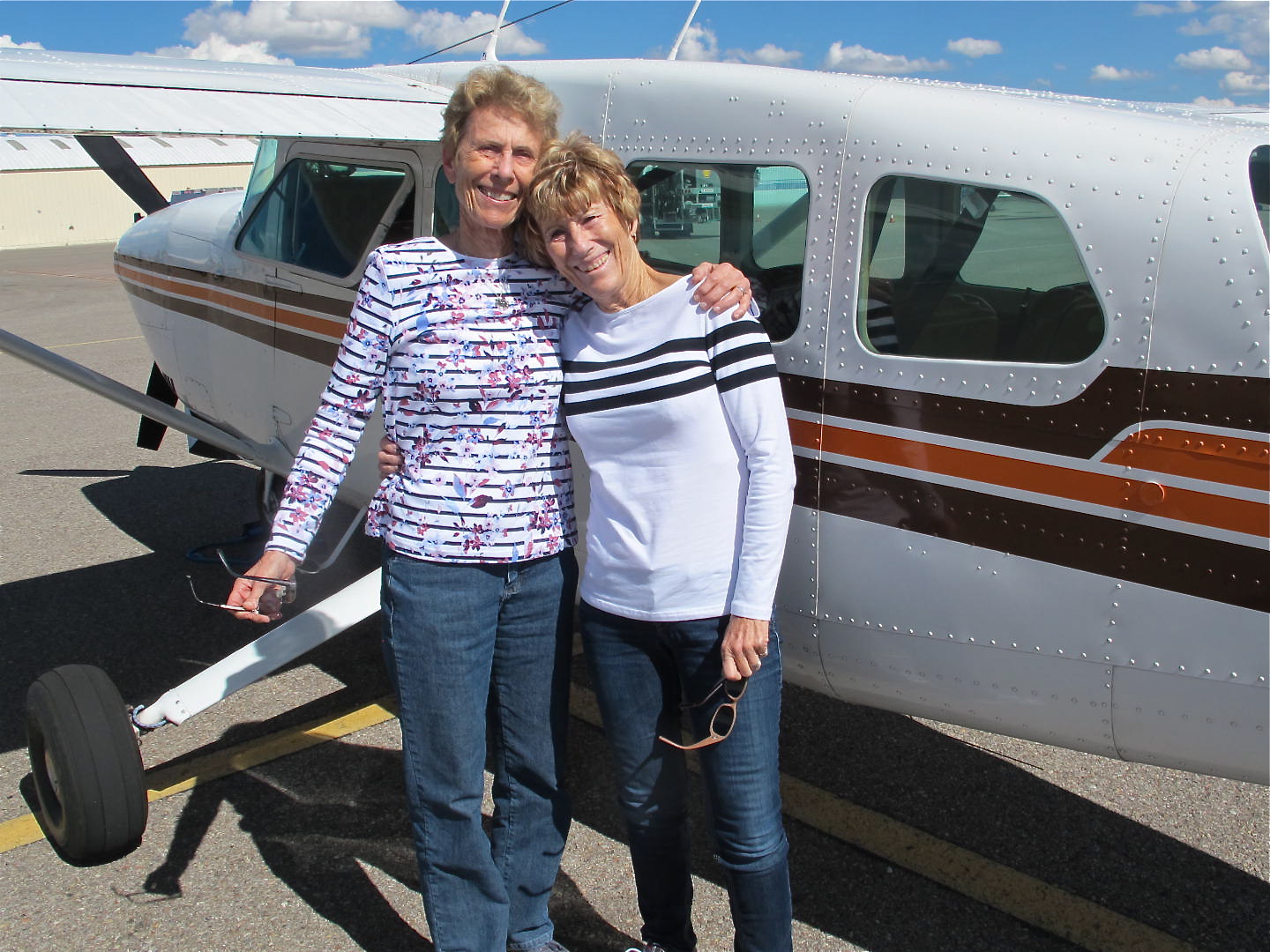
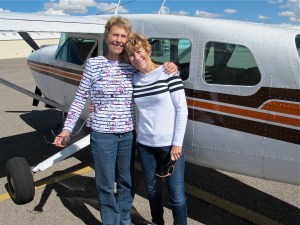
This is the little Cessna that took us on our flight adventure.

This is the little Cessna that took us on our flight adventure.

I found it interesting that Santa Fe’s original name was La Villa Real de la Santa Fe de San Francisco de Asís, the Royal Town of the Holy Faith of Saint Francis of Assisi. It is at the foot of the Sangre de Cristo Mountains and is the oldest continually lived in capital in the US, having been declared a capital in 1610 by the Spanish.
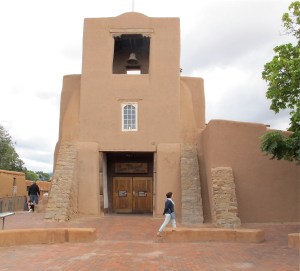
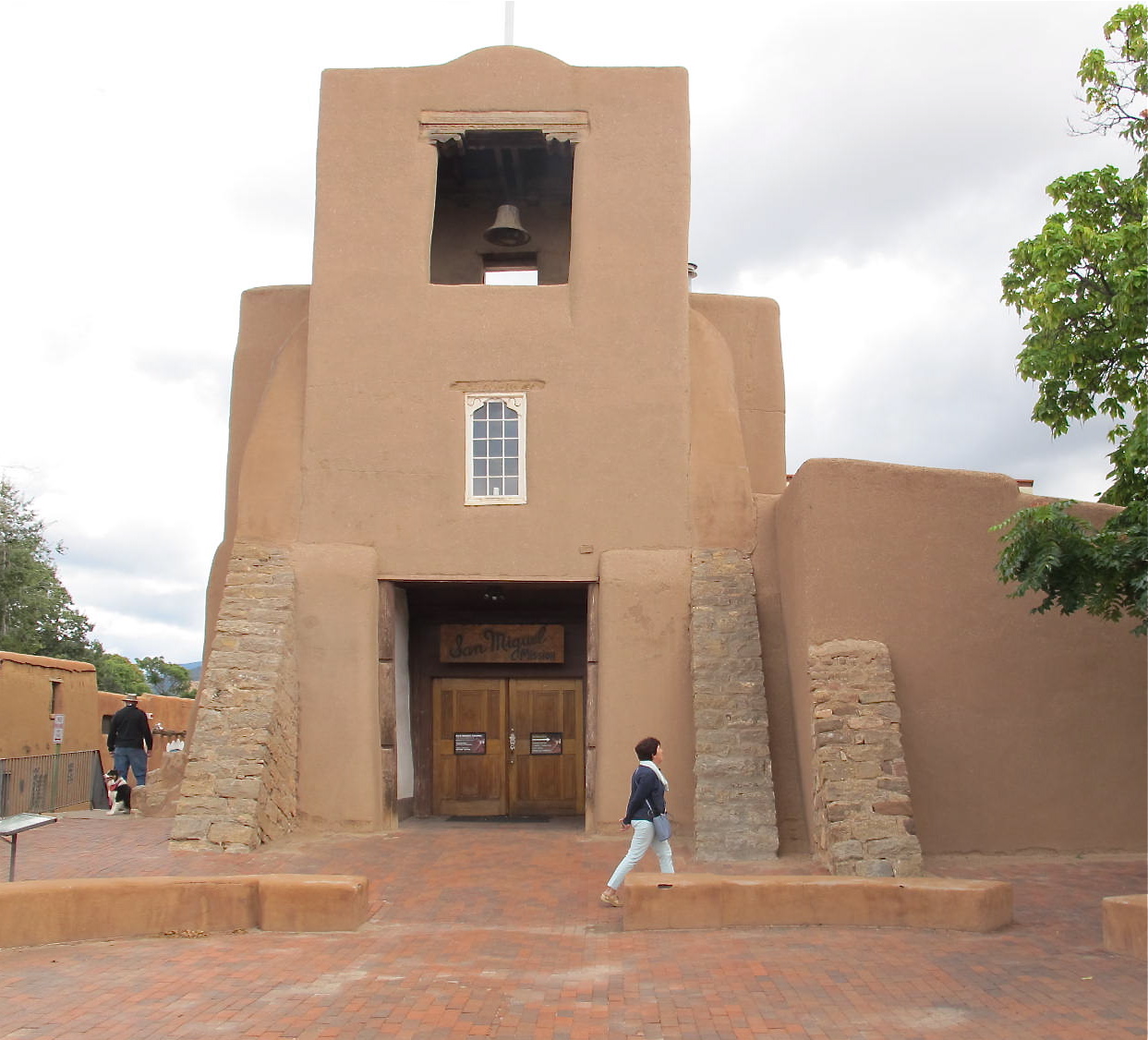
We visited some of the interesting churches in Santa Fe. The first was San Miguel Church, the oldest church structure in the USA, ca. 1610. You can still see some of the straw that was used in the adobe (although, I suspect the some of the adobe has been restored over the years) It seems sort of timeless, doesn’t it?
We visited some of the interesting churches in Santa Fe. The first was San Miguel Church, the oldest church structure in the USA, ca. 1610. You can still see some of the straw that was used in the adobe (although, I suspect the some of the adobe has been restored over the years) It seems sort of timeless, doesn’t it?

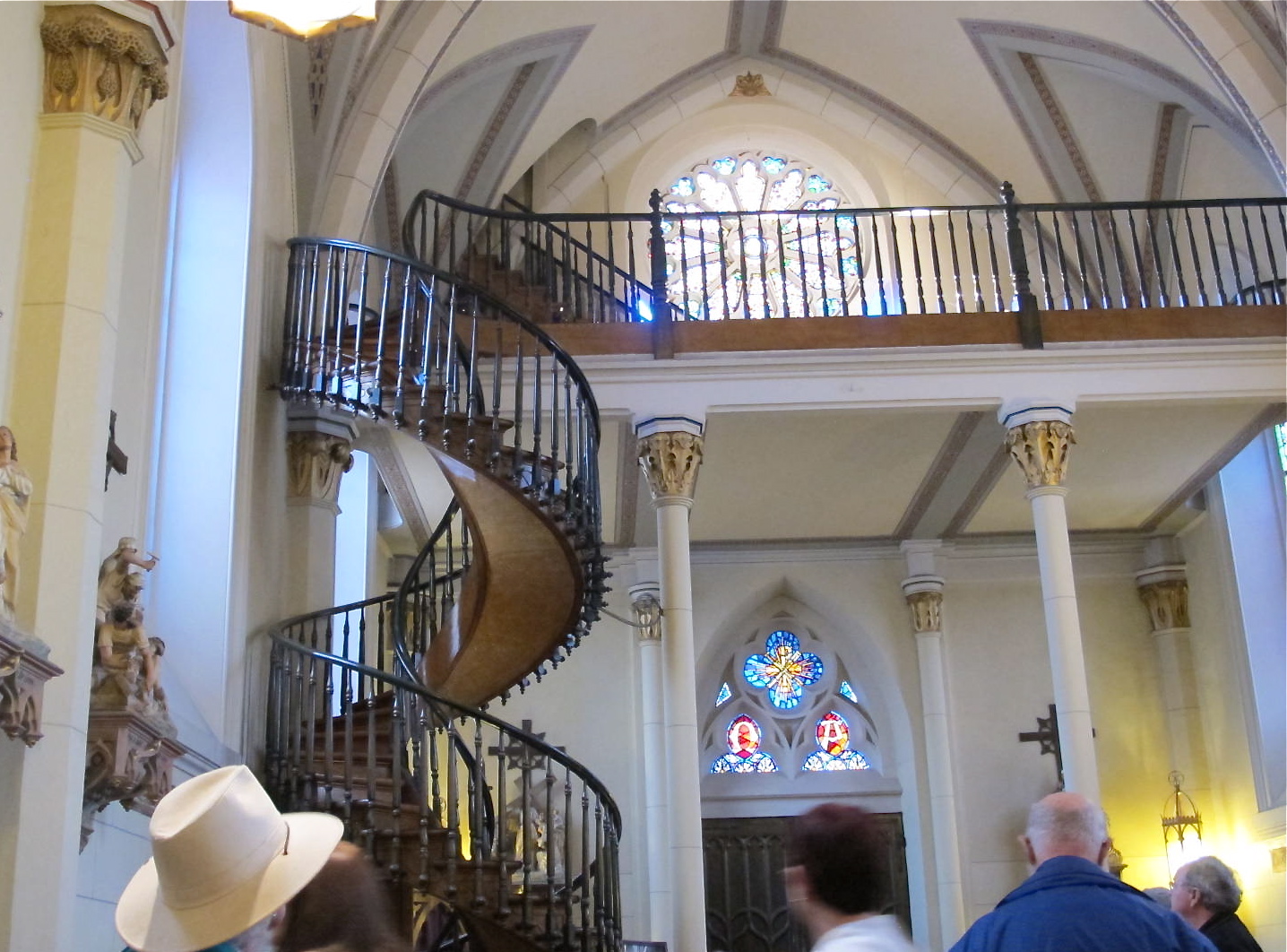
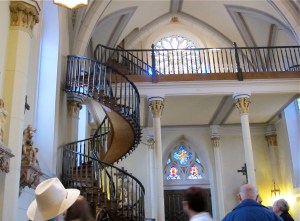
My favorite church is the Loretto Chapel, home of the “Miraculous Staircase.”

My favorite church is the Loretto Chapel, home of the “Miraculous Staircase.”

The story is that builders of the chapel forgot to construct a staircase to the choir loft. While they were trying to decide what to do about the problem, an anonymous carpenter arrived to fashion spiral steps with two 360-degree turns with no visible means of support. He used only wooden pegs in his work. Legend suggests that St. Joseph, the patron saint of carpenters, inspired the work.  Whatever the truth is, Loretto Chapel is beautiful.
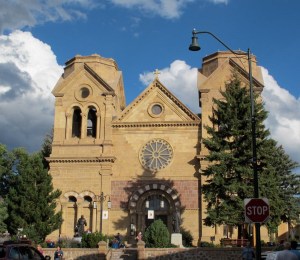
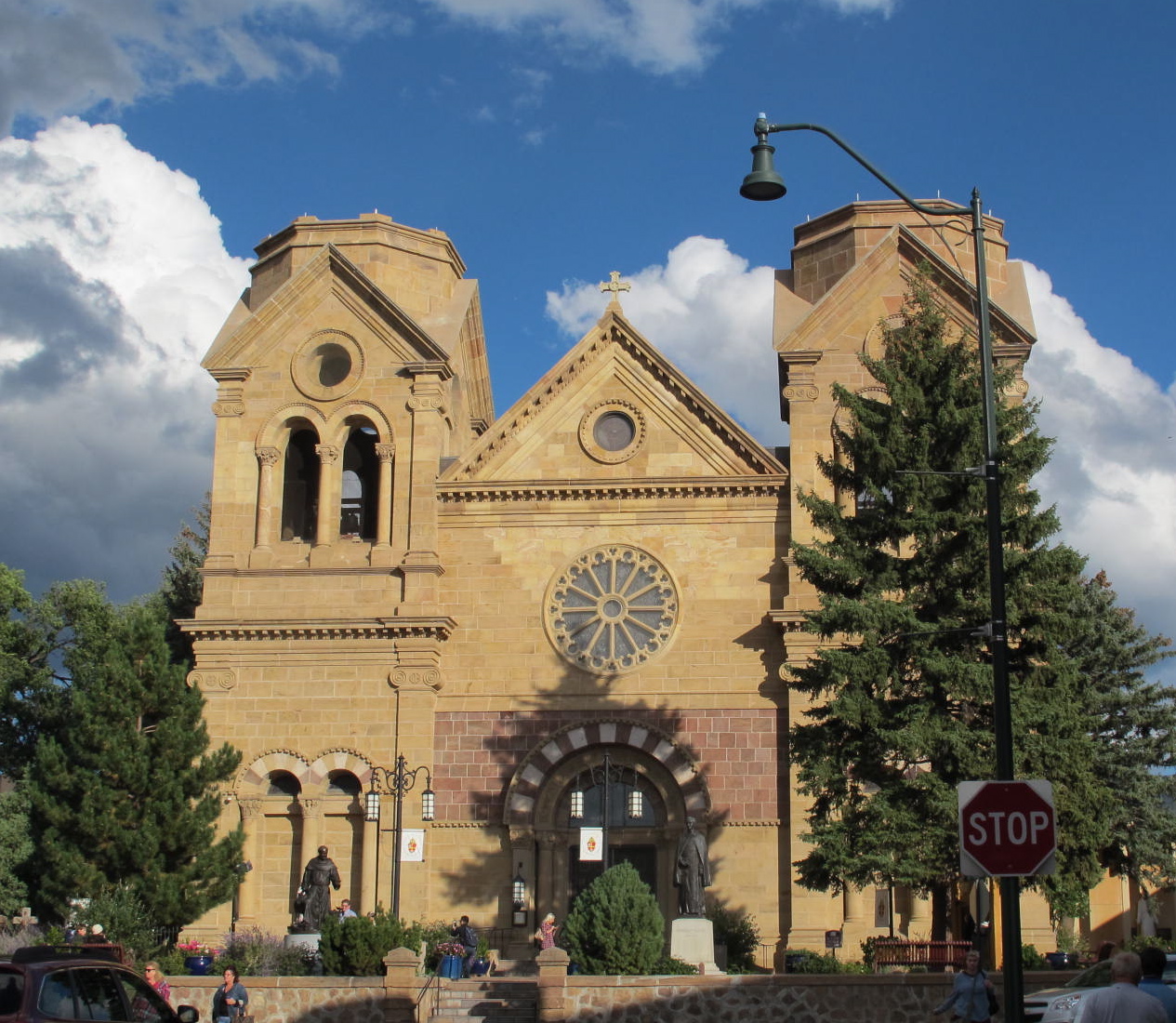
The next church is the Cathedral Basilica of St. Francis of Assisi. The parish was founded in 1610, but the present church was built in 1869. I didn’t get the timing just right, but, to me, the church appears to be glowing when the sun is getting low in the sky.

The next church is the Cathedral Basilica of St. Francis of Assisi. The parish was founded in 1610, but the present church was built in 1869. I didn’t get the timing just right, but, to me, the church appears to be glowing when the sun is getting low in the sky.

We next visited the Palace of the Governors that is considered to be one of the oldest public service buildings in the United States. It is a long, low building with 4-foot-thick walls and was the seat of government under Spanish, Pueblo Indian, Mexican and U.S. territorial rule until 1909, when it became the state history museum. Today, the front area along the walls is lined with Native American artisans selling the wares they have made. It was interesting to walk along and see the elegant, wonderful pieces of jewelry and other art pieces and then hear people discussing prices. Sometimes, some haggling was heard.
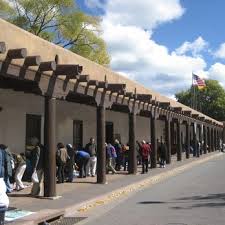
For some reason, I didn’t get a picture of the Palace, so I borrowed one from the internet.

For some reason, I didn’t get a picture of the Palace, so I borrowed one from the internet.

The Plaza is right across the street and was a great place to eat our lunch. There were several musicians, more art and some food vendors to entertain us while we munched on lunch. We did tour the Palace and adjoining New Mexico History Museum and really enjoyed it.
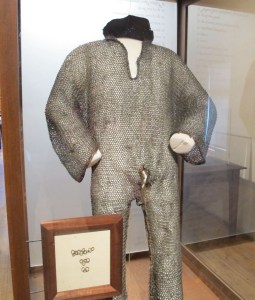
This chain link armor does not look very comfortable, especially during the summer months in New Mexico.
This chain link armor does not look very comfortable, especially during the summer months in New Mexico.

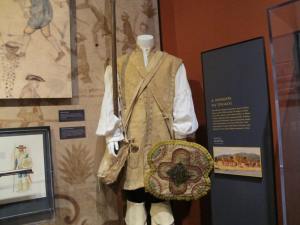
 The soldier’s uniform of the late 1700’s was a bit more practical.
The soldier’s uniform of the late 1700’s was a bit more practical.

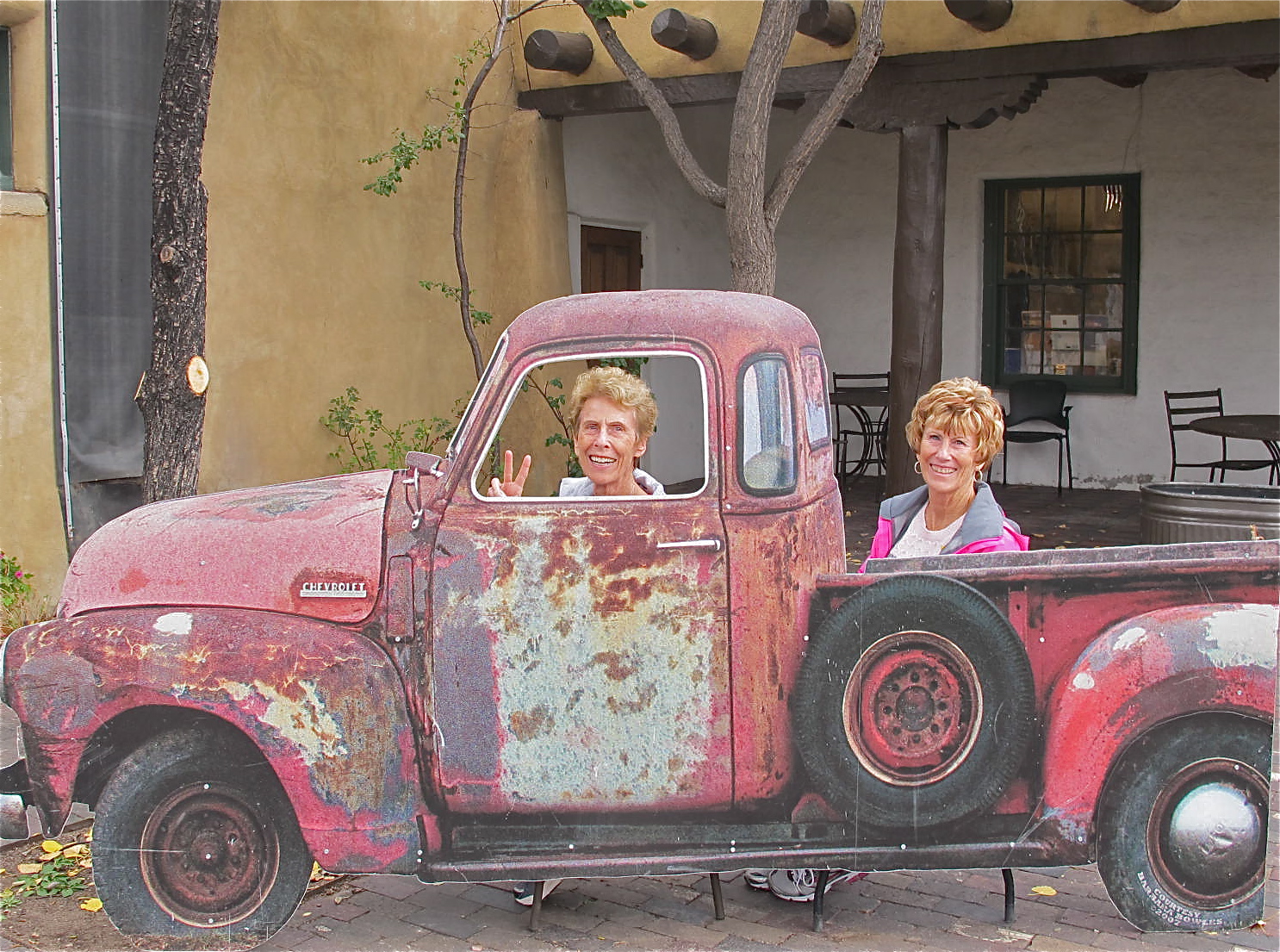
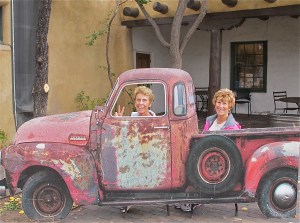
We joked that if our rental car broke down, we’d come back and get this old pickup.

We joked that if our rental car broke down, we’d come back and get this old pickup.

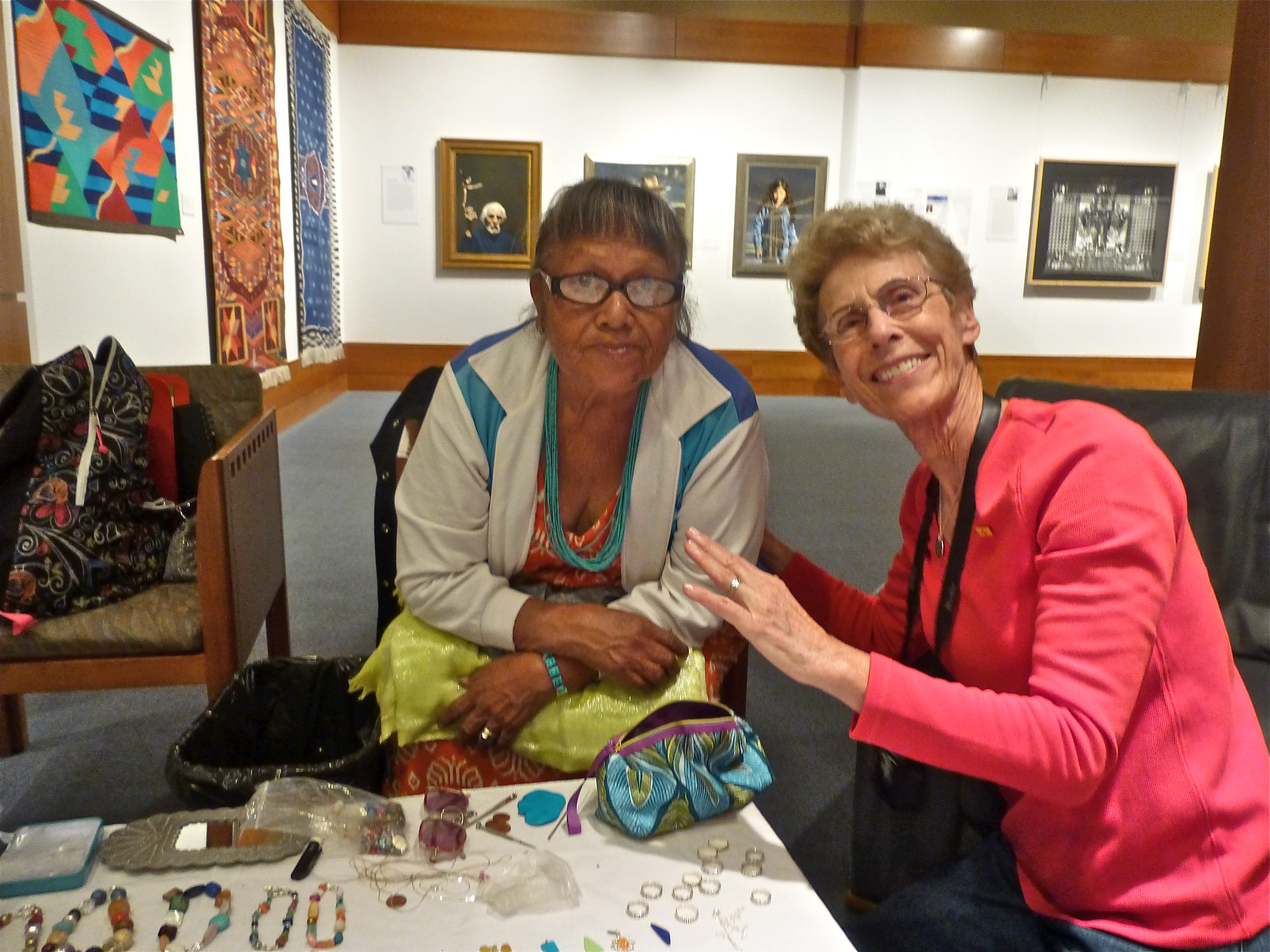
Santa Fe has so many things to see that we had to skip some of the famous places. But we did not skip the New Mexico State Capitol. It’s an interesting building shaped like its state emblem, the Zia sun symbol. We learned that $6.2 million worth of art are housed in the capitol. We were fascinated with a lot of it. We wandered into the governor’s office and chatted with the receptionist, viewed some prize-winning art and met a wonderful lady named Josie from the Santo Domingo tribe (the proper term might be band or family). She had on display jewelry that she had made. We didn’t ask how she got to be there, but I bet there is not another governor’s office that has a Josie. Jerri and I each bought some pieces from her and she was kind enough to let Jerri take her picture.
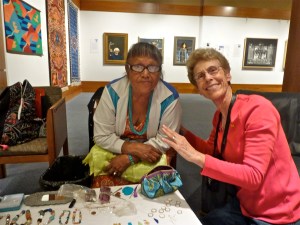
Josie and my new ring
Josie and my new ring

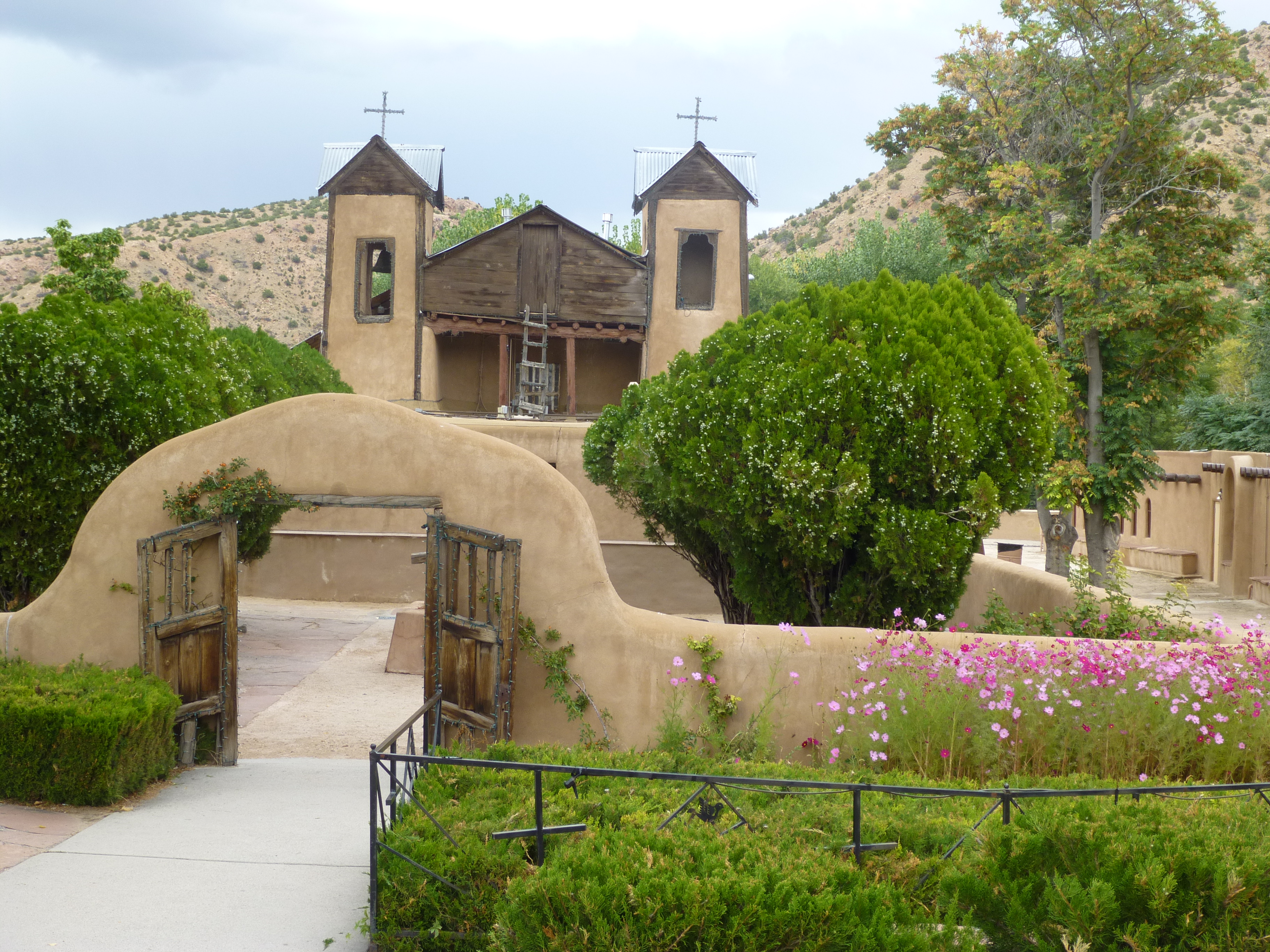
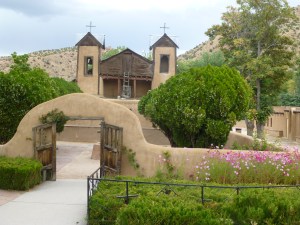
One of our stops after Santa Fe was El Santuario de Chimayo in the tiny town of the same name.

One of our stops after Santa Fe was El Santuario de Chimayo in the tiny town of the same name.

Legend maintains that the earth surrounding a cross (that was found in the area in 1810) has healing power. Many pilgrims come to touch the dirt in a pit inside the chapel to be healed and the chapel is now lined with many crutches, braces and pictures of those who have been healed. Jerri had a badly sprained foot and we took some dirt home for her and also some for an ailing friend. We pray this helps both folks.

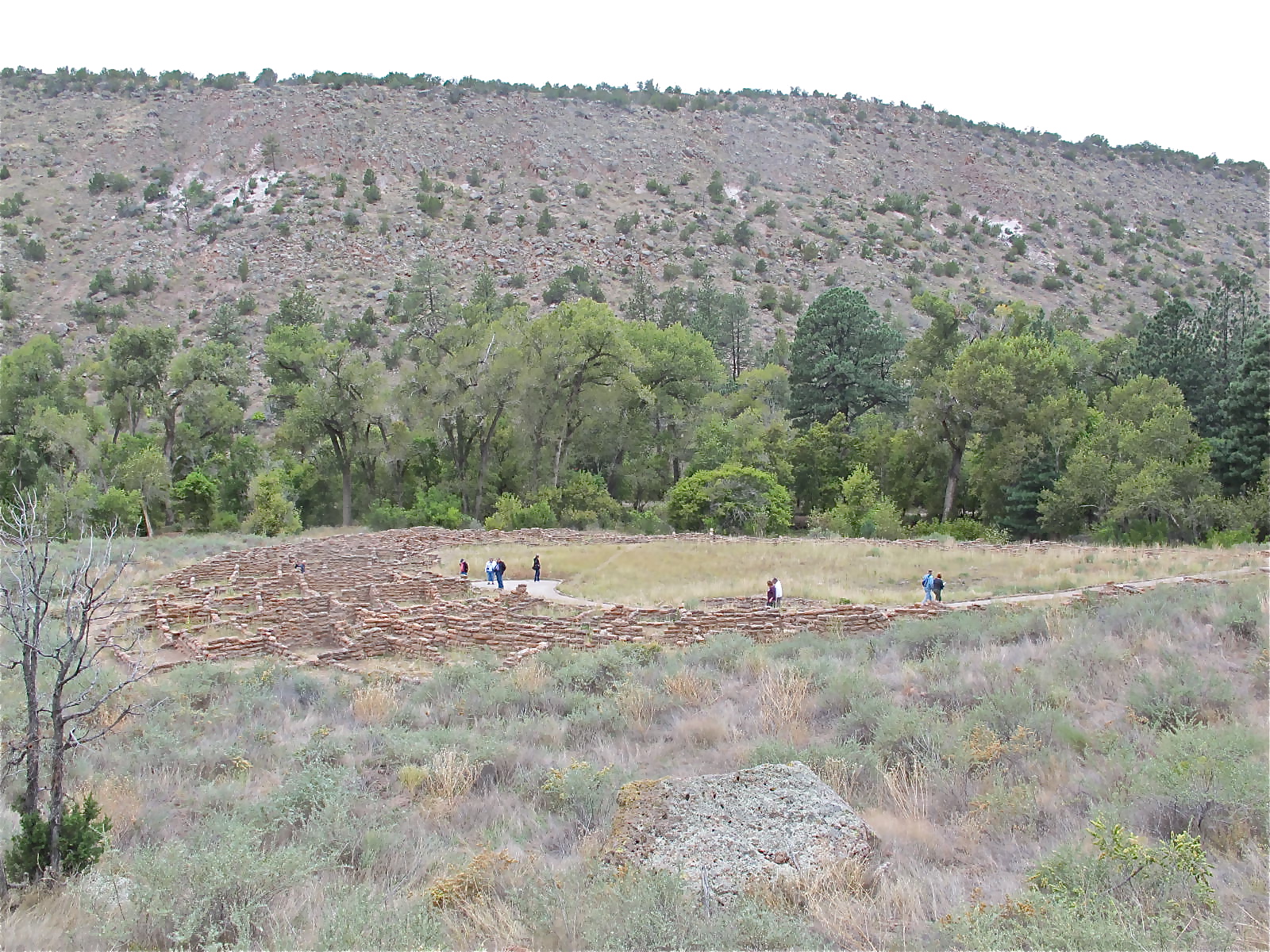
Another stop was the Bandelier National Monument. What a cool place this is. It is in the Frijoles Canyon and is a place where Ancestral Pueblo people lived in as many as 3,000 sites (not all at the same time). The largest populations lived there during the 1200s and some villages included as many as 40 rooms. Some of the people lived in circular pueblos with kivas in the center part. Some parts of the circuar pueblo were at least three stories tall.
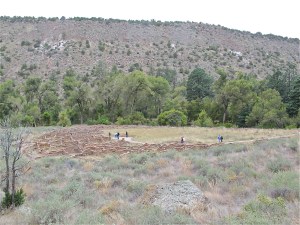
The large, circular pueblo ruins
The large, circular pueblo ruins

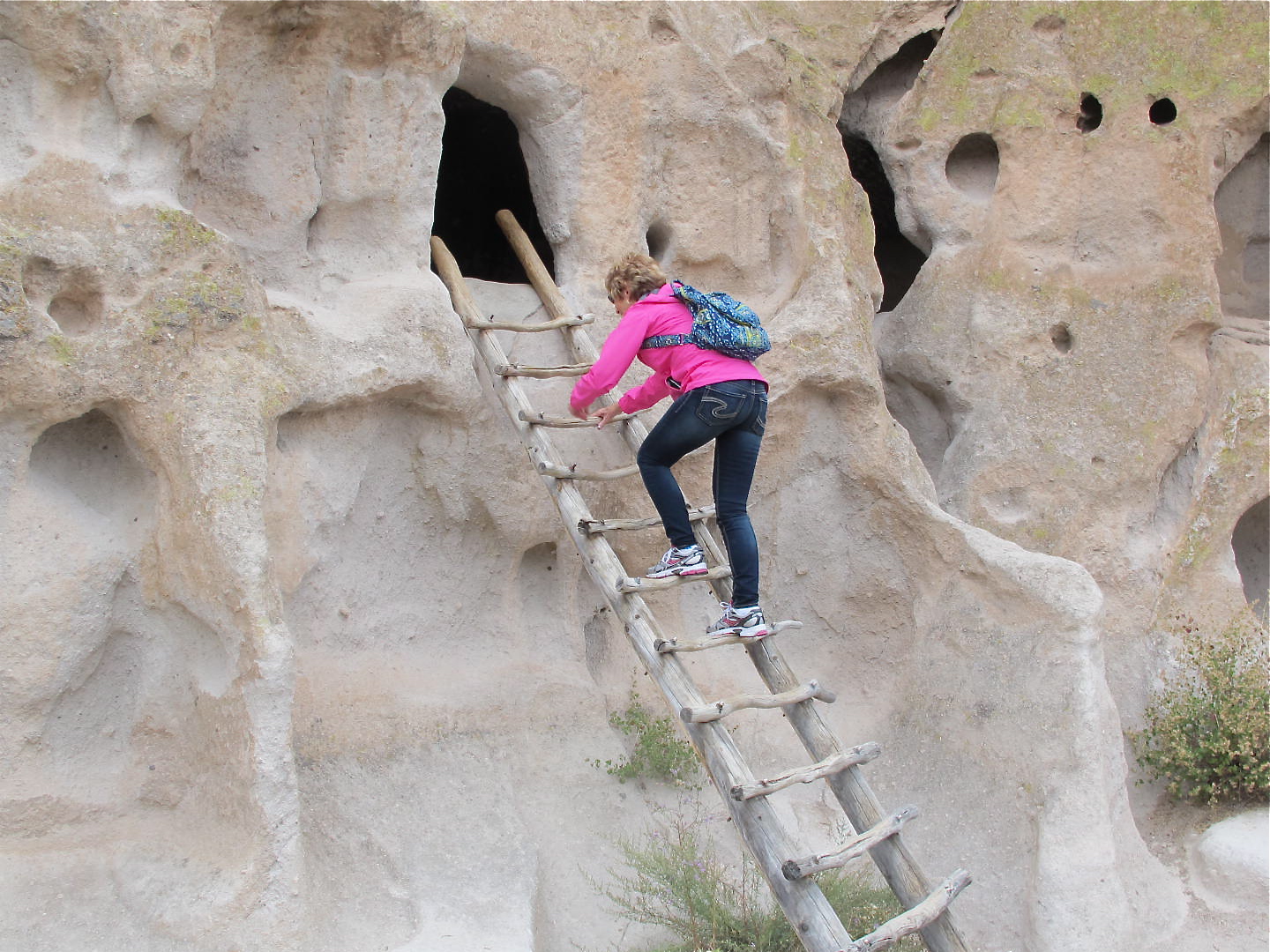
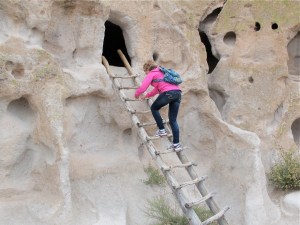
The part that Jerri and I were fascinated with was the cave houses. Jerri is climbing a ladder to one of the caves.

The part that Jerri and I were fascinated with was the cave houses. Jerri is climbing a ladder to one of the caves. Some of the caves had two or three rooms. I surely do hope they had some type of bear robe or perhaps rabbit skins to lie on. A stone floor would be pretty hard after a while.
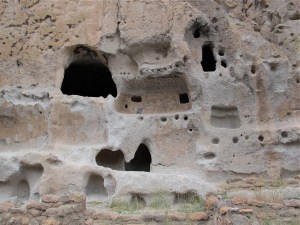
Some more caves where people lived
Some more caves where people lived

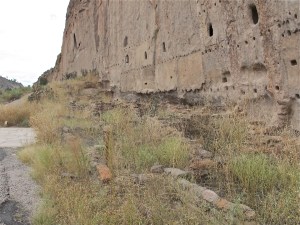
The Long House ruins

The Long House ruins

The Long House is an 800-foot stretch of adjoining, multi-storied stone homes with hand-carved caves as back rooms. You can see pole holes for the viga (large wood timbers)) in the cliff where they put in some support structure.  These structures could have been up to 3 or maybe 4 stories tall.
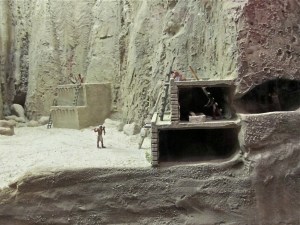
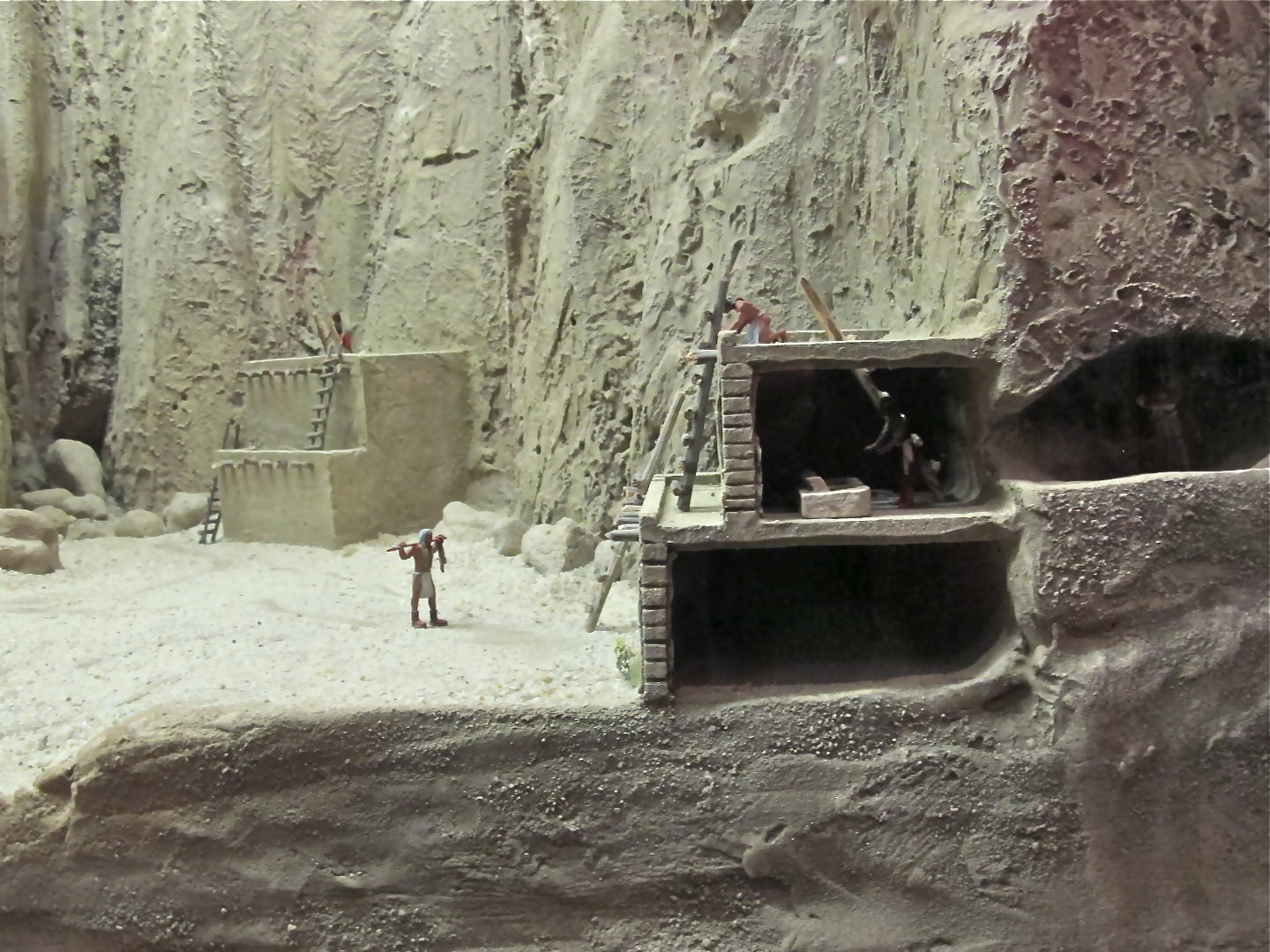
Diorama picture of how caves were dug in back of the houses. It kind of reminds me of a critter’s den in how it’s shaped. The stone was tuff, which is relatively soft but still would have been difficult to sculpt caves using stone tools.

Diorama picture of how caves were dug in back of the houses. It kind of reminds me of a critter’s den in how it’s shaped. The stone was tuff, which is relatively soft but still would have been difficult to sculpt caves using stone tools.

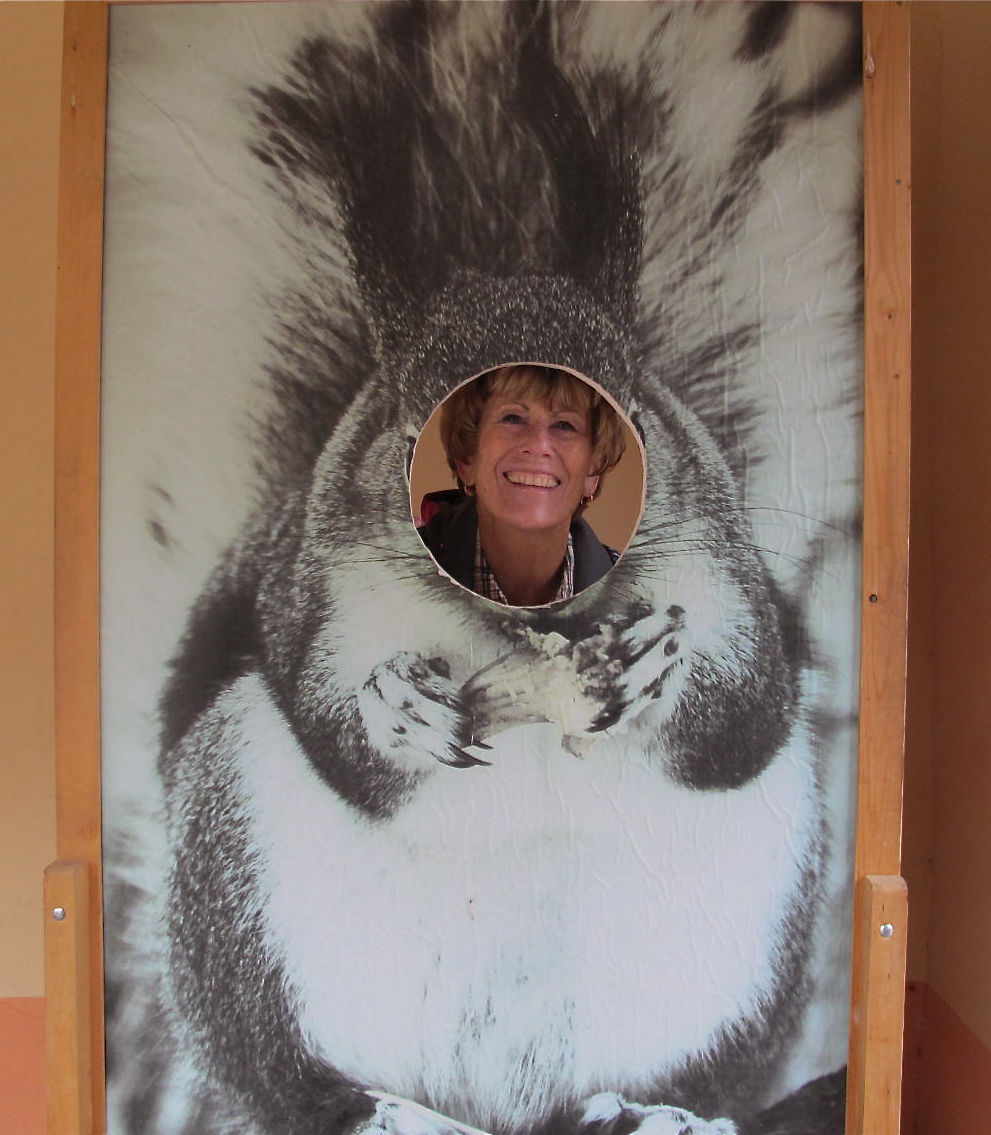
We had been lamenting that we hadn’t seen any critters bigger than locusts, stink bugs or caterpillars when we espied an Abert’s Squirrel. They are cute little devils but too quick for the camera. I tried to download a picture from the ‘net, but couldn’t get a good one. So here is the next best thing.
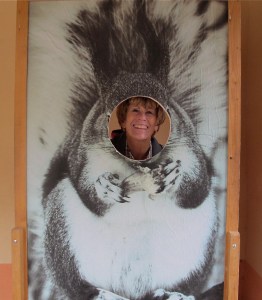
A squirrely picture of an Abert's squirrel

A squirrely picture of an Abert’s squirrel

Taos was our next destination. What a jewel it is. The mountains are resplendent and somewhat mystical with all their colors showing off to humankind. We loved it!

Of course we visited the Taos Pueblo, one of the oldest continuously inhabited communities in North America. (New Mexico is full of these “oldest,” “most” or “longest.”) Visiting the pueblo is like stepping back in time. People still live in the pueblos that were built more than a 1000 years ago. The folks who live there today choose to live like their ancestors…without electricity or plumbing. They still get their water from the Red Willow Creek that runs through the center of the pueblo. The only concession they have made is that they now have doors to enter and exit the buildings instead of ladders to climb up to the top of the building. They also have some windows. A young man named Kevin took us on a historical tour of the pueblo and explained how they lived before the Spanish arrived, what they have gone through for the last 500 years and how things are today. It was a most interesting tour and Jerri and I learned a lot.
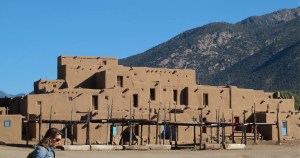
The large Taos Pueblo
The large Taos Pueblo

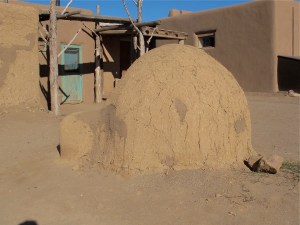
This outdoor oven is called an horno (pronounced “orno”) where people still bake their bread, cookies and cakes.
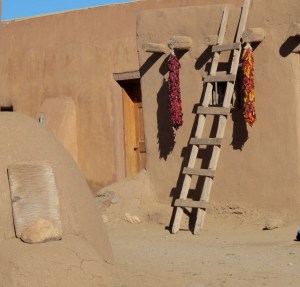
This outdoor oven is called an horno (pronounced “orno”) where people still bake their bread, cookies and cakes.

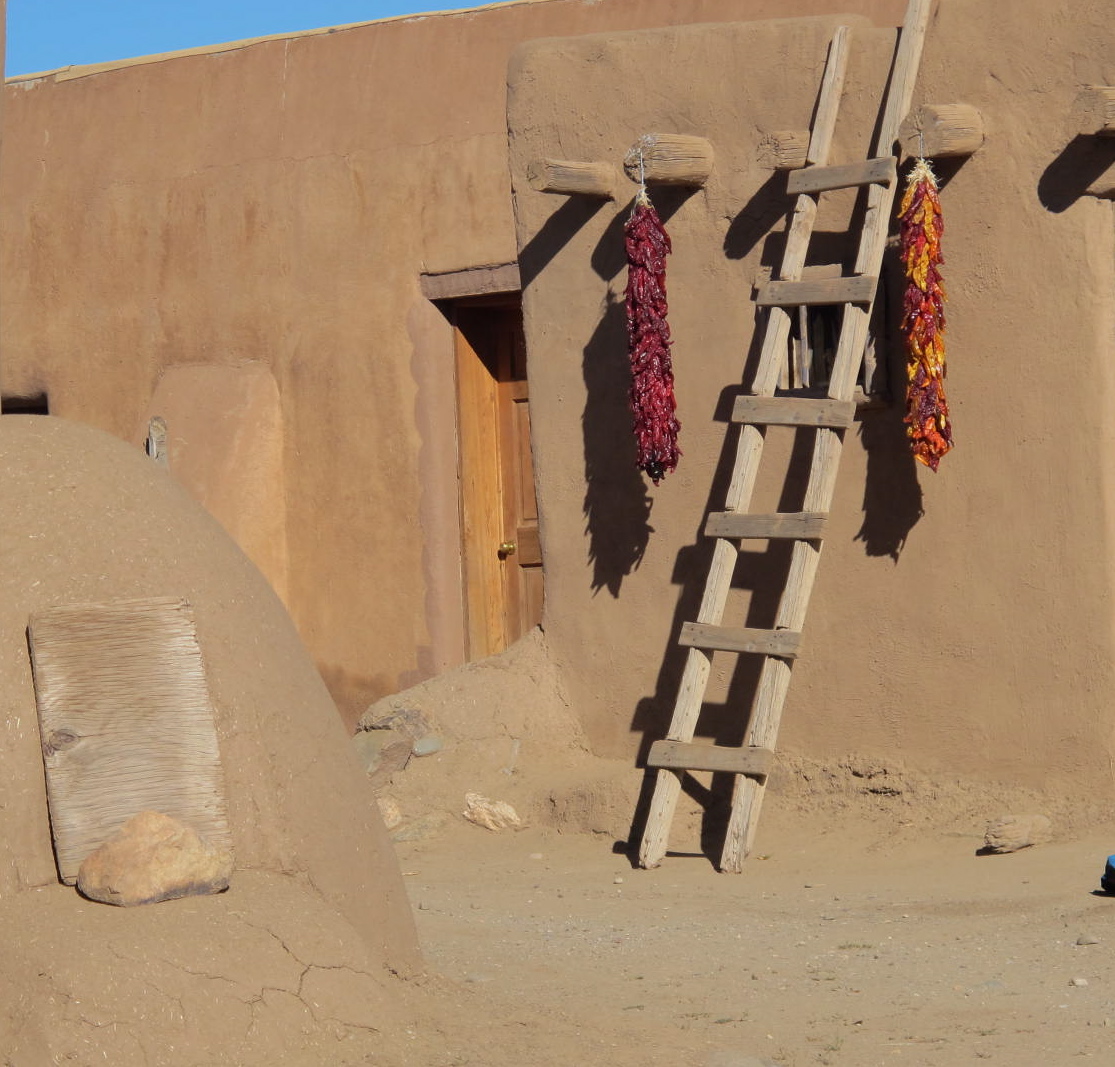
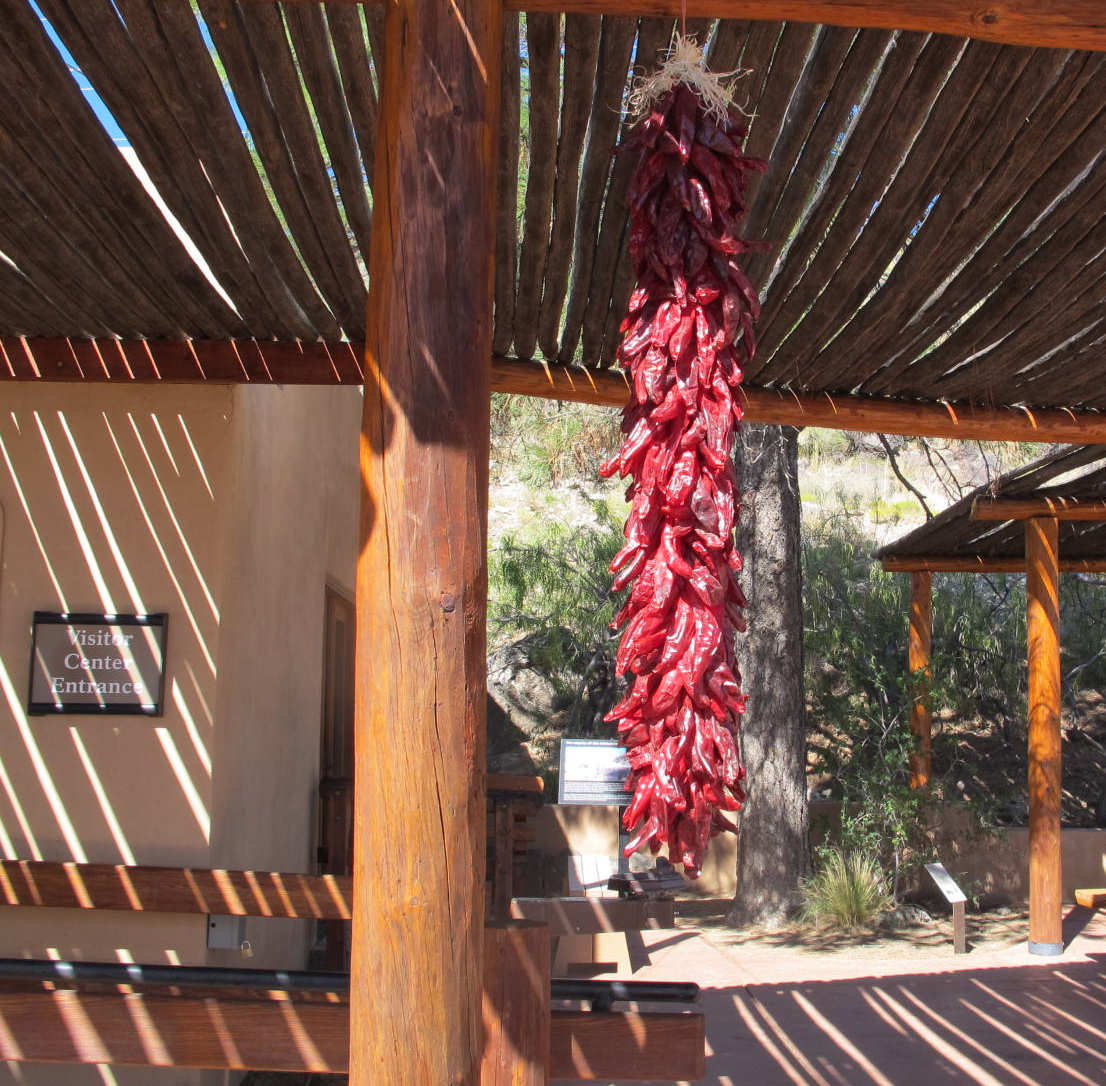
The red and multicolored things hanging down are called ristras. The red one is made up on red chiles while the other one is basically ornamental with multi-colored corn ears. The pueblo people used the corn mostly while the chiles were grown in the southern part of the state.
The red and multicolored things hanging down are called ristras. The red one is made up on red chiles while the other one is basically ornamental with multi-colored corn ears. The pueblo people used the corn mostly while the chiles were grown in the southern part of the state.

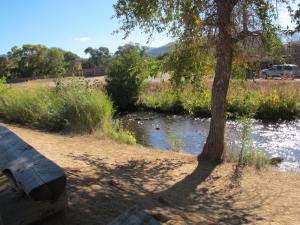
This creek is where the Taos pueblo people get their drinking water. Apparently, they don’t get sick because they have a built in immunity to the cooties in the water.

This creek is where the Taos pueblo people get their drinking water. Apparently, they don’t get sick because they have a built in immunity to the cooties in the water.

The Rio Grande flows past Taos about 10 miles west of the town. It wasn’t grande when we were there, but, still, it flows through that area in a very deep gorge. A bridge was built in 1965 to transverse the gorge, is 1272 feet long and spans the gorge some 650 feet above the Rio Grande. It took quite a bit of gumption for me to walk out on it, but if Jerri could do it, I had to also. Here is proof we did it.
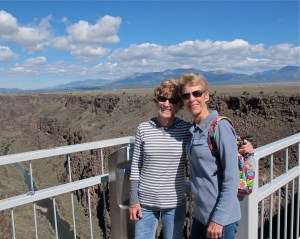
650 feet above the Rio Grande!

650 feet above the Rio Grande!

The Rio doesn't look so grande from here.

The Rio doesn’t look so grande from here.

There is a rest stop on one side of the gorge where we ate lunch that day. I took this picture as we went back across the bridge, passing many vendors and street performers, all trying to get a buck from passing motorists. It was quite a sight.

There is a rest stop on one side of the gorge where we ate lunch that day. I took this picture as we went back across the bridge, passing many vendors and street performers, all trying to get a buck from passing motorists. It was quite a sight.

We decided to go on some back roads from Taos to Las Vegas, New Mexico. It’s quite different than Nevada’s Vegas. It was a mercantile center along the Santa Fe Trail during the 1800s before the Santa Fe Railroad arrived. Apparently, there are still visible wagon wheel ruts in certain areas but we never did find them. Still, it’s still a nice little town.

We visited a nature center a couple miles outside of town, but again, saw only what seemed like a million locusts, some strange looking bugs and some kites called Northern harriers.

Waiting for the critters to show up, but they didn't because it was Columbus Day and the center was closed. who knew?

Waiting for the critters to show up, but they didn’t because it was Columbus Day and the center was closed. Who knew?

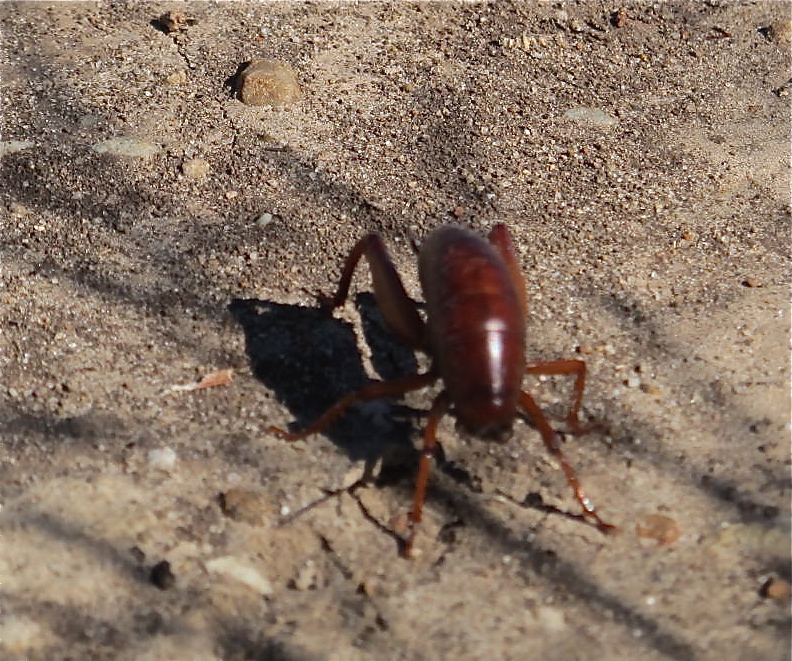
An alien bug

One of the alien bugs we saw

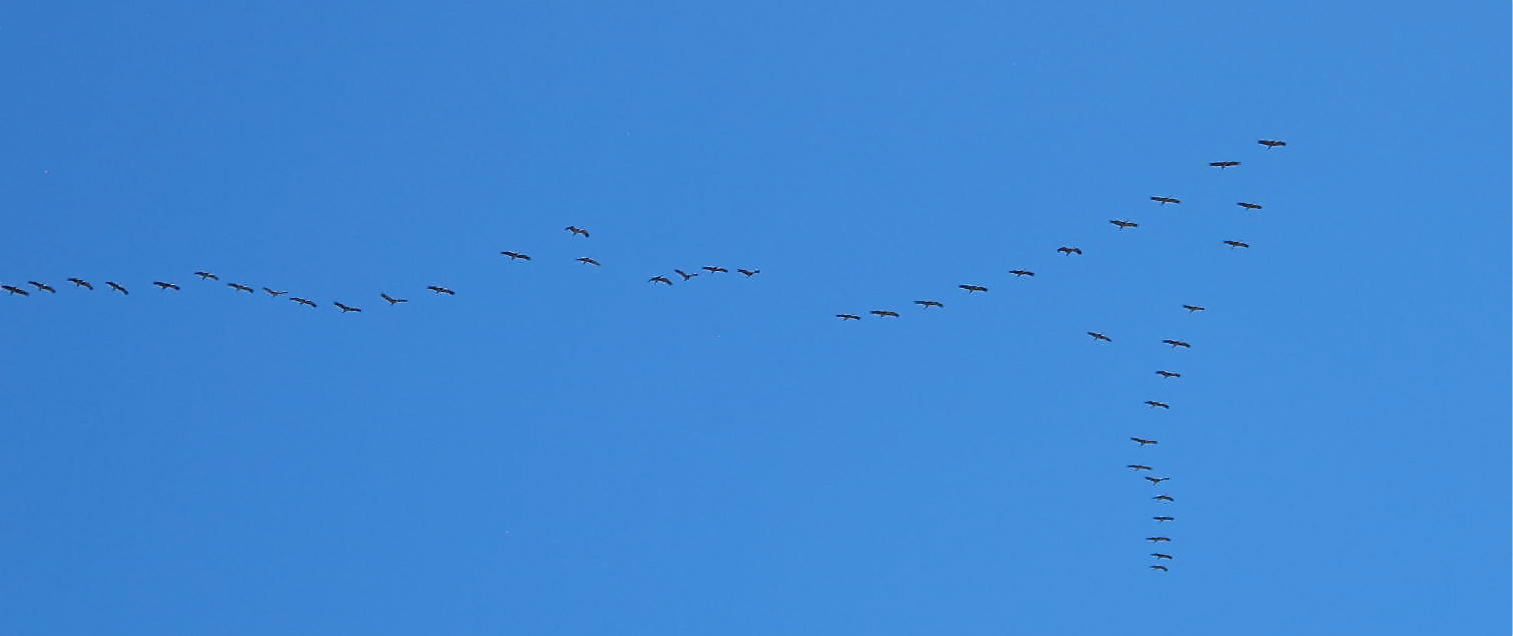
We were walking along a nice little trail when we heard a strange sound and couldn’t identify where it was coming from. Finally, one of us happened to look up and saw a flock of sandhill cranes flying over us. This was fun for us as we’ve only seen one in our neck of the woods in the Carson Valley.   I know you can’t see the details in this picture, but I couldn’t crop it any more than I did. They were communicating with some funny sounding croaking noises. “Hey, Fred, make a left turn at the next mesa.” “George, if you want to give directions, you come up to the front of the vee.”
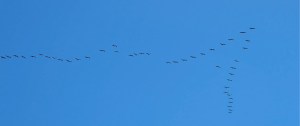
Sandhill cranes on the move with their migration

Sandhill cranes on the move with their migration

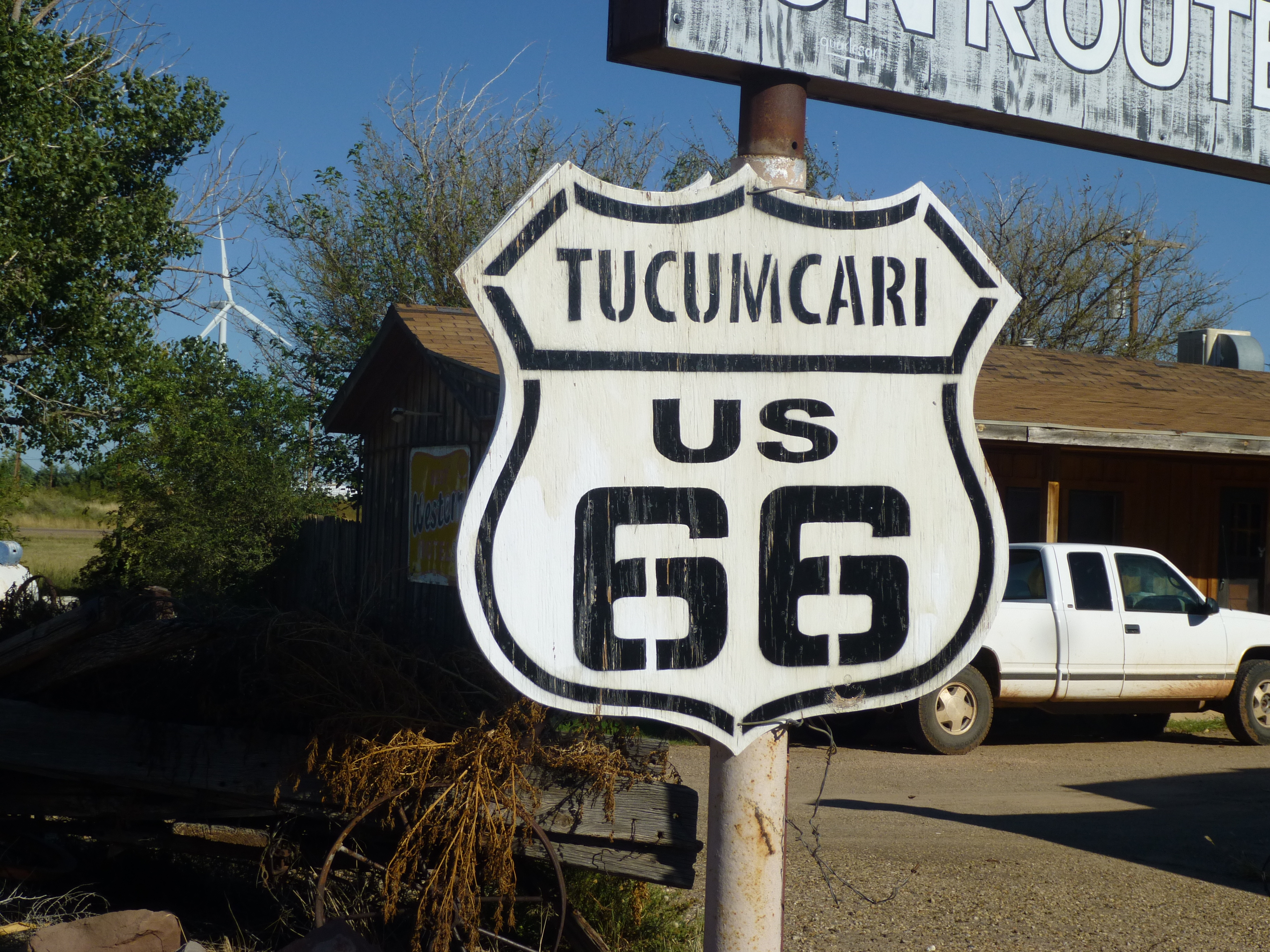
We had seen signs for the “Mother Road,” AKA Route 66 and had been singing terrible renditions of the song when we decided to go to Tucumcari. I liked the sound of the name and wanted to see the place. We headed out across the prairie and in so doing saw more than 150 pronghorns. I quit counting at that point. They were in groups of 3 or 4 on up to 30 or more. So pretty dotting the landscape. They were always off in the distance, so we never got a picture of them. Bummer.
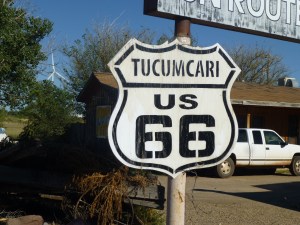
An old Route 66 sign in front of an abandoned motel.

An old Route 66 sign in front of an abandoned motel.

Wow! Tucumcari is a living example of what happens to a town when the Interstate bypasses it. There are many abandoned buildings along the main streets and it just appears to be totally dry and dusty. It just seems to be a dying town. BUT, there is hope. There is the Mesalands Community College in town that is helping the economy and Tucumcari boasts a new high school. Perhaps education will help these folks to turn around the town. I hope so.

We did visit the Mesalands Dinosaur Museum and enjoyed their well done displays. It’s relatively small, but I think it rivals the Dinosaur Journey in Fruita, CO. It was national Fossil Day, so admission was free. You can imagine the jokes we made about that.
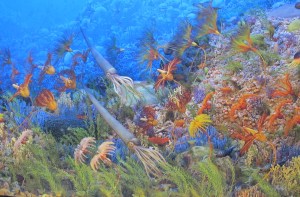
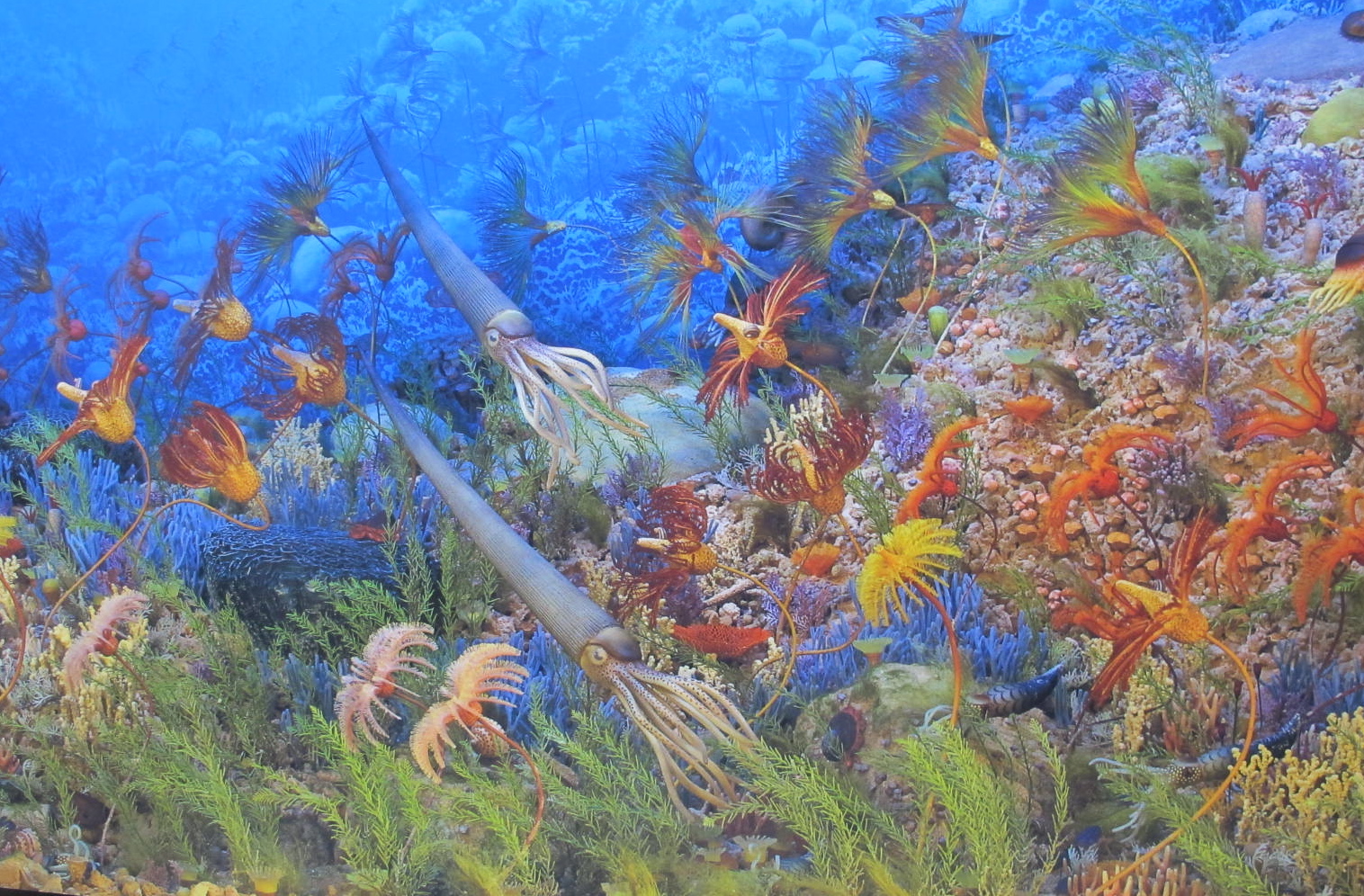
 This is a background painting for their Divonian Sea exhibit.

This is a background painting for their Divonian Sea exhibit.

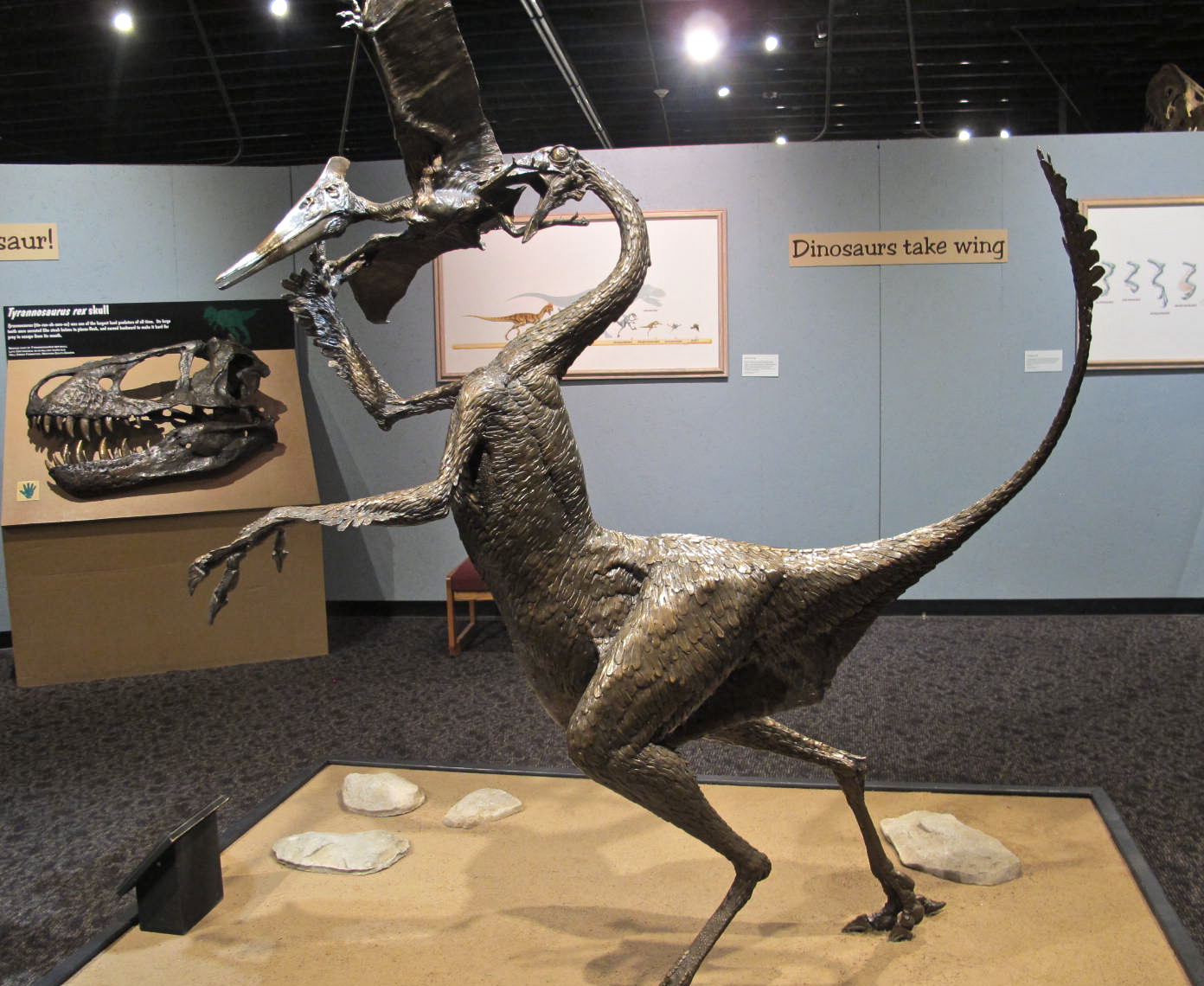
The large animal here is Struthiomimus, a type of meat-eating dinosaur. Its relatives evolved into modern birds. Its winged prey is Nyctosaurus, a distant relative of birds.
The large animal here is Struthiomimus, a type of meat-eating dinosaur. Its relatives evolved into modern birds. Its winged prey is Nyctosaurus, a distant relative of birds.

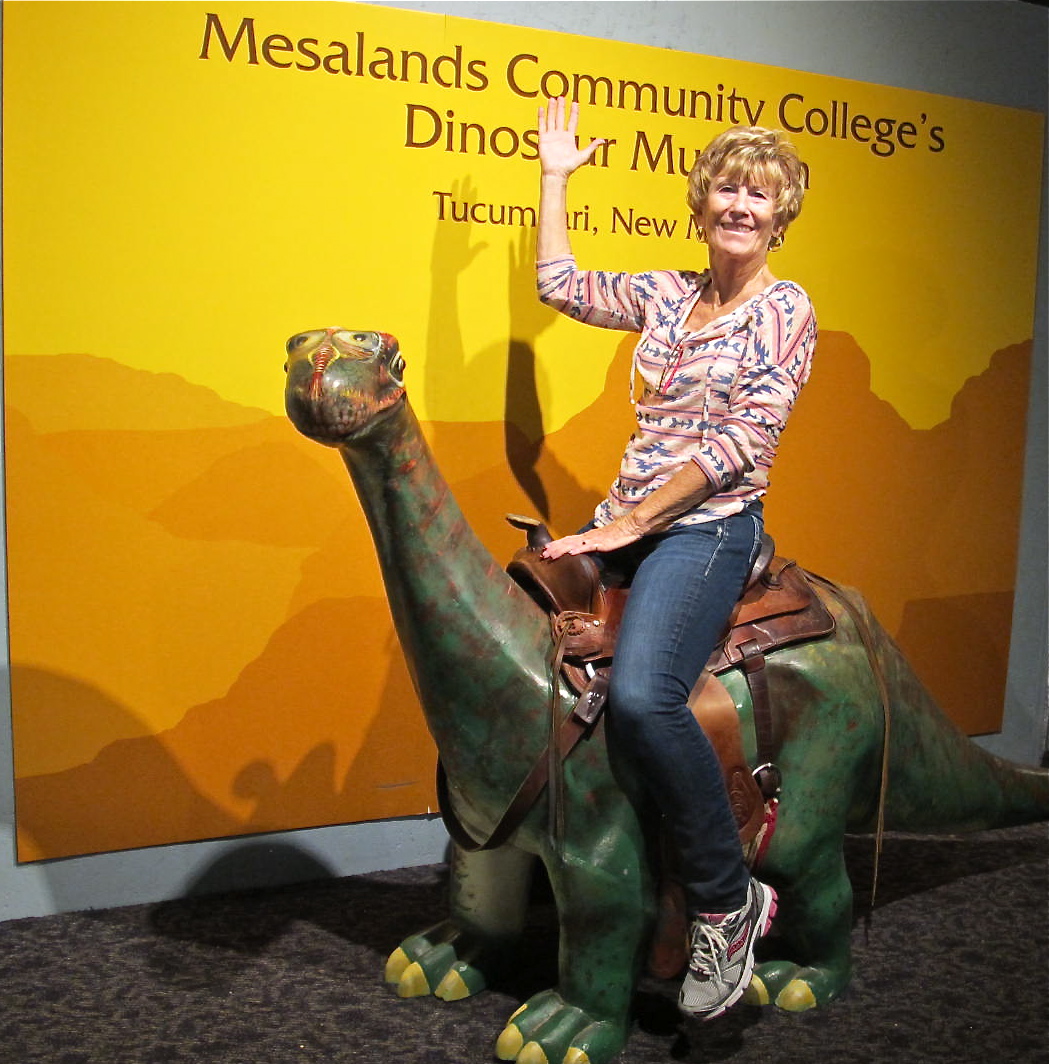
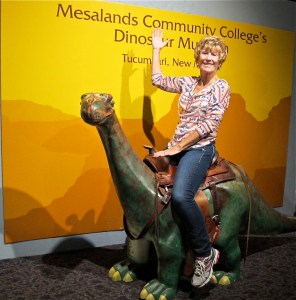
There were lots of things to touch and have fun with, so fun we had. This was the local transportation before Route 66 came through in 1920.

There were lots of things to touch and have fun with, so fun we had. This was the local transportation before Route 66 came through in 1920.

We left Tucumcari and drove to Albuquerque, our last stop before going home. That drive was pretty fast as New Mexico’s interstate speed limit is 75.

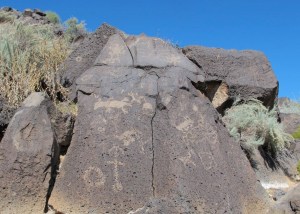
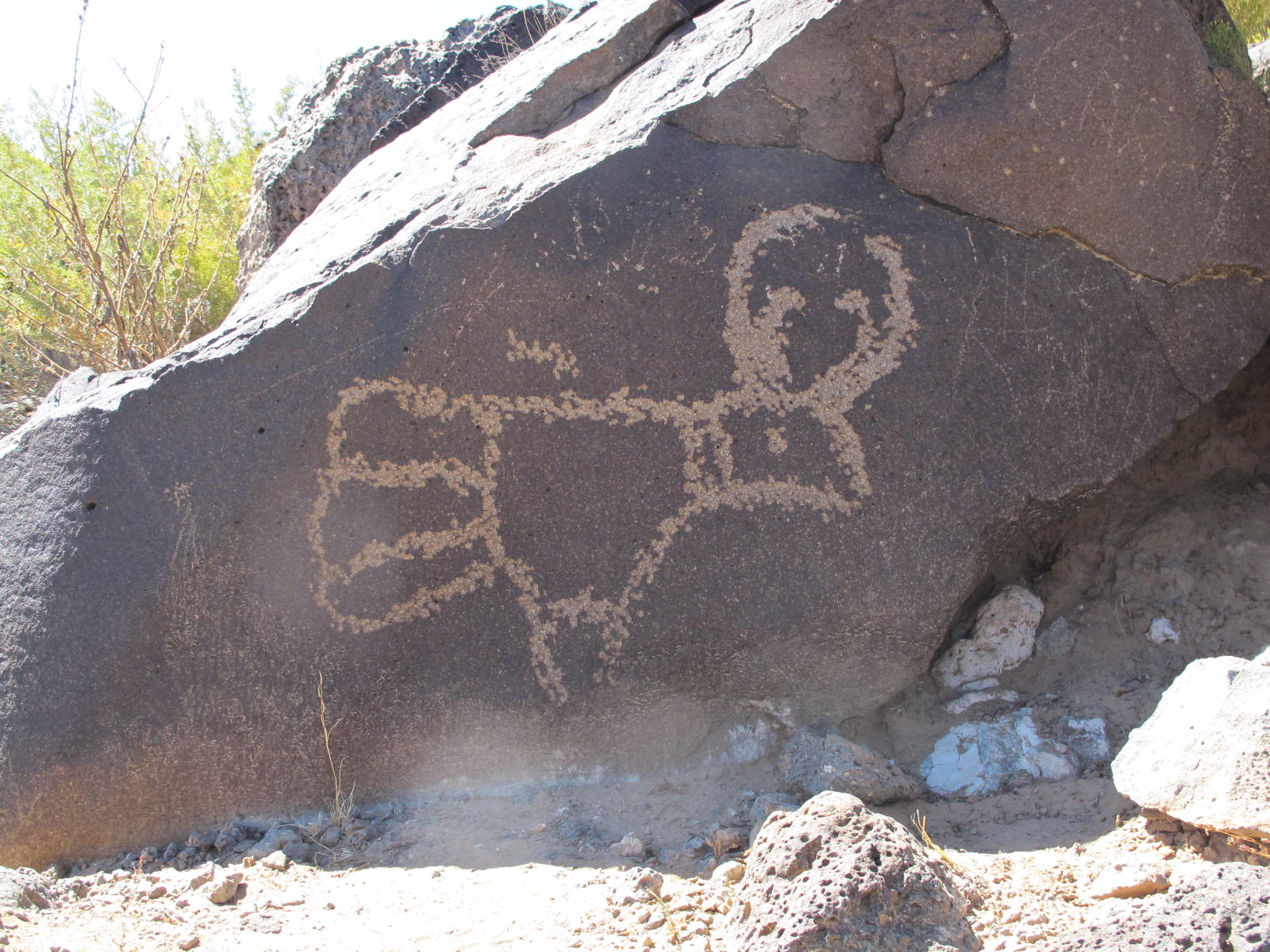
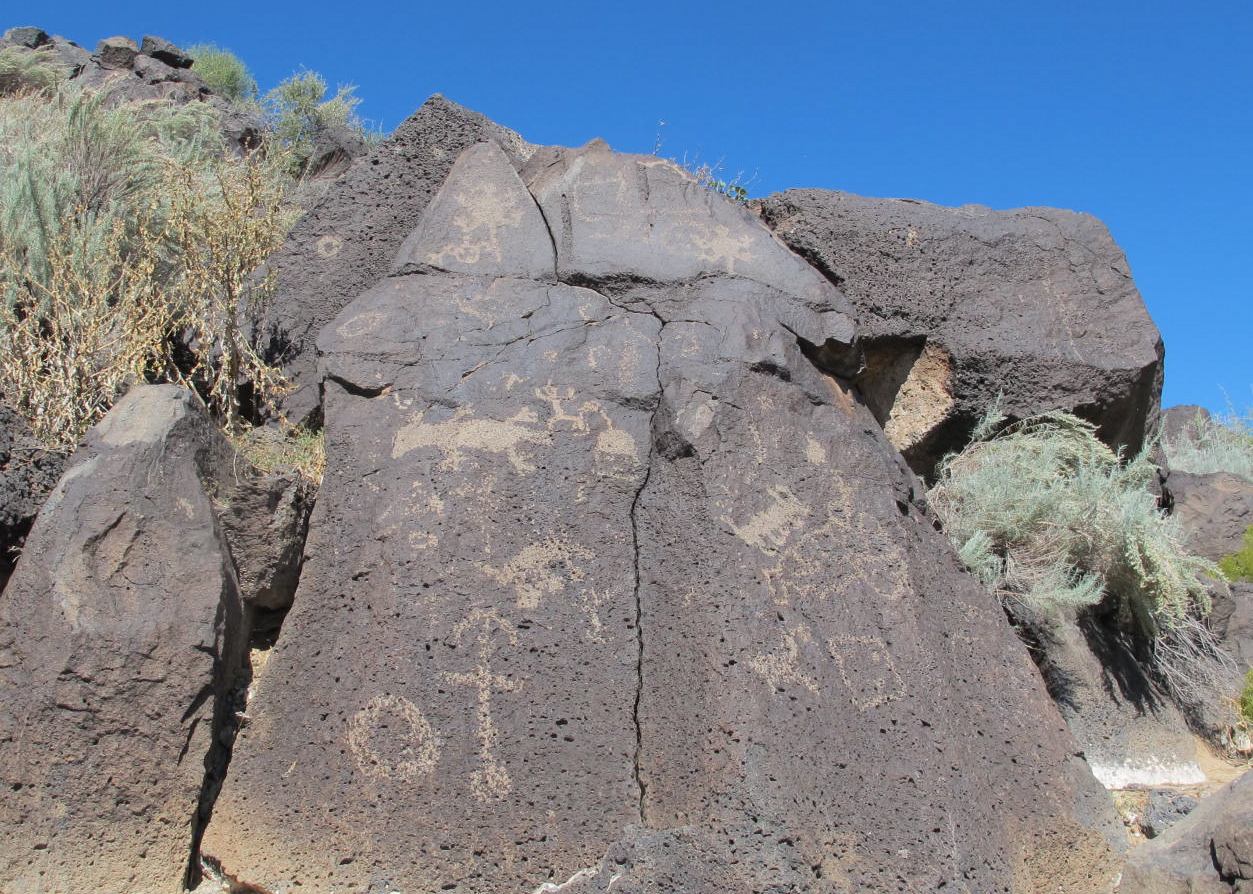
That afternoon, we visited the Petroglyph National Monument. What an interesting place!. There are about 20,000 documented images in three different areas of an escarpment created by a series of volcanic eruptions. The images were created between 400 and 700 years ago by the ancestors of today’s Pueblo people and other native groups traveling through the area.  Some images might be 2,000 to 3,000 years old.

We watched a film introducing the area and showing us what to look for…although they are pretty obvious because there are so many. Of course, Jerri had to use the facilities and was walking to the pit toilet when she almost stepped on a rattlesnake. We have no record of this because she couldn’t get her camera out of her backpack before he slithered away. Should we trust her? I think so. She was too excited to have been making up this little meeting. She said he was about 3 feet long with maybe 2 to 3 inches of rattles.

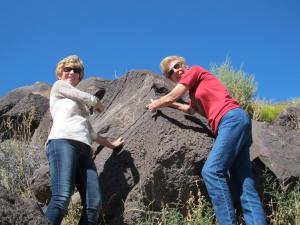
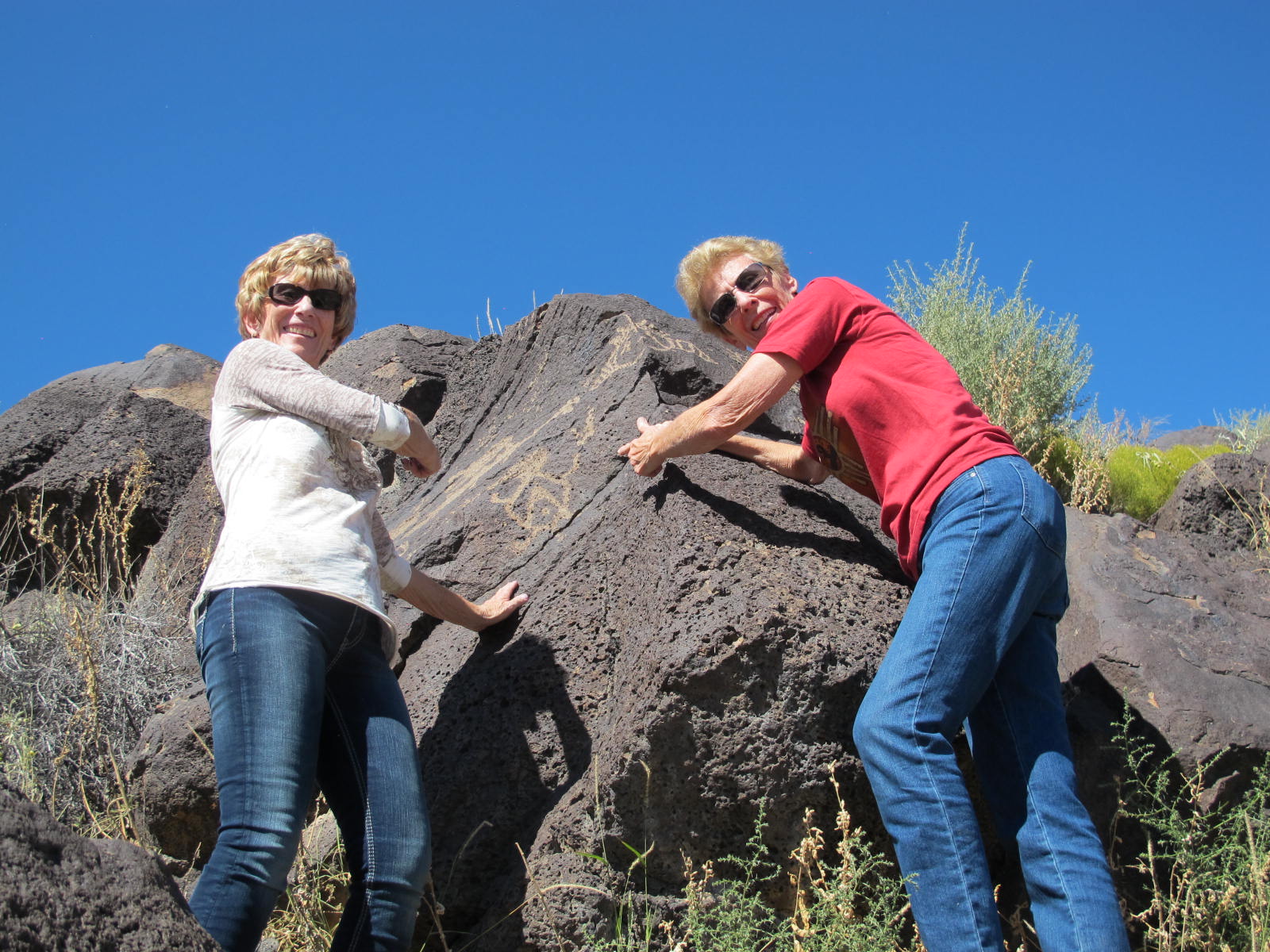
We chose to go to the Piedras Marcadas Canyon (canyon of marked rocks) because it had the most petroglyphs and was the least visited.   Here are some of the images we saw.IMG_0737
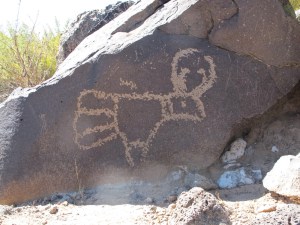
IMG_0717

IMG_0728

Sadly, some folks thought the petroglyphs were best used for target practice, thus defacing some of them. Those pock marks you see are bullet marks. I am surprised that there is not more defacing and vandalism because the particular canyon we were at in not more than 100 yards from a housing development. Good for the people of New Mexico!

Sadly, some folks thought the petroglyphs were best used for target practice, thus defacing some of them. Those pock marks you see are bullet marks. I am surprised that there is not more defacing and vandalism because the particular canyon we were at in not more than 100 yards from a housing development. Good for the people of New Mexico!

We took tons of pictures as the images were literally right next to each other. We could have seen more but the heat got to me and I had to rest a bit before we walked back to the car. I know better than to not stay hydrated but didn’t follow the rules.  What a doofus.

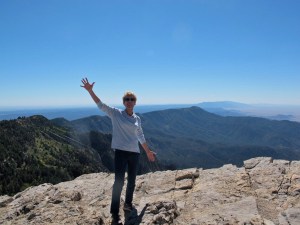
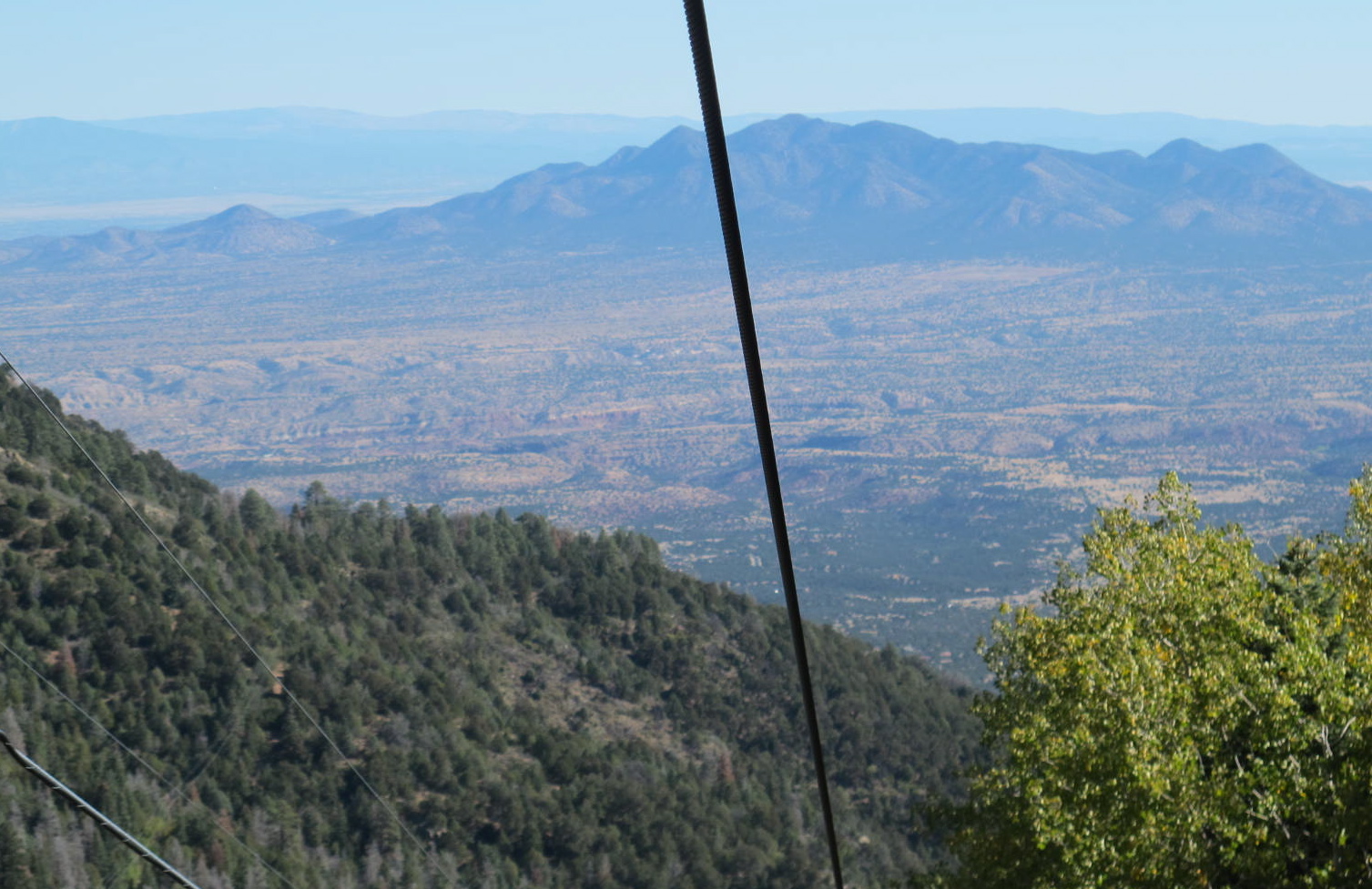
The next day was an exciting adventure. We rode the tram up to Sandia Peak and then hiked around the mountain top. Oh my goodness, what a view!!! You can see more than 15,000 square miles of area from the peak. We know we saw Mt. Thompson and that is at least 80 miles away from the peak. The tram docks at 10,378 feet and we hiked higher than that to get to what is called the Kiwanis Cabin.
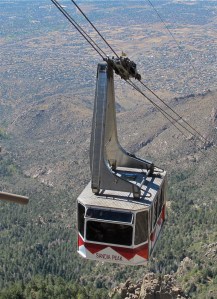
The Sandia tram

The Sandia tram

But first, we walked around a bit and discovered a ski lift going down the other side of the mountain. Again, we took a jillion pictures of the aspens and other trees.

But first, we walked around a bit and discovered a ski lift going down the other side of the mountain. Again, we took a jillion pictures of the aspens and other trees.

The view on the east side of the mountain was spectacular and looked down on the Turquoise Trail that Jerri and I had taken to Santa Fe a few days before.
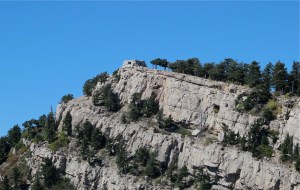
The view on the east side of the mountain was spectacular and looked down on the Turquoise Trail that Jerri and I had taken to Santa Fe a few days before.

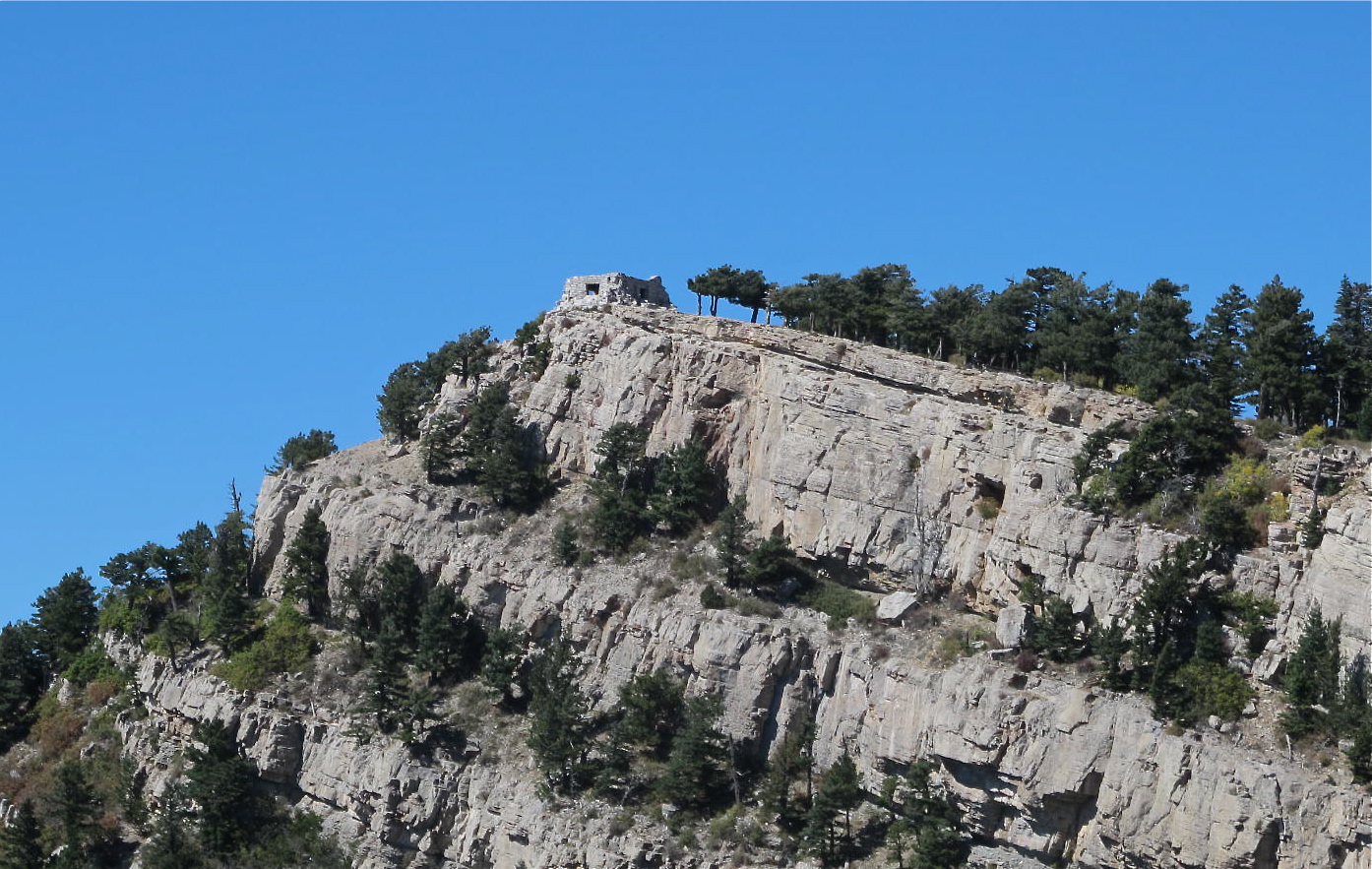
The hike to the Kiwanis Cabin was about a 3 mile round trip but not too strenuous.

The hike to the Kiwanis Cabin was about a 3 mile round trip but not too strenuous. We did pretty well on it.
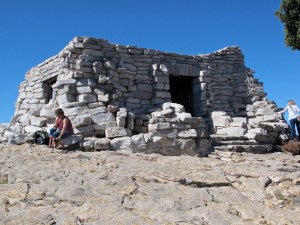
The Albuquerque Kiwanis Club built the first cabin in the early 1920s. It burned a couple of times and was finally reconstructed by the CCC camp at Sandia Park in the 1930s. We liked this cabin because our dad was in the CCC and our uncle is a long time member of a Kiwanis group in Aurora, CO.
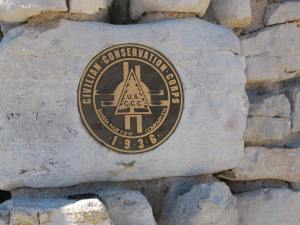
The Albuquerque Kiwanis Club built the first cabin in the early 1920s. It burned a couple of times and was finally reconstructed by the CCC camp at Sandia Park in the 1930s. We liked this cabin because our dad was in the CCC and our uncle is a long time member of a Kiwanis group in Aurora, CO.

The CCC placque

The CCC plaque

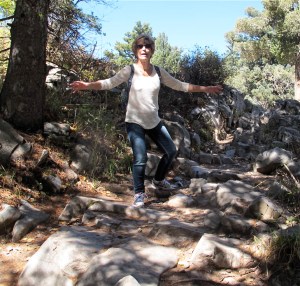
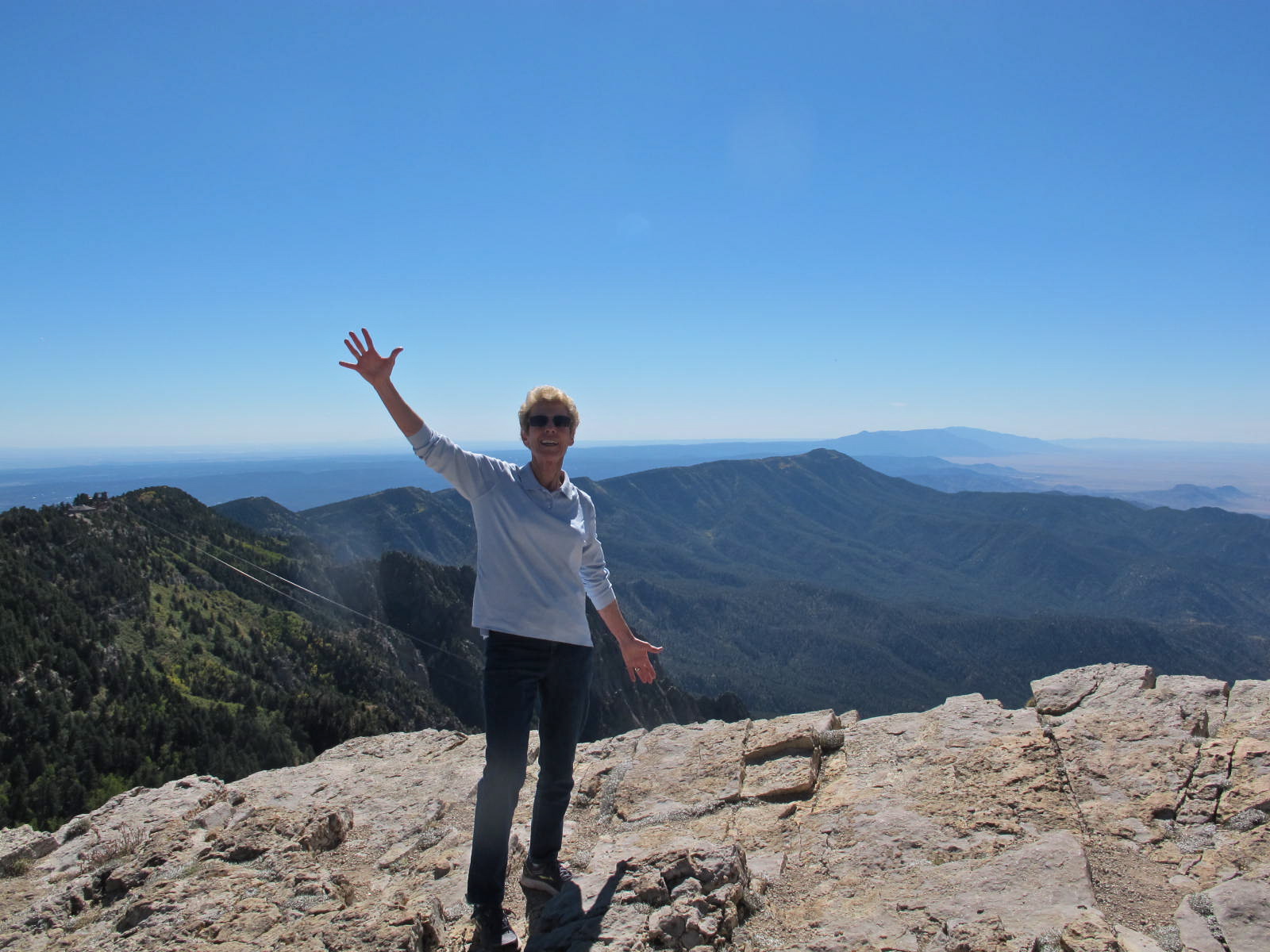
Cora on the edge...sort of

Cora on the edge…sort of

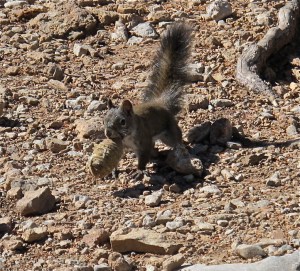
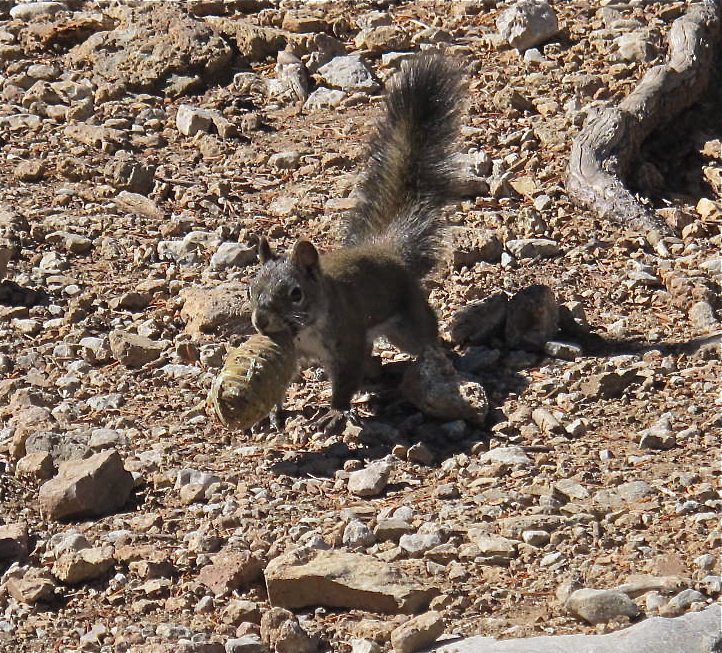
We saw this little squirrel with his pine cone while we were eating our lunch near the cabin. He was a cutie.
We saw this little squirrel with his pine cone while we were eating our lunch near the cabin. He was a cutie.

Jerri is such a show off! :-)

Jerri is such a show off! 🙂

We didn’t really think about the altitude until we got back to the tram and saw several people having breathing issues. Jerri helped a gal while we were waiting for our tram. She ended up needing oxygen on the way down. There was a teenager on our return tram who needed oxygen on the way up and never got off the tram until we docked at the lower level. I guess living at the altitude we do and also working out helped us in our activities on this trip.
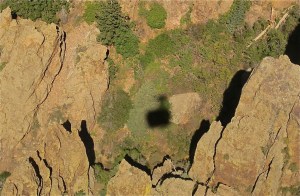
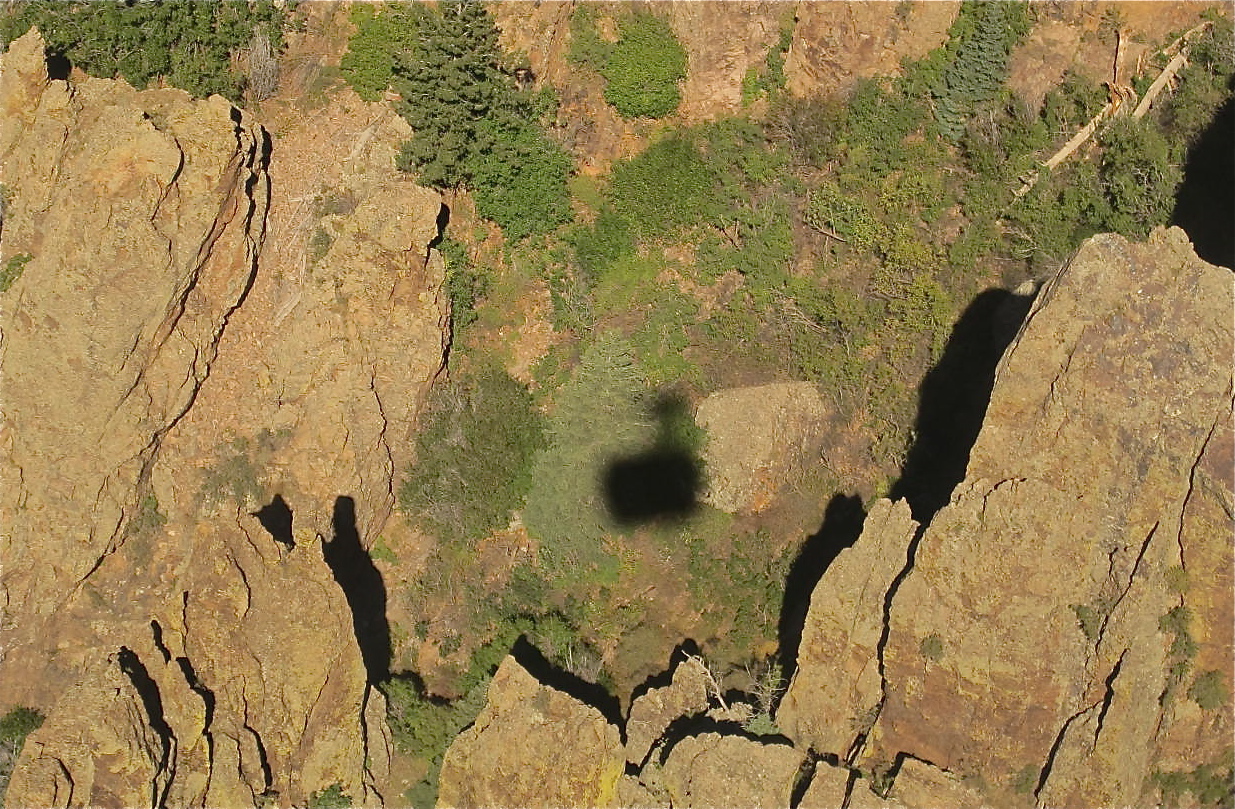
The shadow of our tram going down hill.
The shadow of our tram going down hill.

We went on a ghost tour that night but didn’t see any ghouls, spirits or spiders.
We went on a ghost tour that night but didn’t see any ghouls, spirits or spiders.

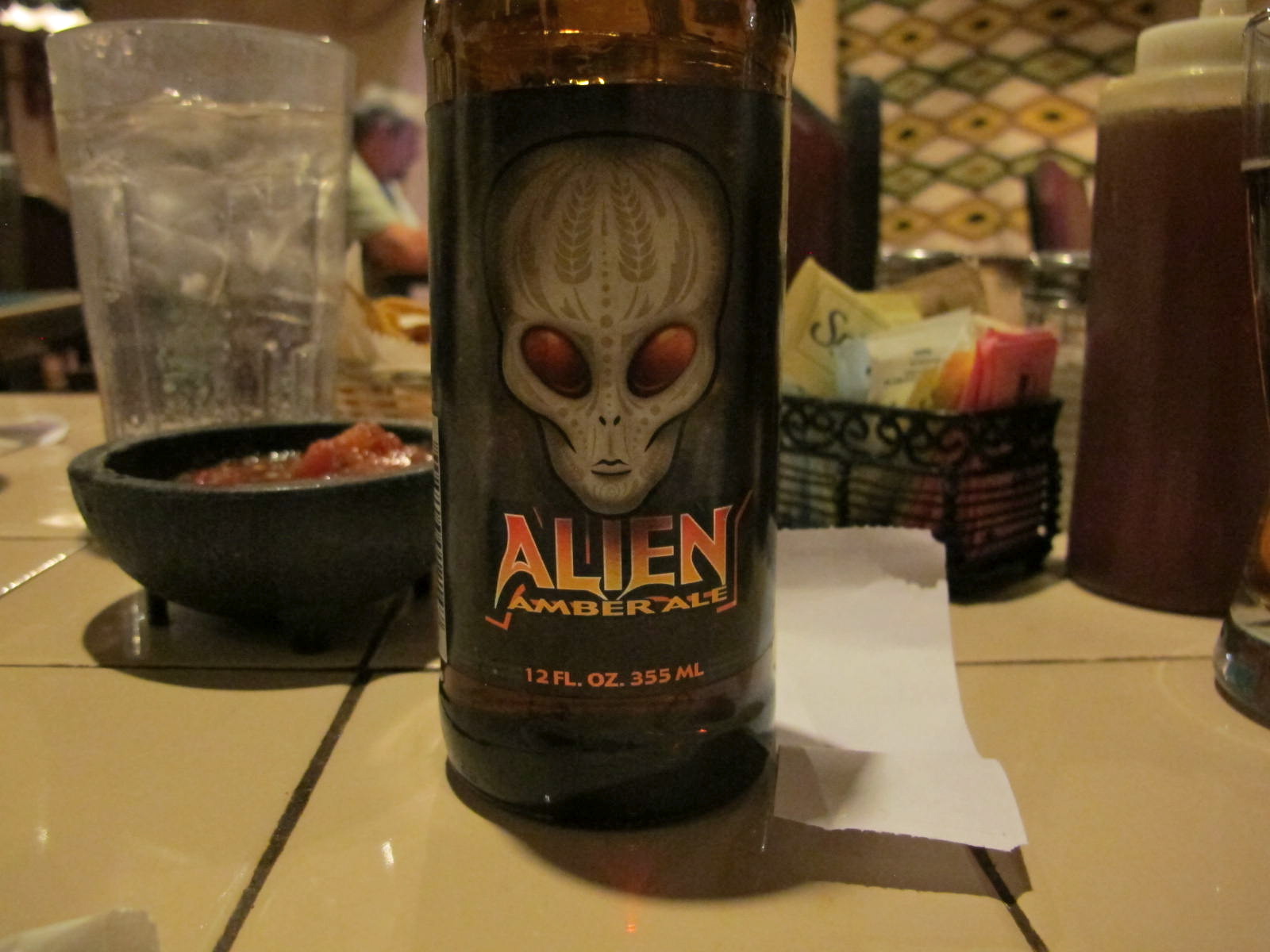
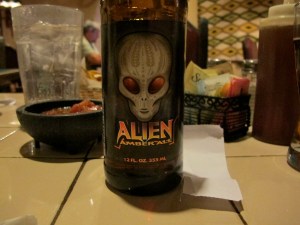
The only alien I saw was the amber ale I drank at dinner.

The only alien I saw was the amber ale I drank at dinner.

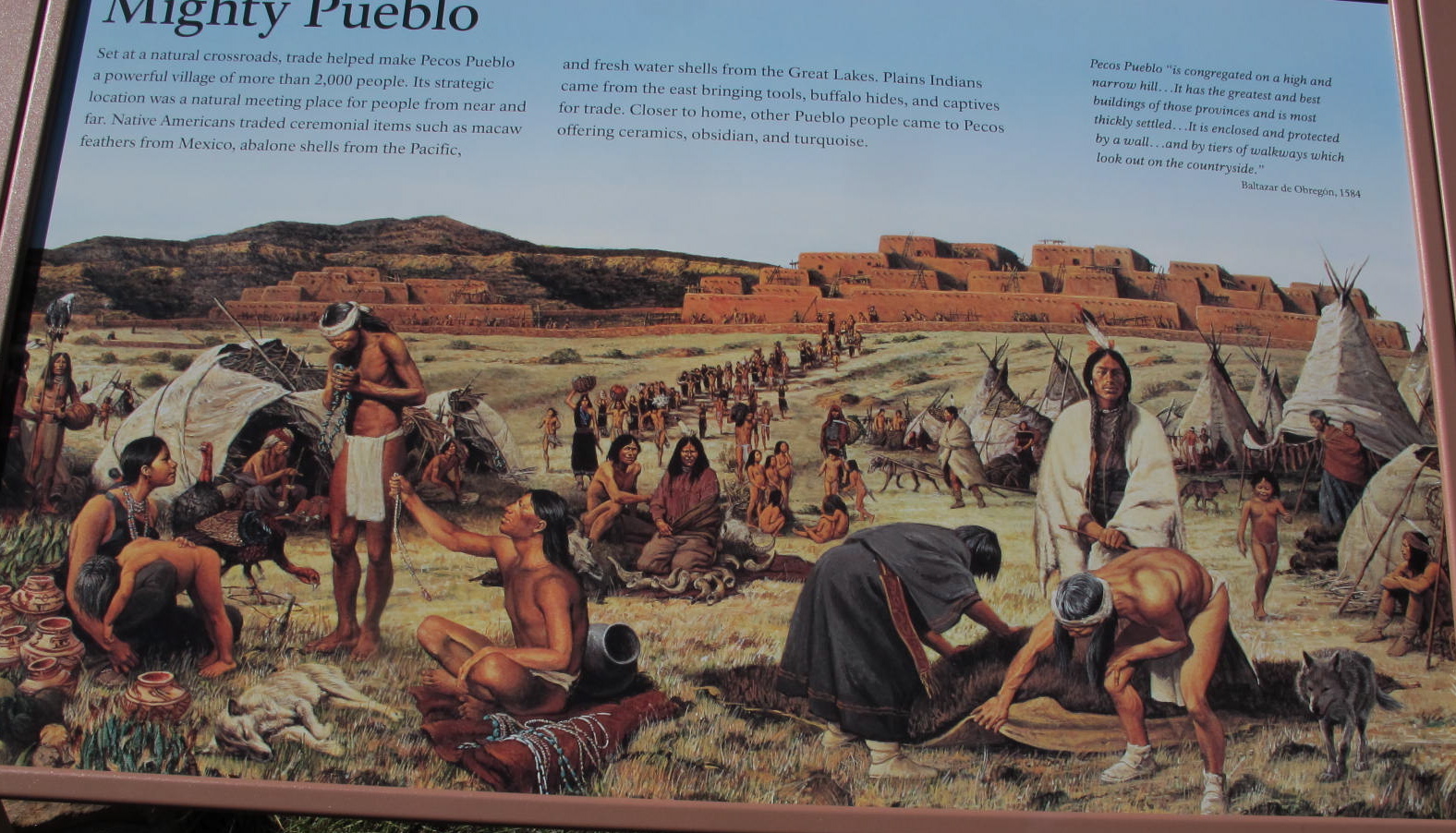
Our last day was spent driving out I-25 to see the Pecos National Historical Park. It preserves the ruins of one of the largest ancient pueblos as well as two mission churches built by Franciscans in the 17th and 18th centuries. The park brochure says this area is a cultural crossroads because for over 10,000 years this landscape has been the backdrop to a continuously unfolding story of human culture: Pueblo and Plains Indians, Spanish conquerors and missionaries, Mexican and Anglo armies and settlers traveling the Santa Fe Trail.

You can see how the pueblo would have looked about 1625.
You can see how the pueblo would have looked about 1625.

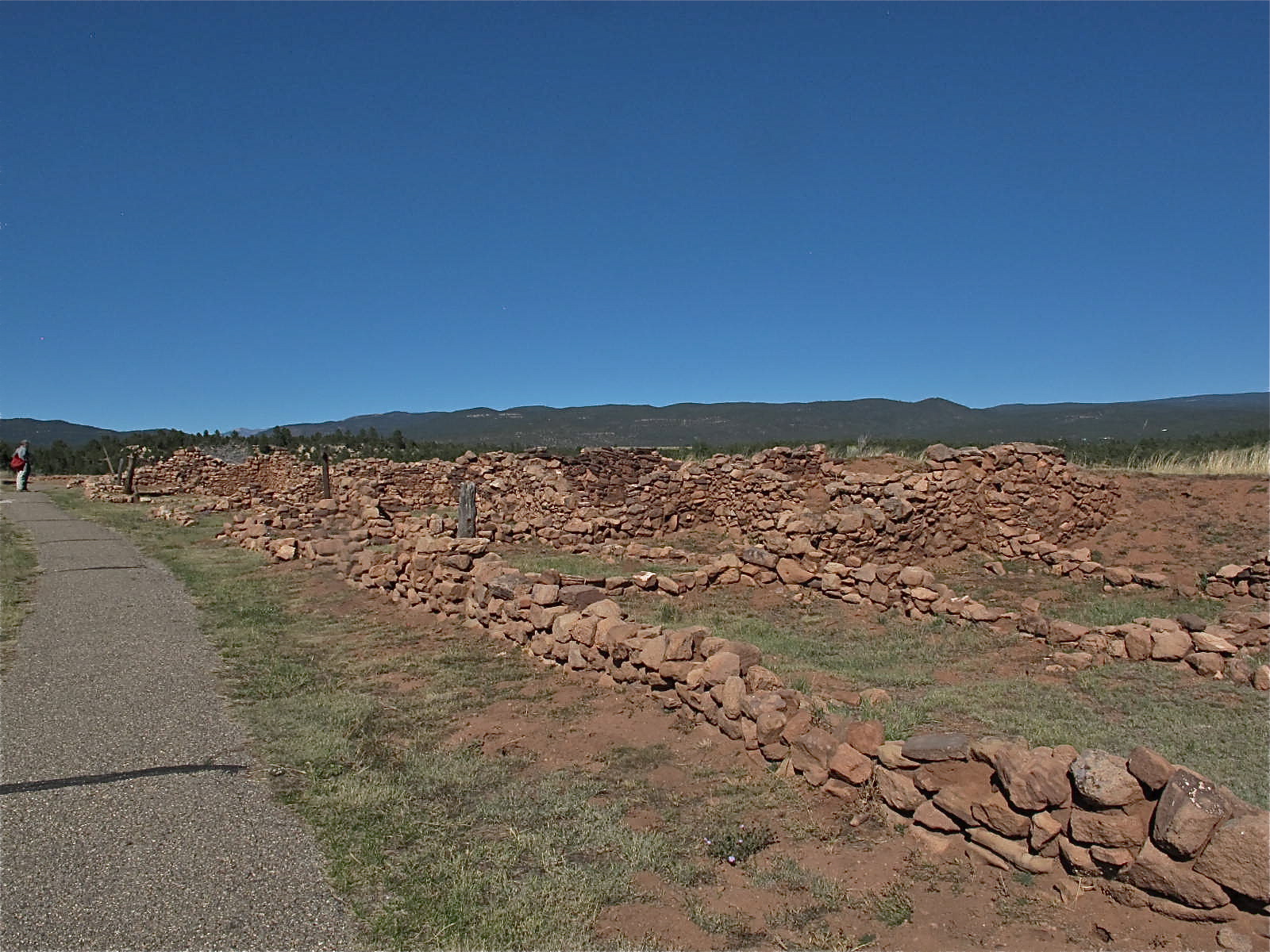
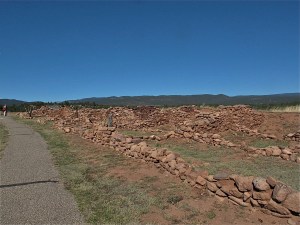
This shows what the ruins look like today. It’s an interesting place in which your imagination can run wild if you let it.
This shows what the ruins look like today. It’s an interesting place in which your imagination can run wild if you let it.

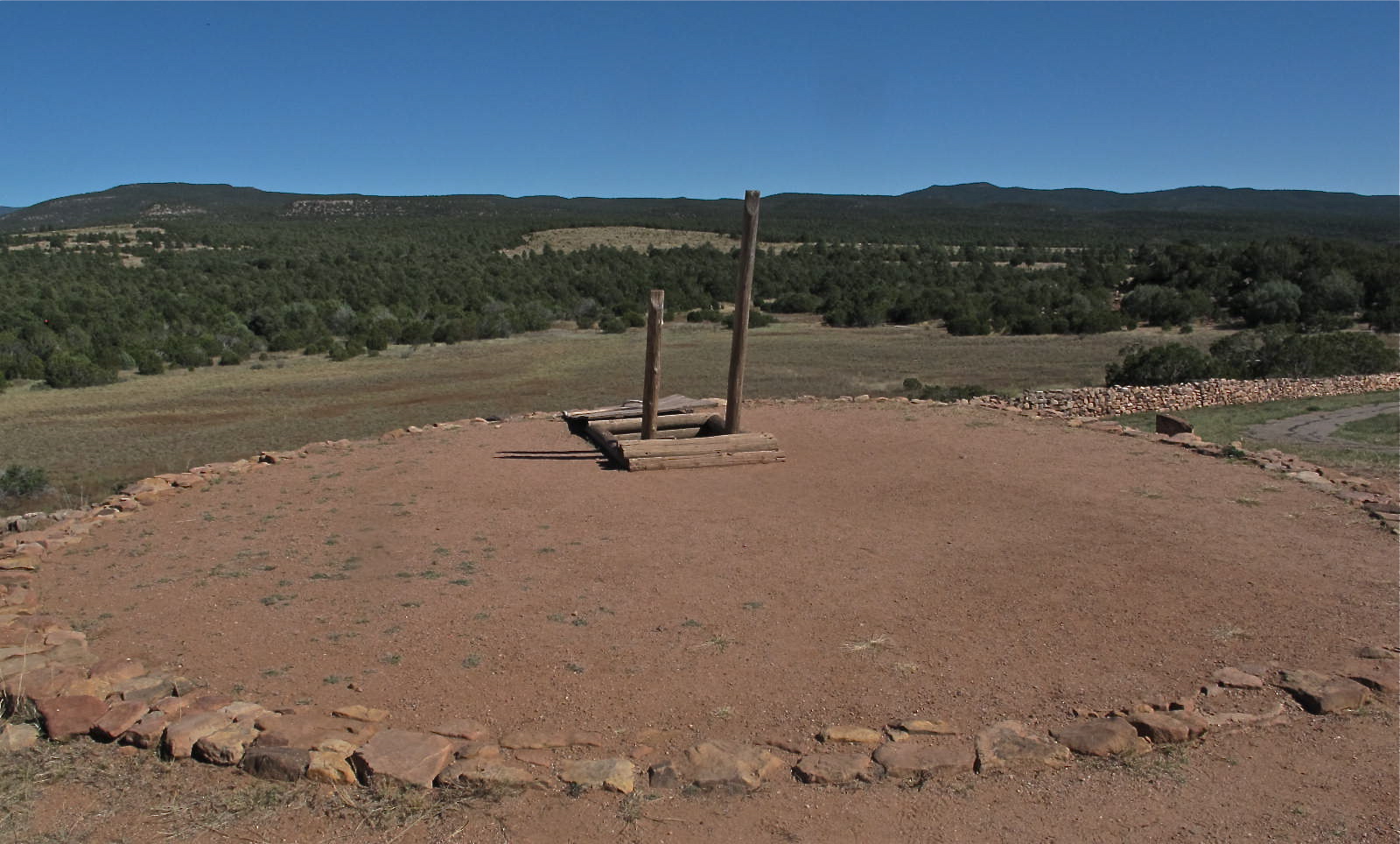
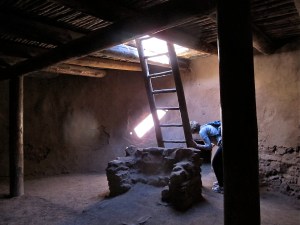
We got to go inside a reconstructed kiva where ceremonies and social events would have taken place for the Pueblos.
We got to go inside a reconstructed kiva where ceremonies and social events would have taken place for the Pueblos.

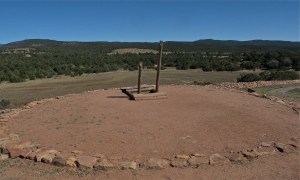
The top of the kiva
The top of the kiva

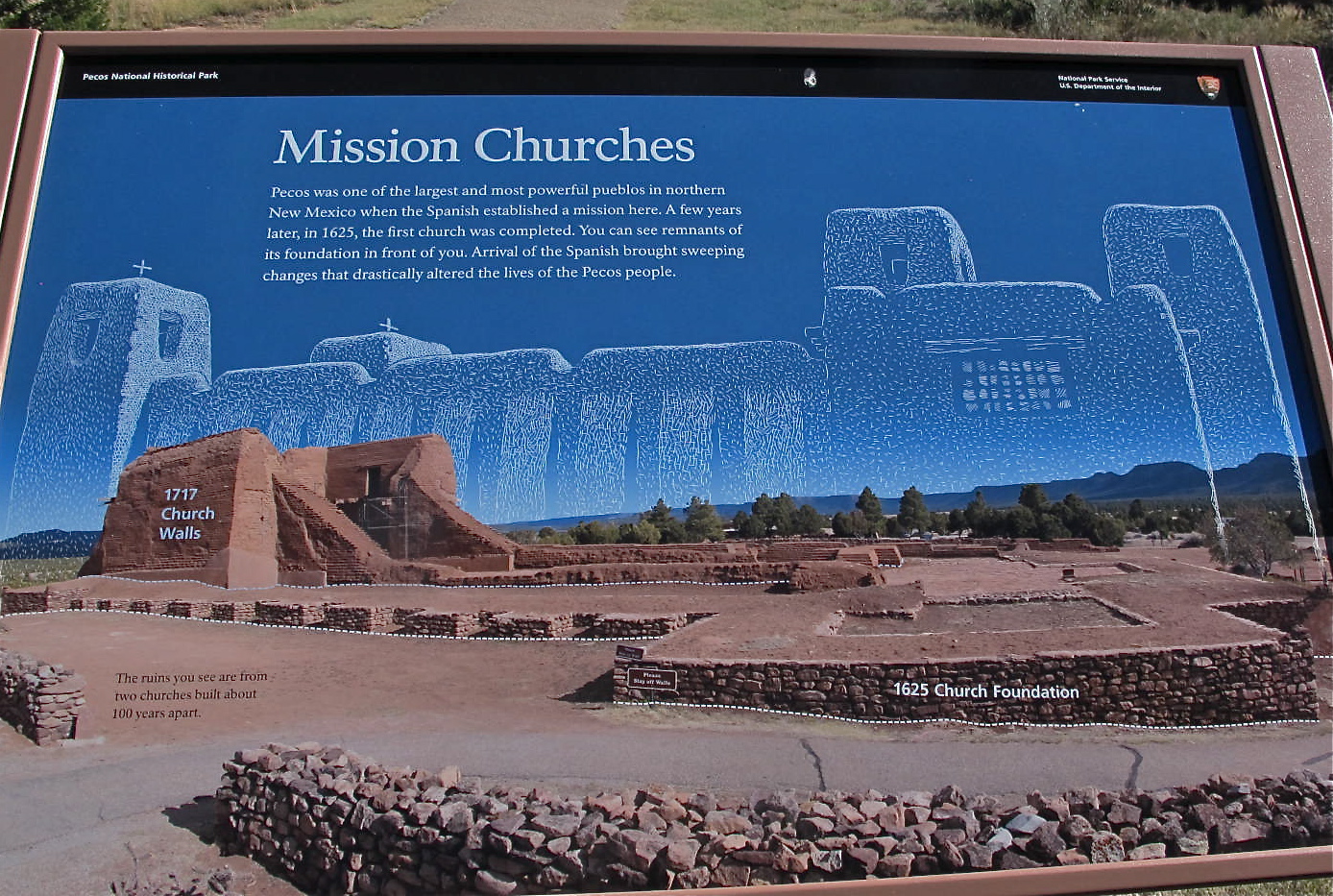
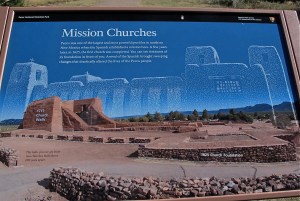
This shows an overlay of the two churches that were built here. The second was smaller due to a smaller Pueblo population.
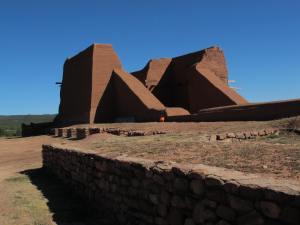
This shows an overlay of the two churches that were built here. The second was smaller due to a smaller Pueblo population.

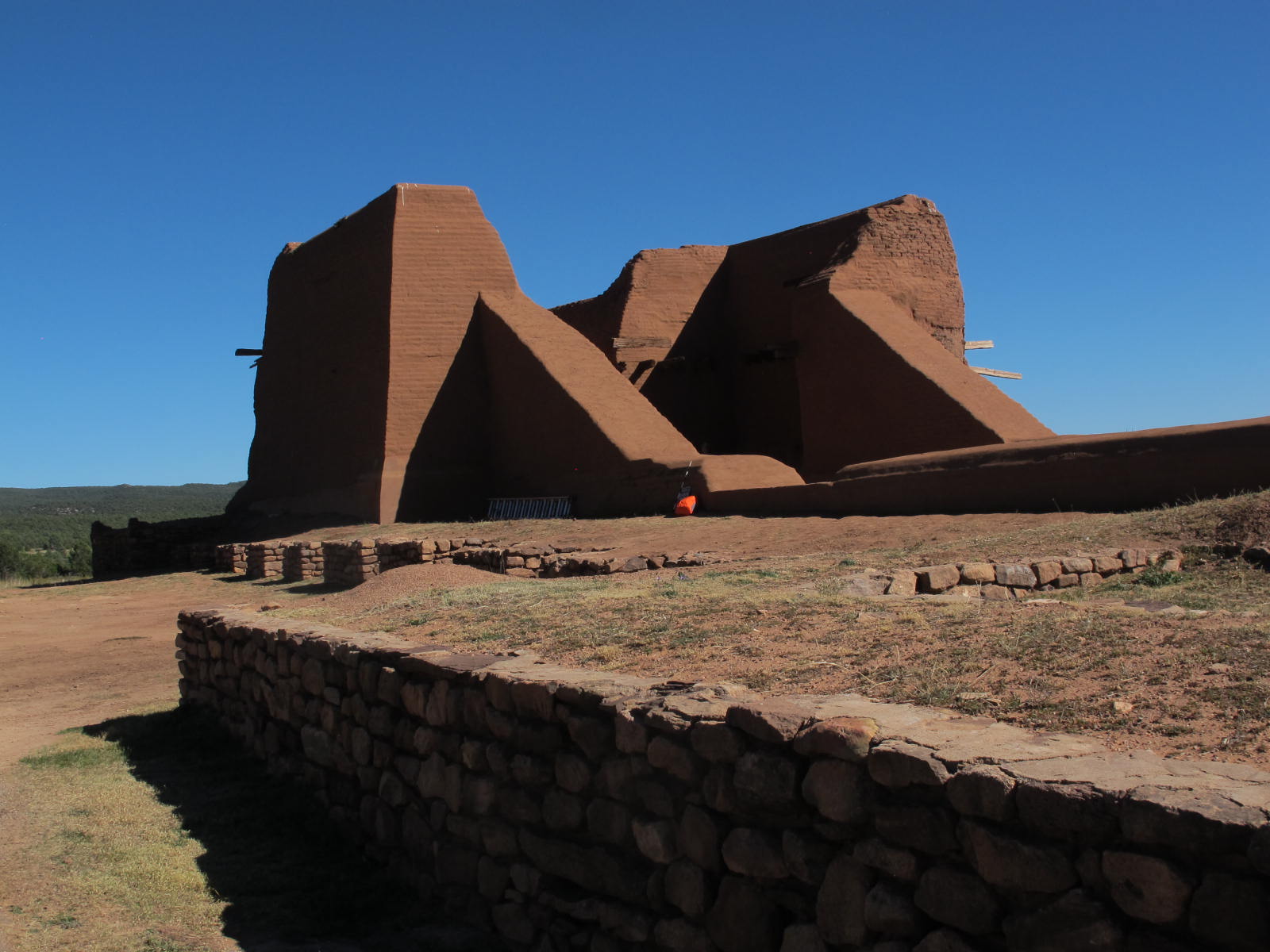
The churches today
The churches today

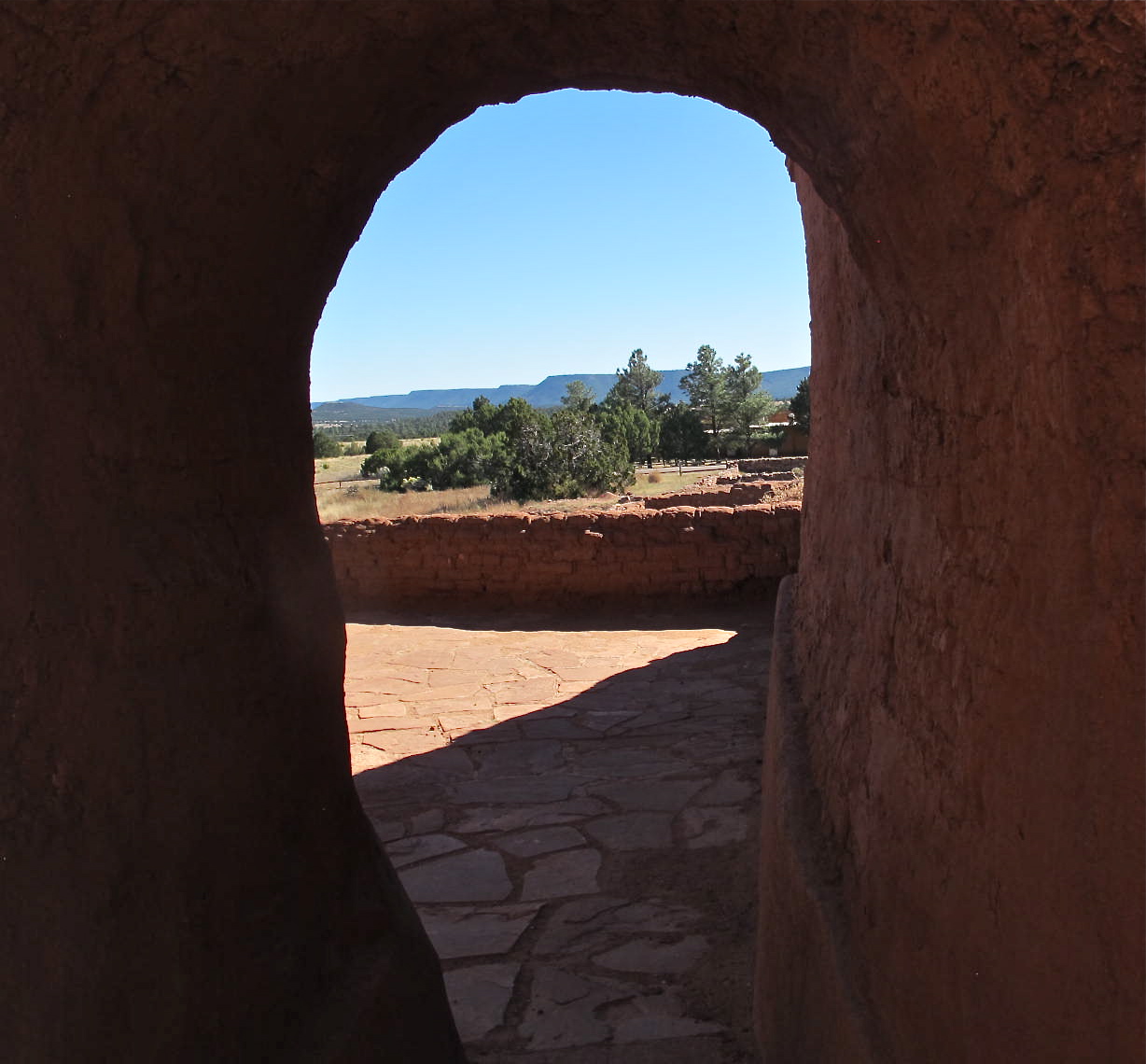
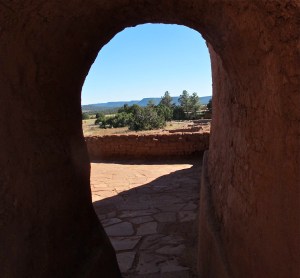
This is a view from one of the church exits near the altar.

This is a view from one of the church exits near the altar.

Jerri and I loved the part of New Mexico that we saw. The many faces of the landscape reminded us somewhat of Nevada, but NM has more colors, I think (although I haven’t seen all of Nevada yet). We liked the pace of the towns…much more relaxed than last year’s trip to Boston. The people were so friendly and we enjoyed chatting with them. We learned to answer New Mexico’s official state question: “Red or green? “   That is to say what color of chile would you like on your food. I would say, Christmas because I liked both flavors. Jerri would usually say green because it’s a bit milder. We would like to go back some day to see more of the state.
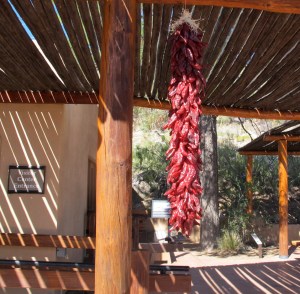
Another ristra. We wanted to bring one home but they were pretty expensive and we didn't ask if they could be shipped. Maybe next time.

Another ristra. We wanted to bring one home but they were pretty expensive and we didn’t ask if they could be shipped. Maybe next time.



Addendum to “Murder at the Mine…or Who Got the Shaft?”

27 Sep

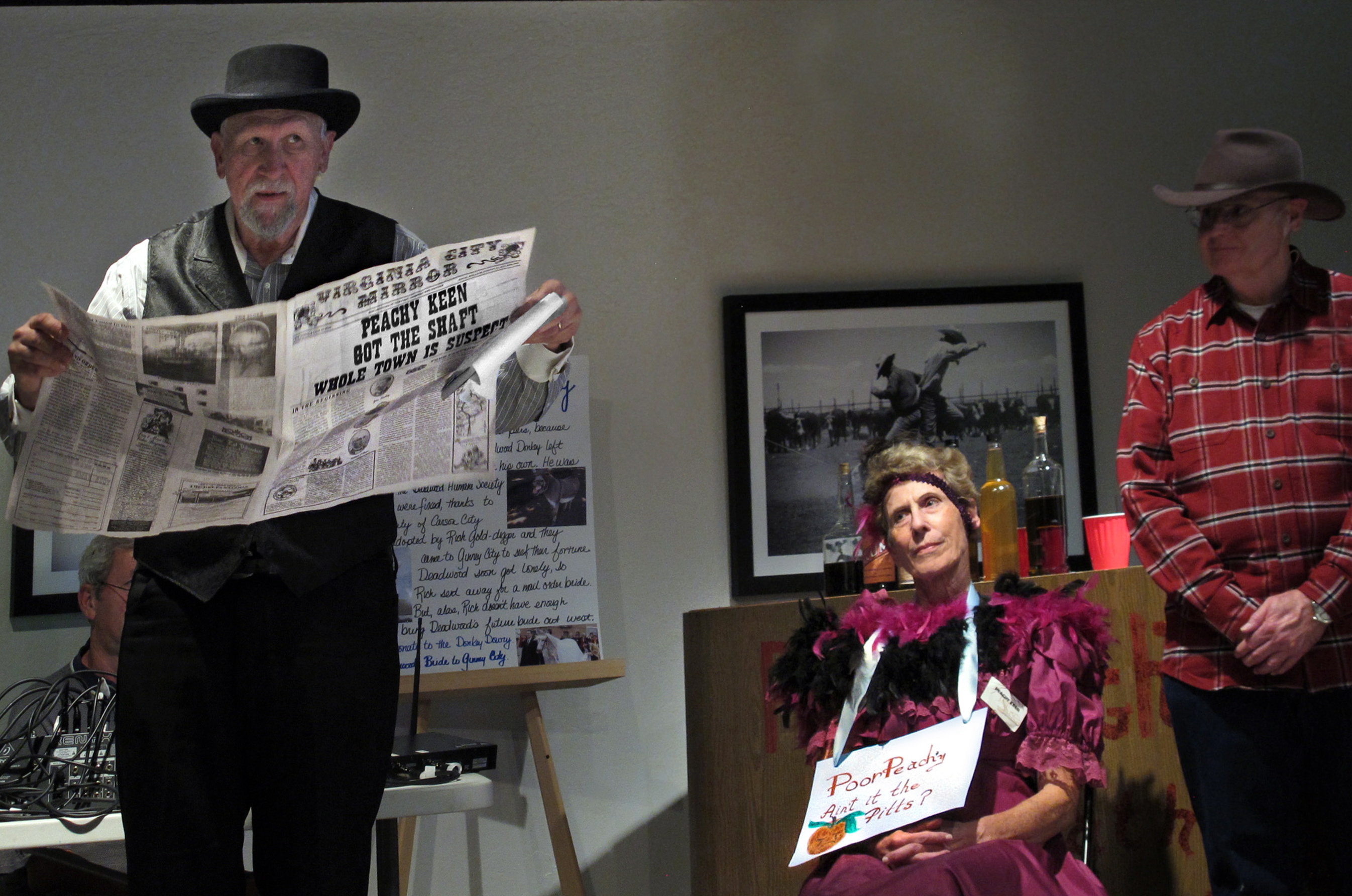
Here are some additional photos due to some comments made by some folks who were there as well as RD Schmidt who took all the wonderful photos.  He feels that the answer to the entire play is summed up in the following picture.

Check out the head line in the paper that Isaiah Clemmens is reading and Peachy's expression

Check out the head line in the paper that Isaiah Clemmens is reading and Peachy’s expression. Also check out Peachy’s sign.

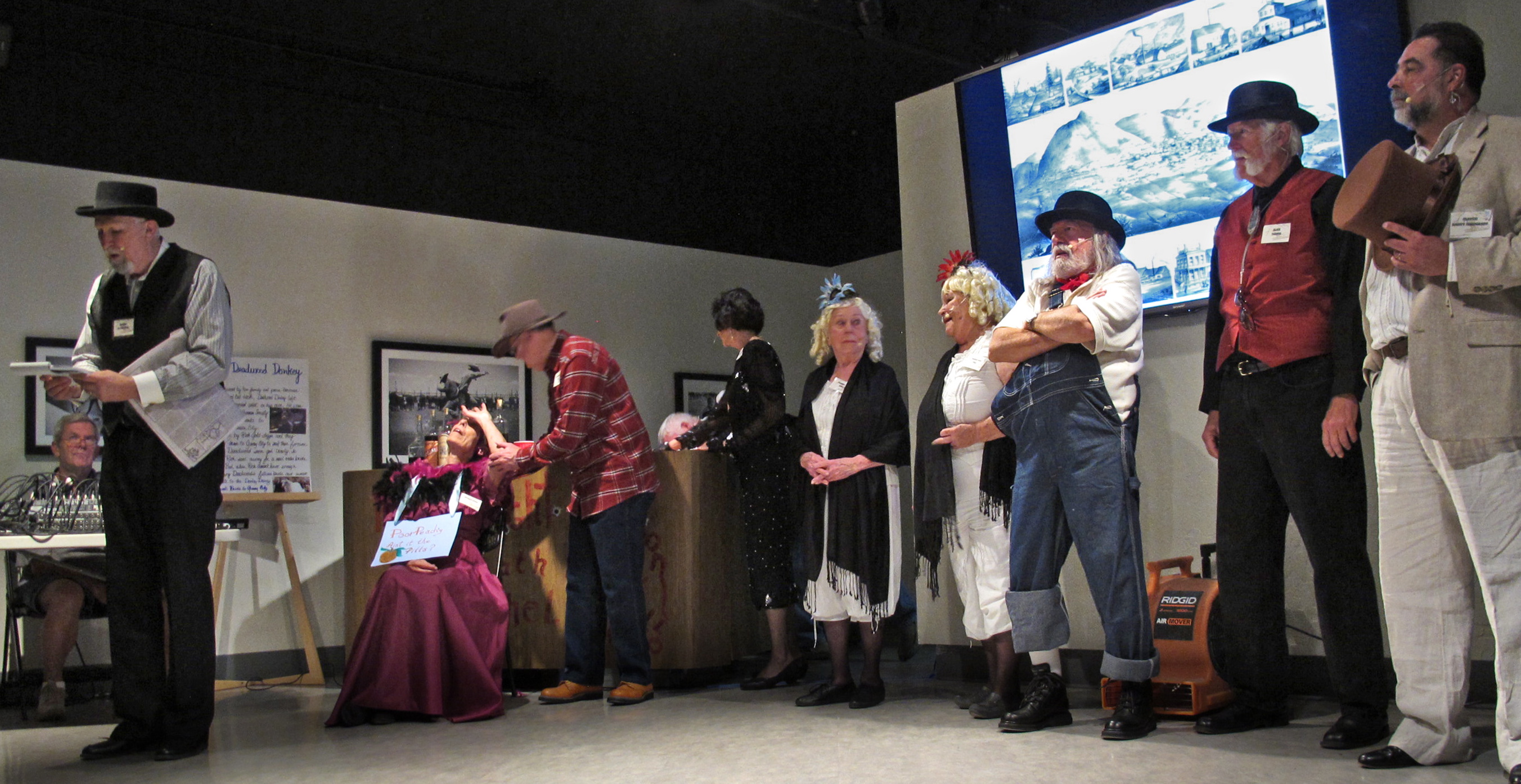
The demise of Peachy...or...The lights are definitely too hot in here!

The demise of Peachy…or…The lights are definitely too hot in here!

Jerri and Peachy. Jerri did a great job handling the raffle while Peachy was on stage.

Jerri and Peachy. Jerri did a great job handling the raffle while Peachy was on stage.

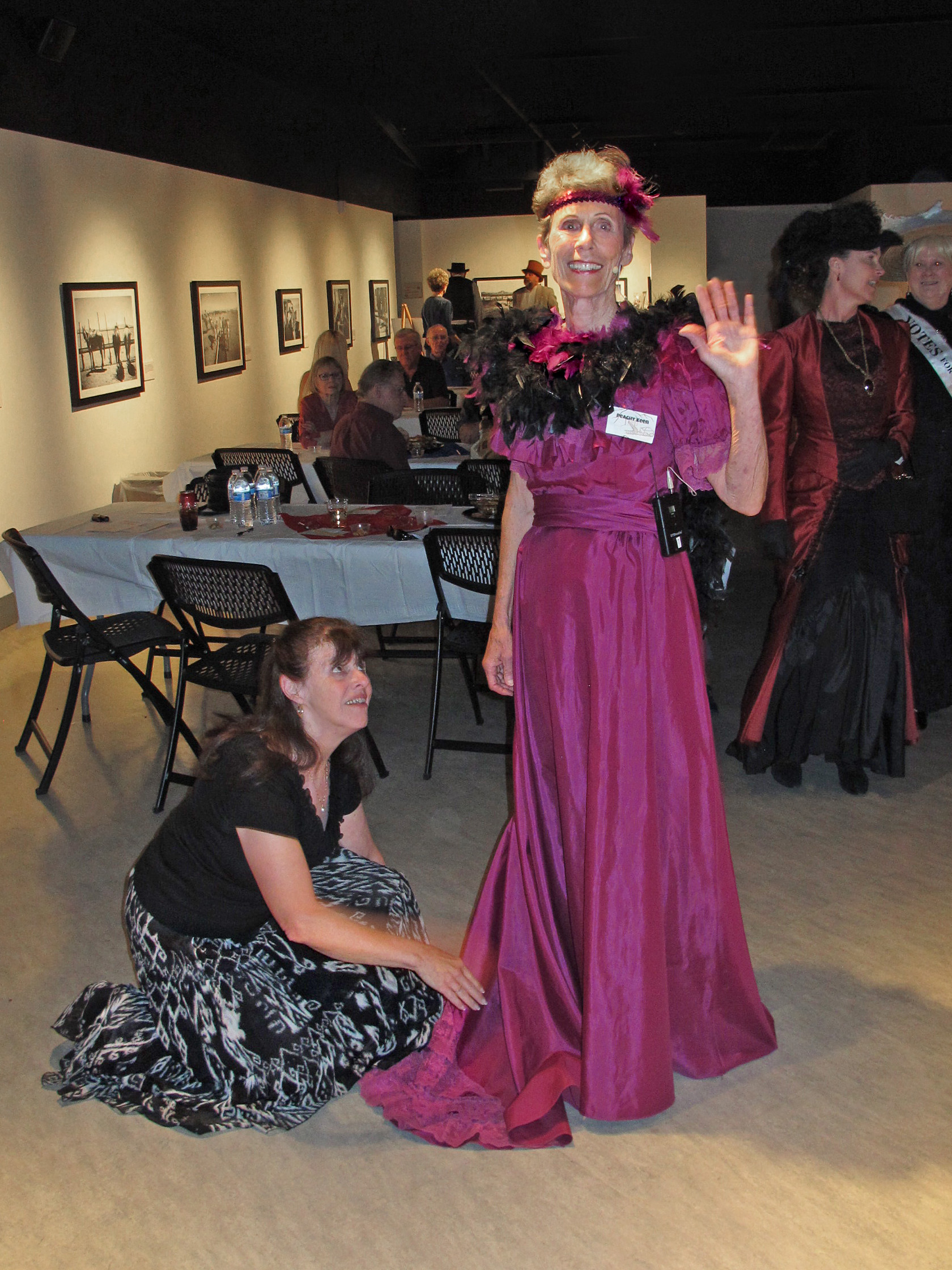
An adoring fan taking care of Peachy's train :-) Just kidding. This is a long time buddy, Connie

An adoring fan taking care of Peachy’s train 🙂 Just kidding. This is a long time buddy, Connie


Jerri and Jolee...the best!

Jerri and Jolee…the best!


As stated before, the play was a lot of fun and the Friends of the Museum were able to raise additional monies to be able to contribute to the Nevada State Museum.  It’s a good cause for a great preserver of Nevada history.

Murder at the Mine… or Who Got the Shaft?

25 Sep

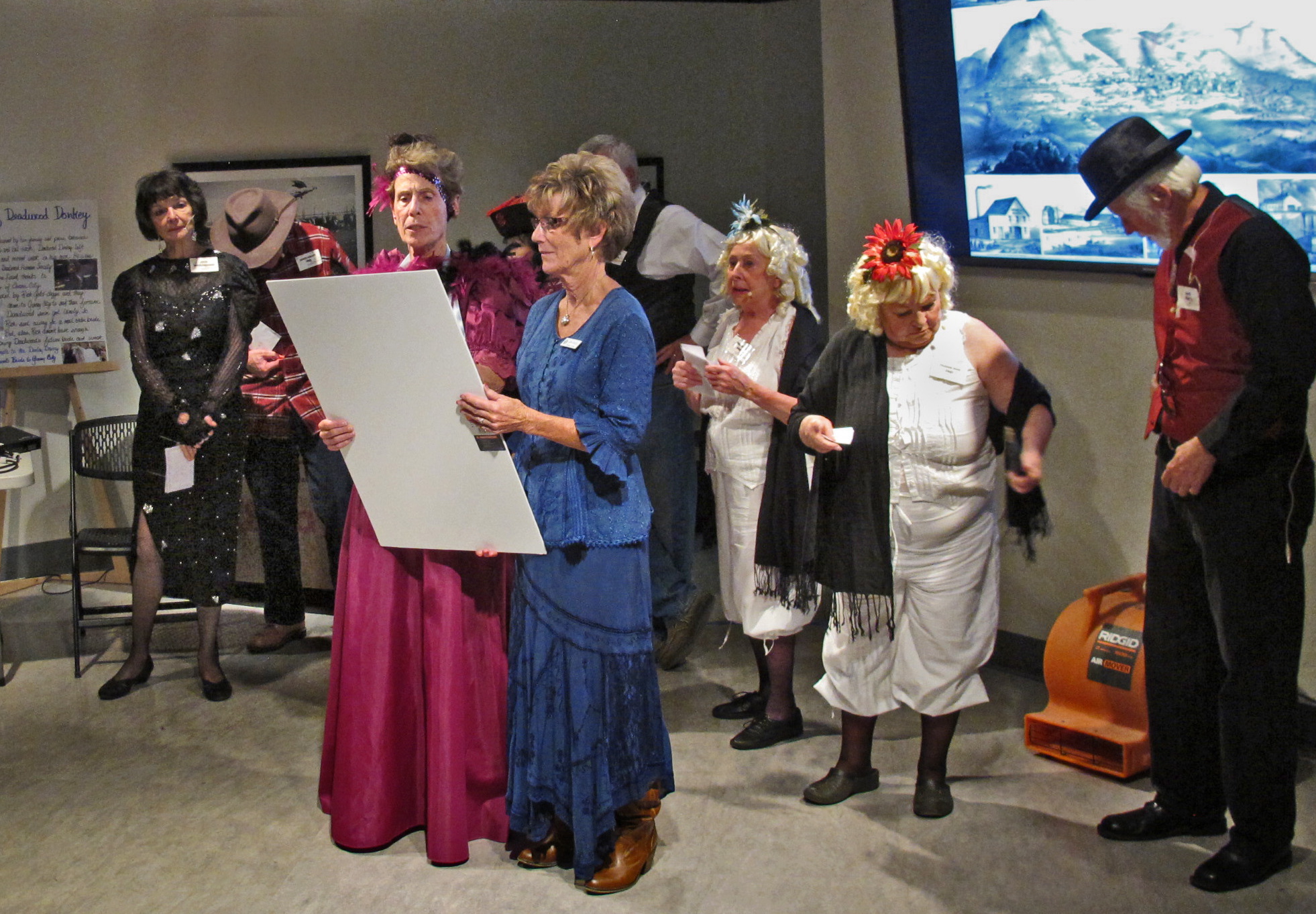
This is the title of the second melodrama murder mystery presented by the Friends of the Nevada State Museum. It is a great fund raiser and people seem to enjoy our shenanigans. It’s fun to do…if you don’t mess up your lines and then forget the next cue. Trust me, I did that in this play.

It began a few months ago when our intrepid script writers, Dave and Kathy went on a cruise. The more beers they consumed, the funnier the lines and gags became. It really is a fun story. I was originally going to be in charge of the raffle and not have a role in the play. However, one of the players was going to have knee replacement surgery and had to back out. There used to be a commercial in So. Cal. with the line “Who ya gonna call?” I was the recipient of that call and became Peachy Keen (in lieu of Black Barbara as in the last play).  (Don’t forget to click on the pictures to enlarge them.)

Kim Chi (Kathy) and Billy Bob Barrista (Dave) were the script writers.

Kim Chi (Kathy) and Billy Bob Barrista (Dave) were the script writers.

Rehearsals began, and again, we never had all of the players together until it was getting close to the play date. We tried to get away with fewer rehearsals but we never got our lines and cues right. So we ended up having 4 rehearsals in the 5 days before the actual play. We were originally going to have it at the Governor’s Mansion, but there was a mix-up with an event planned by the First Lady, so we got bumped. We ended up presenting our play in the cozy atmosphere of the museum. The room only holds 60 people but it worked out ok. We hope to do the play again next April at the Governor’s Mansion.

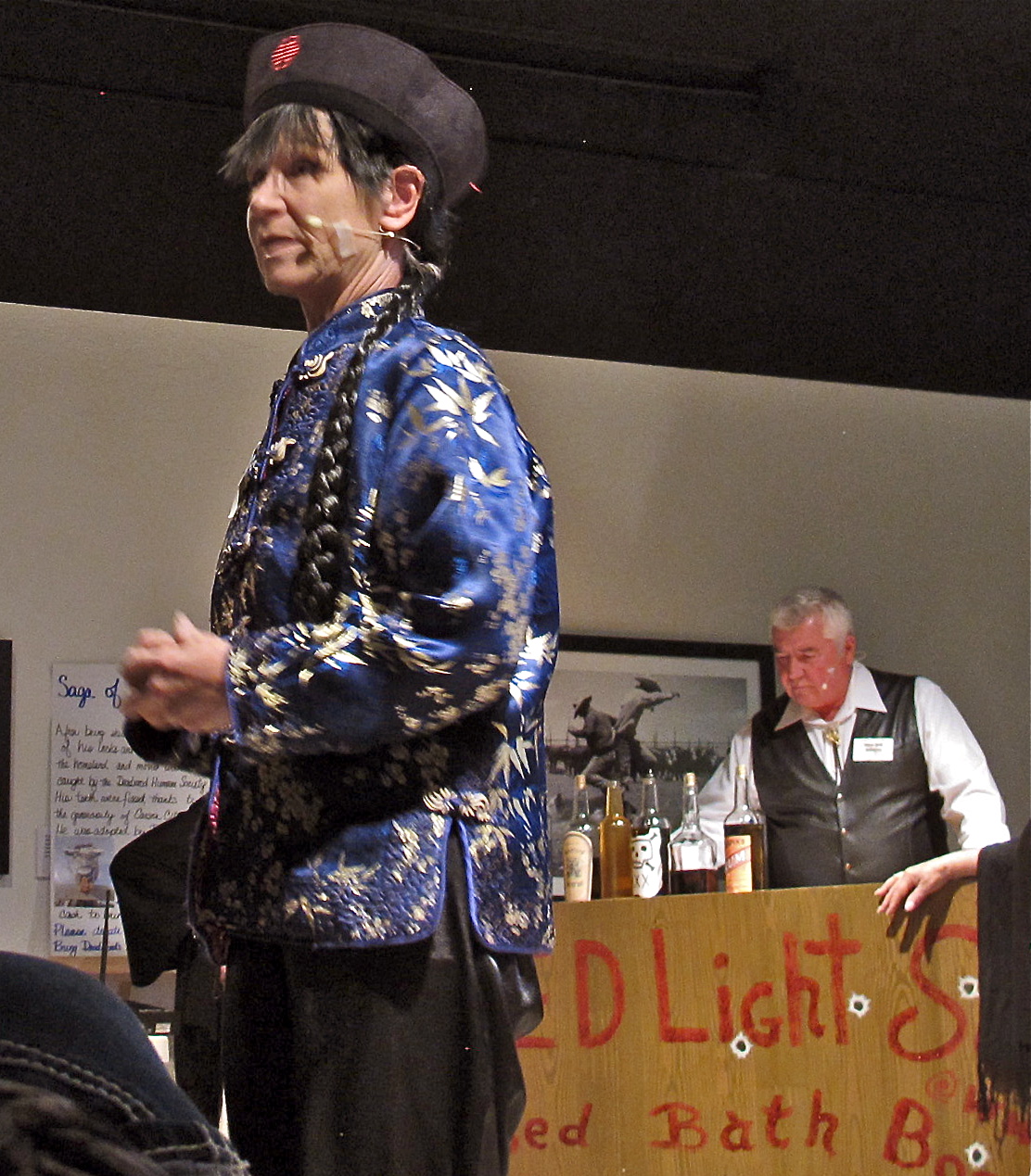
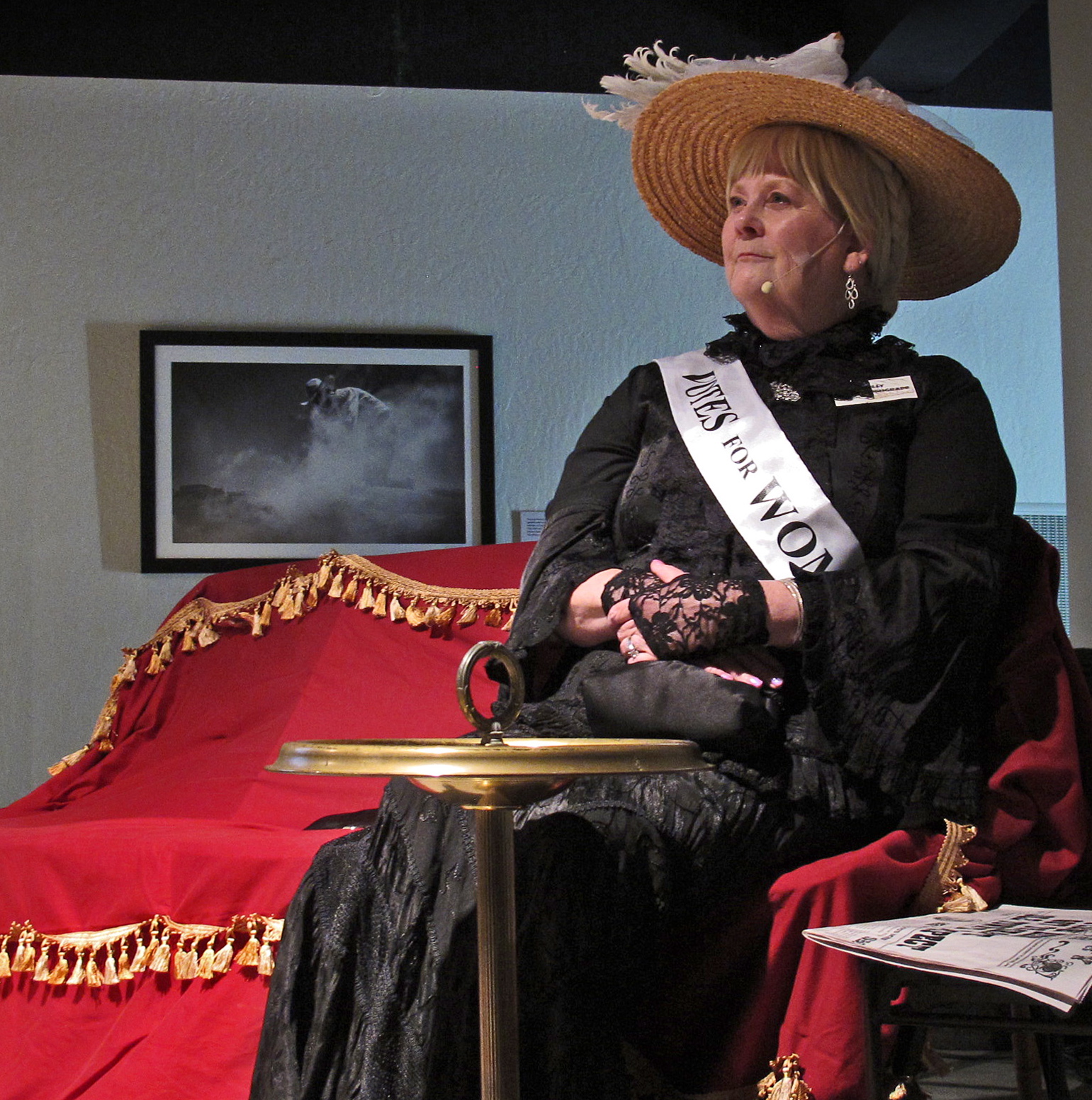
The play takes place in Ginny City (Virginia City) in the Red Light Saloon, Bed, Bath and Brothel. It’s a going enterprise that the mayor’s wife wants to shut down and turn into a high-class tea salon. Polly Tician-Highgrade is ahead of her time as a women’s libber and wants women to have the vote. Maybe even have a woman run for president some day. (Imagine that!) Of course, the men in the town do not want a tea salon. The town is filled with shady characters and the plot is rife with shady dealings, graft and grime.

Polly Tician-Highgrade, a powerful, rich woman in Ginny City

Polly Tician-Highgrade, a powerful, rich woman in Ginny City

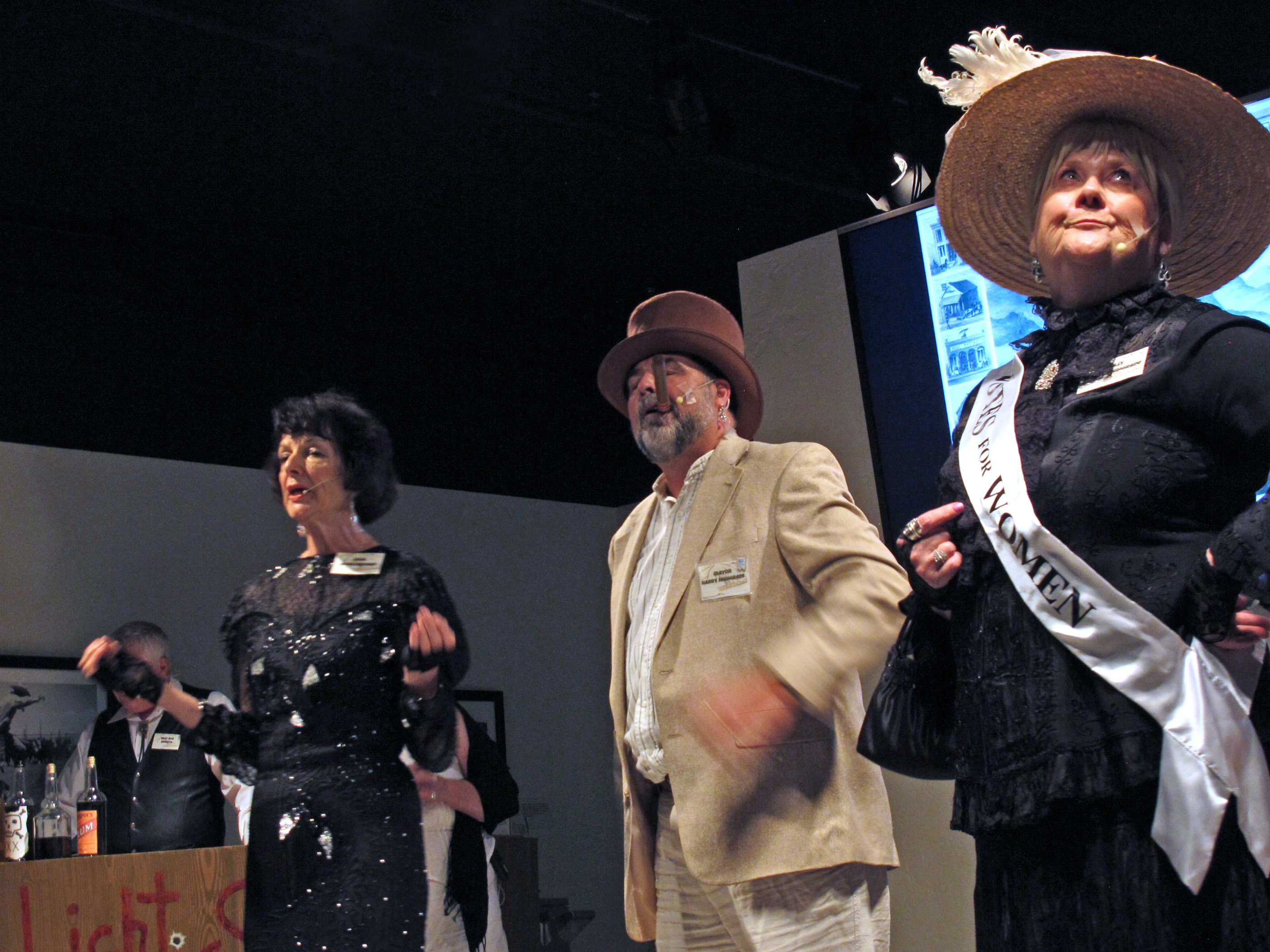
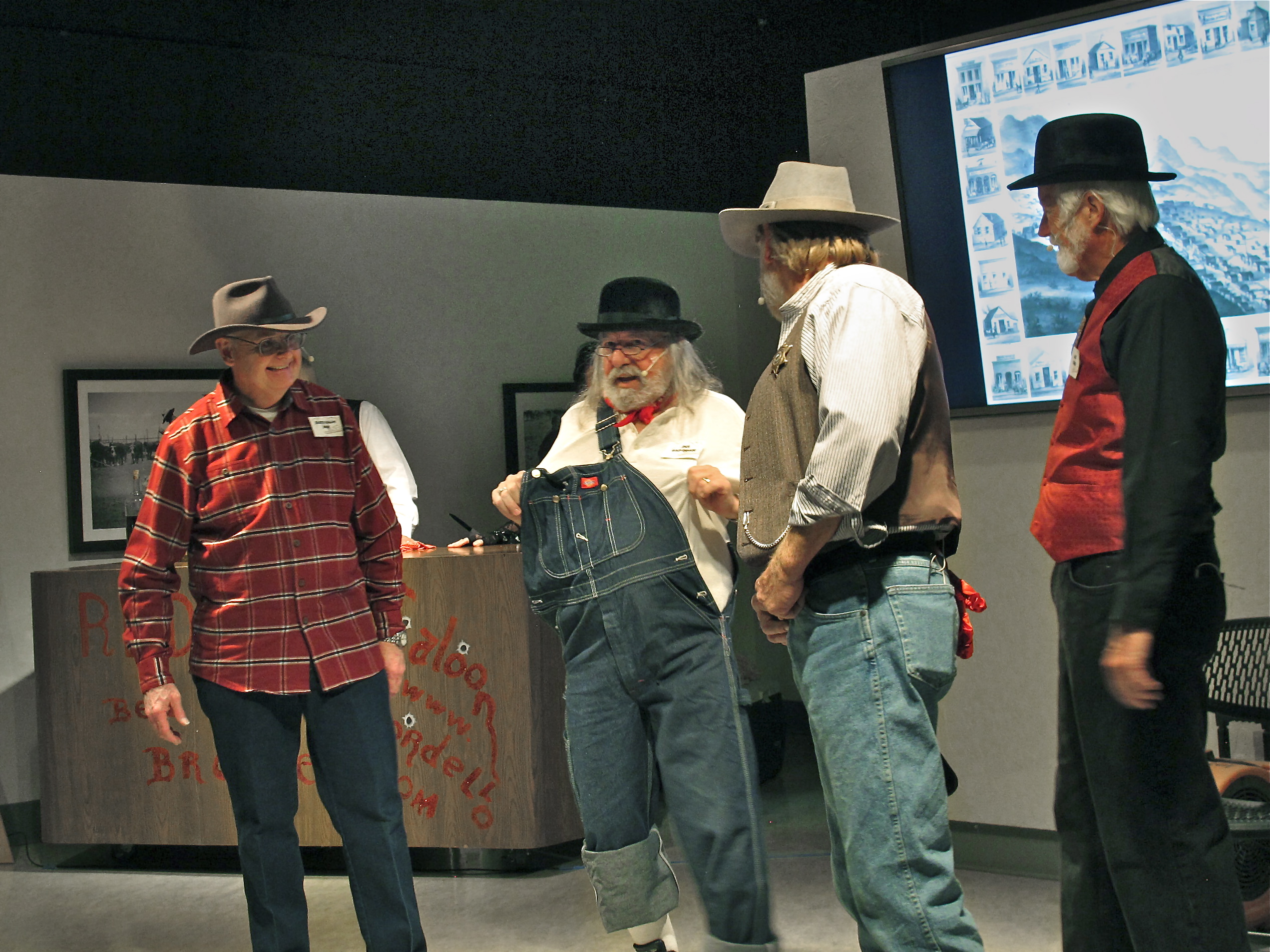
Here are some of the characters.

Julia Bouillabaisse, high madam at the Red Light Saloon. Polly Tician-Highgrade. Harry Highgrade, Ginny City’s mayor

Julia Bouillabaisse, high madam at the Red Light Saloon. Polly Tician-Highgrade. Harry Highgrade, Ginny City’s mayor

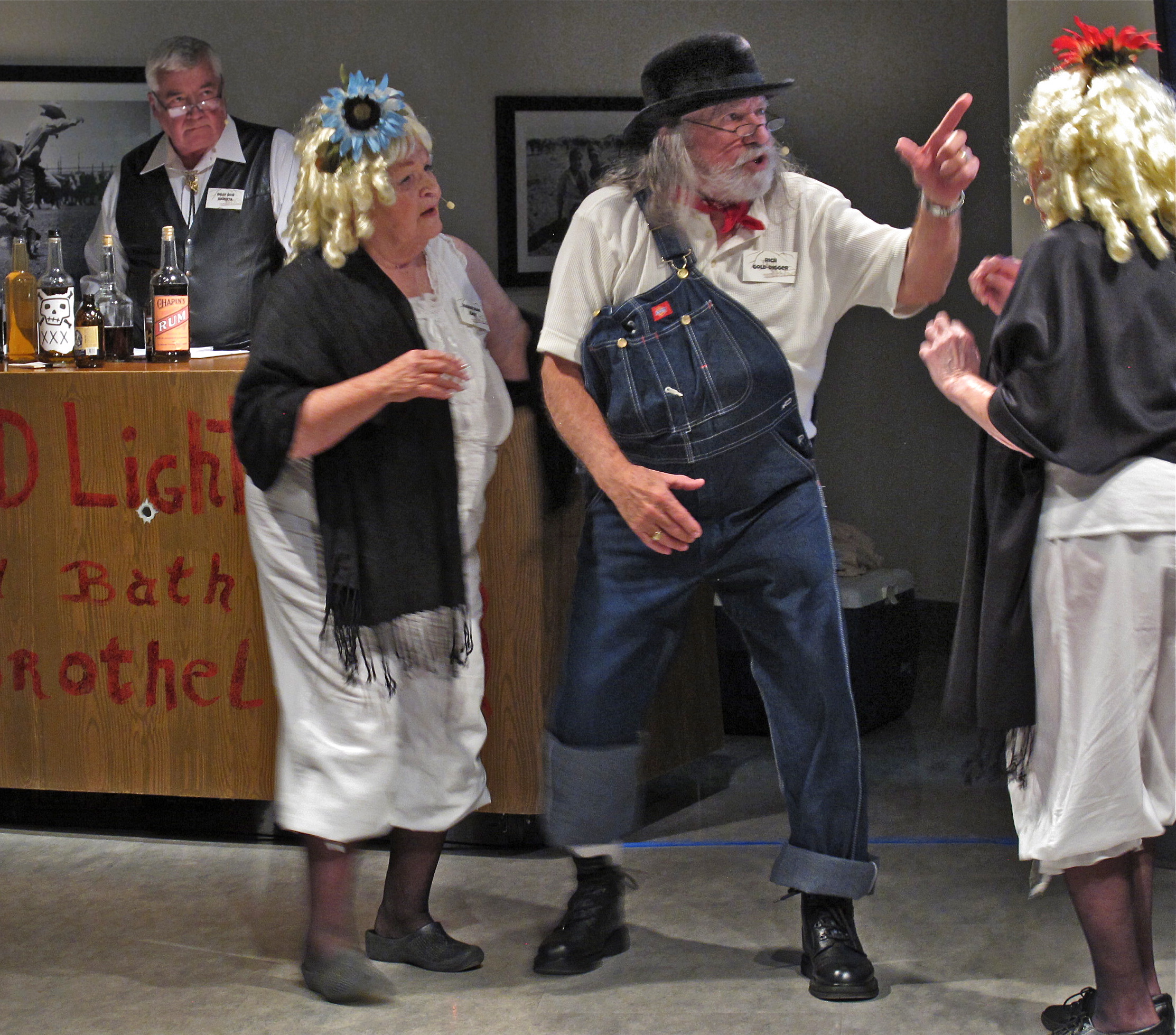
Death Valley Dick, foreman of the Gottrocks min but is really a Pinkerton agent. Rich Gold-digger, who learned how to undermine Jack Gottrocks' mine. Matt Basterson, the sheriff. Slick Thumb, Ginny City's assayer.

Death Valley Dick, foreman of the Gottrocks min but is really a Pinkerton agent. Rich Gold-digger, who learned how to undermine Jack Gottrocks’ mine. Matt Basterson, the sheriff. Slick Thumb, Ginny City’s assayer.

Fannie Mae East, Rich Gold-digger’s girl friend and identical twin to Fannie Mae South. The twins are dancers/singers at the Red Light Saloon, Bed, Bath and Brothel.

Fannie Mae East, Rich Gold-digger’s girl friend and identical twin to Fannie Mae South. The twins are dancers/singers at the Red Light Saloon, Bed, Bath and Brothel.

Fanny Mae South from the North. Peachy Keen, singer/dancer (?) who trained in San Francisco at the Institute of Vulcanology. She is taking over Fannie Mae South’s role at the Bag Piper’s Opera House.

Fanny Mae South from the North. Peachy Keen, singer/dancer (?) who trained in San Francisco at the Institute of Vulcanology. She is taking over Fannie Mae South’s role at the Bag Piper’s Opera House.

There are more characters, but there are not good pictures of them. The puns and bad jokes were great in this play and the audience supported us with lots of groans, laughs and boos.

Peachy is searching for her long lost daddy who might be in Ginny City. She ends up knowing a lot of dirt about many folks in this town that Peachy thinks is too rough for the likes for little, ol’ her.

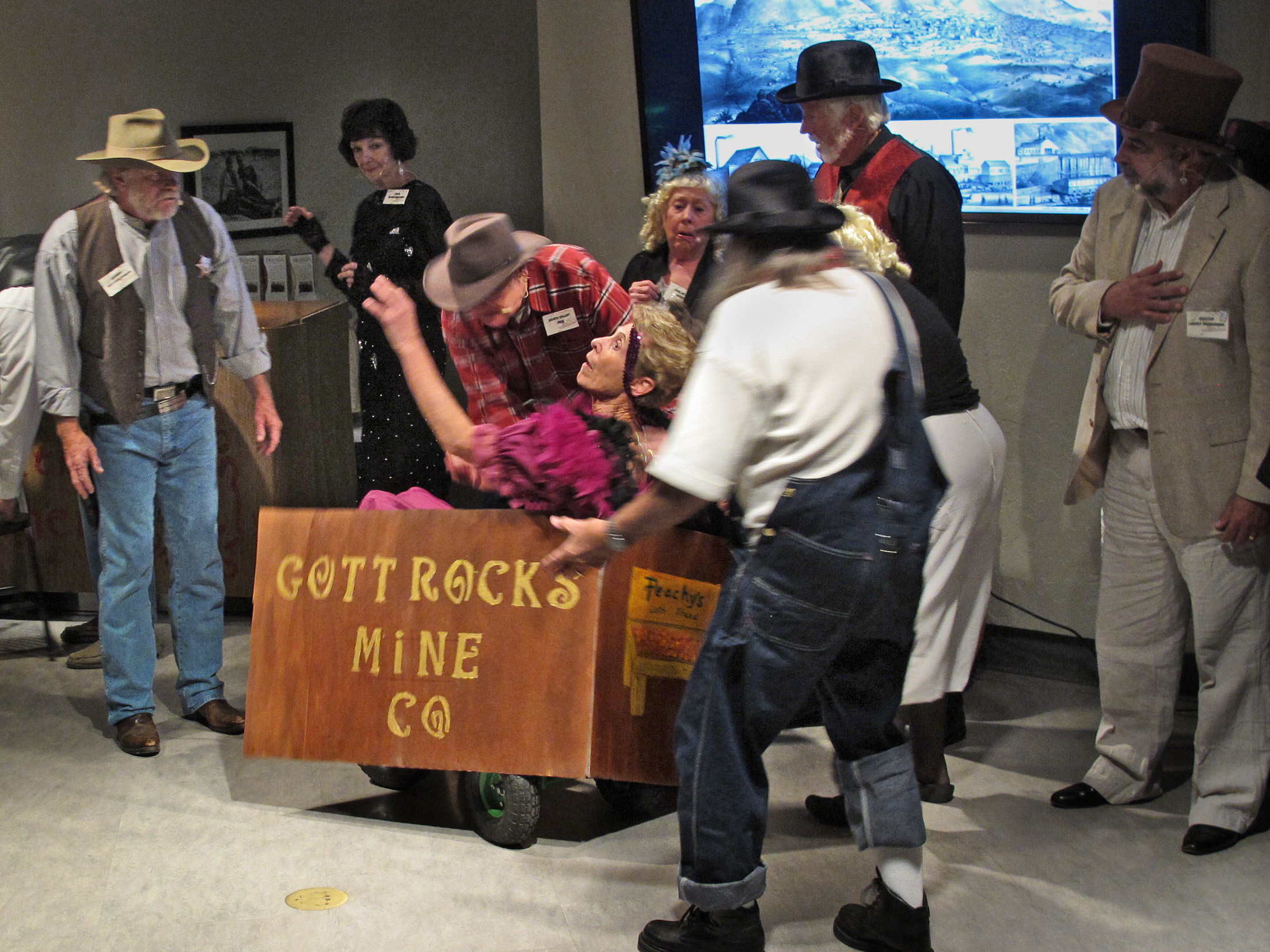
Peachy ends up getting the shaft and is carted back into the saloon in a Gottrocks Mine ore cart.

Peachy ends up getting the shaft and is carted back into the saloon in a Gottrocks Mine ore cart.


Peachy comes to and is helped out of the cart and into a chair

Peachy comes to and is helped out of the cart and into a chair

After Peachy gives a few clues, she has a dramatic passing. Everyone is shocked!

After Peachy gives a few clues, she has a dramatic passing. Everyone is shocked!

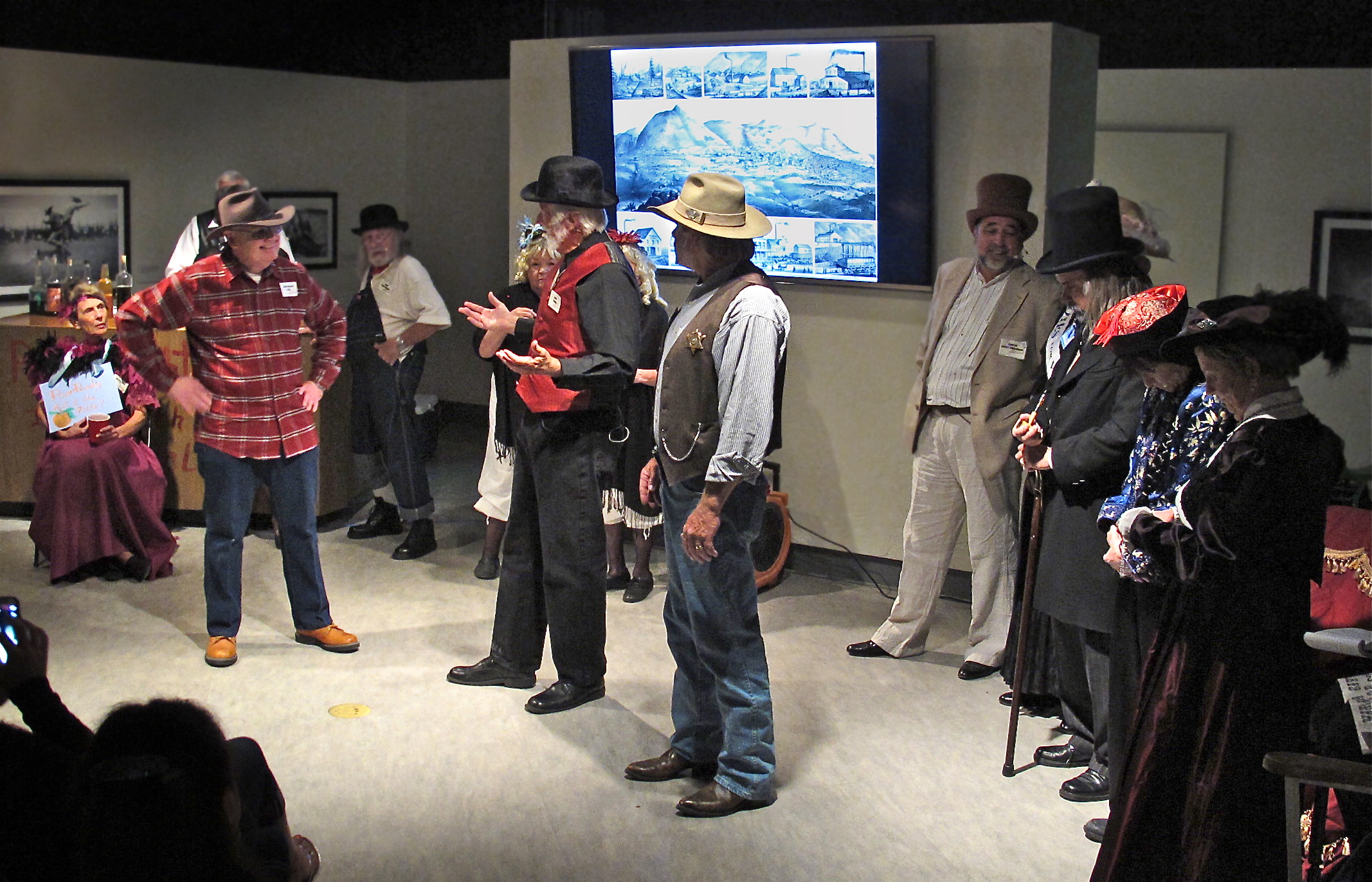
While the Sheriff and Death Valley Dick are finding out who is the murderer, Peachy keeps an eye on what is going on. You know, it's a bit dry on stage and she drinks a beer while watching the proceedings.

While the Sheriff and Death Valley Dick are finding out who is the murderer, Peachy keeps an eye on what is going on. You know, it’s a bit dry on stage and she drinks a beer while watching the proceedings.

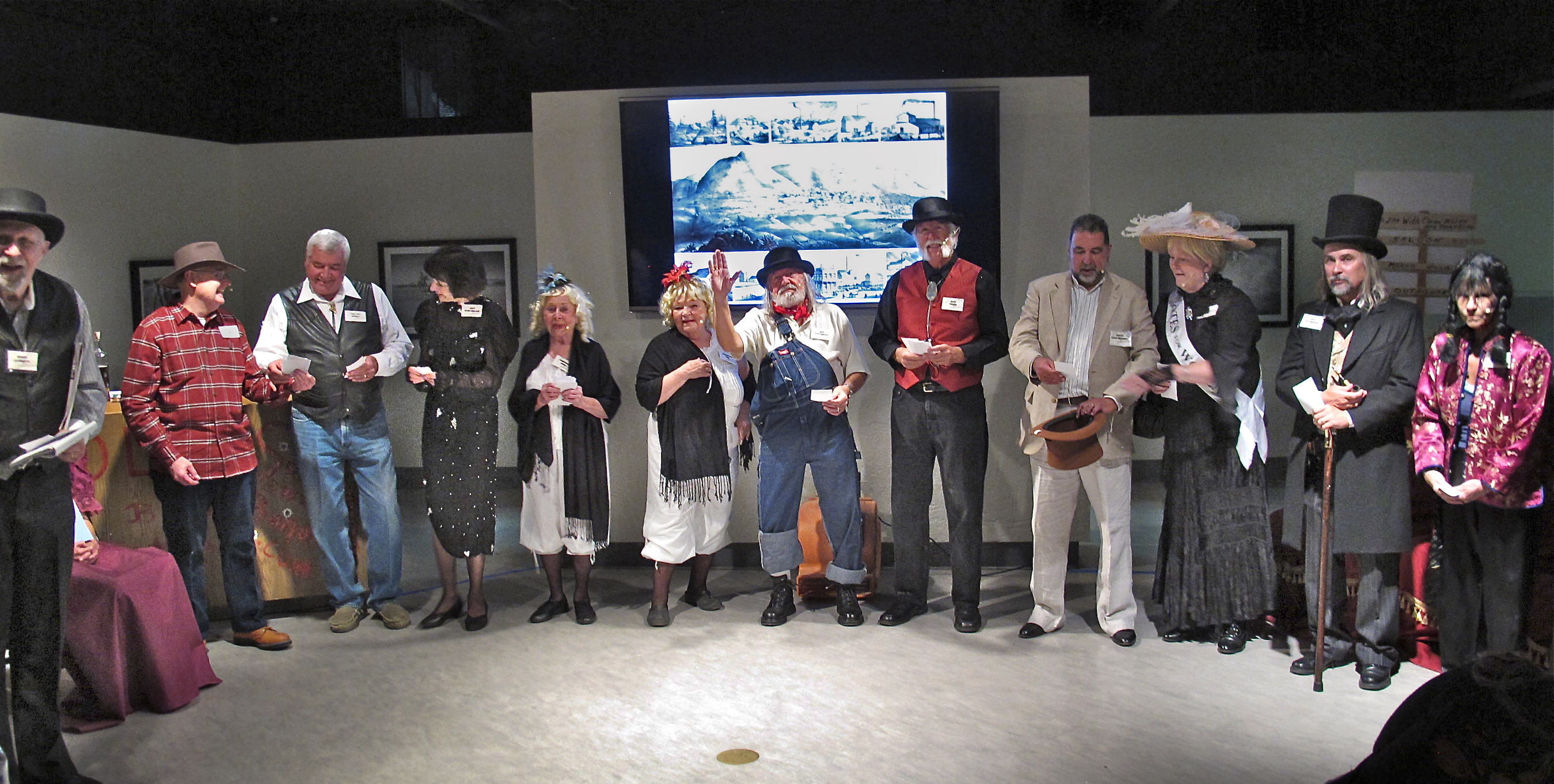
The cast is receiving votes as to who did the dastardly deed. Peachy is still sitting on her death chair, observing

The cast is receiving votes as to who did the dastardly deed. Peachy is still sitting on her death chair, still observing

Well, I didn’t con anyone to take over the raffle, so Jerri and I are reading off the winners of the superb raffle that we had. We even had gifts from Governor Sandoval! He’s a nice, caring man.

Well, I didn’t con anyone to take over the raffle, so Jerri and I are reading off the winners of the superb raffle that we had. We even had gifts from Governor Sandoval!

Of course, it’s traditional for anyone who passes on to get flowers, and Peachy was no exception. Here she is with her long lost daddy, Rich Gold-digger and Jack Gottrocks.

Of course, it’s traditional for anyone who passes on to get flowers, and Peachy was no exception. Here she is with her long lost daddy, Rich Gold-digger and Jack Gottrocks.


Murder at the Mine was a lot of fun to do, even though I groused about having to learn lines, etc.  Once one gets into it, one enjoys the camaraderie of the cast and it’s kind of a kick with the in jokes that a cast develops.  I appreciate the folks who asked me and am glad they did.


Challenges in the Treetops September 7, 2015

8 Sep

Treetops, you ask? We know she’s squirrely, but to go after them in the treetops is a bit ridiculous. No, this has nothing to do with squirrels and I didn’t even see any on this adventure. It has to do with zip lining and rope courses between the zip lines. While this activity was certainly not on my bucket list, it was on Jerri’s. So it was that she promised to take Dalan, her grandson, zip lining for his 13th birthday. I think this promise opened opportunity’s door and gave her the chance to do this crazy undertaking. Not to be outdone, I decided to accompany her and the kids.  Perhaps I could exorcise some of my own demons about heights and risk.

Zip lining was never on my bucket list because I am afraid of heights and have a very odd feeling of wanting to jump if I’m on the edge of a cliff or high building. So you can see why I was reluctant to do this. You can also see why this was a very challenging enterprise on my part (and Jerri’s, too.)

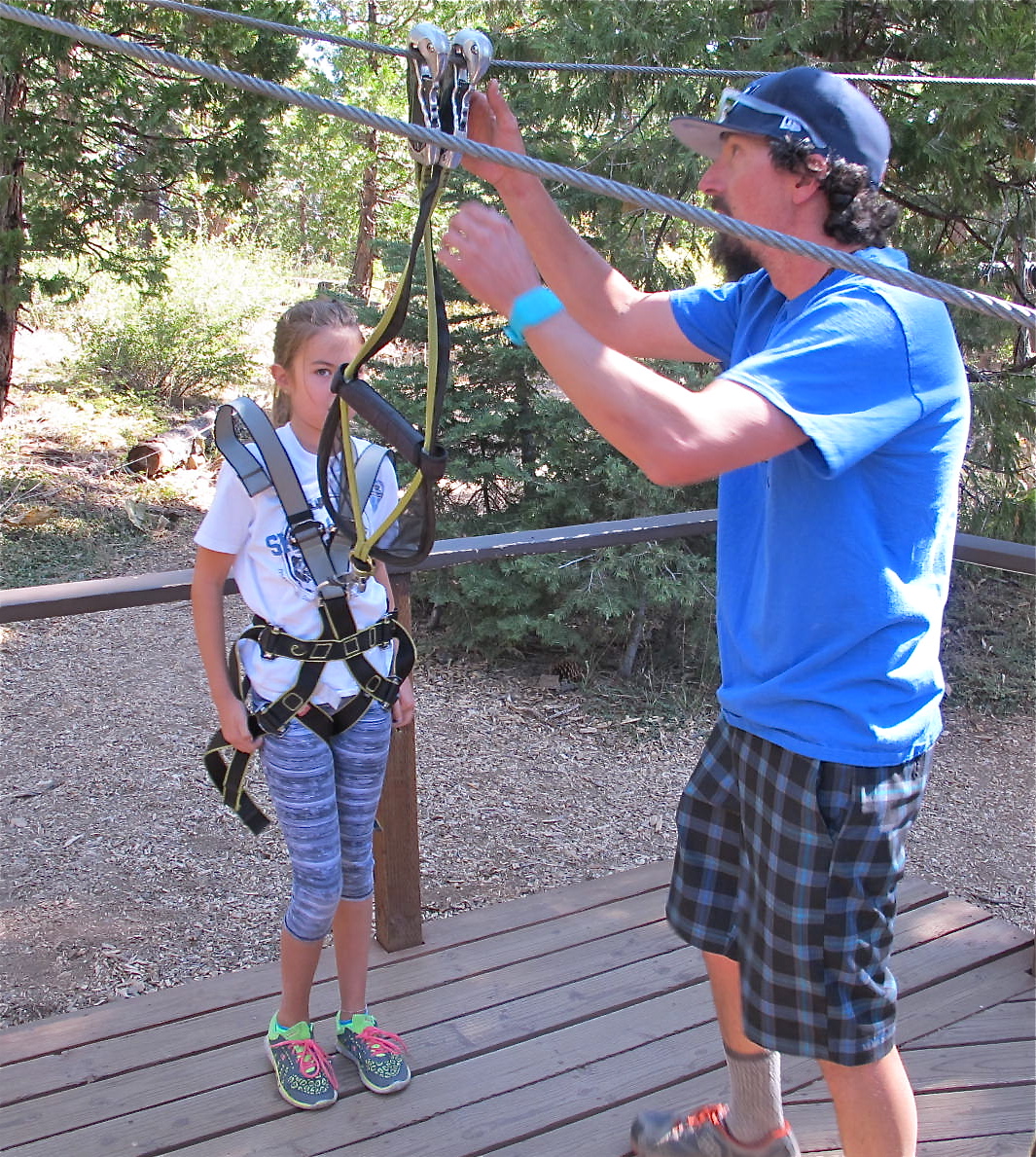
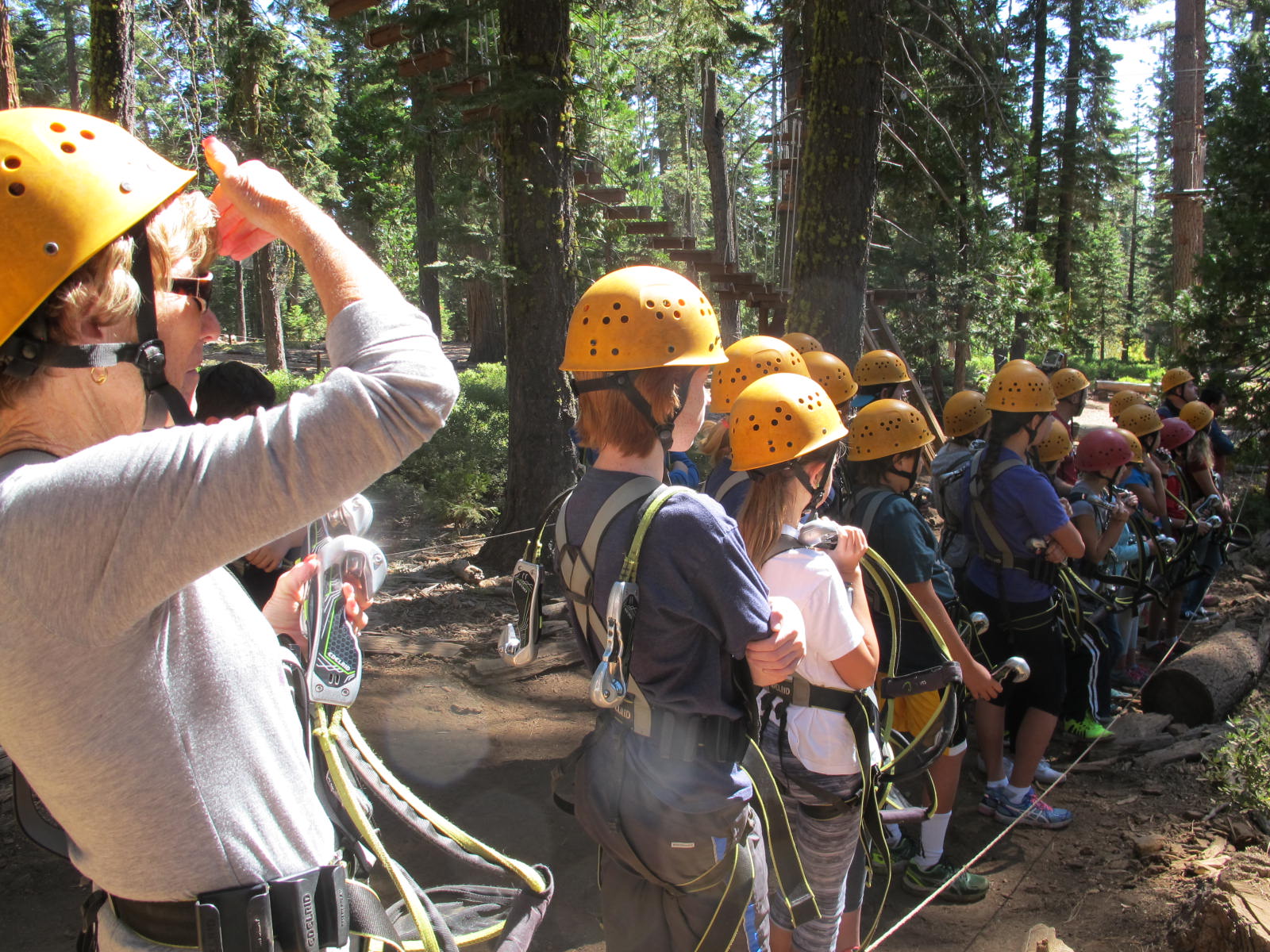
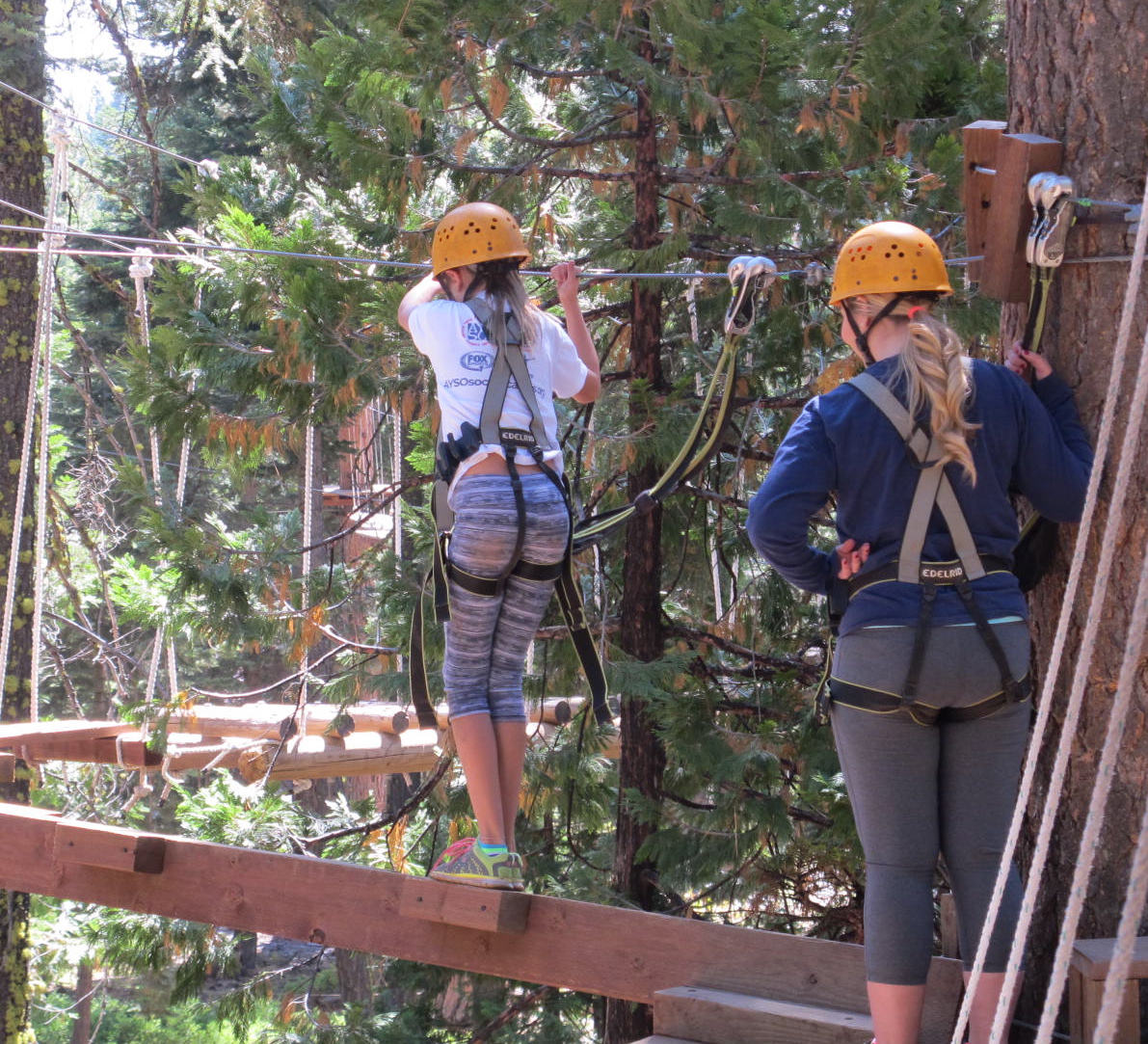
Jerri, Dalan, Megan and Sierra and I drove up to Tahoe City to join a bunch of other folks at the Tahoe Treetop Adventure Park. (for more pictures and to see where the park is, check out http://northtahoeadventures.com/ ). After we got outfitted with our gear and helmets, we were given a short introduction to the sport and how to operate our clamps (the hooks that latch onto the cables). Then we were all required to go through the sample course to make sure we knew how to operate the life-saving clamps.  (Don’t forget to click on the pictures to enlarge them)

Megan is wondering if this is a good idea. Check out the eye you can seen in the picture

Sierra on her qualifying zip ride. She looked like a pro right off the bat.

Jerri is holding her life saving clamps, listening to the orientation

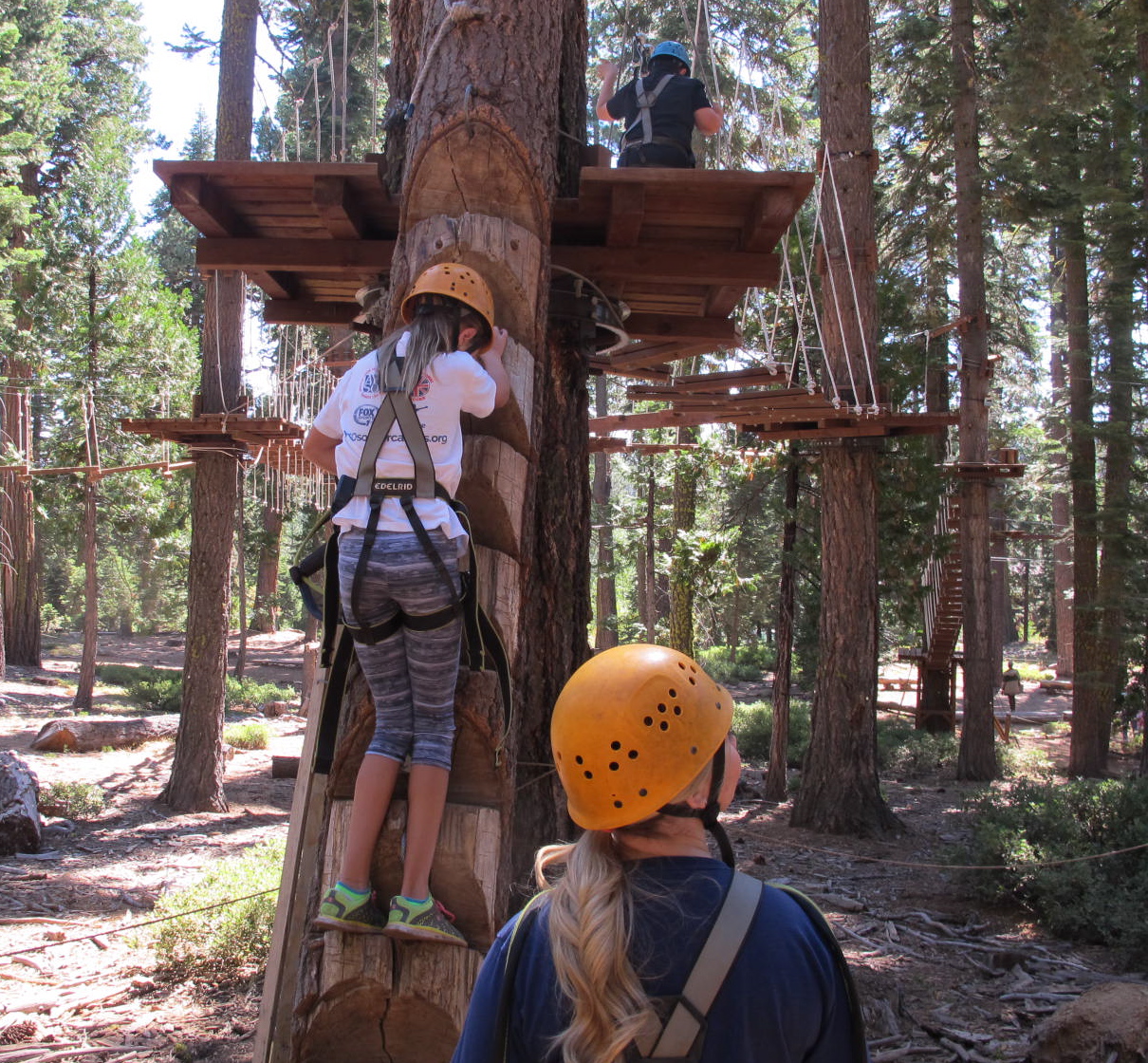
Jerri and I decided to do what would be the equivalent of a bunny slope for our first course. Sierra and Megan decided the Fuzzy Bunny course also. Dalan, the veteran of the bunch, decided to begin his day on the intermediate level Spiral Course. Well, the Fuzzy Bunny was quite an event for me. Just getting up the log ladder was an experience.

Sierra is awaiting her turn while Megan goes up the ladder

Megan got up on the platform and now she and Sierra are beginning their first obstacle


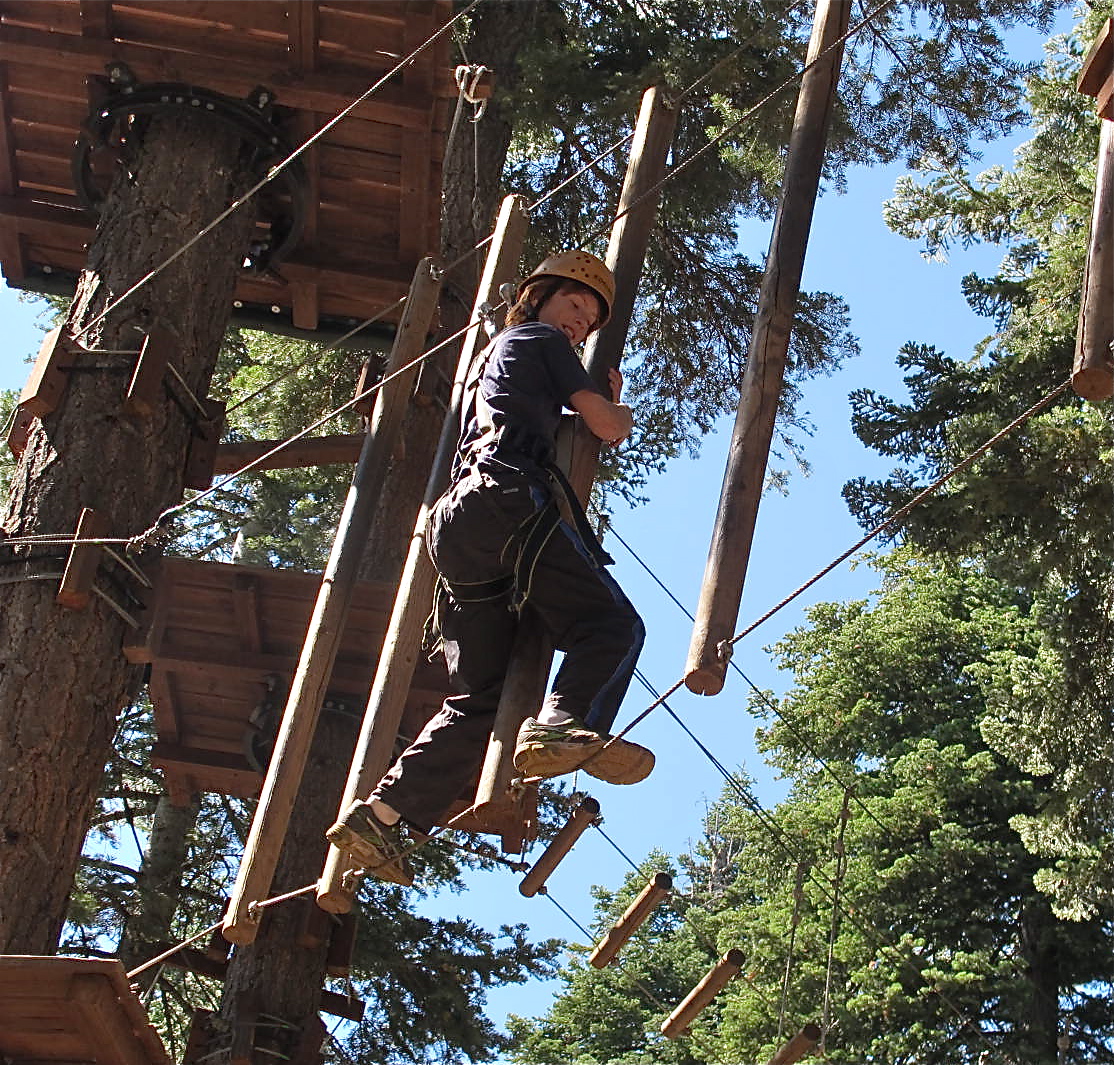
Meanwhile, Dalan was flying around the Spiral Course like (dare I say it?) a squirrel.  We couldn’t keep track of him, he was so fast. Luckily, he’s a strong gymnast, has good balance and has experience on the courses. Plus, he’s 13. No fear whatsoever!

Dalan on one of the Spiral Course obstacles.

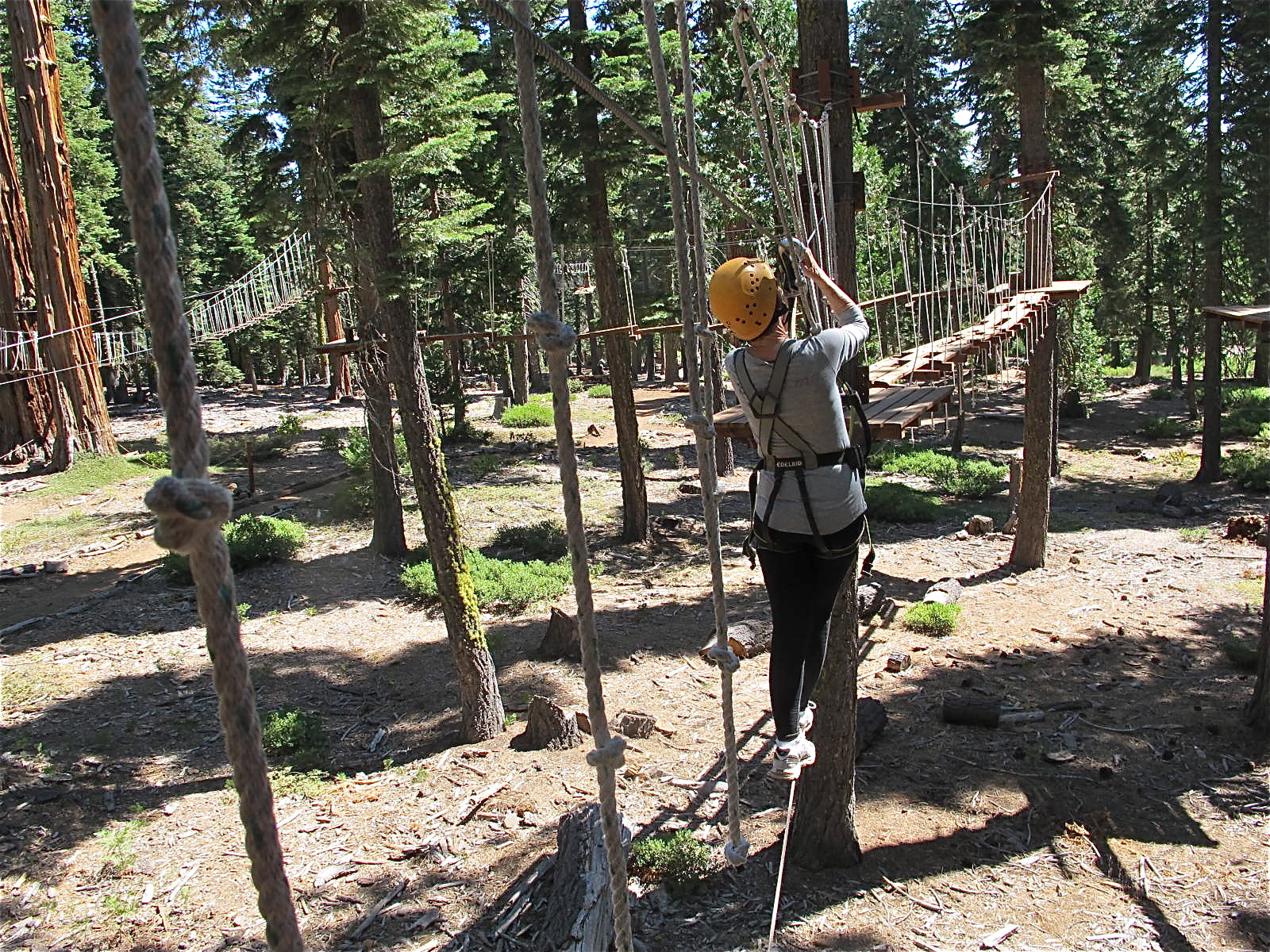
Here’s Jerri on our first obstacle. Note she was standing on a cable and using those free hanging ropes to aid her progress.


Jerri and I found the obstacles to be much more challenging than the zip lines. Upper arm strength was a must. So was balance. We didn’t scamper around the obstacles, but we made pretty good time. We discovered quite often, the item we were standing on was moving in an opposite direction of the thing we were hanging on to.  That made it kinda scary.
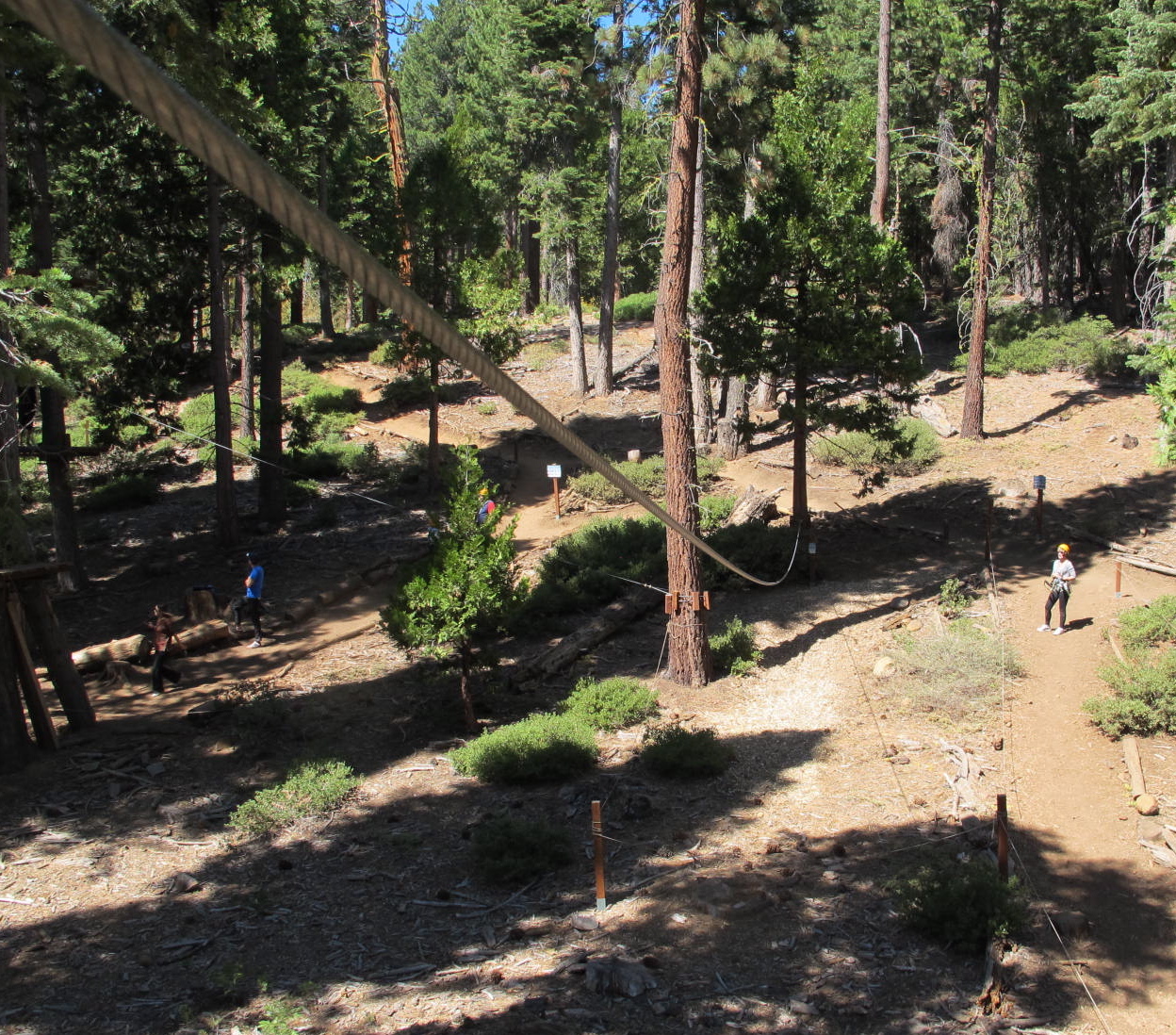
Jerri is waiting for me at the bottom of our first zip line. It looks kinds of far, eh?

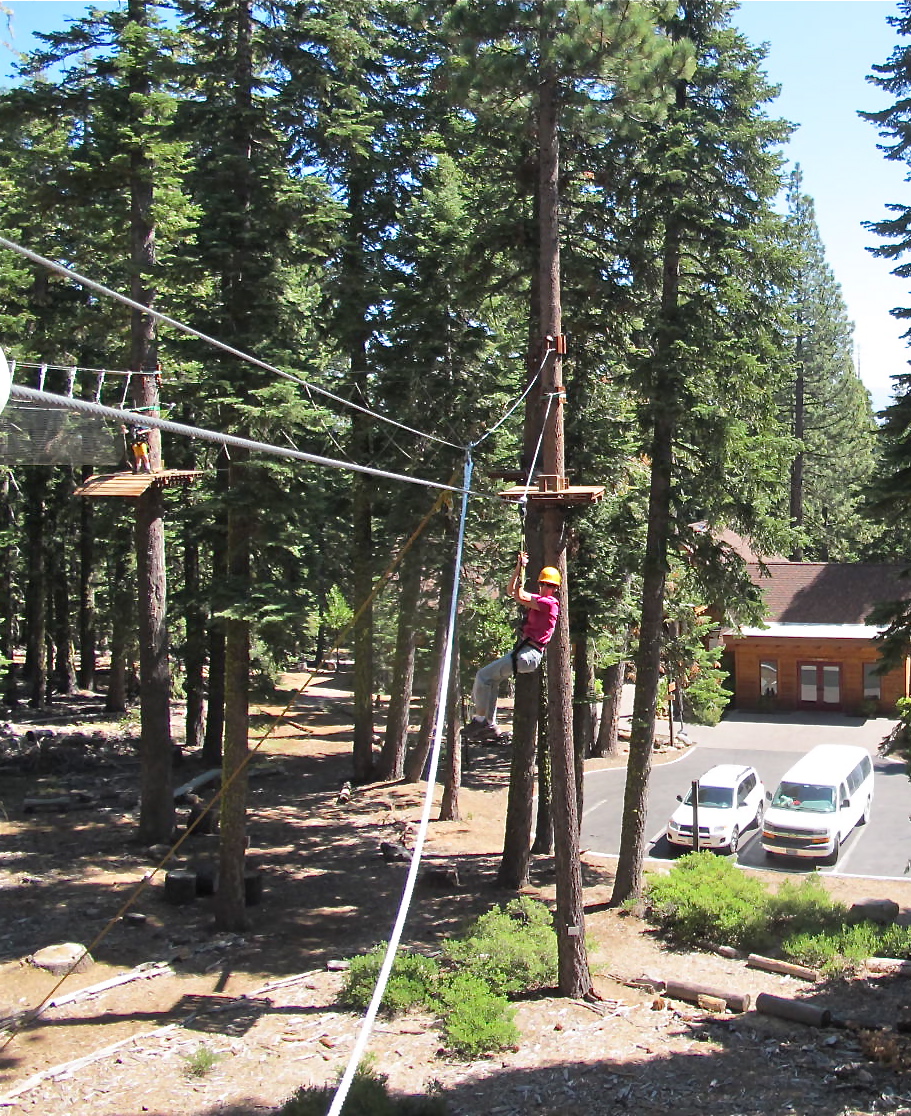
I had a really hard time taking the “step” into the air. There was no place else to go, so I had to do it. As soon as I stepped off the platform, the gear around my legs took hold and it was very comfortable on the ride down.  It was sort of like sitting in a sling and felt very safe. That first “step” plagued me each time I did a zip line, but I didn’t wait to do it. Later, I noticed people (kids mostly) hanging upside down, not hanging on to the handle, and doing other stunts. Logically, nothing will happen because one is secured to the cable, but I just couldn’t get over not hanging on and doing fun things.

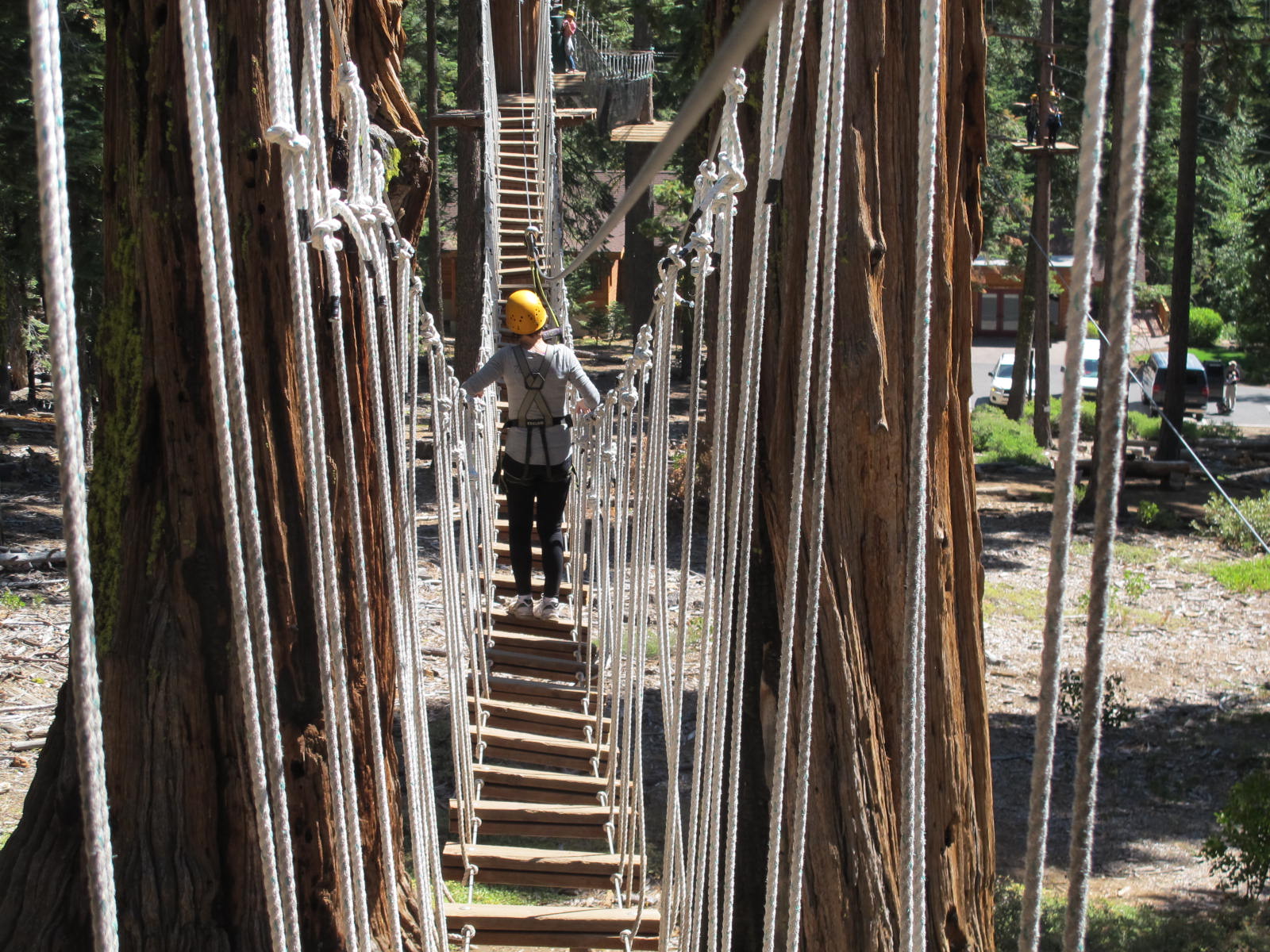
Well, we conquered the Fuzzy Bunny and we trundled off to The Twins course. This was in intermediate course and I don’t know if we were really ready, but there were no more bunny courses. Off we went onto a swinging bridge with very long steps between the slats. It kind of made me think about adventure movies where the hero is trying to get across an old bridge spanning a deep gorge. We were only maybe 20 feet off the ground but it seemed a lot higher than that when we were up there.

Jerri is on the Twins Course swinging bridge. This one was fun!

The most difficult obstacle on this course (for me) was walking a cable with crossing ropes on one side only. My arms were very tired after accomplishing that feat. After having a day to think about it, I think I might do it a bit differently such as not having such a death grip on the ropes. I came to the conclusion that a Flying Wallenda, I’m not. Having said that, I never slipped when walking on one cable. I talked to one of the course monitors and he told me he’s only heard of 5 people falling since the place opened.  I was very happy not to be the 6th.

This is still on the Twins Course. The cable seemed pretty small at the time.
Zippping along in my merry sling (not very tuneful, but it was fun)

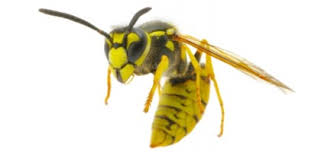
The one downer for the day is that there were lots of meat bees in the area. A meat bee is technically a yellow jacket who loves meat. They will land on your food and you can watch them literally take a chunk out of your hamburger and fly away with it. Those little varmints were flitting around us all day long, probably thinking we were their next meal. I guess one really didn’t like me and stung me in the small of my back. It felt like a hot poker for quite some time. Today the sting spot is a large red lump and hurts and itches to no end, no matter what I try. I’ll probably be zoned out on Benedryl by day’s end. It’ll get better, but right now, it’s a giant inconvenience. The varmint. I wasn’t even swatting at him or shooing him away.
A meat bee with a hot stinger.

A meat bee with a hot stinger. I don’t know why he thought I was a piece of raw meat. I still had my skin on.

While we were doing our courses Dalan ended up doing the Black Diamond Course, which is the same thing on a snow ski course. It’s for the experts. I knew he was going to go on the course but I didn’t get any pictures of him on it. He told me that he was almost totally exhausted when he finished because it demanded so much arm, hand and leg strength. He was glad he did it because the zip line was the longest at the Park and had the best views.  So he told us.

I was proud of Sierra that she stayed with Megan the entire time. She talked Megan through some of the obstacles and kept encouraging her. I know Sierra wanted to do some harder courses, but she was very loyal and protective of Megan. She’s a good kid! Megan is going on 11 and does a lot of stuff, but she had some issues with some of the obstacles. (I don’t blame her. I thought they were hard and scary, too). It was hard for her to go on a zip line beyond the demo ride. But she did it and she and Sierra ended up going on the Twins Course, which I thought was pretty difficult.  They have every right to be proud of themselves also.
Jerri and I never progressed past the intermediate level, but we felt very accomplished at what we did. We conquered some fears and fulfilled an item on Jerri’s bucket list. Plus, we’re pretty sure that we were the oldest folks out there on the course. That made us feel good, too. We may be old broads, but by dern, we’re out there doing our thing, having fun and enjoying life. LIFE IS GOOD!

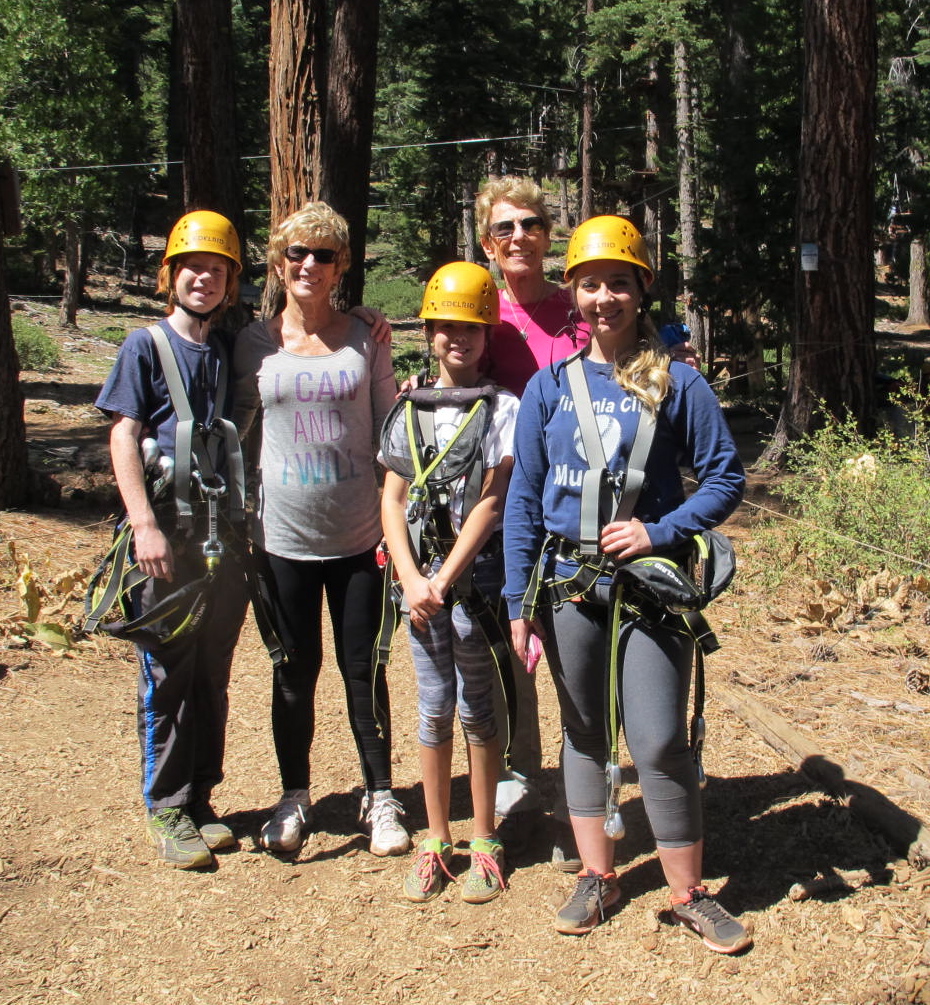
The Crew: Dalan, Jerri, Megan, me, Sierra

The Crew: Dalan, Jerri, Megan, me, Sierra


A Short Window into Life and Death August 20, 2015

20 Aug

As you know, I have written about the wildlife in my backyard, their habits, antics and entertainment value. My critters (they are varmints when they eat my lettuce, sunflowers and other produce…that’s another story) give me a lot of pleasure and while I gripe about the expense of replanting and preventative garden fencing, they are well worth it. But in addition to providing me with entertainment, the critters are carrying on their life cycle to the best of their ability and take advantage of whatever food and water they can get. It’s easy pickins in my backyard, in more ways than one.

A bit before dusk last evening, I was working a crossword and happened to look out and see a sharp-shinned hawk near the seed block under the bird feeders.  He had just caught a dove and was in the process of killing it.

A Sharp-shinned hawk

Not 10 minutes before this event, the feeding area was teeming with various birds, squirrels and rabbits. They were happily pecking and chomping on the seeds and an old zucchini provided for them. When I looked up, it was deathly quiet and nary a critter was to be seen except the hawk and his prey.  Everybody knows to hide quickly when this hawk flies over. However, there is an exception to this, which I will tell you in a minute.

I watched this drama for quite some time and was quite interested in the process and the entire environment as it evolved.

The sharp-shinned hawk is about 14” long and has a wing span of about 20-28.” I’ve seen several but don’t know if they are pairs or what the case is. Anyway, this bird suddenly turned around and spread his wings and tail to cover his prey and then I saw another sharp-shinned hawk make a pass over where my guy was. The intruder hawk didn’t try to interfere and soon my hawk was back to business. He must not be very strong because he had trouble moving his prey just a few feet away to be closer to a bush. That is when he began to eat the dove. Soon there was nothing left except feathers. This entire episode took less than 20 minutes.

Protecting the kill

While the hawk was moving his prey and beginning to eat, Sid, the ground squirrel (a varmint), zoomed into the area just below the bird feeders (where all the good seed has fallen). Sid didn’t seem to be aware of the bird at first and began to eat. They were only about 6 feet apart when they became aware of each other. They stared at each other but then went about their business. I think Sid must have known that he was safe because he was too big for the hawk to kill and move. The hawk knew Sid wasn’t going to try to horn in on his meal.

Sid Squirrel, a common ground squirrel

Some of you know that Sid is my nemesis as he and his family twice ate my sunflower seeds even before I could get my fence up and they have eaten other produce, much to my chagrin. So I was hoping the hawks would take care of Sid and his family. But I guess I need an eagle or some bird that big to take care of Sid in a natural way. Sid is safe for another day to carry on his nefarious ways.

It was quiet in the feeding area for about 10 minutes and then the critters began to return. Soon, it was as if nothing had happened and everything returned to normal.

Upon reflection of the entire event, it occurred to me that the drama I watched is a microcosm of life in general. A tragedy occurs and the world continues its journey through the cosmos. Even the survivors eventually return to “normalcy.” It’s life, I guess.  Sorry to be maudlin here, it’s just that what I just said is reflected in current events in Carson City where a CC sheriff was shot and killed recently (the first since 1867 to be shot). He is being laid to rest today. It’s sad for the entire community.


From Atlantis to Polaris… The Inaugural Ride in Our New Polaris Ranger RZR

3 Jul

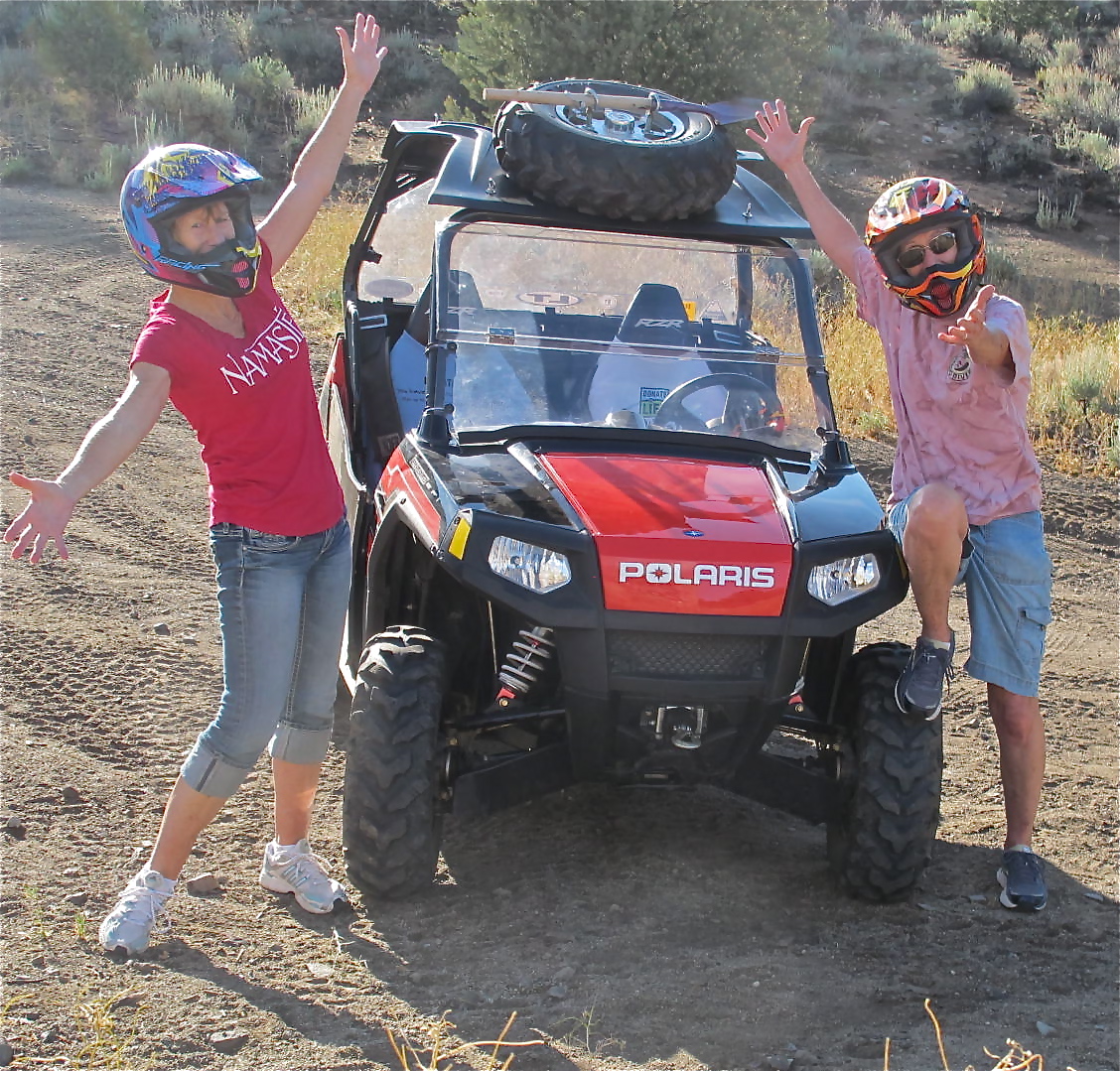
Last week, we were at the Atlantis getting very pampered with massages, pedicures and lunch by the pool. That was the life! But life moves on and this week, we had to try out a brand new adventure with our new toy, a Polaris Razor.

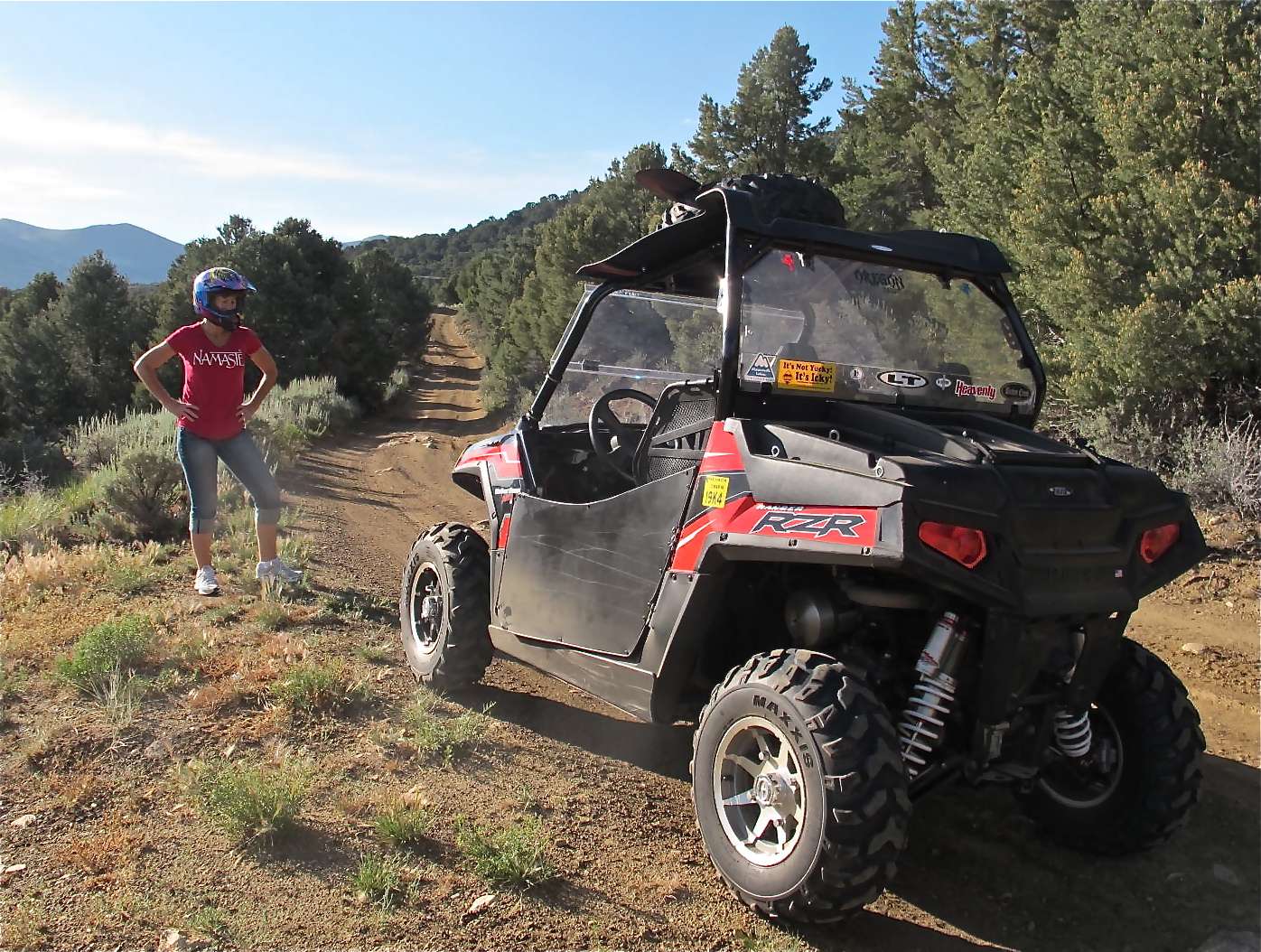
Early this morning, Jerri and I took an inaugural ride in our “new” ATV out east to the Pine Nuts. It’s been so very hot that we had to get an early start (like 6:30 AM) to beat the heat. What a glorious morning it was! The only issue we had was that the rising sun was directly in our eyes, but we made do.  (Don’t forget to click on the photos to enlarge them)

Our "new" Polaris Razor out in the wilderness

Our “new” Polaris Razor out in the wilderness

We went about twenty-miles+ east into BLM land on a recently regarded road. It was really nice and relatively smooth. Our new toy has adjustable shocks, so the ride is much better than on the quad. I also think it’s much safer with roll bars, 5-point seat belts and a winch. Plus, we are side by side and can sort of talk to each other over the noise of the engine. It’s a blast to drive and are looking forward to taking a much longer ride soon.

The road rises into the Pine Nuts and gets into the mountain range filled with piñyon pine trees. (I believe this road goes over the Pine Nuts and ends up somewhere in the Yerrington/Smith Valley areas. Quite a ways from where we were)

Looking toward the southeast, the sky looks a bit hazy, which could be due to possible, pending thunderstorms.

Looking toward the southeast, the sky looks a bit hazy, which could be due to possible, pending thunderstorms.

We took a couple of side roads just to see what is out there because I thought I had seen tailings from a mine, but the roads didn’t take us there.   One of the roads would have taken us about 12 miles northeast to Dayton, NV out on Highway 50 (the loneliest road in the USA), but, that is for another day. That road was definitely for an ATV or 4-wheel drive truck as it was narrow and pretty rough and we will be taking it soon when it’s not as hot later in the day.

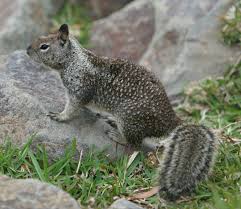
We saw many rabbits, chipmunks, squirrels and one large lizard. I thought it might be a young chuckwalla but he didn’t match the images I found on the Internet. So who knows what he was? Whatever, he was long and fat.

Our only critter that stood still long enough to get his picture taken

Our only critter that stood still long enough to get his picture taken

We were only out for a couple of hours, but plan on doing a longer trip soon. This shakedown cruise let us know that this is going to be quite a lot of fun. It’s too bad it couldn’t be longer but with the heat coming on, my needing to do an errand and Jerri getting back to her dog sitting chore (That’s another story all by itself. That dog is not well trained), we elected to get back home.

Wishing you all a very happy and safe Fourth of July.

Pampered at the Atlantis

25 Jun
A night view of the Atlantis Casino

A night view of the Atlantis Casino

Jolee has been wanting to take Jerri to the spa at the Atlantis in Reno for some time now. She finally tricked Jerri into going and I tagged along because it seemed like a fun and a relaxing day.

Jerri and I were a little leery of doing there because we weren’t sure what a spa at a casino was like. But I knew a great massage was in the offing, so I decided it would be fun no matter what. We walked through the casino to get to the elevators and that was a bit off-putting because of the noise bells and whistles. But, the spa floor was sort of like a beautiful cocoon sheltered from any untoward noise. The pampering began as we walked into the spa, were greeted and taken back to the locker room. As you know, I taught PE for many years and experienced typical smelly rooms. The spa was a class place. We each got our own locker (with a lock for which we decided the combination) with an Atlantis robe and sandals to wear as long as we were there. After we changed clothes, we waited in the “Tea Room” where we had some snacks and water/tea before our massage therapist came to take us to our massage rooms.

Well, a 90-minute massage just about did me in for the rest of the day. It was so relaxing and luxurious that all doubts were erased. I could barely get off the bed to put on my robe to go back to the Tea Room to await the next activity. A 90-minute massage seems to get all the aches and pains better than a 60 minute one. Jerri had a good massage, too, and swondered why she had waited so long to go. Shortly after the massage, we were taken to the salon where we each had pedicures. That was wonderful too.


Jolee ordered lunch for us while we were predicuring and we dined right beside one of the pools that are next door to the spa. After lunch we wandered around and checked out the various treatment rooms that we could use. There was the Brine Inhalation-Light Therapy Room, several different types of saunas, steam rooms, and even a fitness room. Who would want to work out after a massage? Not us! The Brine Room was filled, so we went to the Aqua Spa Lounge (hot tubs to us) and relaxed for a while.

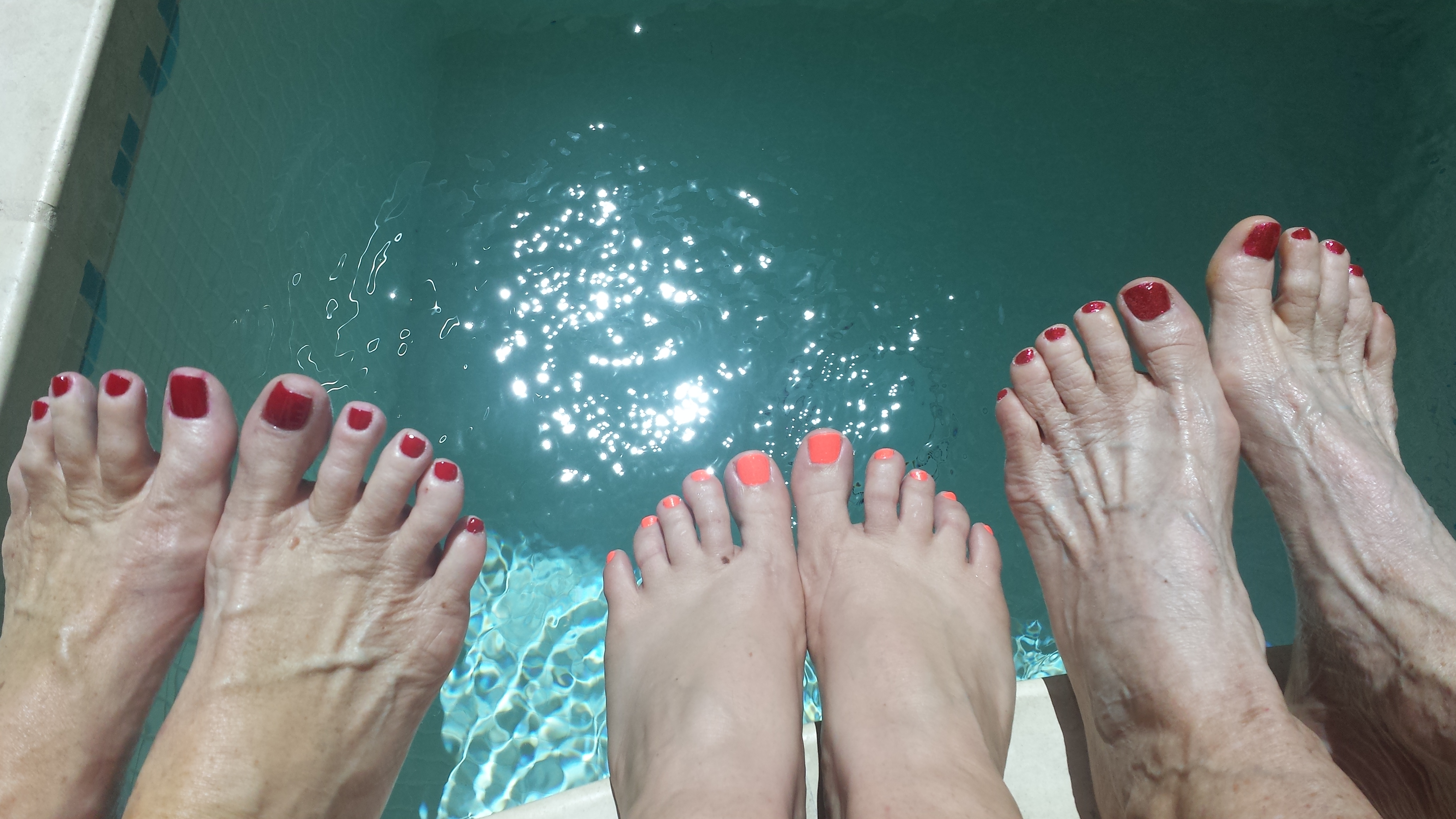
These are our beautiful toes after the pedicure.

These are our beautiful toes after the pedicure.

It was right about then that I happened to see a clock and it was already 3 PM! How did all the time pass so quickly? None of us wanted to go home yet, so we wandered back to the Brine Room where there was finally some room.   This is what the web site says about the Brine Room Inhalation: surrounded by light illusions brings the climate of an ocean shore. Surrounded by soothing music, a waterfall of Brine cascades over decorative stones, creating beautiful crystals and magical colors. While resting on the heated tile bench, your senses will be stimulated, both psychologically and physiologically by the specific colors reflecting over the water cascade. The ambience and inhalation of salt aerosols positively affect the respiratory tract to increase well-being.   It was definitely all that. We relaxed some more.

There comes a time when all good things must end and we had to go back to our regular lives. But the good thing is that we know about this luxurious place now and we can return to be pampered once again. Those folks at Atlantis surely do know how to make one feel like a queen for a day. Thanks, Jolee, for taking us there and introducing us to another world!


A Quick Trip to Clarkston, WA, June 11-13, 2015

20 Jun

Before my trip to Grand Junction and the dinosaurs, Jerri had asked me to go with her to Washington to pick up two of her grandchildren. Of course I said yes, not thinking that there was only a day of being home before we would take off again. Oh well, there would be two of us driving the twelve-hour route to Clarkston, WA.

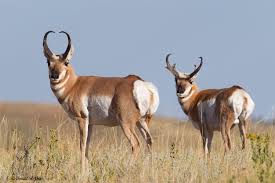
The drive was really quite pretty and different from what I had expected. It had rained quite a bit in the desert from Reno to Winnemucca and there were many puddles and small lakes that glimmered in the dawn’s early light. We turned north on US 95 from Winnemucca and stayed on that road until we were almost to Clarkston. There is quite a bit of desert in the Nevada portion of 95 but it changes to rolling grassy hills in Oregon. There we espied several pronghorn.

Pronghorn do not live in North America!

Pronghorn do not live in North America!

I forgot to tell you that Shirley and I learned there are NO antelope in North America, only pronghorn. (That was an amazing factoid to me as the deer and the antelope have always played on the range. I guess pronghorn just didn’t work in the verse). Anyway, they are pretty animals and seem well adapted to their range in Oregon and Idaho.

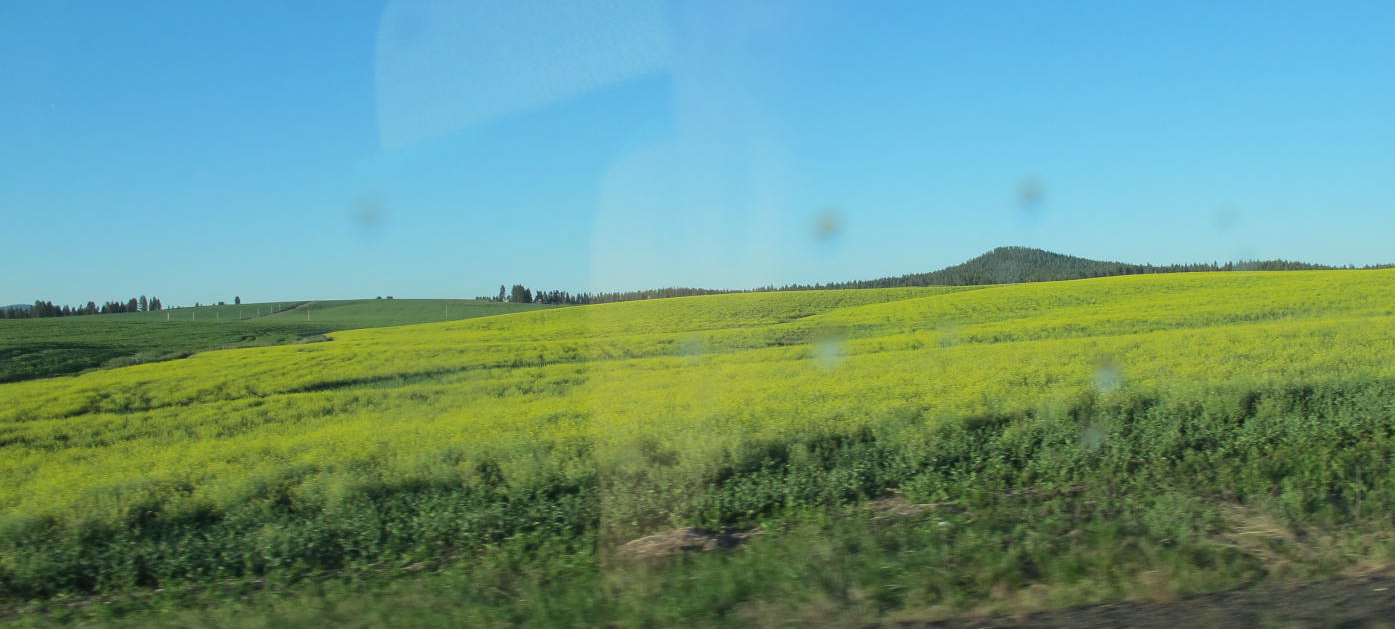
We passed through a lot of farmland in Idaho as well as woods that are used to recreation and lumber production. In fact, southwestern Idaho farmers grow more than a billion pounds of onions each year! We saw many other crops but that stuck in my mind. We also saw many beautiful horses and other livestock along the way. Of course, there were many youngsters who were prancing and dancing around the pastures.  Canola is grown in eastern Washington, too. We drove by miles and miles of these fields.

One crop that surprised us was the growth of canola plants. They look like a short mustard plant (at least that’s what we thought as we were zooming along the highway. Sorry about the reflection from the window).

One crop that surprised us was the growth of canola plants. They look like a short mustard plant (at least that’s what we thought as we were zooming along the highway. Sorry about the reflection from the window).

Erik, Jerri’s oldest son, lives in Clarkston with his wife, Tori, and her nephew, Alex. I should have taken a picture of his house as it is 116 years old and looks pretty good for its age. Erik says the doors don’t always fit well and there is quite a draft in the winter, but it works for them. Erik is the personal gardener for the president of Washington State University in Pullman and the grounds for which he is responsible look terrific.  During our one full day there, he took us on a tour of the campus and the presidential grounds. I was quite impressed with everything we saw. Erik planted over 2000 scarlet (or red) tulips so that the presidential grounds were very colorful in the spring. We didn’t see them, but we did tour the front and back yards. The president is quite ill and we were not able to meet him or his wife, but at least we got to see the grounds.

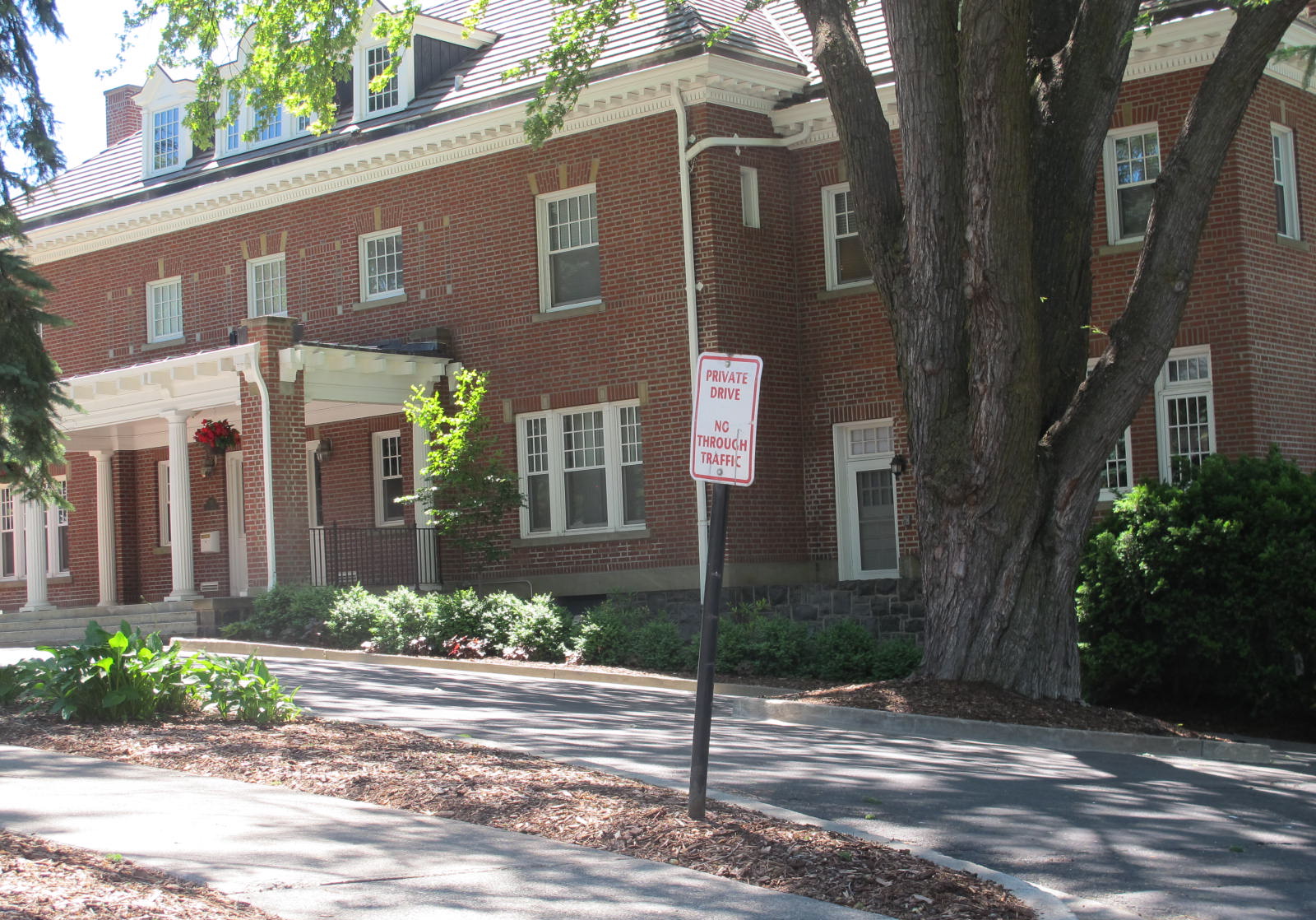
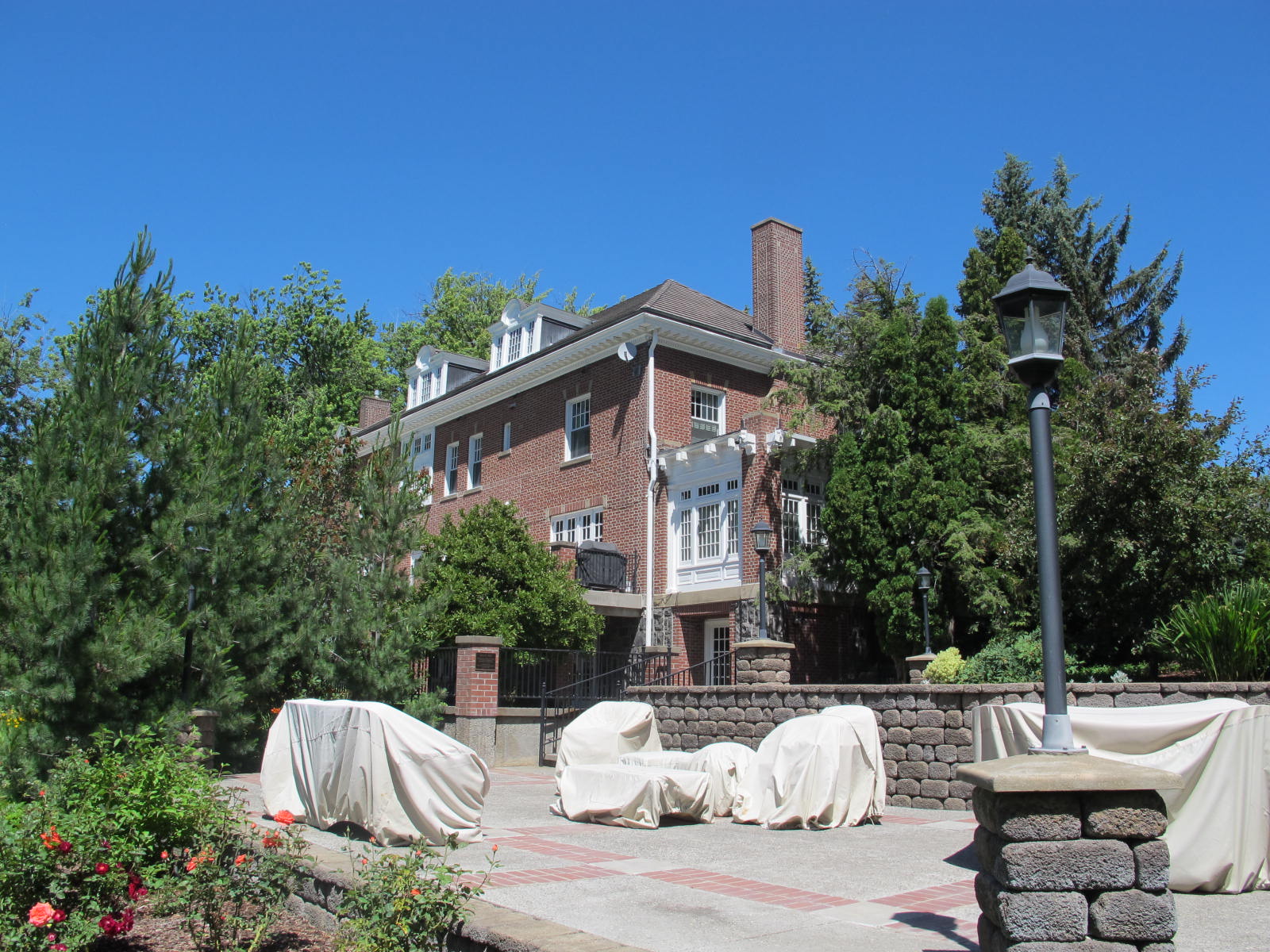
The WSU president's home

The WSU president’s home

A portion of the back yard

A portion of the back yard

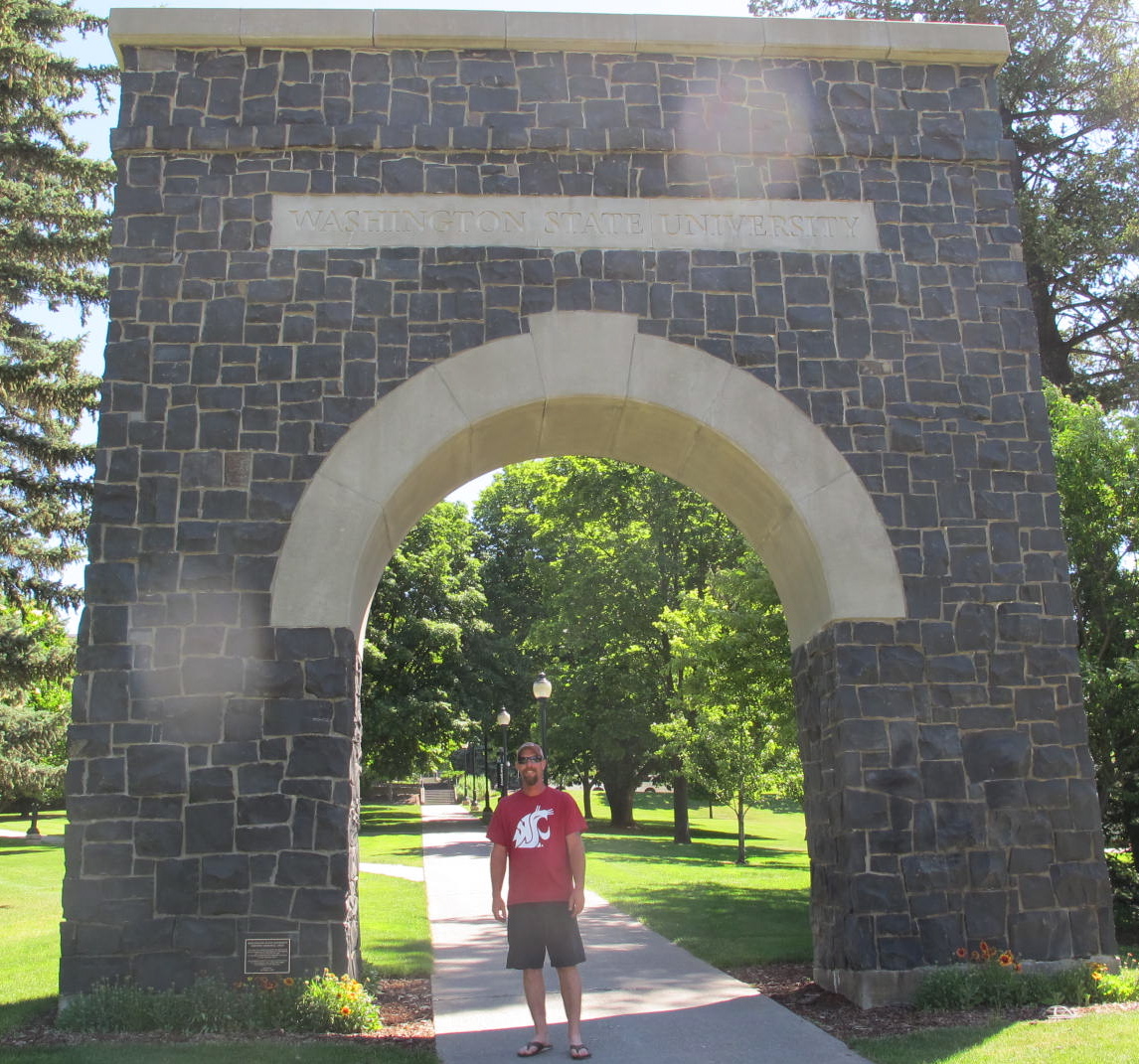
Erik is at the old entrance to the university

Erik is at the old entrance to the university

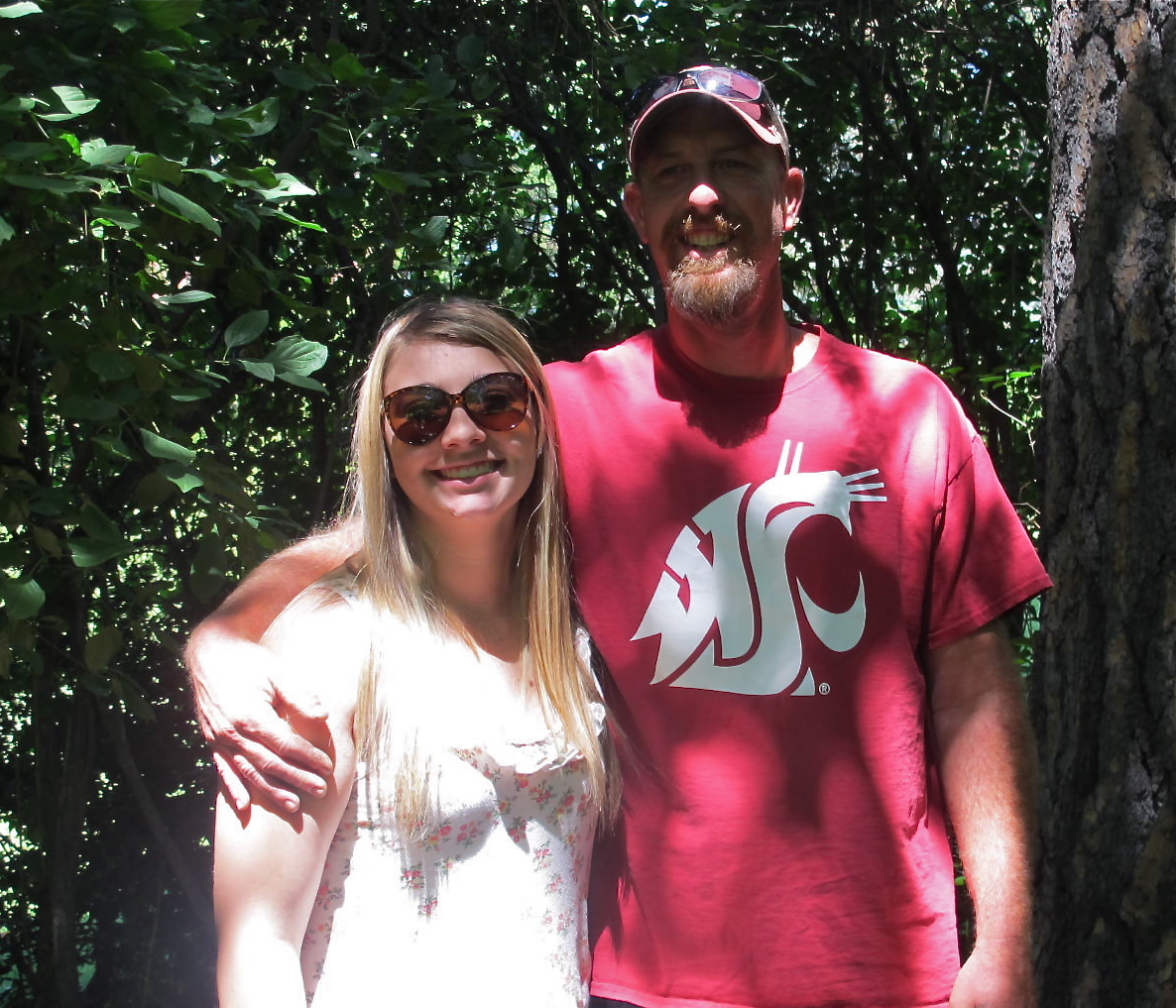
Sierra and Erik in a little private glen he made for the WSU president

Sierra and Erik in a little private glen he made for the WSU president

Sierra, Jerri and Erik

Sierra, Jerri and Erik

We had a great snack at Ferdinand’s, the WSU creamery. Wow! They make super ice cream and delicious cheese there! You might have guessed that Ferdinand’s is named after Ferdinand the bull, which doesn’t quite compute, but it’s cool and all visitors check it out.

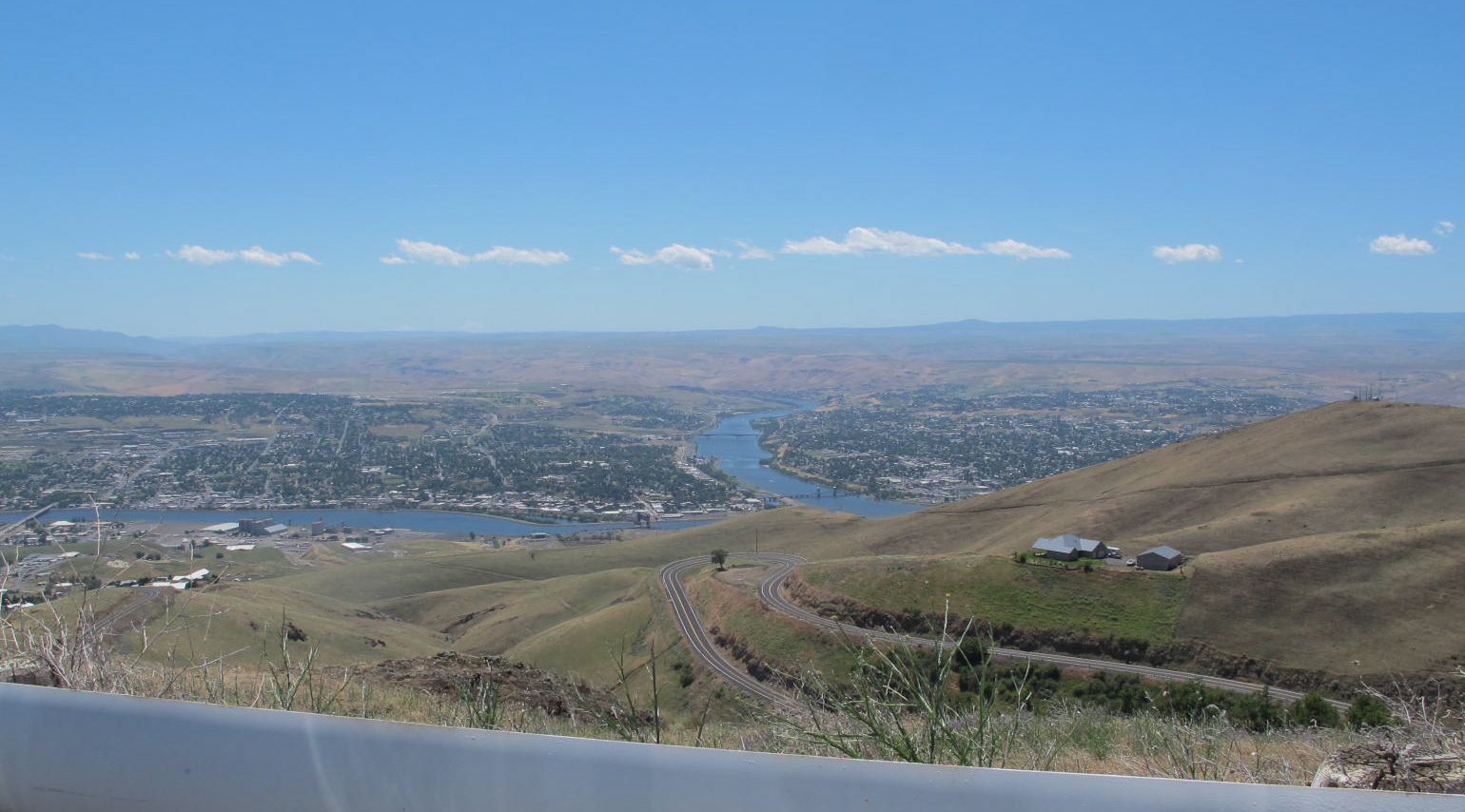
This is the confluence of the Snake and Clearwater Rivers. Clarkston is behind the hill on the right and to the right of the river. The salmon fishing is great there and many, many people fish in those two rivers. Clarkston is also where a paddlewheel boat docks after a river cruise.

This is the confluence of the Snake and Clearwater Rivers. Clarkston is behind the hill on the right and to the right of the river. The salmon fishing is great there and many, many people fish in those two rivers. Clarkston is also where a paddlewheel boat docks after a river cruise.

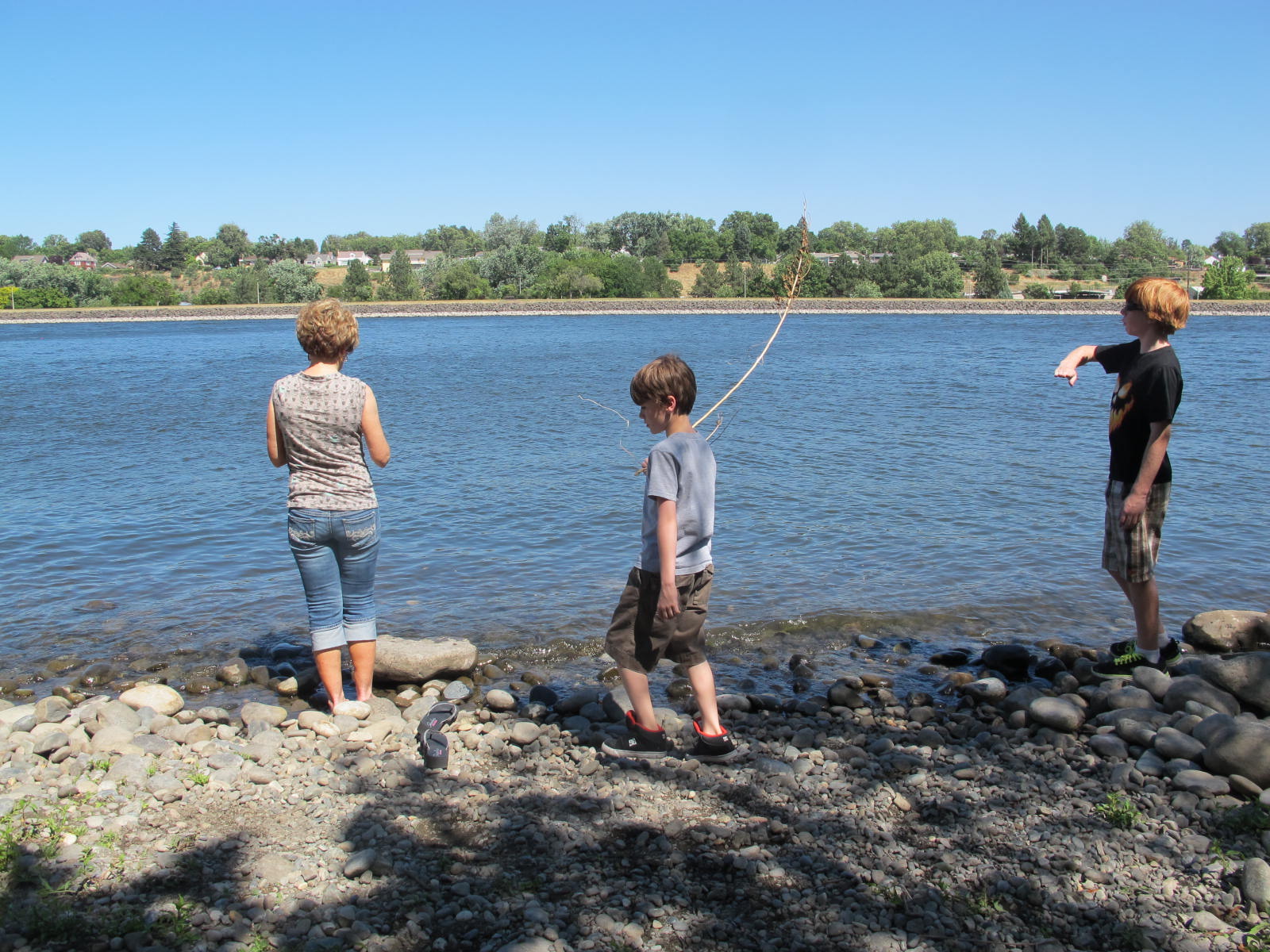
We took a walk along the Snake River and I happened to get a picture of young Alex taking a rest break.

We took a walk along the Snake River and I happened to get a picture of young Alex taking a rest break.

Jerri, Alex and Dalan are checking out the river.

Jerri, Alex and Dalan are checking out the river.

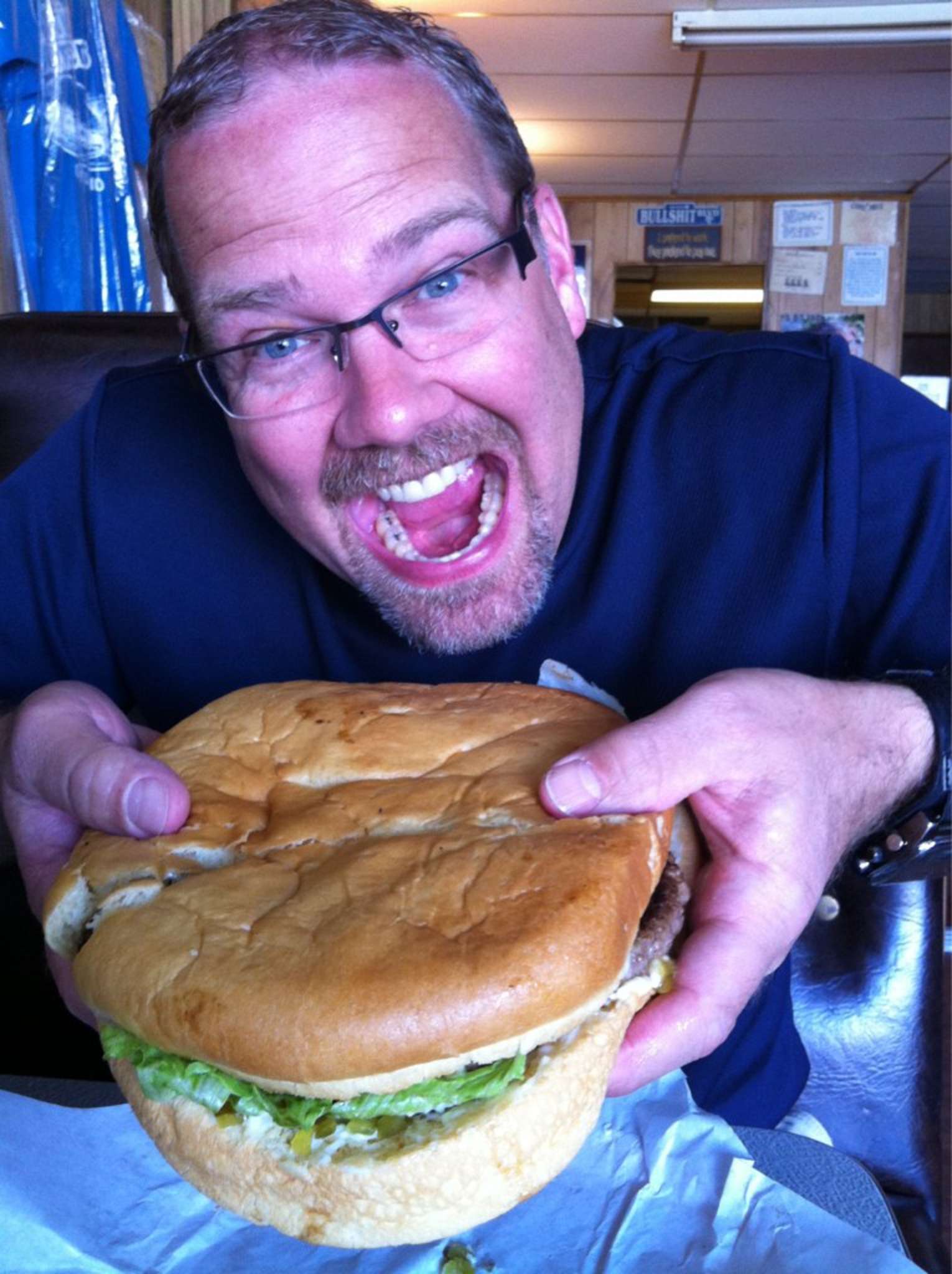
That evening, all of us went to Effie’s for the world’s biggest burgers. Oh my gosh! This is no lie. An Effie burger is at least 9 to 10 inches diameter!  If I’d had my camera, I’d have taken a picture of it so that you would believe this story. Jerri and I split one and we couldn’t finish it. I was so stuffed that I couldn’t eat any dessert. That’s extremely unusual for me. The only one who finished his split burger was Erik and then he ate Alex’s leftovers.

This is a photo from the interet since I didn't get my own photo.  But you get the idea of how big this burger is.

This is a photo from the interet since I didn’t get my own photo. But you get the idea of how big this burger is.

The trip was too short, but I’m glad we did it.  I got to meet Tori and Alex for the first time and that was good.  I got to see Erik’s workplace and find find out why he’s so rightfully proud of his work.  He seems very contented and happy there in Clarkston and is looking forward to staying there for many years with Tori and Alex.  Thank you Erik, Tori and Alex for your hospitality!

We left about 5 AM the next morning for the return trip to Minden. Jerri and I entertained ourselves by guessing 50s and 60s artists on Sirius/XM. She seldom misses with the 60s folks and I don’t get many of either decade.  Sierra and Dalan listened to their tunes on their iPhones. They are the mod ones in the family. Again, it was a twelve-hour trip that seemed endless this time. Needless to say, we were all pretty tired when we got home.  I’m getting too old for this stuff.
Dalan expresses how we all felt when we arrived home.
Dalan expresses how we all felt when we arrived home.